Options Don't Work in DeFi? Vitalik Might Not Agree

marsbitPublicado a 2026-06-19Actualizado a 2026-06-19

Resumen

For years, the prevailing view has been that options struggle to gain traction in DeFi due to complexity, fragmented liquidity, and lack of natural demand compared to products like perpetual futures. However, a recent algorithmic stablecoin design proposed by Vitalik Buterin presents a different perspective, using options not as a standalone trading product, but as foundational infrastructure for other financial instruments. In this design, one unit of ETH is split into two components: a "stable" side (P) that retains value up to a specified strike price, and an "upside" side (N) that captures all appreciation above that strike. Combined, they always equal one ETH, eliminating debt, margin, and liquidation risks inherent in typical collateralized debt position (CDP) stablecoins. The stable component essentially mimics the payoff of a covered call option. To function as a stablecoin, this structure requires continuously rolling deep in-the-money calls, which introduces challenges like rollover slippage, predictable transaction flow vulnerable to front-running, and persistent liquidity needs. A core hurdle is finding consistent buyers for the leveraged ETH upside exposure (N). While it offers leverage without funding rates or liquidation, it must compete with simpler alternatives like direct call options or perpetuals. The system's scalability depends on a sustained demand for this specific form of leverage. The author draws parallels to their experience with Rysk, where ear...

Editor's Note: For a long time, DeFi options have not become a mainstream trading category. Compared to perpetual contracts, they are more complex, have more fragmented liquidity, and find it harder to establish stable, organic demand.

However, Vitalik's recent proposal for an algorithmic stablecoin opens up another possibility for options: they are no longer treated as an independent trading product, but rather become the foundational financial building blocks behind stablecoins, yield products, and structured assets.

The author of this article interprets this proposal from the perspective of options. He believes that the stable-side asset in Vitalik's design is essentially similar to a synthetic covered call: the user splits 1 ETH into two parts, one part obtains 'stable value' below a certain strike price, and the other part obtains the upside gains above the strike price. Since these two parts always add up to 1 ETH, the system does not need to introduce debt, margin, or liquidation mechanisms, thereby avoiding the core liquidation risk of traditional CDP stablecoins.

Yet, the difficulties of this design are equally apparent. For the stable-side asset to approximate a stablecoin, it requires continuously rolling deep in-the-money call options, which brings issues like rollover slippage, front-running of fixed trading paths, and insufficient liquidity. More importantly, behind every unit of stable asset, someone must continuously hold the corresponding upside-side asset, which is essentially a leveraged long ETH position without funding rates or liquidation risk. Whether this demand can exist long-term determines whether the system can truly expand.

Finally, drawing from Rysk's experience, the author points out that the reason DeFi options have struggled to scale in the past is because they are too complex as a direct trading product, and user demand is not sufficiently organic. But if you change its position, placing options at the underlying layer of more complex assets like stablecoins, structured yields, and index products, they might actually be more suitable as DeFi infrastructure. In other words, the opportunity for options in DeFi may not be to become the next perpetual contract, but to become the pricing and risk distribution engine behind the next generation of on-chain financial products.

The original article follows:

For years, I've heard the same line: "Options don't work in DeFi."

After working on Rysk, I admit there's some truth to that. Most DeFi options products have struggled to gain traction. Liquidity is fragmented, attracting organic trading flow is difficult, and traders consistently opt for simpler products. Perpetuals became the default tool for expressing directional views, while prediction markets offer a simpler way to trade event outcomes.

That's precisely why Vitalik's recent proposal caught my attention. He suggests using an option-like equity structure to build an algorithmic stablecoin without a liquidation mechanism.
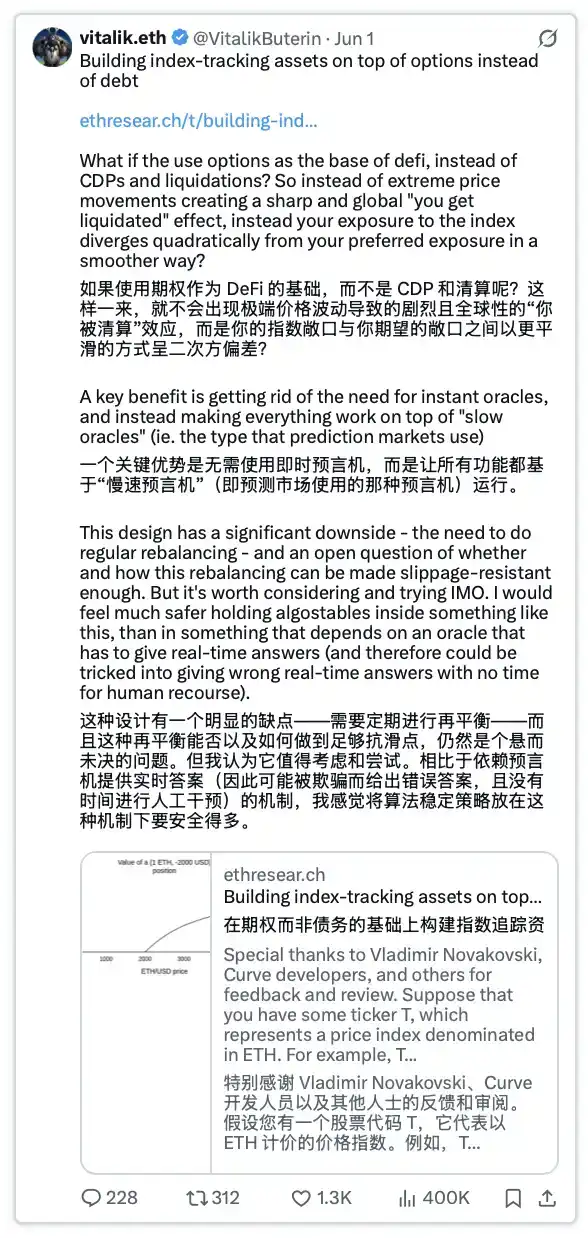
What really drew me in was the angle: options not as a product to trade, but as infrastructure underlying a product.

This is the view I've been pushing for years, and the core idea behind building Rysk V12. For us, the product is yield; for Vitalik, the product is stability. The more I thought about it, the more familiar the design felt.

The stable side he describes is essentially a covered call.

Why It's a Covered Call

His design splits one unit of ETH into two types of equity. One side is P, which holds the value up to a certain strike price; the other side is N, which receives the appreciation above that strike. Together they always sum to one unit of ETH, so there's no debt, no margin, and nothing to liquidate.

Assume ETH price is $2,500, with a strike price of $1,500. As long as ETH stays above $1,500, P behaves like equity stable at $1,500; only if ETH falls below $1,500 does P start taking downside risk. N gets all the upside above $1,500.

This is exactly the payoff structure of a covered call.

The holder keeps the asset, sells the upside above a certain strike, and collects a premium. P replicates precisely this covered call payoff. N is equivalent to the call option held by the buyer.

More accurately, it's a synthetic covered call. No one externally sells an actual option; instead, the equity is split to reconstruct the same payoff.

This is the same thesis behind Rysk V12. Users hold ETH, BTC, or HYPE and earn upfront yield by selling covered calls. Vitalik points the same building block towards stability.

Same engine, different product.

The Problem: It's Deep In-The-Money and Must Be Continuously Rolled

Right now, most Rysk users sell out-of-the-money covered calls. They hold ETH and choose a strike above the current price: either betting price won't reach it, or being willing to sell and take profit at that higher price if it does, while keeping the premium regardless.

But the stable side in Vitalik's design needs a different structure. To behave like a stable amount, the strike must be far below spot, so the call would be deep in-the-money, with most of its value being intrinsic.

At a spot price of $2,500 and a $1,500 strike, there's $1,000 of intrinsic value the buyer must pay upfront. That makes the trade far more capital intensive.

But a call can only stay stable for a moment. Once ETH drifts towards the strike, it starts taking ETH downside, so it must be rolled down to a lower strike, again and again.

So, this stable asset is essentially a program of continuously rolling covered calls.

Vitalik points out this risk himself. The slippage from repeated rollovers is the biggest threat to the design, and how the roll is executed is the truly hard part.

Any mechanism that trades on a fixed, public schedule is easily front-run. This is precisely the problem DeFi Options Vaults (DOVs) faced: they sold the same duration, same strike options every week at the same time, so the market knew exactly what was coming and positioned ahead, extracting value from that flow.

Regardless, every roll needs a buyer. The question is: who buys it? And at what price?

The Hardest Part Is Funding It

In Vitalik's model, someone must deposit a full unit of ETH, split it, sell the stable side, and hold the upside side. This depositor is the person the whole system relies on.

The most obvious candidates are market makers.

But the position they end up holding is essentially leveraged long ETH. And anyone wanting leveraged long ETH can just buy a call option or go long a perpetual. That's simpler, more efficient, and more familiar. The depositor is taking a harder path to get a position they could get more easily elsewhere.

The upside side does have one real advantage: it offers real leverage without funding rates or liquidation risk, which a perpetual cannot.

But it still needs to find buyers, and not just once. For every unit of stable asset that exists, someone must hold the corresponding upside side.

To scale, this model needs a persistent set of people who, in any market environment, are willing to hold ETH leveraged longs in this specific form continuously.

And market makers are resource optimizers by nature. Without a clear reason, they won't adopt something new, capital intensive, and with heavy integration costs. "Speculators and market makers will provide liquidity" is the assumption the whole design rests on. But that behavior doesn't happen in a vacuum.

What We Learned at Rysk

We learned this the hard way at Rysk. Earlier versions of the protocol struggled to expand, lacked organic demand, and never found product-market fit.

In the current protocol, Rysk V12, both sides of the trade have strong reasons to participate. So, Rysk starts with two parties who already want in. Holders want yield from assets they already hold, and their assets are the collateral.

Market makers compete to buy this flow via an RFQ (Request-for-Quote) mechanism. They only pay the premium, don't need to post collateral, end up with the option exposure they actually want, and can price and hedge it on their own books. This is the more capital-efficient side of the trade, which is why trading desks integrate spontaneously.

No one is asked to hold a position they could get more easily elsewhere.

The system also doesn't rely on incentives or token emissions.

Worth Building

I'm glad to see this design being seriously explored. The challenges are real, but they're the interesting kind. This is exactly the design space DeFi should explore.

What feels validating is that this proposal reinforces the same choices we made at Rysk: fully collateralized, no liquidation, no counterparty risk, and physical settlement requiring an oracle only at expiry.

Different use case, same foundation. That foundation is live and proven on HyperEVM, with market makers competing for flow. We've also deployed to Ethereum mainnet and will open to the public soon.

If you're exploring stablecoins, structured products, index products, or anything with optionality under the hood, feel free to reach out.

Options are building blocks. The truly interesting stuff is what gets built on top.

Preguntas relacionadas

QAccording to the article, what is the core financial derivative that Vitalik's proposed stablecoin design is analogous to?

AThe stable-side asset in Vitalik's proposed design is essentially analogous to a synthetic covered call option.

QWhat is the primary challenge identified for Vitalik's stablecoin model based on a covered call structure?

AThe primary challenge is the need to continuously roll deep in-the-money call options to maintain stability, which introduces issues like rollover slippage, front-running on fixed roll schedules, and liquidity dependency.

QFor Vitalik's design to function, who must hold the 'upside' (N) portion of the split ETH, and what does holding it represent?

AFor the system to function, someone must hold the 'upside' (N) portion, which represents a leveraged long position on ETH without funding rates or liquidation risk. The article suggests market makers are the most obvious candidates to provide this liquidity.

QWhat key lesson did the author learn from building Rysk about making DeFi options viable?

AThe key lesson is that DeFi options struggle to scale when positioned as direct trading products due to complexity and lack of natural demand. Instead, they find product-market fit when embedded as a foundational infrastructure layer underneath more complex products like stablecoins, structured yields, or index products.

QWhat is the main advantage of the 'upside' (N) asset in Vitalik's model compared to using perpetual contracts for leveraged ETH exposure?

AThe main advantage of the 'upside' (N) asset is that it provides real leverage on ETH without the recurring costs of funding rates and without the risk of liquidation, which perpetual contracts cannot offer.

Lecturas Relacionadas

A New Scaling Variable for Text-to-Image Generation, Discovered by ByteDance's Seed Team

ByteDance's SEED team investigated a crucial but often overlooked scaling variable in text-to-image diffusion models: the amount of image-grounded information in training captions. They found that simply increasing caption length with natural language does not improve model performance, as it often adds redundancy without new, usable visual supervision. The core discovery is that the final training loss of a diffusion model can be predicted by the *information content* of its text condition, measured by two complementary metrics: Grounded Perplexity Gain (GPG) and Effective Detailness (ED). This establishes a scaling relationship for text conditioning. To systematically increase information content, the team proposed **Structured Prompt (SP)**, a JSON-based representation that organizes visual variables (global scene, object attributes, spatial relationships) into clear fields, enhancing **Diffusability**—the model's ability to learn from captions. For inference, an LLM **Prompter** is trained to convert user queries into detailed SP instances, defining **Promptability**. The overall generation quality is viewed as a product of Diffusability and Promptability. A three-stage training strategy (SFT, cold-start reasoning distillation, and verifier-guided reinforcement) significantly improves the prompter's capability. The structured format also enables efficient iterative refinement through a *refine-render-judge* loop. In matched-control experiments using the same Qwen-Image backbone, data, and compute, the SP-based system substantially outperformed its natural-language counterpart, demonstrating that gains stem from the structured information interface, not just more training. The work shows that scaling text-to-image models requires scaling the *usable visual information* in conditions, not just model size or data volume.

marsbitHace 18 min(s)

A New Scaling Variable for Text-to-Image Generation, Discovered by ByteDance's Seed Team

marsbitHace 18 min(s)

In Just 6 Months, 4 Rounds of Funding: West Lake University Professor's Venture Takes Off

Westlake Robotics, an embodied artificial intelligence company, has completed its Series A financing round within just six months and a total of four rounds, raising a cumulative 5 billion RMB. The investor lineup includes prominent institutions such as SAIF Partners, Xiaomiao Langcheng, Henan Investment Group Huirong Fund, and Haiyuan Fund, forming a high-quality capital matrix comprising state-owned, industrial, and leading venture capital. The rapid and intensive capital injection reflects strong market confidence in the company's technological approach, product deployment capabilities, and long-term potential. The newly acquired funds will be primarily allocated to the research and development of a unified large model for humanoid robots and the establishment of a talent cultivation base for embodied AI. Founded in 2024, Westlake Robotics originated from the industrial transformation of pioneering achievements in AI and robotics at Westlake University. The founding team is led by Wang Donglin, a leading figure in China's embodied AI and robot learning field, and co-founder Zhang Yue, an expert in natural language processing. The core R&D members hail from top-tier tech companies like Alibaba, ByteDance, Tencent, and Huawei, as well as prestigious global universities. The company follows a fully self-developed strategy integrating a "universal brain + humanoid body-specific cerebellum + proprietary humanoid hardware." It is one of the few domestic enterprises capable of holistically connecting the three core areas of embodied AGI cognitive reasoning, full-body motion control, and humanoid hardware. Its proprietary technologies include the General Motion Model-GAE system for low-latency teleoperation and motion generalization, and a dual pre-trained architecture for general and body-specific processing to bridge cognitive reasoning and physical movement. In 2026, Westlake Robotics launched its self-developed humanoid robot "Westlake o1," completing the full technology chain from underlying algorithms to pre-trained models and hardware. The company has secured nearly 100 million RMB in orders, with applications in scientific research, education, data collection, and power inspection. Future targets include high-risk industrial inspection, post-disaster search and rescue, and remote precision assembly. The company has also partnered with the Longyou County government to establish a county-wide real-scenario training base for humanoid robots, aimed at collecting high-quality motion data and validating technology in authentic environments. With the latest funding, Westlake Robotics plans to further advance its core model development and talent acquisition strategy, accelerating progress toward the "GPT moment" for embodied intelligence in China.

marsbitHace 42 min(s)

In Just 6 Months, 4 Rounds of Funding: West Lake University Professor's Venture Takes Off

marsbitHace 42 min(s)

Volatility Plummets to Historic Lows, When Will Bitcoin's 'Summer Sideways Move' End?

Bitcoin is experiencing a classic summer of stagnant price action, trapped in a tight range between approximately $62,000 and $66,000. Analysts point to historically low implied volatility and thin summer liquidity as key characteristics of the current market. The consensus among traders is that the catalyst for a decisive breakout will come from macroeconomic factors, not internal crypto dynamics. The immediate focus is on upcoming U.S. CPI data, which could influence Federal Reserve policy expectations. A softer inflation print is seen as potentially supportive for risk assets like Bitcoin. Furthermore, the pending *Clarity Act* legislation is identified as a crucial long-term catalyst that could boost institutional participation by providing regulatory clarity. While U.S. spot Bitcoin ETFs, led by BlackRock's IBIT, have seen their strongest inflows since April, providing underlying support, this buying pressure is being offset by selling from miners and other large holders. This has resulted in continued consolidation even as global crypto trading volumes hit multi-year lows. Market participants expect the range-bound, low-volatility environment to persist for several more weeks, at least until there is clearer progress on macro policy or regulatory fronts. Any sustained break above or below the current range is likely to trigger a significant expansion in volatility. Long-term bullish narratives around adoption, institutional demand, and Bitcoin's unique attributes as collateral remain intact, but the short-term path depends on external macroeconomic catalysts.

marsbitHace 46 min(s)

Volatility Plummets to Historic Lows, When Will Bitcoin's 'Summer Sideways Move' End?

marsbitHace 46 min(s)

Trading

Spot
活动图片