Optimism Proposes Using 50% of Superchain Revenue for OP Token Buybacks

TheNewsCryptoPublicado a 2026-01-09Actualizado a 2026-01-09

Resumen

Optimism has proposed a major shift in its tokenomics by allocating 50% of Superchain revenue to monthly OP token buybacks, pending community approval. If passed, the program will begin in February 2026, using sequencer fees to purchase OP tokens via an OTC provider. The purchased tokens will be returned to the treasury, not immediately burned or sold, with future governance deciding their use. This initiative aims to tie OP’s value directly to ecosystem usage and economic activity, reflecting Optimism’s significant role in the L2 space, where it holds 61.4% of the fee market share. The proposal has sparked debate over combining buybacks and expanded treasury discretion in a single vote. A governance call is scheduled for January 12, with a formal vote on January 22.

Optimism has proposed a major change to how its ecosystem uses its revenue. The plan is to buy back the OP tokens every month by using 50% of its Superchain revenue. If the Community approves this plan, Optimism is planned to start in February 2026. This makes a major shift in OP’s Role from being just a governance token to a token that is directly tied to the usage and revenue of the Ecosystem.
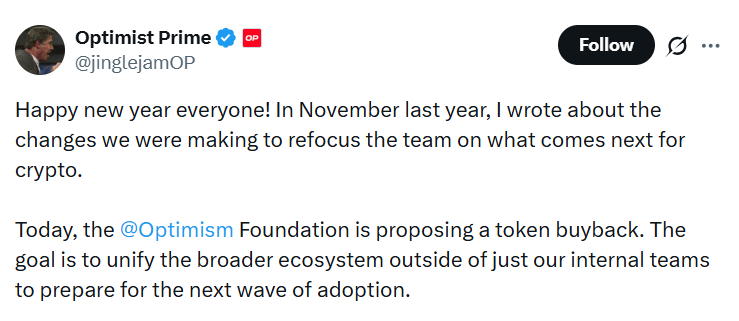
How Optimism Plans to Turn Superchain Fees Into OP Token Demand

The Buyback will happen from the revenue earned by the Superchain from the Sequencer fees. Over the past years, these chains have generated over 5,800 ETH in revenue. So under the proposal, 50% of the revenue will be used to buy OP tokens. Purchases will be made monthly through the OTC Provider. The bought OP tokens will be sent back to the treasury. This will be paused if monthly revenue drops below $200,000. These treasury tokens would not be burned or sold immediately. The Governance would later decide whether to burn or use them for staking and ecosystem incentives.

The reason for this new plan is to make the OP’s value reflect its real economic activity instead of revenue sitting unused in the treasury. Optimism and Superchain agave become dominant players in layer-2. 61.4% of the L2 fee market share and 13% of all on-chain transactions are where the most L2 economic activity is happening.

The Foundation will have the limited discretion to manage remaining ETH. They can use it to generate yield and support ecosystem development. This reduces slow governance overhead while keeping spending within set rules. The Staking partnerships have already generated yield and aim to strengthen OP mainnet’s institutional appeal.

There has been some debate going on for the community members because the proposal combines OP buybacks and expanded treasury discretion in one vote. The Critics argue that these should be voted on separately to avoid bias from the price expectations. The community discussion is going on, a governance call is scheduled for Jan 12, and a formal vote happens on Jan 22. Once it is approved, the buyback will begin in February and the program will run for 12 months.

Highlighted Crypto News:

A Bearish Wall Looms Over BONK: Fade Lower or Fight Back for Gains?

TagsOptimismsuperchain

Preguntas relacionadas

QWhat is the main change proposed by Optimism regarding its Superchain revenue?

AOptimism has proposed using 50% of its Superchain revenue to buy back OP tokens every month.

QWhen is the proposed buyback program planned to begin if approved by the community?

AThe buyback program is planned to start in February 2026 if the community approves the proposal.

QWhat is the source of the revenue that will be used for the OP token buybacks?

AThe buybacks will be funded from the revenue earned by the Superchain from sequencer fees.

QWhat will happen to the purchased OP tokens after they are bought back?

AThe purchased OP tokens will be sent back to the treasury, and governance will later decide whether to burn them or use them for staking and ecosystem incentives.

QWhat is the minimum revenue threshold that would pause the monthly buyback program?

AThe monthly buyback program will be paused if the monthly revenue drops below $200,000.

Lecturas Relacionadas

In Jinjiang, Fujian, a Storage Super Unicorn Lies Quiet

In Fujian's Jinjiang, a city known for sportswear, lies a quiet semiconductor giant: Fujian Jinhua Integrated Circuit Co. (JHICC). Once a promising domestic DRAM manufacturer alongside Yangtze Memory and ChangXin Memory Technologies (CXMT), its journey was derailed in 2018 when the U.S. placed it on an Entity List and filed criminal charges for alleged trade secret theft. This halted production for years. A turning point came in February 2024 when a U.S. federal court found JHICC not guilty. However, it had lost crucial time. While CXMT soared to become a top-valued A-share company in 2024, JHICC, with an estimated valuation of 80 billion RMB, was just restarting. Its current output is primarily customized DDR4 chips, not the advanced DDR5/HBM demanded for AI, but it still benefits from the broader memory chip upcycle. JHICC's story is tied to Chen Zhengkun, a veteran engineer who left Micron to lead the venture. Founded in 2016 with state-backed funding, JHICC partnered with Taiwan's UMC to develop DRAM technology. Rapid progress was cut short by the U.S. actions, which Micron initiated, partly due to its heavy reliance on the Chinese market. Post-sanctions, Chen's team worked to rebuild the production line with reduced reliance on U.S. technology. According to its records, JHICC achieved small-scale production and revenue growth under immense pressure. It now focuses on the stable "niche" DRAM market (e.g., TVs, routers) with a monthly capacity of ~40,000 wafers, aiming for 60,000 by 2026. It holds over 1,000 patents but remains on the Entity List. For Jinjiang, investing in JHICC was a bold industrial leap. The local government provided unwavering financial and logistical support during the crisis, helping the company survive. JHICC has become the anchor for a growing local semiconductor cluster. Though its scale lags behind domestic peers, JHICC's persistence symbolizes a hard-won foothold in a global market long dominated by Samsung, SK Hynix, and Micron. Having missed one boom, it seeks a place in the new AI-driven memory supercycle.

marsbitHace 1 hora(s)

In Jinjiang, Fujian, a Storage Super Unicorn Lies Quiet

marsbitHace 1 hora(s)

Trading

Spot
活动图片





