Opinion: Military Conflicts Accelerate Cryptocurrency Adoption in the Middle East

cryptonews.ruPublicado a 2026-09-07Actualizado a 2026-09-07

Resumen

Military conflicts and national currency instability have accelerated cryptocurrency adoption in the Middle East, according to an analysis for the Bitcoin Policy Institute. On-chain transaction volume in the region is estimated to have grown from around $100 billion in 2022 to $350 billion in 2025-2026, driven by macroeconomic pressure and government digitization programs, unlike global trends fueled by institutional investment. The market's initial reaction to the Israel-Iran escalation in June 2025 saw Bitcoin drop 2.3% and Ethereum 7.5%, with total crypto market cap falling 3.7%. However, Bitcoin later stabilized, with its market share rising to 64.8%, interpreted as a flight to safety from altcoins. Notably, crypto exchanges continued operating during regional conflicts while traditional stock exchanges halted. Adoption drivers vary across the region. In Egypt, Turkey, Lebanon, and Iran, demand for Bitcoin and dollar stablecoins stems from currency devaluation and traditional financial restrictions. In contrast, the UAE and Bahrain see growth supported by clear regulation, institutional players, and economic diversification programs. Data shows a surge in small everyday crypto payments in the UAE, while Turkey leads in transaction volume but with increased speculative trading. Iran's crypto market is becoming more isolated, requiring more intermediate transfers for international access. Analysts suggest these conflicts are pushing Bitcoin closer to becoming a genuine se...

Military conflicts and the instability of national currencies have increased interest in cryptocurrencies as a tool for preserving and transferring capital in the Middle East. This conclusion was reached by Zaid Belbagi, managing partner of London-based Hardcastle Advisory, in a report for the Bitcoin Policy Institute (BPI).

According to the organization's estimates, the annual volume of on-chain transactions in the region has grown from approximately $100 billion in 2022 to around $350 billion in 2025-2026.

Unlike the global market, where growth has been driven by institutional investments and regulatory changes, in the MENA region, the drivers are identified as macroeconomic pressure and government digitalization programs.

Digital Sands

Market's Initial Reaction

Belbagi examined the market's reaction to the escalation between Israel and Iran in June 2025. After the first strikes, Bitcoin fell by approximately 2.3% to $105,200, and Ethereum lost 7.5%. The total cryptocurrency market capitalization decreased by 3.7%.
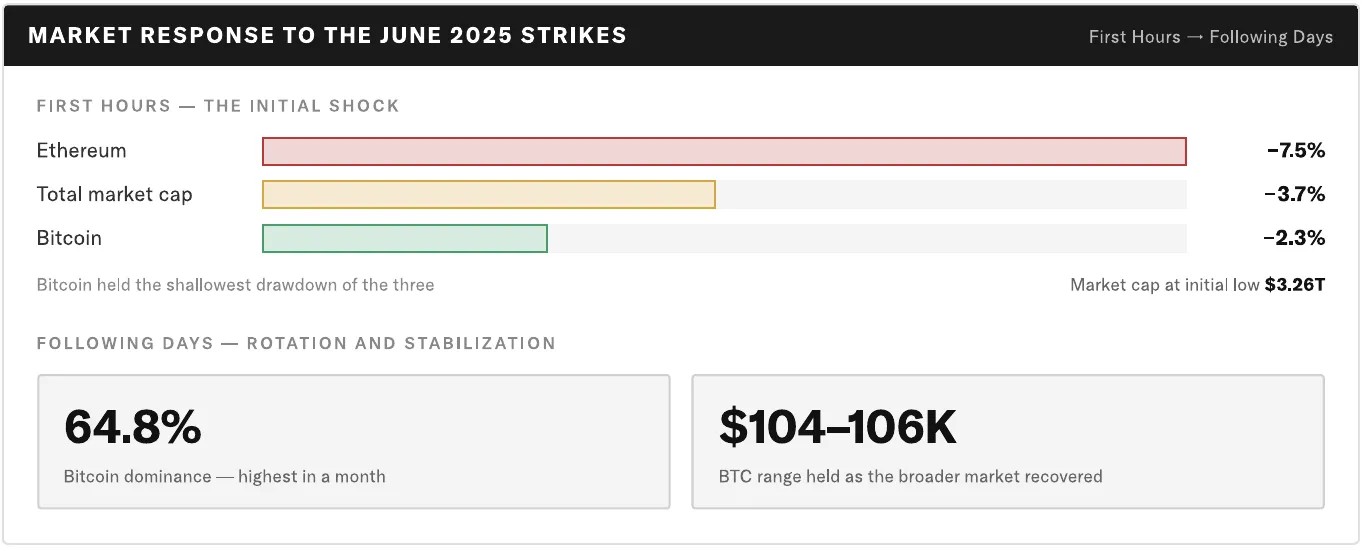
Initial market reaction to the escalation of the conflict between Israel and Iran. Source: Bitcoin Policy Institute.

Later, the price of the first cryptocurrency stabilized in the range of $104,000-106,000, and its share of the market capitalization reached 64.8%. The expert interpreted this dynamic as investors shifting from altcoins to Bitcoin to reduce risk.

Separately, he noted the continuous operation of crypto platforms. BPI cites Steven Coltman of 21Shares, who pointed out that during strikes on the UAE in 2026, local stock exchanges suspended trading, while platforms for trading digital assets continued operations.

Strait of Hormuz Paradox: Why the Oil Shock Didn't Break Bitcoin

Different Reasons for Adoption

Belbagi highlighted two scenarios for the region's development. In Egypt, Turkey, Lebanon, and Iran, the demand for Bitcoin and dollar-pegged stablecoins was linked to currency depreciation and restrictions of the traditional financial system.

In the UAE and Bahrain, growth is supported by regulation, institutional participants, and government economic diversification programs.
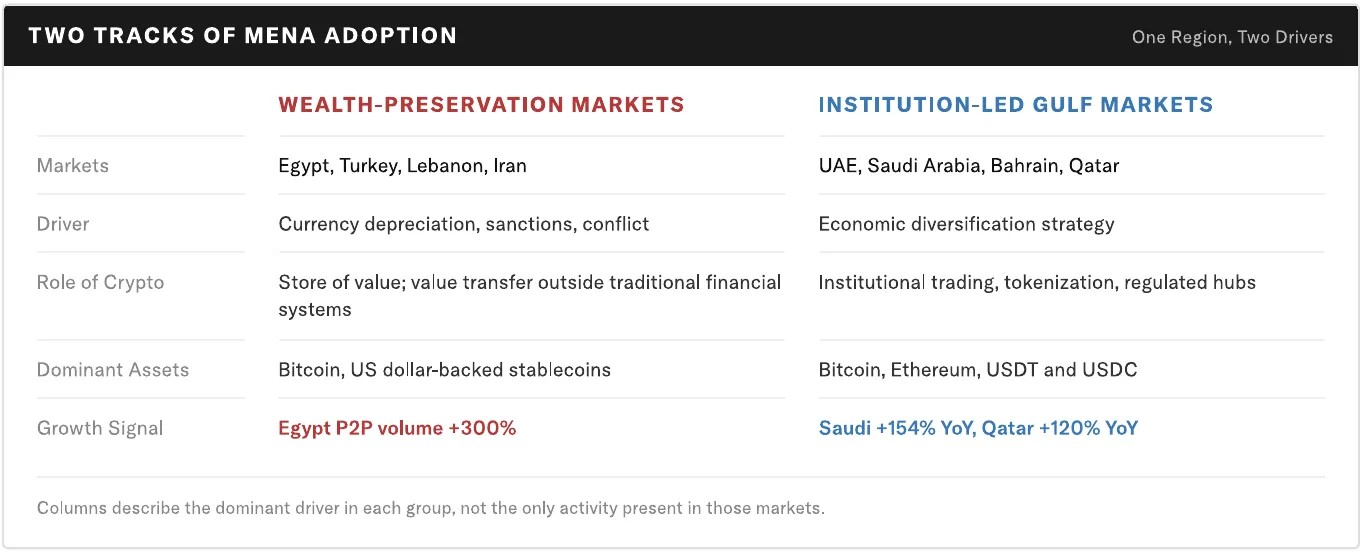
Two paths of cryptocurrency adoption in MENA. Source: Bitcoin Policy Institute.

Differences between markets were also noted by Chainalysis analysts in their 2025 report. In the UAE, the volume of small crypto payments through merchant services — less than $1000 — grew by 88.1% over the reporting period. Analysts linked this to the expansion of everyday use of digital assets.

In Turkey, the picture was different. The country led the region with an annual crypto transaction volume of around $200 billion, but researchers noted an increase in speculative trading.

By mid-2025, the 31-day smoothed average daily turnover of altcoins exceeded $240 million, compared to approximately $50 million at the end of 2024.
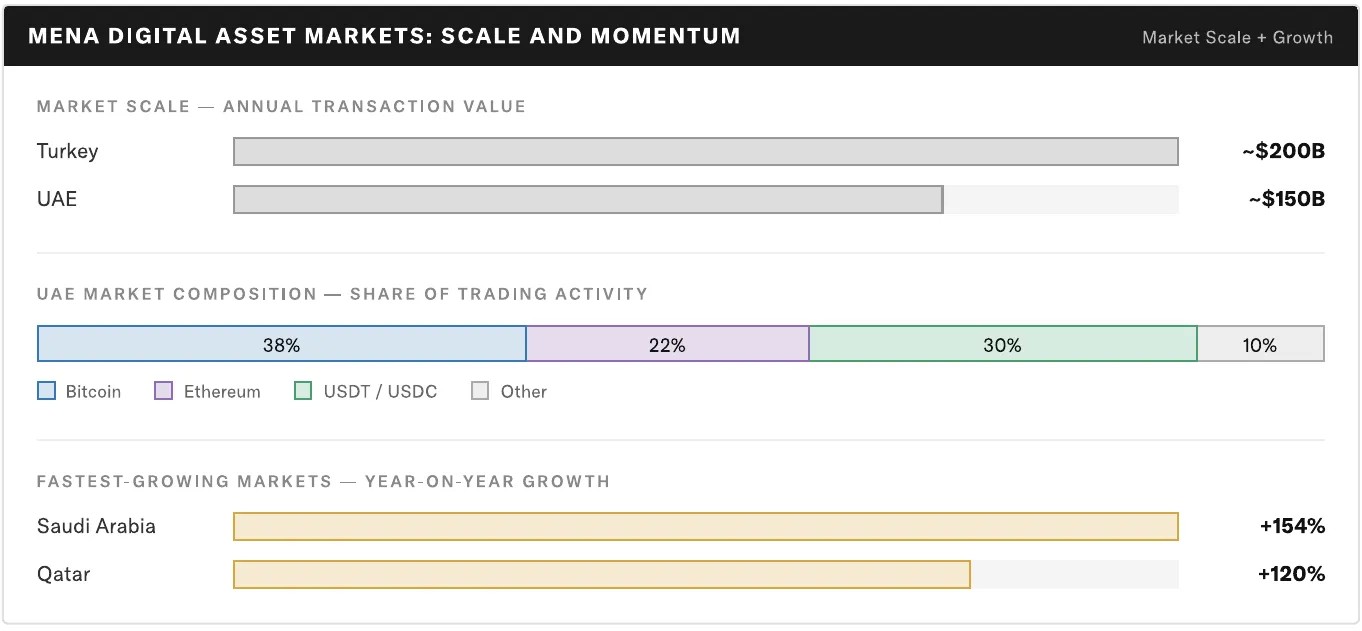
Source: Bitcoin Policy Institute.

According to Chainalysis, some participants, facing reduced purchasing power, began taking greater risks for returns. At the same time, the volume of transfers in the retail categories below $1000 and between $1000 and $10,000 decreased by 2.3% and 1.6%, respectively.

In Iran, analysts discovered growing isolation of the local crypto market: the average number of intermediate transfers between Iranian services and international exchanges increased from 1.6 in 2021 to 4.1 in 2025.

Recall that in April, Bitwise Chief Investment Officer Matt Hougan and Head of Research Ryan Rasmussen stated that the conflict in Iran has brought Bitcoin closer to the role of a real medium of exchange.

end-content
Preguntas relacionadas

QAccording to the article, what are the main factors driving the adoption of cryptocurrencies in the MENA region?

AThe main drivers are macroeconomic pressure (such as military conflicts and instability of national currencies) and government-led digitalization programs. This differs from the global market, where growth is driven by institutional investment and regulatory changes.

QHow did the crypto market react to the initial escalation of the Israel-Iran conflict in June 2025, according to Zaid Belbagi?

AAfter the initial strikes, Bitcoin's price fell by approximately 2.3% to $105,200, and Ethereum lost 7.5%. The overall crypto market capitalization decreased by 3.7%. Later, Bitcoin stabilized between $104,000 and $106,000, with its market share reaching 64.8%, which was interpreted as investors shifting from altcoins to Bitcoin to reduce risk.

QWhat key difference in crypto adoption is highlighted between countries like Egypt/Turkey/Lebanon/Iran and countries like the UAE/Bahrain?

AIn Egypt, Turkey, Lebanon, and Iran, demand for Bitcoin and dollar-pegged stablecoins is driven by currency devaluation and restrictions in the traditional financial system. In the UAE and Bahrain, growth is supported by regulation, institutional participants, and state-led economic diversification programs.

QWhat contrasting trends in cryptocurrency usage were identified in Turkey compared to the UAE based on the Chainalysis 2025 report?

AIn the UAE, the volume of small crypto payments (under $1,000) via merchant services grew by 88.1%, indicating expanding everyday use. In Turkey, despite leading the region with around $200 billion in annual transaction volume, there was a noted increase in speculative trading, with a significant rise in altcoin trading volume, while retail transfers in smaller amounts declined slightly.

QWhat observation did the article make about the operational resilience of cryptocurrency platforms during regional conflicts?

ADuring strikes on the UAE in 2026, while local stock exchanges halted trading, platforms for trading digital assets continued their operations without interruption. This highlights the resilience and continuous operation of crypto exchanges compared to traditional financial markets in times of conflict.

Lecturas Relacionadas

Trading

Spot
活动图片