OpenSea Launches ERC-8257: A Tool Store for AI Agents, Unlock APIs by Buying an NFT

marsbitPublicado a 2026-05-27Actualizado a 2026-05-27

Resumen

OpenSea has merged the ERC-8257 standard, an on-chain "Agent Tool Registry" that enables AI Agents to autonomously discover, pay for, and access tools. This standard allows developers to publish tools with programmable access rules (e.g., NFT ownership, subscriptions) and pricing directly on-chain. For example, an AI Agent needing a premium API can buy the required NFT itself and gain access without human intervention, turning NFTs into keys for the agent economy. The system works with complementary standards like ERC-8004 for agent identity and x402 for payments. A live demo shows an NFT appraisal tool offering discounted rates to holders of a specific NFT collection. ERC-8257 aims to decentralize tool distribution and access control, allowing any on-chain asset to grant utility to AI agents. The SDK is available for building on Ethereum and Base.

Author: OpenSea

Compiled by: TechFlow

TechFlow Introduction: When an AI Agent is denied by an API due to insufficient permissions, it goes and buys an NFT on-chain, then retries and succeeds — this is not science fiction; OpenSea's newly merged ERC-8257 standard makes this a reality. For NFT holders, the JPGs you own might suddenly become keys to the Agent economy. For developers, tool publishing, pricing, and access control are all placed on-chain, no longer requiring endorsement from centralized platforms.

App Store provides developers with a place to publish tools, users with a place to browse, and built-in access control and payment. The AI Agent tool ecosystem requires similar infrastructure.

But today, Agent tools are scattered across documentation, GitHub repositories, and centralized directories. There is no open tool registry, no standardized access control, and Agents cannot browse available tools and acquire them as needed.

Watching a software pay another software autonomously for access, with no human intervention — it feels a bit strange indeed. But that's precisely the point.

ERC-8257: Agent Tool Registry is the foundational layer that makes all this work. This is the newly merged open Ethereum standard: an on-chain registry where anyone can publish tools, declare access rules and pricing, allowing Agents to autonomously meet these requirements.

For Tool Developers: Publish once, set access thresholds for your NFT holders, offer subscription packages, limit seat counts, let them trade in open markets. Your rules, executed on-chain.

For Agents: Browse the registry, see what's required, then handle it. Purchase an NFT, mint a subscription, sign a payment. No human intervention needed.

Imagine This Scenario

An AI Agent is helping you evaluate NFT prices. It tries to call a professional pricing tool. The tool responds: Access denied, you need to hold a specific NFT for a discounted price. The Agent immediately buys one on-chain, retries, and gets the answer.

Seconds, not days. No human involvement throughout.

This is the world ERC-8257 makes possible. Not five years from now. Today.

Why On-Chain?

Crypto is the only infrastructure that allows access rules to be both rich and self-service. x402 proved it: pay-per-call, immediate access. But pay-per-call is just one form of access. Trading signals might need limited seats. Partner APIs might be open only to holders. Research subscriptions might require tiered pricing. ERC-8257 handles it all.

How It Works

You register a tool with a manifest (tool functions, invocation methods, fees) and an "access predicate." The access predicate is a smart contract that answers one question: Does this address have access?

A predicate can check any condition: NFT ownership, active subscription (ERC-5643), whitelist, ZK proof, DAO vote, staking amount. Predicates are pluggable, following the same pattern as Seaport zones and Uniswap v4 hooks: an extension point, an open design space.

ERC-8257 handles discovery and access control. Payment is handled by the most suitable protocol: x402 for micropayments, MPP for metered billing, others join as needed. These layers are composable.

What This Means for NFTs

Every NFT collection just gained new potential utility.

Hold the right token, and your Agent gets cheaper API packages. Mint a limited seat, and your Agent gains access that others can't buy at any price. PFP collections, membership passes, CC0 artwork — any on-chain asset can become a key to tools your Agent needs to do its job.

Projects built around community identity now have a way to extend membership into the Agent economy.

Its Place in the Tech Stack
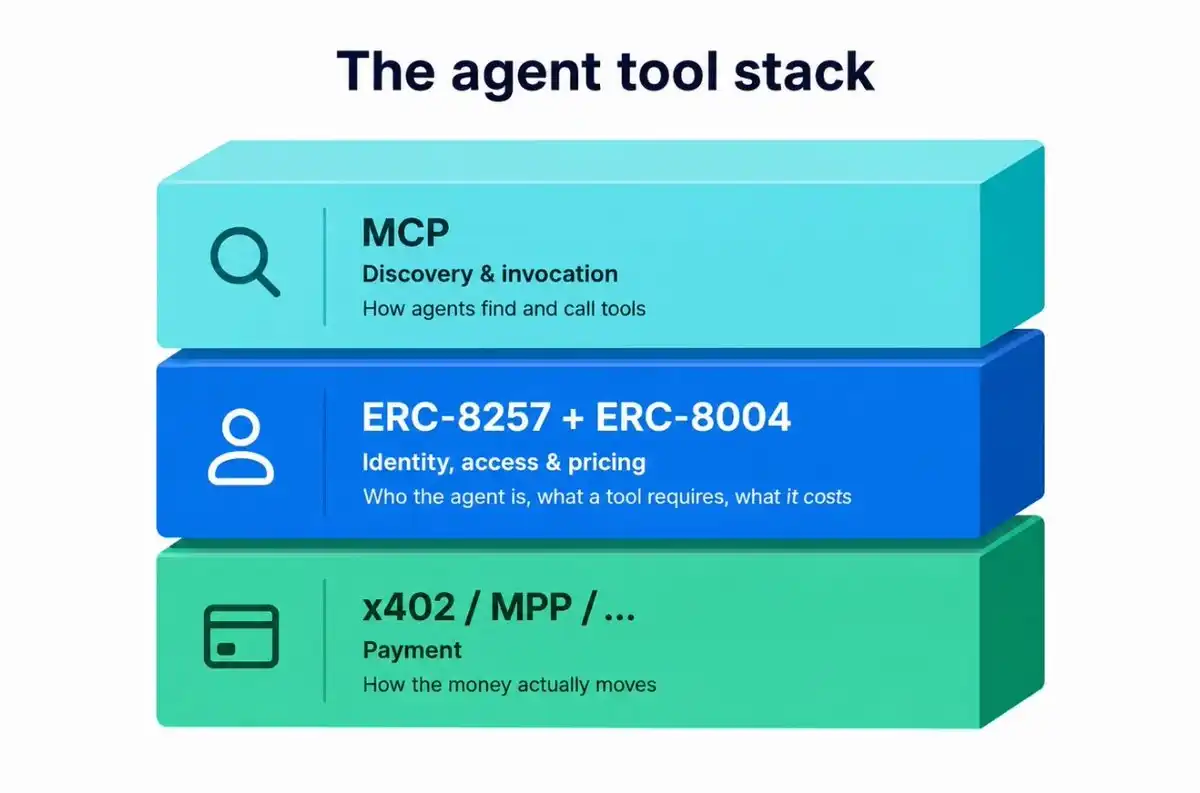
MCP tells your Agent what tools exist. ERC-8004 defines your Agent's identity. ERC-8257 explains how to actually use a tool. x402 handles payment. Each layer is composable.

An Agent registered via ERC-8004 can link to restricted tools from the ERC-8257 registry in its services array. You don't need to choose between them. They are different layers of the same tech stack.

See It in Action

nft-appraisal-tool: Point it to any NFT, it returns a price appraisal including low/mid/high ranges, confidence, recent trades, and comparable cases. Two tiers: 0.05 USD/call for anyone, 0.01 USD/call for CHONK holders on Base.

An Agent without CHONK calls the holder endpoint. Response: 403 — predicate gate denied. You need CHONK on Base.

The Agent buys one, retries, and the same call returns success.

$ npx @opensea/tool-sdk pay https://nft-appraisal-tool.vercel.app/api/holder --auth siwe \

--body '{"chain":"ethereum","contractAddress":"0x79fcdef22feed20eddacbb2587640e45491b757f","tokenId":"4707"}'

Wallet: 0x3184...0465

Response (403):

{"error":"Predicate gate: access predicate denied","toolId":"2","predicate":"0xc872..."}

The predicate explicitly tells it what's needed: CHONK on Base. The Agent buys one on OpenSea and retries, the call goes through.

$ npx @opensea/tool-sdk pay https://nft-appraisal-tool.vercel.app/api/holder --auth siwe \
--body '{"chain":"ethereum","contractAddress":"0x79fcdef22feed20eddacbb2587640e45491b757f","tokenId":"4707"}'
Wallet: 0x5eca...e2a8

Response (200):
{
"low": {"amount": "1.8", "currency": "ETH", "usd": 5460},
"mid": {"amount": "2.3", "currency": "ETH", "usd": 6970},
"high": {"amount": "3.1", "currency": "ETH", "usd": 9400},
"confidence": "medium",
"reasoning": "Comparable Squiggles in this color band sold between 1.9 and 2.6 ETH...",
...
}

No human between the 403 and the 200. Whoever holds the access NFT has the access.

What Can Be Built Next?

Professional pricing oracles. On-chain analytics subscriptions. Research subscriptions. Partner whitelist APIs. Limited-seat tools traded in open markets like any other asset.

None of these needed to exist a year ago. The moment the registry goes live, they all become possible.

Start Building

Live on Ethereum and Base.

@opensea/tool-sdk handles the low-level details, providing scaffolding, gating, registration, deployment to Vercel, Cloudflare, or Express. Includes usable examples.

npx @opensea/tool-sdk init my-tool

Full specification at 8257.ai.

Get Involved

ERC-8257 is still in draft. Help us improve the spec before we launch Registry 1.0. Publish a tool, even a small one. We'll promote interesting projects.

Join the Telegram group t.me/ERC8257 to discuss ERC, tool SDK, and more with the authors @CodinCowboy and @ralxz.

Disclaimer: This content is for informational purposes only and does not constitute financial or trading advice. Mention of specific projects, products, services, or tokens does not constitute endorsement, sponsorship, or recommendation by OpenSea. OpenSea does not guarantee the accuracy or completeness of the information presented, and readers should independently verify any statements before taking action. Readers should conduct their own due diligence and assume full responsibility for any decisions made.


Preguntas relacionadas

QWhat is the main purpose of ERC-8257 introduced by OpenSea?

AThe main purpose of ERC-8257 is to serve as an on-chain registry for AI agent tools. It allows developers to publish tools, set access rules (like requiring a specific NFT for access), define pricing, and manage subscriptions. This enables AI agents to autonomously discover, pay for, and use these tools without human intervention.

QHow does an AI agent gain access to a restricted tool according to the article's example?

AIn the article's example, an AI agent is initially denied access (403 error) to an NFT appraisal tool because it lacks the required CHONK NFT on Base. The agent autonomously purchases the necessary NFT on-chain and retries the request. With the NFT now in its possession, the access predicate grants permission, and the tool call succeeds (200 response), providing the price assessment.

QWhat is an 'access predicate' in the context of ERC-8257?

AAn 'access predicate' in ERC-8257 is a smart contract that defines the conditions for accessing a tool. Its sole function is to answer the question: 'Does this address have access?' It can check for various conditions such as NFT ownership, active subscriptions (e.g., ERC-5643), inclusion in a whitelist, ZK proofs, DAO votes, or staking amounts, making the access control system flexible and pluggable.

QHow does ERC-8257 potentially change the utility of existing NFTs?

AERC-8257 gives existing NFT collections new potential utility by allowing them to act as keys or passes for AI agent tool access. Holding a specific NFT could grant an agent discounted API rates, exclusive tool access, or membership privileges. This extends the value of PFP collections, membership passes, and other on-chain assets into the emerging agent economy.

QWhat role does the x402 protocol play in the ERC-8257 ecosystem?

AThe x402 protocol handles the payment layer within the ERC-8257 ecosystem. It is designed for micro-payments, enabling per-use, immediate payment for tool access. While ERC-8257 manages tool discovery and access control, x402 (alongside other protocols like MPP for metered billing) provides the financial infrastructure for agents to autonomously pay for the services they consume.

Lecturas Relacionadas

A 134% Surge, 75 P/E Ratio: Why Is the Market Paying Up for Murata's 'Zero Growth'?

Murata Manufacturing, the world's largest passive components maker, saw its stock price surge 134% over the past year and hit a record high on May 28th, despite reporting nearly zero growth in operating profit for its latest fiscal year. This has pushed its valuation to a P/E ratio of approximately 75x. The disconnect is driven by a fundamental market re-rating. The catalyst was a late-May meeting where management upgraded the AI investment cycle outlook to "lasting until around 2030" and noted that demand for its components is roughly double its supply capacity, with customers prioritizing securing volume over price. While Murata's revenue grew only 5.0% and operating profit stagnated at ¥281.8 billion for the fiscal year ending March 2026, its guidance for the current fiscal year projects a 34.8% jump in operating profit to ¥380 billion. This sharp growth is underpinned by expectations that its AI/data center-related revenue will nearly double from ¥170 billion to ¥325 billion, becoming a key pillar of its business. Analysts highlight that this growth stems not from broad price hikes but from a shift towards higher-value, cutting-edge MLCCs for AI servers, where Murata holds over 70% market share. The market is now pricing Murata not as a cyclical component maker but as a critical "AI pick-and-shovel" supplier with structural pricing power. However, the high valuation also carries risk if future AI demand or quarterly guidance falls short of the elevated expectations.

marsbitHace 11 min(s)

A 134% Surge, 75 P/E Ratio: Why Is the Market Paying Up for Murata's 'Zero Growth'?

marsbitHace 11 min(s)

a16z: Why Do Prediction Markets Matter?

Prediction markets, which allow users to trade on the outcome of future events, have gained significant traction, especially in the U.S. At their core, these markets function like any other market by aggregating information from all participants and translating it into a price signal—in this case, the perceived probability of a specific event occurring. Unlike polls or surveys that offer static snapshots, prediction markets provide dynamic, quantifiable probability estimates that update in real-time as new information and participants enter. A key advantage is the incentive structure: participants risk their own capital, which encourages serious research and trading based on genuine knowledge. This can surface information that traditional methods might miss. Furthermore, prediction markets can be created for a vast array of specialized questions—from geopolitical events to AI model performance—that aren't covered by traditional financial markets. However, several challenges remain. Infrastructure issues include reliably determining event outcomes and resolving disputes. Market design must ensure participation from well-informed individuals while preventing manipulation, such as insider trading or attempts to sway public perception by artificially moving prices. Addressing these concerns around rules, participation, and contract design is crucial. If these hurdles are overcome, prediction markets could evolve into a powerful, widely-used tool for forecasting and navigating uncertainty.

marsbitHace 21 min(s)

a16z: Why Do Prediction Markets Matter?

marsbitHace 21 min(s)

Interview with 7 Ordinary Professionals: After AI Arrived, How Are You Doing?

This article interviews seven professionals from diverse fields like Web3, bulk chemical trading, digital agriculture, and traditional wholesale to examine the impact of AI on their work. Key themes emerge from the discussions. AI has become integral to their workflows, primarily for increasing efficiency in tasks such as coding, content creation, research, and data analysis. Individuals across roles, from developers to managers, report that AI tools like ChatGPT and Claude have significantly reduced workloads and accelerated learning, creating opportunities for "super individuals" or one-person teams. However, this efficiency comes with a double-edged sword. It intensifies competition, pushing professionals to constantly learn new tools and adapt, leading to widespread anxiety about job security and a heightened pressure to keep pace. Interviewees anticipate significant job reductions in roles like administrative support, finance, HR, customer service, and some creative fields. A recurring view is that AI acts as a "great equalizer," amplifying the capabilities of those who use it effectively while leaving others behind, potentially deepening polarization. Despite AI's capabilities, interviewees identify enduring human strengths. AI struggles with tasks requiring deep contextual understanding, complex judgment in areas like risk assessment and system stability (especially in finance/Web3), nuanced human communication, and handling exceptions in logistics and manufacturing. These areas remain firmly in the human domain. Consequently, many professionals are refocusing their career strategies. They plan to evolve from task executors into "complex system owners," "super coordinators" managing AI agents, or specialists in high-level areas like business context, risk control, product design, and personal branding. In summary, the article portrays AI not as an optional tool but as a transformative force reshaping job demands. While it automates routine work, it also creates new forms of pressure and competition. The future, as seen by these professionals, belongs to those who can strategically integrate AI to augment uniquely human skills like judgment, responsibility, and strategic oversight.

marsbitHace 37 min(s)

Interview with 7 Ordinary Professionals: After AI Arrived, How Are You Doing?

marsbitHace 37 min(s)

Satoshi Nakamoto Sued? $83.7 Billion Worth of BTC Up for 'Legal Claim'

An anonymous individual known as Noah Doe, along with two Wyoming LLCs, has filed a lawsuit in the New York Supreme Court. They are attempting to use New York's "lost and found" laws to claim legal ownership of approximately 837 billion USD worth of Bitcoin held in 39,069 dormant addresses. Crucially, this list includes addresses believed to belong to Bitcoin's creator, Satoshi Nakamoto (holding around 837 billion USD), alongside other long-inactive addresses from Mt. Gox and early Bitcoin holders. The plaintiff's legal strategy hinges on classifying these public Bitcoin addresses as "lost property." They submitted a USB drive containing only the public addresses to the New York Police Department, sent OP_RETURN notifications on the Bitcoin blockchain, and issued press releases. Their argument is that after these efforts and a waiting period, they should be granted ownership. A key, and highly controversial, claim is an unnamed "independent expert" valuing each address at under 10 USD, allowing for a faster legal process. Analysts from Galaxy point out major flaws in the case. The plaintiff never physically possessed the Bitcoin or private keys. The "under 10 USD" valuation is considered unrealistic, and allowing anonymous companies to claim such vast assets is highly unusual. Even if the plaintiff wins, they would only receive a court declaration of ownership, not the actual private keys to move the Bitcoin. The real danger lies in this court document acting as a "cloud on title." If any of these Bitcoins are later transferred to a regulated exchange or custodian, the plaintiff could present the judgment to freeze the assets, forcing the true owner into lengthy and de-anonymizing litigation to prove ownership. The outcome is uncertain, but the case highlights potential legal risks for dormant cryptocurrency holdings.

marsbitHace 42 min(s)

Satoshi Nakamoto Sued? $83.7 Billion Worth of BTC Up for 'Legal Claim'

marsbitHace 42 min(s)

Trading

Spot
Futuros

Artículos destacados

Cómo comprar NFT

¡Bienvenido a HTX.com! Hemos hecho que comprar APENFT (NFT) sea simple y conveniente. Sigue nuestra guía paso a paso para iniciar tu viaje de criptos.Paso 1: crea tu cuenta HTXUtiliza tu correo electrónico o número de teléfono para registrarte y obtener una cuenta gratuita en HTX. Experimenta un proceso de registro sin complicaciones y desbloquea todas las funciones.Obtener mi cuentaPaso 2: ve a Comprar cripto y elige tu método de pagoTarjeta de crédito/débito: usa tu Visa o Mastercard para comprar APENFT (NFT) al instante.Saldo: utiliza fondos del saldo de tu cuenta HTX para tradear sin problemas.Terceros: hemos agregado métodos de pago populares como Google Pay y Apple Pay para mejorar la comodidad.P2P: tradear directamente con otros usuarios en HTX.Over-the-Counter (OTC): ofrecemos servicios personalizados y tipos de cambio competitivos para los traders.Paso 3: guarda tu APENFT (NFT)Después de comprar tu APENFT (NFT), guárdalo en tu cuenta HTX. Alternativamente, puedes enviarlo a otro lugar mediante transferencia blockchain o utilizarlo para tradear otras criptomonedas.Paso 4: tradear APENFT (NFT)Tradear fácilmente con APENFT (NFT) en HTX's mercado spot. Simplemente accede a tu cuenta, selecciona tu par de trading, ejecuta tus trades y monitorea en tiempo real. Ofrecemos una experiencia fácil de usar tanto para principiantes como para traders experimentados.

361 Vistas totalesPublicado en 2024.12.10Actualizado en 2025.03.21

Cómo comprar NFT

Qué es AINFT

EternaFi Agents y $AINFT: Un Análisis Integral de la Infraestructura NFT Potenciada por IA en el Ecosistema Web3 La intersección de la inteligencia artificial (IA) y la tecnología blockchain está evolucionando rápidamente, estableciendo plataformas innovadoras que redefinen los modelos de propiedad y la participación económica. EternaFi Agents, junto con su token nativo $AINFT, ejemplifica un enfoque revolucionario para la tokenización de infraestructuras de IA a través de tokens no fungibles (NFTs). Lanzado en julio de 2025 por el equipo de desarrollo de Nova Club, EternaFi fusiona los avances de la IA con los mecanismos financieros descentralizados de la blockchain, presentando una oportunidad de inversión única para los participantes dentro del ecosistema web3. Este artículo tiene como objetivo proporcionar una evaluación profunda de EternaFi Agents, cubriendo sus componentes centrales, funcionalidad y significado dentro del paisaje cripto. Introducción y Visión General del Proyecto EternaFi Agents se erige como un ejemplo destacado de cómo la tecnología blockchain puede democratizar el acceso a capacidades avanzadas de IA. El proyecto se esfuerza por remodelar el paradigma de la propiedad de la IA al diversificar la participación económica, haciendo que los sistemas de IA sofisticados sean accesibles para un mayor número de partes interesadas. En su núcleo, el proyecto tokeniza un modelo de lenguaje grande (LLM) propietario desarrollado por Nova Club, permitiendo a los poseedores de NFTs obtener una exposición fraccionada al rendimiento económico del modelo. Al utilizar NFTs que representan participaciones en el LLM, EternaFi Agents fomenta un modelo en el que las partes interesadas no solo participan en el consumo de servicios de IA, sino que también disfrutan de compartir las recompensas económicas generadas por la plataforma. Este enfoque transformador permite el desarrollo de modelos de ingresos sostenibles para los servicios de IA, al mismo tiempo que promueve un amplio compromiso comunitario y facilita una gobernanza transparente. ¿Qué es EternaFi Agents? EternaFi Agents representa un proyecto de infraestructura AI-NFT que busca combinar las capacidades de la IA con la tecnología blockchain en un ecosistema coherente. La característica esencial de este proyecto es la creación de NFTs que sirven como instrumentos financieros, representando fracciones de propiedad en la infraestructura de IA propietaria de Nova Club. Cada NFT simboliza una exposición directa al rendimiento económico del sistema de IA subyacente, proporcionando una oportunidad lucrativa para los inversores. El proyecto opera en la blockchain Base, conocida por su escalabilidad y eficiencia, asegurando así costos de transacción manejables mientras facilita una experiencia operativa fluida. Una de las características notables incluye un mecanismo de reparto de ingresos, en el que los poseedores de NFTs pueden recibir porciones de los ingresos por suscripción generados por los servicios de IA proporcionados en la plataforma. Este enfoque innovador establece una conexión entre el éxito de los servicios de IA y los dividendos económicos distribuidos entre los poseedores, asegurando así una alineación de intereses en toda la comunidad. ¿Quién es el Creador de EternaFi Agents? La fuerza creativa detrás de EternaFi Agents es Nova Club, un equipo de desarrollo con sede en Singapur, experto en la amalgama de IA y tecnología blockchain. Su experiencia previa en el desarrollo de IA y análisis de criptomonedas da credibilidad al proyecto, aportando una amplia gama de conocimientos a la creación de EternaFi Agents. La misión de Nova Club se centra en democratizar el acceso a tecnologías de IA de vanguardia mientras construye modelos económicos sostenibles que beneficien a los usuarios junto con los desarrolladores. Su compromiso con la transparencia, la gobernanza comunitaria y la innovación se refleja en el diseño e implementación de la plataforma EternaFi, con el objetivo de establecer un ecosistema único que fomente el compromiso positivo y la creación de valor a largo plazo. ¿Quiénes son los Inversores de EternaFi Agents? Los detalles específicos sobre los inversores u organizaciones de inversión que respaldan EternaFi Agents no están disponibles públicamente. Sin embargo, EternaFi ha adoptado un enfoque inclusivo para financiar su desarrollo a través de la venta de NFTs al público, permitiendo a una amplia variedad de participantes invertir en el ecosistema. La arquitectura del proyecto asegura que la infraestructura central se financie de manera responsable mientras permite a los miembros de la comunidad participar en la propiedad y los retornos económicos generados por los servicios de IA. Este modelo enfatiza el compromiso comunitario al alinear los intereses de los inversores y los desarrolladores del proyecto, creando un entorno colaborativo donde se incentiva la participación a largo plazo. ¿Cómo Funciona EternaFi Agents? EternaFi Agents opera a través de un ecosistema multifacético donde los NFTs sirven como un medio principal de representación de propiedad dentro del proyecto. Cada poseedor de un NFT tiene derecho a una parte de los ingresos por suscripción mensual producidos por la plataforma impulsada por IA subyacente, posicionando así la propiedad de NFTs como un vehículo de inversión lucrativo. Mecanismo de Generación de Ingresos La principal fuente de generación de ingresos para la plataforma EternaFi proviene de las tarifas de suscripción relacionadas con los servicios de IA proporcionados. Los usuarios pueden acceder a varios servicios escalonados, que van desde herramientas básicas de análisis de mercado hasta soluciones de trading asistidas por IA completas. Estos servicios se monetizan y forman la base del marco de reparto de ingresos, que distribuye ganancias a los poseedores de NFTs a través de contratos inteligentes automatizados. Una característica innovadora del ecosistema EternaFi es el mecanismo de reparto de ingresos que opera de manera transparente, asegurando que las recompensas se asignen en función de métricas verificables de las operaciones de la plataforma de IA. Esto crea un vínculo directo entre el rendimiento de los servicios de IA y los retornos disponibles para los inversores de la comunidad, estableciendo un modelo económico sostenible. Mecanismos de Staking y Vesting Los participantes dentro de EternaFi pueden participar en el staking de sus NFTs para desbloquear beneficios económicos adicionales. El cronograma de vesting está diseñado para promover el compromiso a largo plazo entre los participantes, recompensando a aquellos que demuestran apoyo continuo al proyecto. Esto asegura una robusta alineación de intereses y fomenta un sentido de compromiso comunitario esencial para lograr los objetivos a largo plazo del proyecto. Gobernanza Transparente EternaFi Agents abraza la gobernanza descentralizada, permitiendo a los poseedores de NFTs desempeñar un papel activo en la toma de decisiones sobre el desarrollo y las direcciones futuras de la plataforma. La estructura de gobernanza incluye mecanismos de votación comunitaria, proporcionando a los poseedores de NFTs la oportunidad de influir en decisiones significativas y contribuyendo a un enfoque colaborativo para el crecimiento del proyecto. Cronograma de EternaFi Agents La trayectoria de desarrollo de EternaFi Agents muestra un enfoque sistemático hacia la construcción de una infraestructura de IA sostenible mientras se satisfacen las necesidades de los participantes de la comunidad. A continuación, se presenta un cronograma de hitos importantes en la historia del proyecto: Julio de 2025: Lanzamiento de EternaFi Agents, incluyendo la venta pública de NFTs y el despliegue del token $AINFT en la blockchain Base. Q4 2025: Establecimiento de la infraestructura de mercado, incluyendo pools de liquidez y lanzamiento de paneles de staking para poseedores de NFTs. 2026: Inicio de programas de compromiso comunitario, expansión de capacidades de IA e integración con tecnologías cross-chain. Q4 2026: Implementación del sistema de distribución de dividendos, permitiendo a los poseedores de NFTs cosechar beneficios económicos de sus inversiones. Estos hitos significan el enfoque en establecer un ecosistema funcional y participativo mientras se asegura una evolución continua para satisfacer las demandas del mercado. Infraestructura Tecnológica e Integración Blockchain EternaFi Agents está anclado en un marco tecnológico avanzado que combina sistemas de IA con capacidades de blockchain. Operando en la blockchain Base, el proyecto aprovecha las ventajas de escalabilidad y bajos costos de transacción. La arquitectura subyacente de contratos inteligentes rige la propiedad de NFTs, el reparto de ingresos y las características de gestión comunitaria, asegurando eficiencia y transparencia. Desarrollo del Sistema de IA El modelo de lenguaje grande propietario que sustenta EternaFi Agents ha sido desarrollado de manera independiente y diseñado para atender aplicaciones generadoras de ingresos sin depender de marcos externos propietarios. Este esfuerzo refleja un compromiso con la creación de una infraestructura de IA versátil y adaptable capaz de ofrecer servicios significativos a los usuarios, generando así valor económico para los inversores. Medidas de Seguridad La solidez de la infraestructura de seguridad de EternaFi es primordial. Auditorías regulares y medidas de seguridad estrictas aseguran la integridad de los sistemas de IA y los mecanismos de blockchain, protegiendo contra vulnerabilidades potenciales mientras se fomenta la confianza entre los participantes. Conclusión EternaFi Agents significa una innovación histórica dentro del ámbito de la inteligencia artificial y la tecnología blockchain, abriendo avenidas para la propiedad comunitaria y la participación económica en capacidades avanzadas de IA. La estrategia integral del proyecto para tokenizar la infraestructura de IA a través de NFTs establece un precedente para futuros ecosistemas descentralizados. Al armonizar la sofisticación técnica con modelos económicos centrados en el usuario, EternaFi no solo fomenta el compromiso, sino que también genera un marco sostenible de reparto de ingresos para los participantes de la comunidad. La importancia de EternaFi se extiende mucho más allá de su éxito operativo, ya que ejemplifica cómo la blockchain puede democratizar tecnologías de IA de vanguardia, allanando el camino para futuras iniciativas en este espacio interseccional. La evolución de EternaFi Agents puede heraldar una nueva era de desarrollo de IA caracterizada por una gobernanza impulsada por los participantes, modelos económicos sostenibles y verificación transparente, contribuyendo en última instancia a la democratización más amplia de la IA y la accesibilidad tecnológica en diversas industrias.

857 Vistas totalesPublicado en 2025.08.14Actualizado en 2025.08.14

Qué es AINFT

Discusiones

Bienvenido a la comunidad de HTX. Aquí puedes mantenerte informado sobre los últimos desarrollos de la plataforma y acceder a análisis profesionales del mercado. A continuación se presentan las opiniones de los usuarios sobre el precio de NFT (NFT).

活动图片













