OpenAI Shuts Down Sora, Disney's $1 Billion Investment Goes Down the Drain, AI Video Market Reshuffles

marsbitPublicado a 2026-03-27Actualizado a 2026-03-27

Resumen

OpenAI has officially shut down its AI video generation product Sora, including its consumer app, API, and the sora.com domain, as of March 24, 2026, just six months after its public launch. This decision also led to the cancellation of Disney’s three-year licensing agreement and a planned $1 billion investment in OpenAI. The tech community’s reaction highlighted Sora’s lack of real-world adoption, with many questioning whether the product was ever widely used. Competitors like Runway Gen-4, Kling 3.0, and Google Veo are now positioned as the main players in the AI video market. Sora’s shutdown is attributed to high operational costs—estimated at $15 million daily during peak usage—coupled with limited revenue alignment ahead of OpenAI’s expected IPO. Deepfake concerns related to Sora’s content generation features also contributed to its termination. OpenAI will retain Sora’s underlying technology for internal "world simulation" research aimed at robotics field, but no consumer-facing video products are planned. Current Sora users are advised to migrate to alternatives such as Runway, Kling, or Pika. The exit of OpenAI is expected to lead to market consolidation, potential price increases from remaining providers, and greater enterprise opportunities for competitors like Kling. Runway, in particular, may raise subscription prices due to increased demand.

Author: RoboRhythms

Compiled by: Deep Tide TechFlow

Deep Tide Guide: On March 24, 2026, OpenAI shut down Sora's App, API, and domain all at once. Disney's three-year licensing agreement and $1 billion investment subsequently collapsed.

The first reaction from the tech community was not regret, but "Did anyone actually use this thing?"—this statement speaks volumes more than any official announcement. Runway, Kling, and Google Veo are now the only real players left in the AI video space.

Full Text Below:

The product that was supposed to bring AI video generation to the masses has disappeared. OpenAI shut down Sora on March 24, 2026, taking down the standalone App, API, and sora.com, just about six months after the product's high-profile public release.

The timing is awkward. Disney signed a three-year licensing agreement in December 2025, authorizing OpenAI to use iconic characters like Mickey Mouse and Cinderella for Sora-generated content, and planned to invest $1 billion in OpenAI.

All of this is now canceled.

I think the most telling thing is the reaction from the tech community: the mainstream sentiment wasn't regret, but "Did anyone actually use this thing?" This statement reveals the product's actual trajectory more truthfully than any official announcement.

If you were using Sora or planning to build a product based on its API, here's what you need to know.

What Exactly Happened

Sora's shutdown is a complete product termination, covering the App, developer API, and the sora.com domain.

OpenAI confirmed on March 24 that the entire Sora product line would be completely shut down. This is not a pivot, a rebrand, or a merger into another product.

The App is gone, the API is being shut down, sora.com is being taken offline.
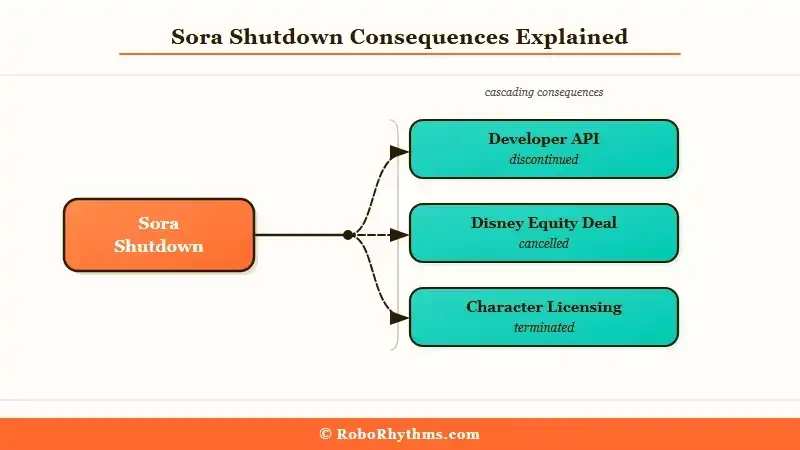
Here is everything that was terminated:

  • Sora consumer App (text-to-video)
  • Sora API (developer and enterprise access)
  • sora.com website

Disney's planned $1 billion equity investment in OpenAI

The three-year character licensing agreement with Disney announced in December 2025

The Disney angle is not a footnote. A $1 billion deal collapsing within three months of its announcement suggests the relationship had already become complicated before the shutdown was officially announced.

Both Variety and Bloomberg confirmed that the deal was directly called off due to Sora's cessation of operations.

Only one part of Sora remains: the internal research team continues to advance what OpenAI calls "world simulation" research, aimed at robotics applications.

This project has nothing to do with the video product you might have used. OpenAI explicitly positions this as infrastructure research, not a future consumer product.

This also aligns with a pattern I've reported on before. OpenAI has a history of terminating products that no longer fit its revenue roadmap, and the timing—ahead of a planned IPO—follows the same logic.

Why This Is More Serious Than It Sounds

Sora's shutdown isn't just a product failure; it's OpenAI publicly conceding an entire AI category to the competitors it once looked down upon at its launch.
When Sora first debuted in 2024, the demos were stunning. Posts on r/singularity garnered hundreds of thousands of views, with a widespread belief that OpenAI had once again leapfrogged all competitors overnight.

Runway, Pika, and Kling were supposed to become irrelevant.

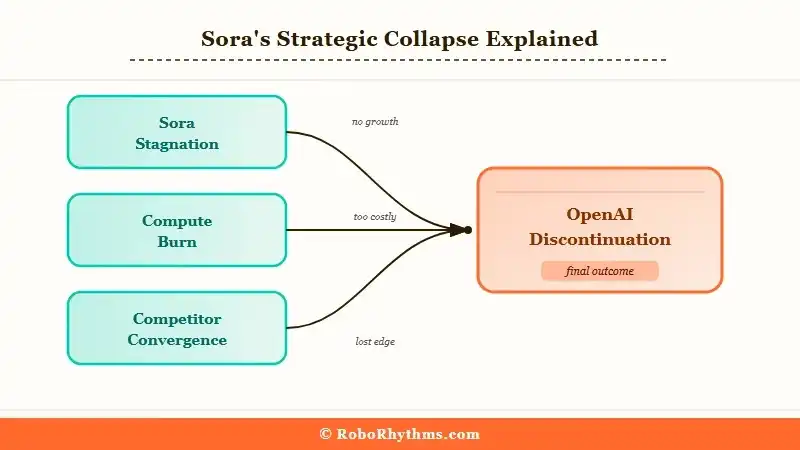
But the product stalled after its public launch. Runway Gen-4 kept iterating and shipping, Kuaishou's Kling 3.0 closed the quality gap faster than most analysts expected.

Google Veo's compute advantages were something OpenAI couldn't easily match in this non-core revenue赛道 (market).

Compute cost is the most staggering number. Analysts estimate Sora's compute cost peaked at around $15 million per day during peak usage.

For a company focused on pre-IPO financials, this was an extremely difficult expense to justify when the models that actually drive revenue (GPT-5 series, Operator API, enterprise contracts) all require more investment.

Then there was the deepfake issue. TechCrunch, in its shutdown report, called Sora "the most disturbing app on your phone," referring to the cameo feature that allowed users to insert real people into AI-generated scenes.

The backlash from this feature was significant, and in my view, the reputational drag made the shutdown decision easier than it otherwise might have been.

The industry impact is now clear: Runway, Kling, and Google Veo are the true players in AI video. The strategic uncertainty that OpenAI's presence created for every competitor has now been removed.

What This Means For You

If you were using Sora or accessing its API, you need to act immediately. The shutdown timeline is effective now.
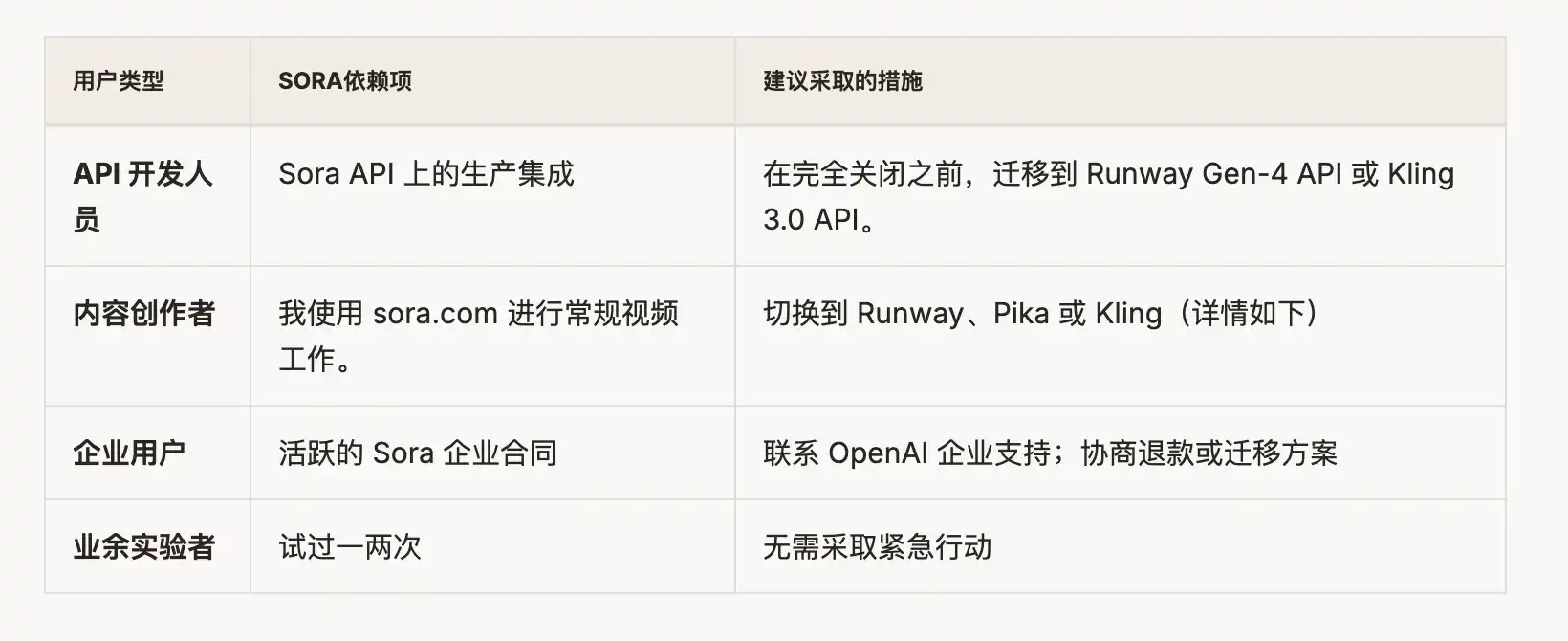
The three tools currently best positioned to absorb Sora's former user base:

Runway Gen-4—Technically closest to Sora's cinematic quality goals, with a mature API and an active developer community. Best for professional long-form video production.

Kling 3.0—Kuaishou's model has become the community's top choice for realistic motion effects and is the tool most recommended by former Sora users in migration discussions. Developer API available.

Pika 2.0—Faster, cheaper, and easier to use than the above two. Plans start around $8/month. Best for content creators prioritizing speed over cinematic quality.

If your primary use case is for virtual avatars or talking head videos, rather than purely generative scenes, the tool choice differs.

What Happens Next

The AI video market is about to consolidate, and prices will rise.

With OpenAI's exit, Runway, Kling, and Google Veo no longer operate in a market where a well-funded new entrant could颠覆 (disrupt) everyone's pricing expectations at any moment.

This changes the commercial dynamics for all remaining players.

My predictions for the next six months:

Runway will raise subscription prices. Demand will surge with the influx of Sora users, and Runway's pricing has been below what its competitive position could support. The diminished threat from OpenAI gives them clear room to reprice.

Google Veo will more aggressively push a consumer product. Google had been deliberately quiet about a public rollout for Veo; the addressable market is now clearer. Expect a more prominent consumer product before the end of 2026.

Kling will target the enterprise contracts Disney's departure leaves behind. Kuaishou has been building Kling as a professional-grade product. The OpenAI-Disney deal effectively blocked some enterprise relationships that are now reopening.

An outcome I don't see happening: OpenAI returning to AI video with a consumer product. Internal signals point to video being recast as robotics infrastructure research, and the window for re-entering the market is shorter than this company's typical development cycles.

From my experience observing every AI category, the company that wins is the one that accumulates iterations over time, not the one that released the best demo. Sora peaked at the demo; Runway has been accumulating for three years.

Frequently Asked Questions

Q: As of March 2026, is the Sora App still usable?

As of March 24, 2026, Sora has entered the shutdown process. OpenAI has not announced a specific final access date for all users, but the termination process has begun. Do not rely on its continued availability for any production environment work.

Q: What is the best alternative to Sora for API developers?

Runway Gen-4 currently has the most mature and stable developer API among AI video tools. Kling 3.0 also offers API access and is widely recommended in developer migration discussions. It's advisable to test both before fully migrating.

Q: Why did Disney cancel its $1 billion investment in OpenAI?

Disney's investment and the three-year licensing agreement were directly tied to the Sora product line, including rights to use Disney characters in AI-generated videos. With Sora's shutdown, the licensing arrangement lost its foundation. Both parties have called it off, according to Bloomberg and Variety.

Q: What will happen to the internal Sora research team at OpenAI?

The team continues to work on world simulation research for robotics. This work will not result in any consumer or developer-facing video products. OpenAI positions it as infrastructure research, not something on the product roadmap.

Q: Does this mean OpenAI is broadly scaling back consumer products?

OpenAI has made it clear that pre-IPO resources are focused on enterprise software, programming tools, and agent products. Sora's shutdown aligns directly with this direction.

Q: Is Google Veo now the best Sora alternative?

Veo is technically strong, but for developers and content creators, Runway Gen-4 and Kling 3.0 are currently more accessible and better supported. For most users needing to migrate today, Runway or Kling is the more practical choice.


Preguntas relacionadas

QWhat was the main reason for OpenAI shutting down Sora according to the article?

AThe article states that Sora was shut down due to its high operational costs (estimated at $15 million daily in compute costs during peak usage) and because it did not align with OpenAI's pre-IPO focus on revenue-generating products like enterprise software, coding tools, and agent products. Additionally, reputational issues from deepfake concerns made the decision easier.

QWhich companies are now considered the main players in the AI video generation market after Sora's shutdown?

AAccording to the article, the main players in the AI video generation market after Sora's shutdown are Runway (Gen-4), Kling (3.0 by Kuaishou), and Google Veo.

QWhat was the financial and strategic impact of Sora's shutdown on Disney?

ADisney's planned $1 billion equity investment in OpenAI and a three-year character licensing deal, announced in December 2025, were both canceled as a direct result of Sora's shutdown. The deal had granted OpenAI rights to use Disney characters like Mickey Mouse and Cinderella in AI-generated content.

QWhat is the future of the internal Sora research team at OpenAI?

AThe internal Sora research team will continue its work, but it has been re-focused on 'world simulation' research for robotics applications. This is positioned as infrastructure research and will not lead to any future consumer or developer-facing video products.

QWhat does the article predict will happen to the AI video market in the next six months following Sora's exit?

AThe article predicts market consolidation and price increases. Specifically, it forecasts that Runway will raise its subscription prices, Google will more aggressively push Veo as a consumer product, and Kling will target the enterprise contracts that were previously blocked by the OpenAI-Disney deal.

Lecturas Relacionadas

KOL's Perspective: Why Is SOL Set to Rise from This Point?

**Summary: Why SOL is Positioned for Growth at This Level** The article argues that SOL is poised for an upward move from its current price point, citing several key factors. Primarily, SOL has just broken out of a 4-month consolidation phase. This breakout signals a return of risk appetite to the broader crypto market, as SOL is seen as a key indicator of overall crypto health. The token's ownership has reportedly shifted from short-term traders and tourists to long-term accumulators, leading to low volume. Any meaningful increase in trading activity could thus trigger significant upward momentum. Fundamental strengths include strong institutional adoption, integration with DeFi and RWAs (Real-World Assets), and the potential benefits from the Clarity Act. Despite its high volatility—having dropped 70% from its all-time high but still up 12x from its bear market low—SOL is highlighted as one of the few tokens from the last cycle to reach new highs. It boasts a robust ecosystem of applications, users, and protocols. Future catalysts include the expected influx of AI developers following the Miami Accelerate conference, which focused on AI on Solana. Furthermore, Solana is positioned as the premier chain for memecoin activity, a trend expected to continue and drive network usage and fees. The article concludes that recent price action reflects a healthy transfer to long-term holders, setting the stage for growth.

marsbitHace 30 min(s)

KOL's Perspective: Why Is SOL Set to Rise from This Point?

marsbitHace 30 min(s)

Those Pre-Bitcoin PoW Protocols Have Recently Been Reimplemented

This article details a recent surge in replicating pre-Bitcoin Proof-of-Work (PoW) protocols, specifically focusing on Hal Finney's 2004 RPOW (Reusable Proofs of Work). Within five days in May 2026, multiple independent builders in the Bitcoin/cypherpunk community launched projects inspired by this early electronic cash proposal. The initiative began with Fred Krueger's `rpow2.com`, a centralized but auditable system that replaced RPOW's original IBM 4758 hardware with Ed25519 signatures. Initially a faithful replica, it later adopted Bitcoin-like features (21M supply cap, difficulty adjustment) and a controversial 5.24% founder allocation. This sparked rapid forks, including `rpow4.com` which incorporated full Bitcoin parameters, a prediction market (`rpowmarket.com`), and a DEX (`rpow2swap.com`). Concurrently, Mike In Space created a prototype of Wei Dai's 1998 b-money proposal (`b-money.replit.app`), pushing the historical exploration even further back. The article contrasts these centralized, server-dependent experiments with Bitcoin's core innovation of decentralized, trustless consensus. It also highlights a parallel development: the `HASH` project on Ethereum, which uses smart contract hooks to enable a purely fair-launch, browser-mineable PoW token with 0% allocations to team or VCs. The collective activity is framed as a meme-driven, educational exploration of cypherpunk history rather than a serious financial movement, with all projects heavily disclaiming any investment value.

marsbitHace 34 min(s)

Those Pre-Bitcoin PoW Protocols Have Recently Been Reimplemented

marsbitHace 34 min(s)

South Korean Exchanges 'Battle' Regulators, Challenging the Boundaries of Enforcement and Legislation

South Korea's cryptocurrency industry is engaged in a rare, direct confrontation with regulators. The Financial Intelligence Unit (FIU), the primary anti-money laundering (AML) watchdog, has recently imposed heavy penalties on major exchanges like Upbit and Bithumb for alleged violations involving unregistered overseas VASPs and AML procedures. However, exchanges are now actively challenging these actions in court and through industry associations. In a significant shift, the Seoul Administrative Court ruled in favor of Upbit's operator, Dunamu, overturning part of an FIU-ordered business suspension. The court found the FIU's penalty criteria and justification insufficiently clear. Similarly, the court suspended the enforcement of a six-month business suspension against Bithumb pending a final ruling, citing potential irreversible harm to the exchange. Beyond legal battles, the industry is contesting proposed legislative amendments. The Digital Asset eXchange Alliance (DAXA) strongly opposes a draft rule that would mandate Suspicious Transaction Reports (STRs) for all crypto transfers over 10 million KRW (~$6,800). DAXA argues this "poison pill" clause violates legal principles and would overwhelm the STR system, increasing reports from 63,000 to an estimated 5.45 million annually for major exchanges, thereby crippling effective AML monitoring. This conflict highlights a structural tension in South Korea's crypto governance: comprehensive digital asset laws are still developing, while regulators rely heavily on AML enforcement. The industry's move from passive compliance to active legal and legislative challenges signifies a new phase, pressing for clearer rules and more proportionate enforcement. While short-term disputes may intensify, this clash could ultimately lead to a more mature and sustainable regulatory framework for South Korea's vibrant crypto market.

marsbitHace 1 hora(s)

South Korean Exchanges 'Battle' Regulators, Challenging the Boundaries of Enforcement and Legislation

marsbitHace 1 hora(s)

After 50x Storage Surge, Justin Sun Always Looks to the Next Decade

Sun Yuchen, known for his controversial stunts like a $30 million lunch with Warren Buffett (canceled due to a kidney stone) and eating a $6.2 million duct-taped banana, is often overshadowed by a significant fact: his decade-long track record of spotting major investment trends. In 2016, he famously advised young people to invest in Bitcoin, Nvidia, Tesla, and Tencent instead of buying property. A hypothetical $20,000 investment in Nvidia and Tesla from that list would now be worth over 50 million RMB. His latest major call was on November 6, 2025, predicting a "50x storage opportunity" tied to the AI boom, which materialized with Sandisk's stock surging nearly 50-fold by 2026. Looking ahead, Sun now focuses on the next frontier: Physical AI. He identifies four key areas: 1. **Embodied AI/Robotics**: He sees this reaching its "iPhone moment," with companies like UBTech and Galaxy General leading in commercialization. 2. **Drones**: Viewed as the first commercially viable form of Physical AI, revolutionizing sectors from warfare (e.g., AeroVironment's Switchblade) to logistics. 3. **Spatial Computing**: Beyond VR, it's about AI understanding physical space, a foundational technology for robotics and autonomous systems, exemplified by Apple's Vision Pro. 4. **Space Exploration**: After a 2025 suborbital flight with Blue Origin, Sun advocates for space as the ultimate frontier, discussing blockchain's potential role in space asset management and data transactions. His investment philosophy involves betting on entire, inevitable trends rather than single companies. For robotics, he sees Tesla (the body/manufacturer) and Nvidia (the brain/AI platform) as complementary plays. In defense drones, he highlights companies making tanks obsolete (AeroVironment) and those augmenting fighter jets (Kratos). For space, he participated in Blue Origin's flight and anticipates SpaceX's potential IPO to redefine the sector's valuation. Sun Yuchen's vision frames the next two decades not as a revolution in information flow (like the internet), but in the fundamental operation of the physical world through AI-powered robots, autonomous systems, and spatial intelligence, ultimately extending human and AI activity into space. While many still focus on conventional assets, he continues to look toward the next technological horizon.

marsbitHace 2 hora(s)

After 50x Storage Surge, Justin Sun Always Looks to the Next Decade

marsbitHace 2 hora(s)

Trading

Spot
Futuros
活动图片




