OpenAI Official Plugin Strongly Integrated into Claude Code

marsbitPublicado a 2026-03-31Actualizado a 2026-03-31

Resumen

OpenAI has officially released the "codex-plugin-cc" on GitHub, enabling developers to integrate OpenAI’s Codex model capabilities directly into Anthropic’s command-line development tool, Claude Code. This cross-platform integration breaks down ecosystem barriers between major AI tools, allowing developers to leverage the strengths of both models without switching environments. With simple configuration, Claude Code becomes a versatile programming assistant combining the advantages of both companies. Key features include: - Standard code review via the `/codex:review` command, providing expert improvement recommendations and double-checking for logic errors. - Adversarial review using `/codex:adversarial-review`, which challenges design decisions to identify potential performance bottlenecks or security risks. - Task delegation through `/codex:rescue`, allowing complex debugging or repair tasks to be handed off to a Codex sub-agent for collaborative problem-solving. This integration enhances code quality and development efficiency through multi-model collaboration.

Recently, the AI developer community welcomed a major update: OpenAI officially released an open-source project named codex-plugin-cc on GitHub. This plugin allows developers to directly utilize the capabilities of OpenAI's Codex model within the command-line development tool Claude Code, introduced by Anthropic.

This "cross-brand" integration breaks down the ecosystem barriers that previously existed between major AI model tools, enabling developers to leverage the technical strengths of both industry giants without switching environments. With simple command configurations, Claude Code instantly transforms into an all-in-one programming assistant that combines the best of both.
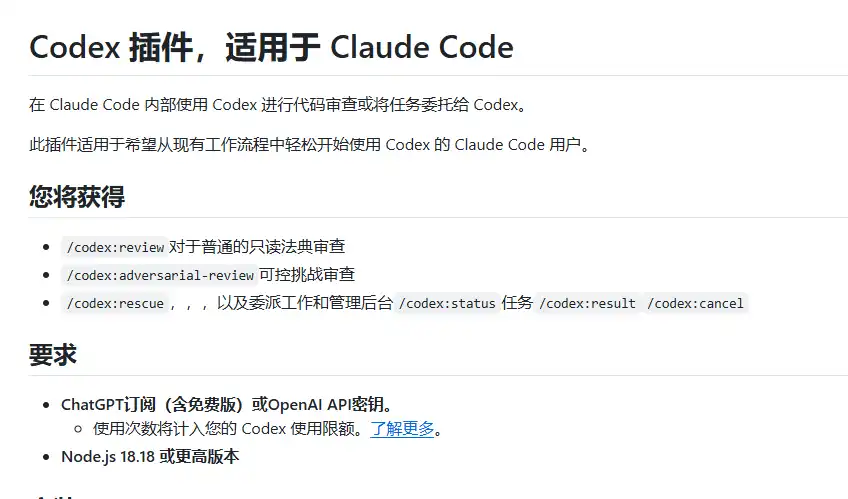
Empowered by this plugin, users can initiate a standard read-only code review using the /codex:review command to receive professional improvement suggestions from Codex. This dual verification mechanism effectively catches logical vulnerabilities that a single model might miss, adding a "double insurance" for code quality.

More uniquely, its "adversarial review" feature allows developers to use /codex:adversarial-review to actively request Codex to challenge existing design decisions. This mode is specifically designed to stress-test the rationality of system architecture, uncovering potential performance bottlenecks or security risks from a "fault-finding" perspective.

Additionally, the plugin introduces a task delegation mechanism, enabling users to transfer complex debugging or repair tasks to a Codex sub-agent via /codex:rescue. This collaborative model achieves automatic task distribution, allowing the primary model and auxiliary models to each focus on their respective areas of expertise.

github:https://github.com/openai/codex-plugin-cc

Preguntas relacionadas

QWhat is the name of the official OpenAI plugin that integrates with Claude Code?

AThe plugin is called codex-plugin-cc.

QWhat is the primary function of the /codex:review command in the new plugin?

AThe /codex:review command is used to initiate a standard read-only code review to get professional improvement suggestions from the Codex model.

QWhat unique feature does the /codex:adversarial-review command provide?

AThe /codex:adversarial-review command enables an 'adversarial review' function, which actively challenges existing design decisions to stress-test the system architecture and uncover potential performance bottlenecks or security risks.

QHow does the /codex:rescue command facilitate task management?

AThe /codex:rescue command allows users to delegate complex debugging or repair tasks to a Codex sub-agent, enabling a collaborative model where the main and auxiliary models work in their respective areas of expertise.

QWhere was the codex-plugin-cc project officially released?

AThe project was officially released by OpenAI on GitHub.

Lecturas Relacionadas

Has Bitcoin Bottomed, or Is a 'Shakeout' Approaching? What's the Situation with XRP?

Cryptocurrency analytics platform Santiment shared key insights on Bitcoin and altcoin markets, highlighting significant signals from on-chain data. Analysis shows Bitcoin's 365-day MVRV ratio has fallen to -26%, indicating substantial losses for long-term holders, a level historically associated with market bottom formations and long-term buying opportunities. While short-term MVRV is near breakeven, suggesting no clear directional signal, the annual perspective points to a bottom before bullish cycles. On-chain data reveals divergent behavior: large wallets (10-10,000 BTC) have been accumulating, adding ~18,500 BTC in 10 days, while smaller retail investors continue buying dips. Analysts caution that high retail demand can sometimes create a risk of a final market shakeout or correction. The altcoin market shows a mixed picture. Ethereum's 365-day MVRV is around -33%, but recent monthly gains combined with overly optimistic social sentiment pose a short-term correction risk. XRP is in oversold territory with 30-day and 365-day MVRVs at -57.5% and -45.5% respectively, signaling potential for a strong mid-to-long term rebound. Social activity and optimism are rising for Solana, while investor sentiment remains calmer towards Cardano. Future direction for Bitcoin and altcoins depends not only on on-chain metrics but also on macroeconomic and regulatory developments. The Federal Reserve's interest rate decision and upcoming policy rulings are increasing market volatility expectations, while uncertainty around the U.S. Congressional clarity process continues to pressure pricing. *This is not investment advice.

cryptonews.ruHace 14 min(s)

Has Bitcoin Bottomed, or Is a 'Shakeout' Approaching? What's the Situation with XRP?

cryptonews.ruHace 14 min(s)

Bank of Korea Reveals Results of Tokenized Deposit Testing

The Bank of Korea has announced the results of its pilot test for tokenized deposits. Involving 28 central banks and international financial organizations, the project saw participation from major South Korean banks including KB Kookmin Bank, NH NongHyup Bank, Shinhan Bank, Woori Bank, and Hana Bank. Transactions, from payment orders to final settlement, were completed in real time, averaging just 80 seconds. The test involved 30 transactions across 17 different scenarios—such as corporate and interbank transfers—and was conducted in six currencies, including the Korean won, US dollar, and euro, with a total transaction value reaching approximately $995,000. The central bank reported that the platform operated stably throughout, despite being only partially connected to the existing banking infrastructure. Settlements using tokenized deposits were executed seamlessly, quickly, and transparently. An internal transfer of 20 million won (about $13,890) between NH NongHyup Bank and Shinhan Bank was also successfully processed via the Project Agora platform, which involved connecting to the Bank of Korea's CBDC test platform, Project Hangang. Additionally, KB Kookmin Bank and Japan's MUFG Bank tested cross-border payments using these deposit tokens—digital certificates issued by commercial banks within the pilot, not directly by the central bank. The Bank of Korea plans to continue testing payments with tokenized deposits. This follows last year's pledge by South Korean authorities to tighten regulations for won-based stablecoins, which will require approval from both the central bank and the Financial Services Commission.

cryptonews.ruHace 2 hora(s)

Bank of Korea Reveals Results of Tokenized Deposit Testing

cryptonews.ruHace 2 hora(s)

Trading

Spot
活动图片