OpenAI Official Plugin Strongly Integrated into Claude Code

marsbitPublicado a 2026-03-31Actualizado a 2026-03-31

Resumen

OpenAI has officially released the "codex-plugin-cc" on GitHub, enabling developers to integrate OpenAI’s Codex model capabilities directly into Anthropic’s command-line development tool, Claude Code. This cross-platform integration breaks down ecosystem barriers between major AI tools, allowing developers to leverage the strengths of both models without switching environments. With simple configuration, Claude Code becomes a versatile programming assistant combining the advantages of both companies. Key features include: - Standard code review via the `/codex:review` command, providing expert improvement recommendations and double-checking for logic errors. - Adversarial review using `/codex:adversarial-review`, which challenges design decisions to identify potential performance bottlenecks or security risks. - Task delegation through `/codex:rescue`, allowing complex debugging or repair tasks to be handed off to a Codex sub-agent for collaborative problem-solving. This integration enhances code quality and development efficiency through multi-model collaboration.

Recently, the AI developer community welcomed a major update: OpenAI officially released an open-source project named codex-plugin-cc on GitHub. This plugin allows developers to directly utilize the capabilities of OpenAI's Codex model within the command-line development tool Claude Code, introduced by Anthropic.

This "cross-brand" integration breaks down the ecosystem barriers that previously existed between major AI model tools, enabling developers to leverage the technical strengths of both industry giants without switching environments. With simple command configurations, Claude Code instantly transforms into an all-in-one programming assistant that combines the best of both.
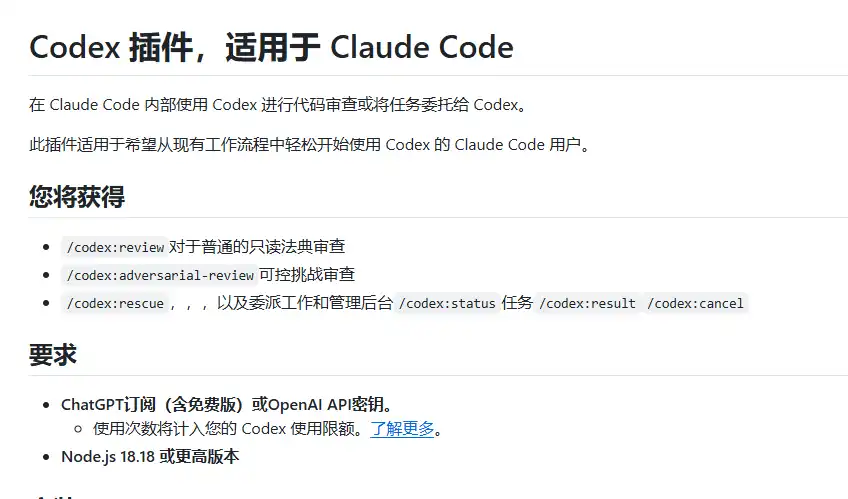
Empowered by this plugin, users can initiate a standard read-only code review using the /codex:review command to receive professional improvement suggestions from Codex. This dual verification mechanism effectively catches logical vulnerabilities that a single model might miss, adding a "double insurance" for code quality.

More uniquely, its "adversarial review" feature allows developers to use /codex:adversarial-review to actively request Codex to challenge existing design decisions. This mode is specifically designed to stress-test the rationality of system architecture, uncovering potential performance bottlenecks or security risks from a "fault-finding" perspective.

Additionally, the plugin introduces a task delegation mechanism, enabling users to transfer complex debugging or repair tasks to a Codex sub-agent via /codex:rescue. This collaborative model achieves automatic task distribution, allowing the primary model and auxiliary models to each focus on their respective areas of expertise.

github:https://github.com/openai/codex-plugin-cc

Preguntas relacionadas

QWhat is the name of the official OpenAI plugin that integrates with Claude Code?

AThe plugin is called codex-plugin-cc.

QWhat is the primary function of the /codex:review command in the new plugin?

AThe /codex:review command is used to initiate a standard read-only code review to get professional improvement suggestions from the Codex model.

QWhat unique feature does the /codex:adversarial-review command provide?

AThe /codex:adversarial-review command enables an 'adversarial review' function, which actively challenges existing design decisions to stress-test the system architecture and uncover potential performance bottlenecks or security risks.

QHow does the /codex:rescue command facilitate task management?

AThe /codex:rescue command allows users to delegate complex debugging or repair tasks to a Codex sub-agent, enabling a collaborative model where the main and auxiliary models work in their respective areas of expertise.

QWhere was the codex-plugin-cc project officially released?

AThe project was officially released by OpenAI on GitHub.

Lecturas Relacionadas

Bernstein Reveals Details of Core Scientific's $14 Billion Deal with AMD

Analysts from Bernstein revealed details of a deal between Core Scientific and AMD with a potential total value of over $14 billion. According to the report, initial contracts for 530 MW of capacity could generate this revenue over 15 years, with AMD acting as a credit guarantor for part of the bitcoin miner's infrastructure. The partnership, announced on July 28, has the potential to allocate up to 2.5 GW of data center capacity for AI. Bernstein broke down the 530 MW into 377 MW of direct triple-net lease for AMD and 152 MW for an unnamed cloud provider backed by AMD's credit. This structure is seen as lowering financing costs and counterparty risk. AMD also received warrants to buy 30 million Core Scientific shares at $23.47 each, which vest upon reaching the 2.5 GW target. Average annual revenue from the deal is estimated at around $0.9 billion, or about $1.8 million per megawatt, which is 5-25% below recent AI hosting deals by other miners. However, the 377 MW triple-net lease for AMD carries a margin close to 100%. Core Scientific expects capital expenditures for the deal to be $11-12 million per MW, totaling about $6 billion. Bernstein views this partnership as a new phase in the transformation of former bitcoin miners into AI infrastructure operators, with AI chipmakers like AMD now acting as direct anchor tenants. Recent similar deals include Hut 8 allocating 704 MW to a tenant believed to be Nvidia, and AMD reserving 200 MW with Riot Platforms. Core Scientific also paid Block $41.9 million to terminate a mining chip supply contract as part of its accelerated diversification into AI.

cryptonews.ruHace 58 min(s)

Bernstein Reveals Details of Core Scientific's $14 Billion Deal with AMD

cryptonews.ruHace 58 min(s)

Trading

Spot
活动图片