OpenAI Bets on 'Robot Army': 23-Year-Old Prodigy Wins Favor from Sam Altman

marsbitPublicado a 2026-03-26Actualizado a 2026-03-26

Resumen

While OpenAI adjusts its video strategy, Sam Altman is setting his sights on the more ambitious field of "multi-agent systems." According to The Wall Street Journal, OpenAI has secretly invested in Isara, an AI startup founded by 23-year-old researchers Eddie Zhang and Henry Gasztowtt. Despite being established only in June last year in San Francisco, Isara has already recruited over a dozen top researchers from Google, Meta, and OpenAI itself, forming a highly skilled technical team. Isara’s core vision is to develop a system that enables thousands of AI agents to collaborate efficiently. While individual AI assistants are powerful, they often struggle with large-scale industrial challenges such as biotech R&D or complex financial modeling. Isara aims to solve this by creating a framework where diverse AI agents can communicate, align goals, share data, and tackle interconnected problems—functioning like a coordinated "robot army." This multi-agent approach is seen as a critical step toward Artificial General Intelligence (AGI). OpenAI’s endorsement signals industry recognition of distributed intelligence. In biopharma, the system could simulate thousands of protein-folding pathways, with specialized agents identifying patterns. In finance, it could perform real-time stress tests using global market data. Led by young innovators, this shift suggests the next breakthrough in AI lies not in building larger models, but in enabling smarter collective intelligence.

As OpenAI adjusts its video strategy, Sam Altman is setting his sights on the more ambitious track of 'intelligent agent clusters'. According to the Wall Street Journal's disclosure, OpenAI has secretly invested in an AI startup named Isara. The background of this startup is particularly striking—its founders are two 23-year-old AI researchers, Eddie Zhang and Henry Gasztowtt. Although the company was only established in San Francisco last June, it has quickly poached over a dozen top research talents from Google, Meta, and OpenAI itself, forming a technically profound 'elite force'.

Reshaping Collaboration Logic: Enabling Thousands of AI Agents to 'Communicate'

Isara's core vision is to build a software system capable of coordinating the collaborative work of thousands of AI agents. In the current technological context, while individual AI assistants are powerful, they often fall short when handling large-scale industrial problems such as biotechnology R&D or complex financial modeling. The challenge Isara aims to tackle is how to enable these 'robot armies' to achieve efficient communication and task division. Through its underlying architecture, AI agents with different functions can, like a well-trained army, automatically align goals, exchange data, and solve chain-reaction problems in complex industry processes.

From Lab to Industrial Frontier: Pioneering a New Paradigm for Autonomous R&D

This 'intelligent agent cluster' technology is seen as a critical step toward Artificial General Intelligence (AGI). OpenAI's endorsement is not only a financial injection but also signifies industry giants' recognition of the 'distributed intelligence' direction. In the biopharmaceutical field, this technology can allow AI armies to simultaneously simulate thousands of protein folding pathways, with specialized 'coordinator agents' summarizing patterns; in finance, it can link global market data in real-time for stress testing. This technological transformation, led by 23-year-olds, is attempting to prove that the next breakthrough in AI lies not in how large models become, but in how effectively they work together in groups.

Preguntas relacionadas

QWhat is the core vision of the AI startup Isara, as mentioned in the article?

AIsara's core vision is to build a software system that can coordinate the collaborative work of thousands of AI agents.

QWho are the founders of Isara and what is notable about them?

AThe founders are Eddie Zhang and Henry Gasztowtt, who are both 23-year-old AI researchers.

QWhich major tech companies has Isara recruited research talent from?

AIsara has recruited over a dozen top research talents from Google, Meta, and OpenAI itself.

QAccording to the article, what is considered a key step for AI towards Artificial General Intelligence (AGI)?

AThe 'agent swarm' technology, which enables coordinated work among multiple AI agents, is seen as a key step towards AGI.

QHow can Isara's 'agent swarm' technology be applied in the field of biotechnology?

AIn biotechnology, this technology can allow an AI swarm to simultaneously model thousands of protein folding pathways, with a specialized 'coordinator agent' summarizing the patterns.

Lecturas Relacionadas

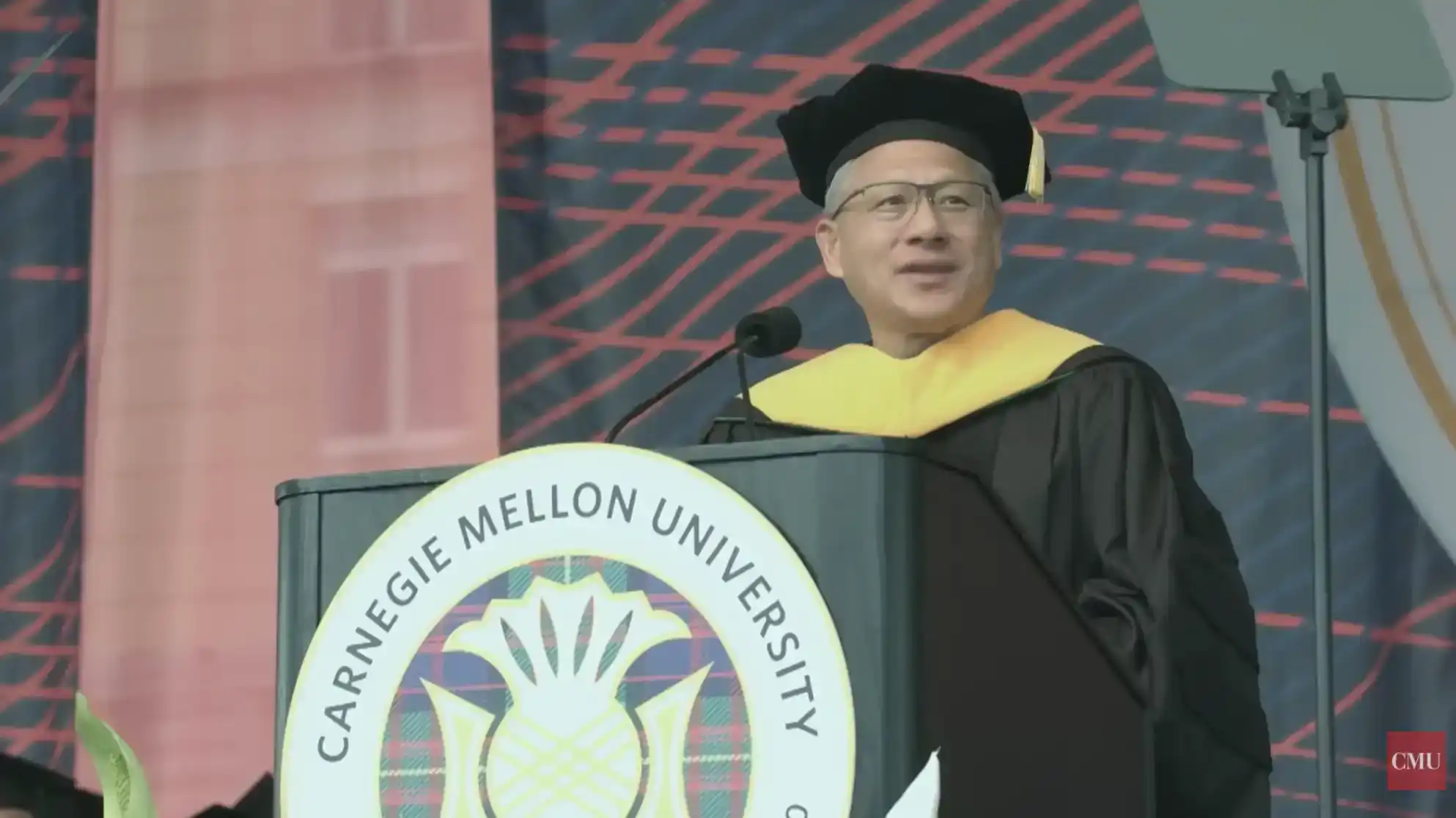
Jensen Huang's CMU Speech: In the AI Era, Don't Just Watch, Build

Jensen Huang, CEO of NVIDIA and a first-generation immigrant, delivered the commencement address to Carnegie Mellon University's class of 2026. He shared his personal journey from a humble background to founding NVIDIA, emphasizing resilience, learning from failure, and the responsibility that comes with leadership. Huang framed the present moment as the dawn of the AI revolution, a shift he believes is more profound than previous computing waves. He described AI as fundamentally resetting computing—moving from human-written software to machines that understand, reason, and use tools. This will create a new industry for generating intelligence and transform every sector. While acknowledging AI's potential to automate tasks and displace some jobs, Huang distinguished between the *tasks* of a job and its core *purpose*. He argued AI will augment human capability, not replace humans. The real risk, he stated, is not AI itself, but people being left behind by those who effectively use AI. He presented AI as a generational opportunity for massive infrastructure investment—in chip factories, data centers, energy grids, and advanced manufacturing—that could re-industrialize nations like the U.S. and bridge the digital divide by making computing and intelligent tools accessible to all. Huang called for a balanced approach: advancing AI safely and responsibly, establishing prudent policies, ensuring broad access, and encouraging universal participation. He urged the graduates not to fear the future but to engage with optimism and ambition, reminding them of CMU's motto, "My heart is in the work." His core message was clear: this is their moment to actively build and shape the AI-powered future, not merely observe it.

marsbitHace 57 min(s)

Jensen Huang's CMU Speech: In the AI Era, Don't Just Watch, Build

marsbitHace 57 min(s)

The Era Has Arrived Where Human Writers Must Prove They Are Not Machines

The article describes an era where AI-generated content is flooding the market, forcing human authors to prove they are not machines. It begins with the example of dozens of AI-written, error-ridden biographies of Henry Kissinger appearing on Amazon within hours of his death, a pattern repeated for other deceased celebrities and even living experts who find fraudulent books under their names. This spam content has exploded, with monthly new book releases on platforms like Amazon reaching 300,000 by late 2025. The issue spans genres, from suspiciously high proportions of AI-written teen romance and self-help books to dangerous, AI-generated foraging guides containing lethal advice. The platforms' automated review systems, designed to catch plagiarism and banned words, are ill-equipped to detect AI-generated text that avoids these pitfalls while being nonsensical or fraudulent. The problem has infiltrated traditional publishing. A major publisher, Hachette, had to recall a bestselling horror novel after AI detection tools suggested 78% of its content was machine-generated. An acclaimed European philosophy book was later revealed to be entirely written by AI under a fake author persona. In response, authors are fighting back. At the 2026 London Book Fair, 10,000 writers published a blank book titled "Don't Steal This Book" containing only their signatures—using emptiness as a protest weapon in an age of AI overproduction. Initiatives like the "Human Author Certification" program have emerged, ironically placing the burden on humans to prove their work is not machine-made. The article warns of a vicious cycle: AI-generated low-quality books pollute the data used to train future AI models, leading to "model collapse" and an ever-worsening flood of digital waste, eroding trust in publishing and devaluing human creativity.

marsbitHace 1 hora(s)

The Era Has Arrived Where Human Writers Must Prove They Are Not Machines

marsbitHace 1 hora(s)

Trading

Spot
Futuros
活动图片