Only Work 2 Hours a Day? This Google Engineer Uses Claude to Automate 80% of His Work

marsbitPublicado a 2026-04-15Actualizado a 2026-04-15

Resumen

A Google engineer with 11 years of experience automated 80% of his work using Claude Code and a simple .NET application, reducing his daily work from 8 hours to just 2–3 hours while generating $28,000 in monthly passive income. The key to this transformation lies in three core elements: First, using a structured CLAUDE.md file based on Andrej Karpathy’s principles—Think Before Coding, Simplicity First, Surgical Changes, and Goal-Driven Execution—reduces Claude’s rule violations from 40% to just 3%. Second, the "Everything Claude Code" system acts as a full AI engineering team, with 27 pre-built agents for planning, reviewing, and executing tasks across multiple AI platforms. Third, a hidden token consumption issue in Claude Code v2.1.100 was identified, where 20,000 extra tokens were silently added, diluting instructions and reducing output quality. A quick fix using npx downgrades the version to avoid this. The automated system enables code generation, testing, and review to run autonomously in 15-minute cycles. The engineer now only reviews output, saving 5–6 hours daily. The setup takes less than 20 minutes, and the return on time investment is significant—potentially saving $10,000–$12,000 monthly for those valuing their time at $100/hour. The article emphasizes that managing AI systems, not just using them, is the new critical skill, enabling a shift from doing work to overseeing automated processes.

Editor's Note: As "AI writing code" gradually becomes an industry consensus, what truly changes productivity is not the model itself, but how you set rules for the model, organize workflows, and embed it into a sustainable operating system.

Starting from a simple CLAUDE.md file, to multi-agent collaboration, and then to an automated development loop, this method transforms the development process from a "dialogue between humans and AI" into "managing an AI engineering team." In this process, errors are constrained upfront, workflows are structured, and code generation, testing, and review are gradually taken over by the system instead of being manually executed.

More notably, the article also reveals a neglected detail: in long contexts and complex systems, model behavior is not entirely controllable. Whether it's hidden token consumption or diluted instructions, they can invisibly affect output quality. This makes "how to manage AI," rather than just "how to use AI," the new core competency.

At this point, developers no longer focus on coding but instead work around rule design, workflow scheduling, and result validation. Those who have completed this step first have already started shifting from "doing things personally" to "letting the system do things for them."

Below is the original text:

A Google engineer with 11 years of experience automated 80% of his work using Claude Code and a simple .NET application.

Now, he only works 2-3 hours a day instead of the original 8 hours. The rest of the time, he is basically in a "relaxed" state, with the system running on its own, generating $28,000 in passive income for him each month.

What he has mastered is precisely that set of methods you haven't yet learned.

Part 1—Writing CLAUDE.md According to Karpathy's Principles

Andrej Karpathy—one of the world's most influential AI researchers—once systematically summarized the most common mistakes large language models make when writing code: over-engineering, ignoring existing patterns, and introducing unnecessary additional dependencies that no one asked for.
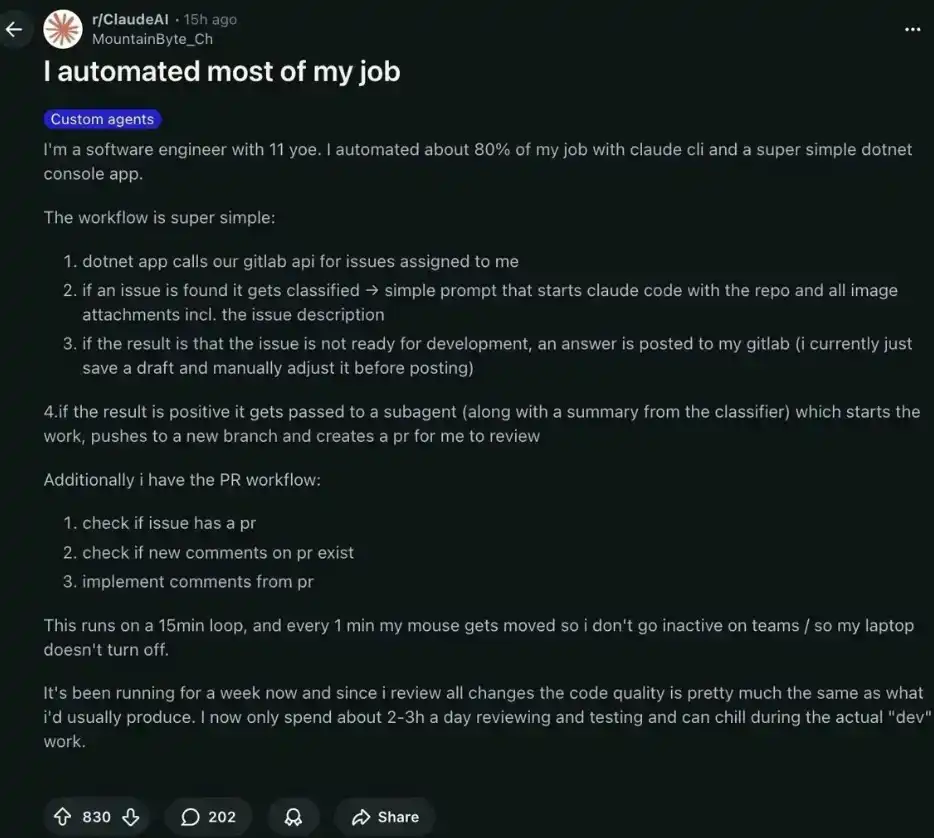
Someone compiled these observations into a unified CLAUDE.md file.

The result: this project gained 15,000 stars on GitHub in a week. In a sense, it can be said that 15,000 people changed their way of working because of it.

The core idea is actually very simple: if errors are predictable, they can be prevented in advance with clear instructions. Just by placing a markdown file in the code repository, you can provide Claude Code with a complete set of structured behavioral rules, thereby unifying decision-making and execution across the entire project.

Inside this file, there are mainly four core principles:

· Think Before Coding → Avoid wrong assumptions and overlooked trade-offs
· Simplicity First → Avoid over-engineering and bloated abstractions
· Surgical Changes → Avoid modifying code that no one asked to change
· Goal-Driven Execution → Test first, then validate against clear success criteria

It doesn't rely on any framework, nor does it require complex tools—just one file can change Claude's behavior at the project level.

The real difference is:

· Without CLAUDE.md: Claude violates specifications about 40% of the time
· Using Karpathy's CLAUDE.md: Violation rate drops to about 3%
· Setup time: Only 5 minutes

Command to automatically generate your own CLAUDE.md file:

claude -p "Read the entire project and create a CLAUDE.md based on:
Think Before Coding, Simplicity First, Surgical Changes, Goal-Driven Execution.
Adapt to the real architecture you see." --allowedTools Bash,Write,Read

It replaces this kind of Claude: over-engineering simple tasks, introducing unrequested dependencies, and even arbitrarily modifying files that shouldn't be touched.

Part2 Everything Claude Code: A Complete Engineering Team in a Repository

Everything Claude Code (Over 153,000 stars on GitHub)

This is not just a collection of prompts; it's more like a complete AI operating system for building products.
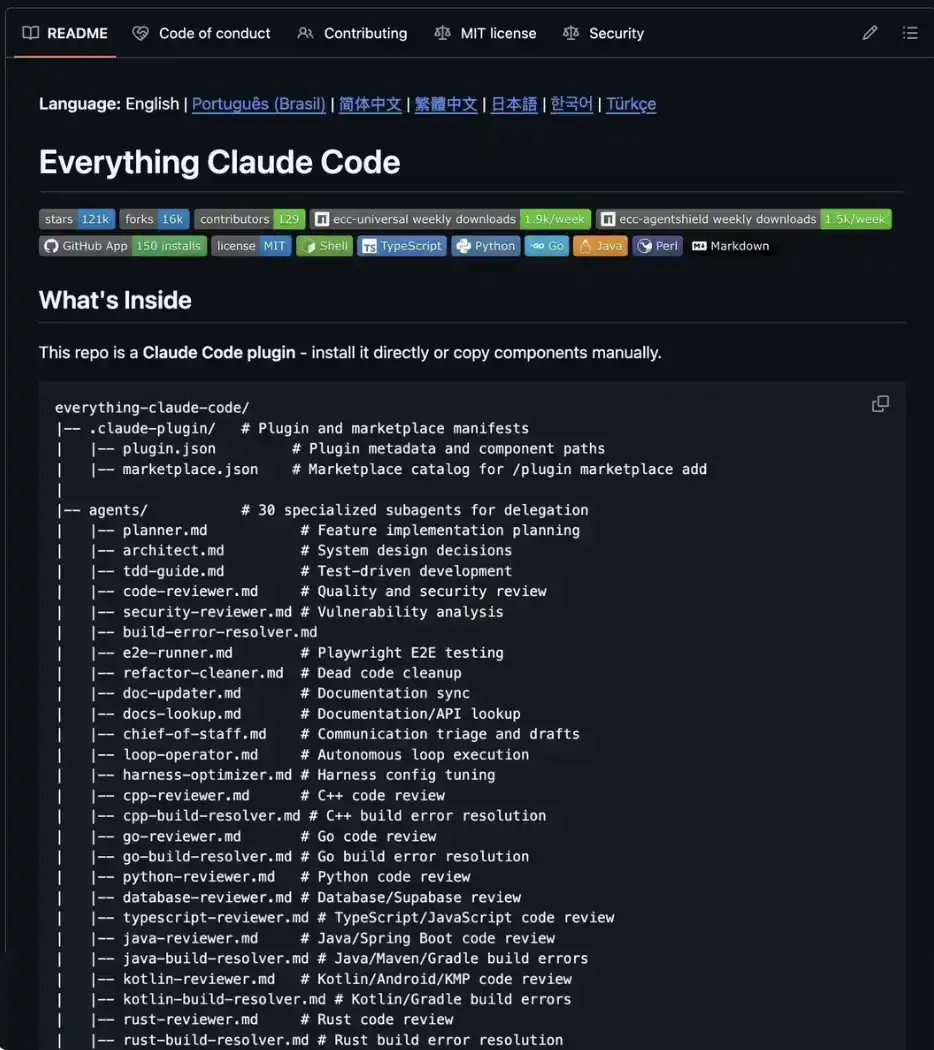
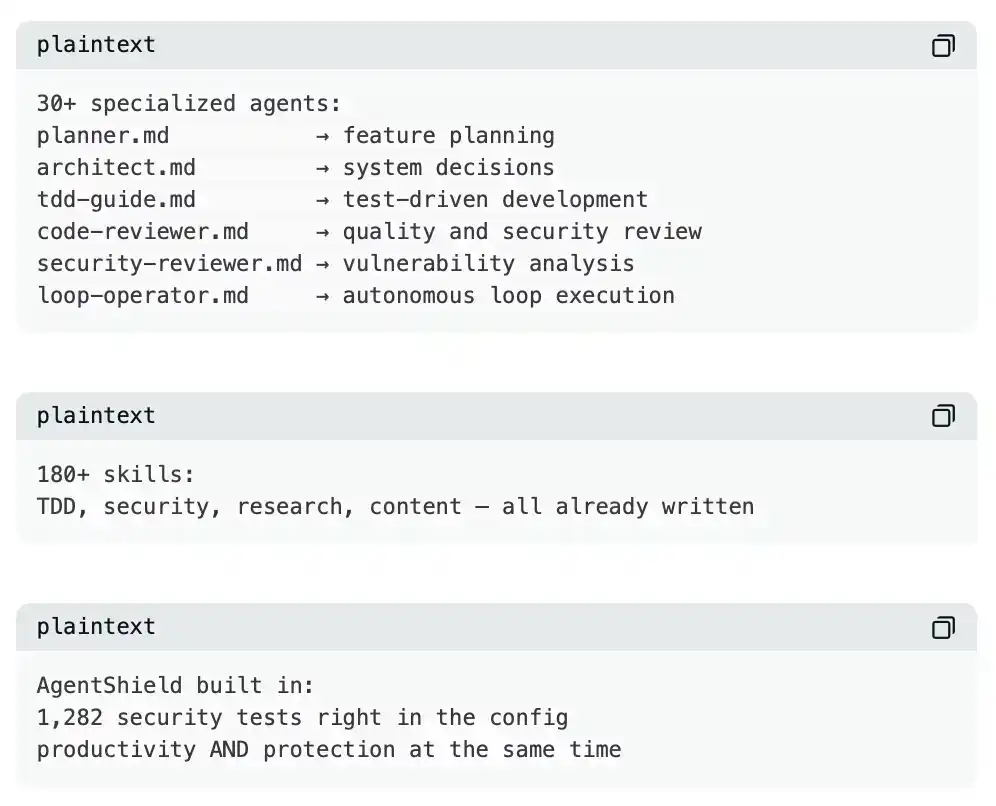
Supports running on Claude, Codex, Cursor, OpenCode, Gemini, and more—one system, usable everywhere.

Installation:

/plugin marketplace add affaan-m/everything-claude-code

Or install manually—just copy the components you need into the project's .claude/ directory. Don't load everything at once—loading 27 agents and 64 skills simultaneously will likely exhaust your context allowance before you even input your first prompt. Only keep what you truly need.

The real difference is:

· Before: You were conversing with an AI
· After: You are managing an automatically running AI engineering team

It replaces: The weeks you would have spent building your own agent system, separately setting up different tools for planning/review/security, and the $200–500 monthly cost for various AI services.

Part3 A Hidden "Scandal": Claude Code v2.1.100 Is Quietly Consuming Your Tokens

Someone set up an HTTP proxy and intercepted and analyzed the complete API requests of 4 different versions of Claude Code.

They found:

v2.1.98: 169,514 bytes request → 49,726 tokens charged
v2.1.100: 168,536 bytes request → 69,922 tokens charged
difference: -978 bytes but +20,196 tokens

v2.1.100 sent fewer data bytes but charged an extra 20,000 tokens. This "inflation" happens entirely on the server side—you can't see it, nor can you verify it through the /context interface.
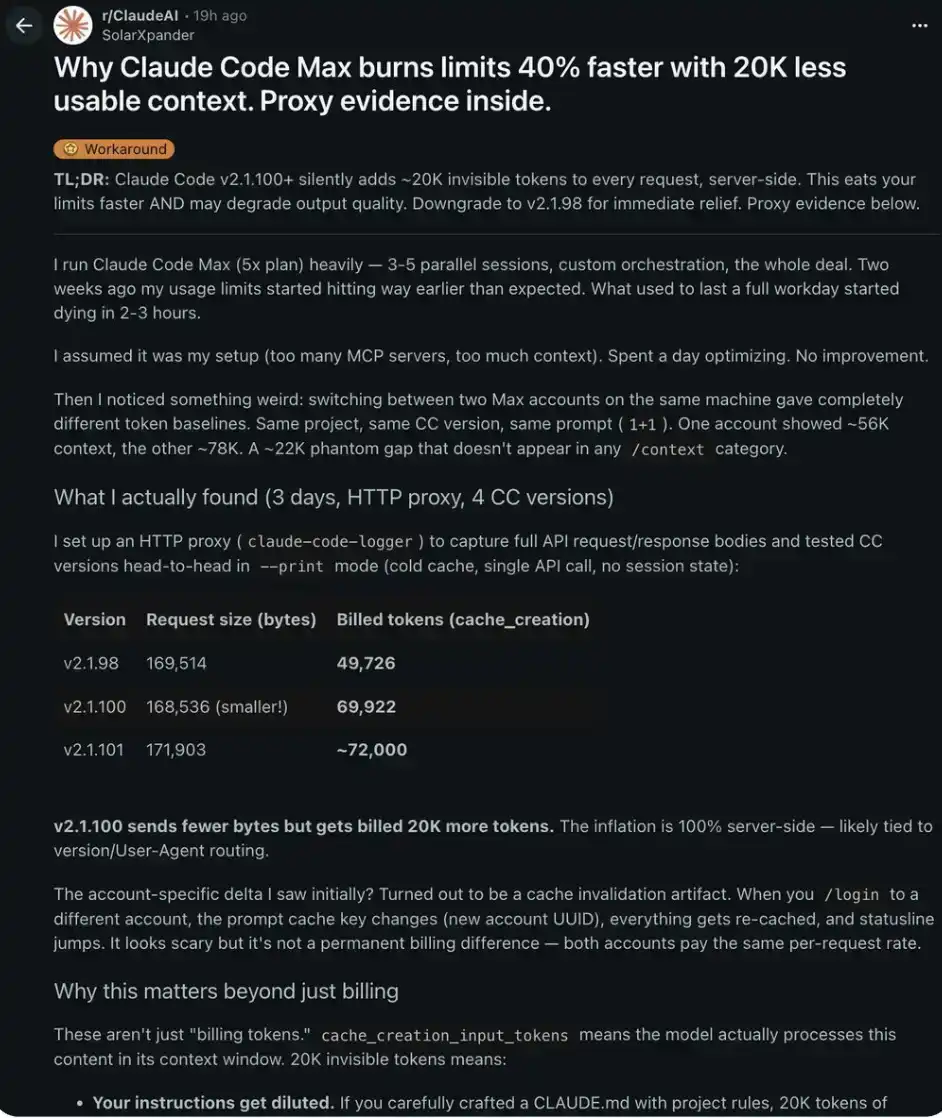
Why this matters beyond billing: these extra 20,000 tokens are stuffed into Claude's actual context window.

This means:

→ Your CLAUDE.md instructions get diluted by these 20,000 "hidden contents"

→ Output quality degrades faster in long conversations

→ When Claude ignores your rules, it's hard to find the cause

→ Claude Max usage allowance is consumed about 40% faster than normal

Fix takes only 30 seconds: npx [email protected]

This is a temporary solution before Anthropic officially fixes the issue, but in practice, you can almost immediately feel the change in session effectiveness.

It replaces: You no longer need to guess why Claude suddenly stops following your instructions.

Case Study: What a Complete Automated System Looks Like

An engineer with 11 years of experience built a system consisting of three parts:
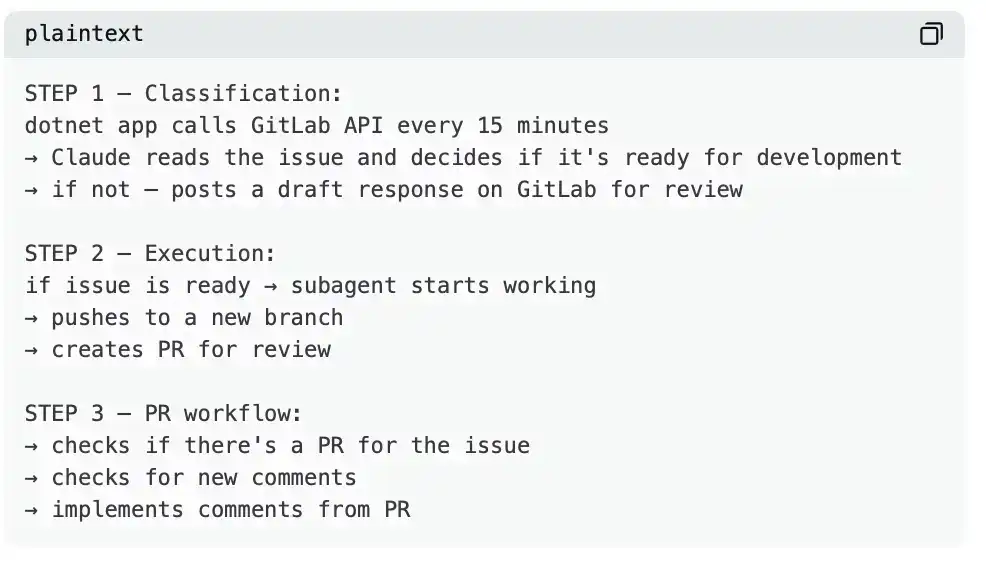
Results after one week:

· Before: 8 hours a day writing code
· After: Only 2–3 hours a day doing code review and testing

· Code quality: Basically unchanged—because he reviews each one
· Teams status: Always online—mouse moves automatically every minute
· Remaining time: Free to use all day

This isn't some "magic"; it's the result of CLAUDE.md + the right agents + a loop mechanism running every 15 minutes.

Complete checklist:
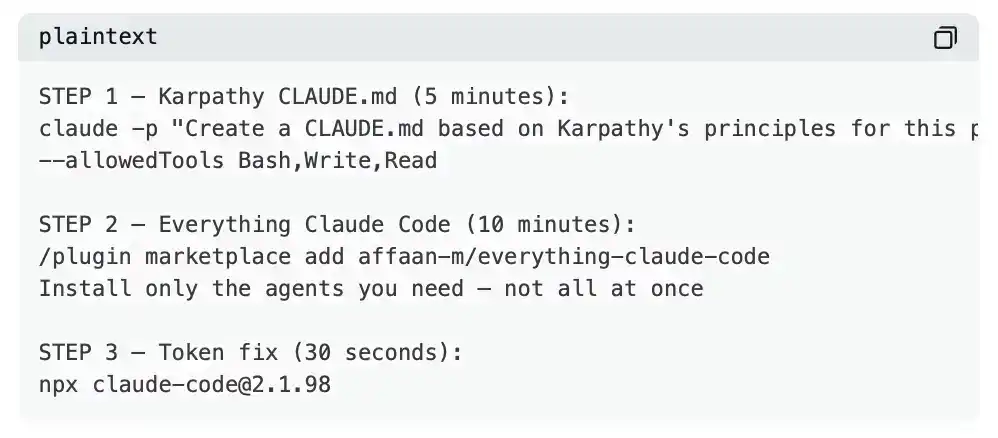
What you gain after reading this:

· Before: Claude violated existing specifications 40% of the time
· After: Using Karpathy's CLAUDE.md, violation rate dropped to 3%

· Before: You needed weeks to build agents
· After: 27 agents ready to use out-of-the-box

· Before: Claude Max exhausted its allowance in 2–3 hours
· After: Downgrading to v2.1.98 recovers about 40% of the usage limit

· Before: Needed 8 hours a day to write code
· After: Only 2–3 hours for review, the rest runs automatically

· Setup time: 15–20 minutes
· Daily savings: 5–6 hours
· Monthly savings: 100–120 hours

If your time is worth $30 per hour—you are "invisibly losing" $3000–3600 every month.

If it's $100 per hour—that's $10,000–12,000 flowing away monthly, just because you're still manually writing code that Claude could have done itself.

Most developers will never reach this level—not because they can't, but because they think it's complicated. In reality, between you and "full automation," there are only three commands and one file.

The engineer I mentioned at the beginning isn't some genius, nor is he a senior engineer from Google. He just spent one evening setting up the system—since then, the system does the work, and he lives his life.

You can do the same thing tonight. While others are still arguing whether AI will replace developers, those who have already set up the system are just collecting money and relaxing.

The choice is clear. You are building your own life—so choose the right path.

Preguntas relacionadas

QWhat is the core concept behind the CLAUDE.md file mentioned in the article?

AThe core concept of the CLAUDE.md file is to provide a structured set of behavioral rules for Claude Code, based on principles like 'Think Before Coding', 'Simplicity First', 'Surgical Changes', and 'Goal-Driven Execution'. This file helps prevent common AI coding errors by setting clear, project-wide instructions, reducing violation rates from around 40% to just 3%.

QHow does the 'Everything Claude Code' system transform the developer's role?

AThe 'Everything Claude Code' system transforms the developer's role from directly coding and interacting with AI to managing an automated AI engineering team. It includes multiple agents and skills that handle tasks like planning, reviewing, and security, allowing the developer to focus on oversight and results rather than manual execution.

QWhat hidden issue was discovered with Claude Code v2.1.100, and what was its impact?

AClaude Code v2.1.100 was found to silently consume approximately 20,000 extra tokens per request compared to v2.1.98, despite sending fewer bytes. This 'hidden inflation' dilutes instructions from files like CLAUDE.md, reduces output quality in long conversations, and depletes usage limits about 40% faster, without any visible indication to the user.

QWhat were the key components of the automated system built by the Google engineer?

AThe automated system built by the Google engineer consisted of three main parts: a CLAUDE.md file for rule-based AI behavior, a set of tailored AI agents from the 'Everything Claude Code' repository, and an automated loop that ran every 15 minutes to handle coding, testing, and review processes with minimal human intervention.

QWhat time and financial benefits did the engineer achieve by automating 80% of his work?

AThe engineer reduced his daily work from 8 hours to just 2-3 hours, saving 5-6 hours per day and 100-120 hours per month. This automation generated $28,000 in monthly passive income. If valued at $30 per hour, this saves $3,000-$3,600 monthly; at $100 per hour, it saves $10,000-$12,000 monthly.

Lecturas Relacionadas

Can DeepSeek Save China One Trillion Dollars?

"DeepSeek and the $1 Trillion Infrastructure Question" The article examines whether DeepSeek's AI optimization breakthroughs could potentially save China $1 trillion in future AI infrastructure costs. The analysis begins with Nvidia's upcoming Vera Rubin AI platform, costing ~$7.8 million, where memory (HBM4/LPDDR5X) constitutes $2 million—a 435% cost increase in one year, highlighting how AI hardware spending is shifting toward expensive memory components. DeepSeek's approach works in the opposite direction. Through three key technical innovations showcased in DeepSeek V4, the company dramatically improves hardware efficiency: 1. **Memory Compression (MLA)**: Re-engineers the attention mechanism to compress long-context memory (KV Cache) by over 90%, drastically reducing expensive HBM usage. 2. **Selective Activation (MoE)**: Employs Mixture-of-Experts architecture where only a small fraction of parameters (e.g., 49B out of 1.6T in V4-Pro) are activated per token, allowing most parameters to reside in cheaper memory/SSD. 3. **Computation Caching**: Reuses previously computed results via cache hits, replacing expensive GPU computations with cheap memory reads. Combined, these optimizations allow the same hardware to produce approximately 4x more tokens, effectively reducing required hardware investment by 75%. DeepSeek's pricing reflects this: a 10-billion token workload costs ~$522 monthly versus ~$9,000-$10,000 for competitors. The $1 trillion savings projection stems from McKinsey's estimate that global AI infrastructure will require ~$5.2 trillion investment by 2030. As China's daily token consumption grows toward quadrillions, even marginal efficiency gains scale massively. With a conservative 4x throughput improvement, China could avoid building tens of thousands of AI data centers equivalent to ~7 trillion RMB ($1 trillion) in saved investment. Critically, this strategy shifts dependency from scarce, expensive GPU/HBM—where China lags—toward more accessible storage, caching, and systems engineering where domestic suppliers like CXMT are gaining strength. Rather than "replacing Nvidia," DeepSeek rebalances AI's value chain away from monolithic hardware dependency. Ultimately, DeepSeek's technical breakthroughs could lower the barrier to AI adoption across Chinese industries by making advanced capabilities affordable at scale—transforming who can access next-generation AI.

marsbitHace 41 min(s)

Can DeepSeek Save China One Trillion Dollars?

marsbitHace 41 min(s)

Overturning the Mainstream Approach to Hallucinations: Metacognition is the New Solution for Large Models to Break the Hallucination Barrier

This paper, "Hallucinations Undermine Trust; Metacognition is a Way Forward," proposes a paradigm shift in combating AI hallucination. It argues that the current mainstream approaches—striving for omniscience by scaling data/models or having AI abstain from uncertain answers—are fundamentally flawed. The former has inevitable knowledge gaps, while the latter imposes a crippling "utility tax," requiring the rejection of many correct answers to achieve high accuracy, due to models' poor "discrimination" (the ability to distinguish correct from incorrect answers internally). The core contribution is redefining hallucination not as "being wrong," but as "expressing false information with unwarranted certainty." The proposed solution is **Faithful Uncertainty** or **Metacognition**: enabling AI to accurately perceive its internal uncertainty and honestly express it in its language (e.g., using hedging phrases when unsure). This creates a more reliable assistant that provides useful information while signaling its confidence, minimizing harm from errors. The paper emphasizes that metacognition is critical for the era of AI Agents. Without it, Agents cannot intelligently decide when to use tools like search engines, leading to inefficiency and misuse. Key implementation challenges are highlighted: the "bootstrapping paradox" of training with static uncertainty data, the "alignment distortion signal" where human preference training suppresses internal uncertainty cues, and the difficulty of causally evaluating true metacognition vs. its superficial imitation. The paper concludes that the goal should not be an infallible AI, but one that is honest about the limits of its knowledge, thereby building user trust through transparent communication of its certainty.

marsbitHace 46 min(s)

Overturning the Mainstream Approach to Hallucinations: Metacognition is the New Solution for Large Models to Break the Hallucination Barrier

marsbitHace 46 min(s)

Hedge by Buying Gold and Oil, Chase Soaring Returns with AI. ‘Dated’ Bitcoin Enters a Bear Market

Bitcoin has recently declined, hitting a two-month low near $66,123, while Ethereum fell to a three-month low around $1,837. Analysts suggest the drop is not merely due to factors like ETF outflows or MicroStrategy's selling but reflects a deeper issue: Bitcoin is losing a broader asset competition. In a near-zero interest rate environment, Bitcoin previously thrived as an outlet for investor dissatisfaction with inflation and limited options. However, the market landscape has shifted. Bitcoin now occupies an "awkward middle ground," facing competition on three fronts. For inflation hedging, investors prefer gold, energy stocks, and commodity producers—assets with tangible backing and clearer pricing power. For growth exposure, AI-related companies with actual revenues and profits are more attractive. Even within crypto, investors can choose stablecoins, exchanges, or infrastructure firms tied directly to adoption, offering clearer business models and leverage. Thus, Bitcoin is no longer the top choice for hedging, growth, or crypto exposure. This shift is evident in market reactions: despite recent warnings about persistent inflation from a Fed official, Bitcoin did not rally as it might have in the past. Instead, capital flowed to assets with direct commodity or energy exposure. The recent ETF outflows and MicroStrategy sales are symptoms, not causes, of this new reality. Investors are becoming more selective, demanding clearer value propositions beyond mere scarcity. The emerging bear case for Bitcoin is not about it being a bubble or failed technology, but that scarcity alone is no longer sufficient.

华尔街日报Hace 48 min(s)

Hedge by Buying Gold and Oil, Chase Soaring Returns with AI. ‘Dated’ Bitcoin Enters a Bear Market

华尔街日报Hace 48 min(s)

Trading

Spot
Futuros
活动图片