Only 60% Real Win Rate: Data Reveals the Truth Behind ICO Predictions on Polymarket

marsbitPublicado a 2026-01-31Actualizado a 2026-01-31

Resumen

Polymarket's TokenSale markets have processed nearly $250 million in volume, boasting impressive accuracy rates—100% for fundraising amounts and over 90% for fully diluted valuations (FDV). However, an analysis of 231 prediction markets across 29 token sales reveals these figures are misleading. The platform functions more as a sentiment indicator, often acting as a contrarian signal. Key findings show that the true prediction accuracy one week before market close is only 66.7%, meaning the crowd is wrong one-third of the time, with errors consistently skewing toward over-optimism. FDV predictions averaged a 35% overestimation. Analysis of 24-hour post-launch volatility showed an average price swing of ±23%, with 75% of tokens facing sell-offs. Only 62.5% of 24-hour FDV predictions were accurate. The 100% accuracy claim is meaningless because markets close after results are known. High trading volume on Polymarket often serves as a reverse indicator—more optimism typically leads to greater inaccuracy. Tokens with conservative predictions (e.g., Monad, Football.fun) saw smaller declines. Actionable signals: High volume (>$50M) and high optimism (>50% FDV overestimation) are bearish. Low volume (<$5M) and accurate predictions (within 20% of actual FDV) are relatively bullish. In a market where most tokens fall below ICO price, "less bad" is the best outcome. Polymarket’s token sales market is essentially a hype meter—extreme confidence often signals maximum investor pain.

Author: @WazzCrypto, Legion

Compiled by: Frank, PANews

Observations on Prediction Markets in the Token World

Polymarket's Token Sale market has processed nearly $250 million in trading volume. The platform's advertised accuracy data is impressive: 100% accuracy in fundraising amount predictions and over 90% for FDV (Fully Diluted Valuation). However, a deeper analysis reveals that these numbers are misleading. The real signal is not what the crowd predicts, but how wrong they are.

By analyzing 231 prediction markets across 29 token sale events and cross-referencing Polymarket's historical probability data with actual token performance on CoinGecko, we found that "prediction markets are not reliable forecasting tools. Instead, they are actually sentiment indicators, and often a contrarian signal.

Key Finding: One week before market close, the real prediction accuracy was only 66.7%. At critical moments, the crowd is wrong one-third of the time, and incorrect predictions often show systematic over-optimism.

24-Hour Volatility Issue: Using CoinGecko's hourly data, we found that Polymarket's markets for "FDV above X 24 hours after launch" are essentially bets on extreme volatility. The average 24-hour price change was ±23% (e.g., Best performer: Monad +54.8%; Worst performer: Trove -38.7%). 75% of tokens faced selling pressure within 24 hours of launch. In this context, Polymarket's accuracy for 24-hour FDV predictions was only 62.5%.

The Fallacy of Accuracy: The Market is Wrong One-Third of the Time

When we track how market probabilities evolve over time, rather than just looking at static data at settlement, a completely different picture emerges. The fundraising amount prediction markets appear "100% accurate" because the final figures are inevitably leaked gradually as the sale progresses. Insiders and observers update prices accordingly; this is merely ex-post price discovery.
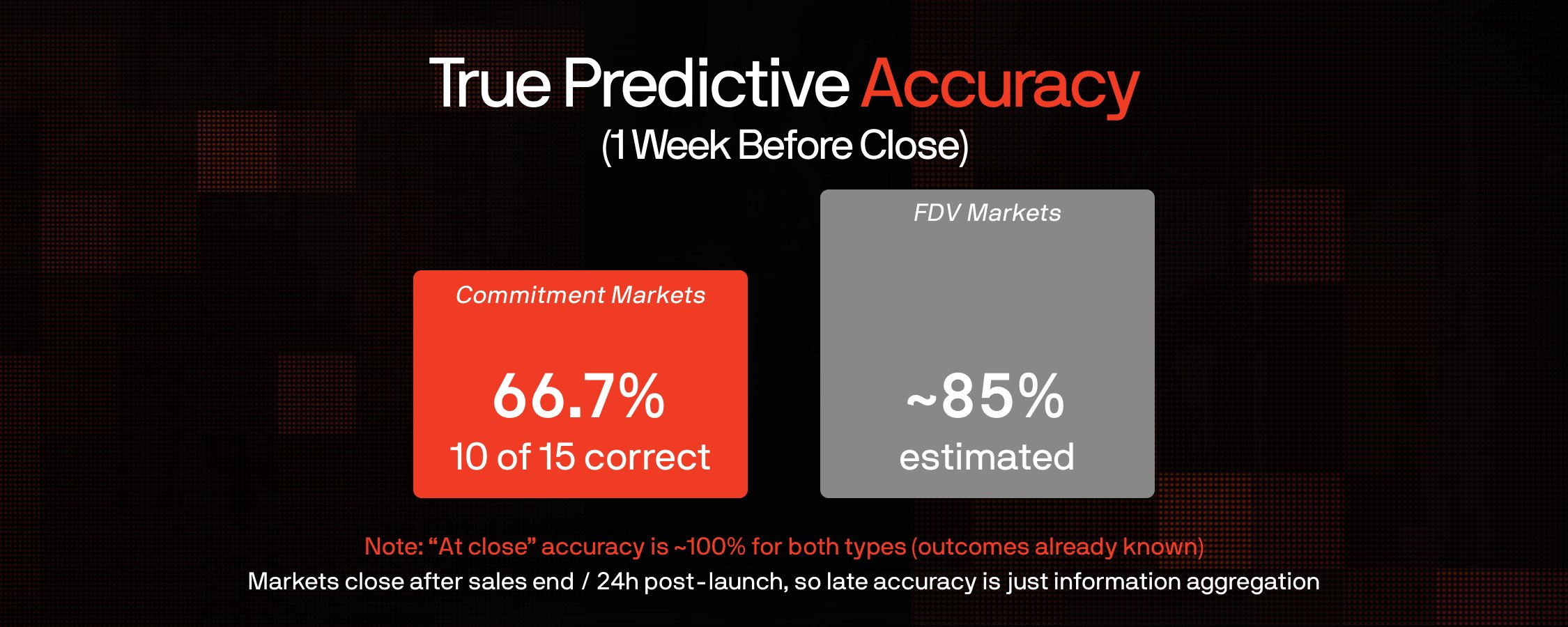
Key Insight: The reason fundraising and FDV markets tend towards 100% accuracy at close is because they settle *after* the outcome is largely certain. Fundraising markets close after the sale ends; FDV markets close 24 hours after launch. The only meaningful predictive metric is the accuracy one week before close, when genuine uncertainty exists. The 66.7% accuracy rate for fundraising predictions shows that, at the critical moment, the market is wrong 1/3 of the time.

Crowd Predictions Err on the Side of Excessive Optimism

We reviewed every prediction market where "crowd confidence exceeded 60% but ultimately failed to materialize." In every case, the error was consistent: over-optimism. The crowd consistently believed the raise would be higher and the valuation more expensive than reality.
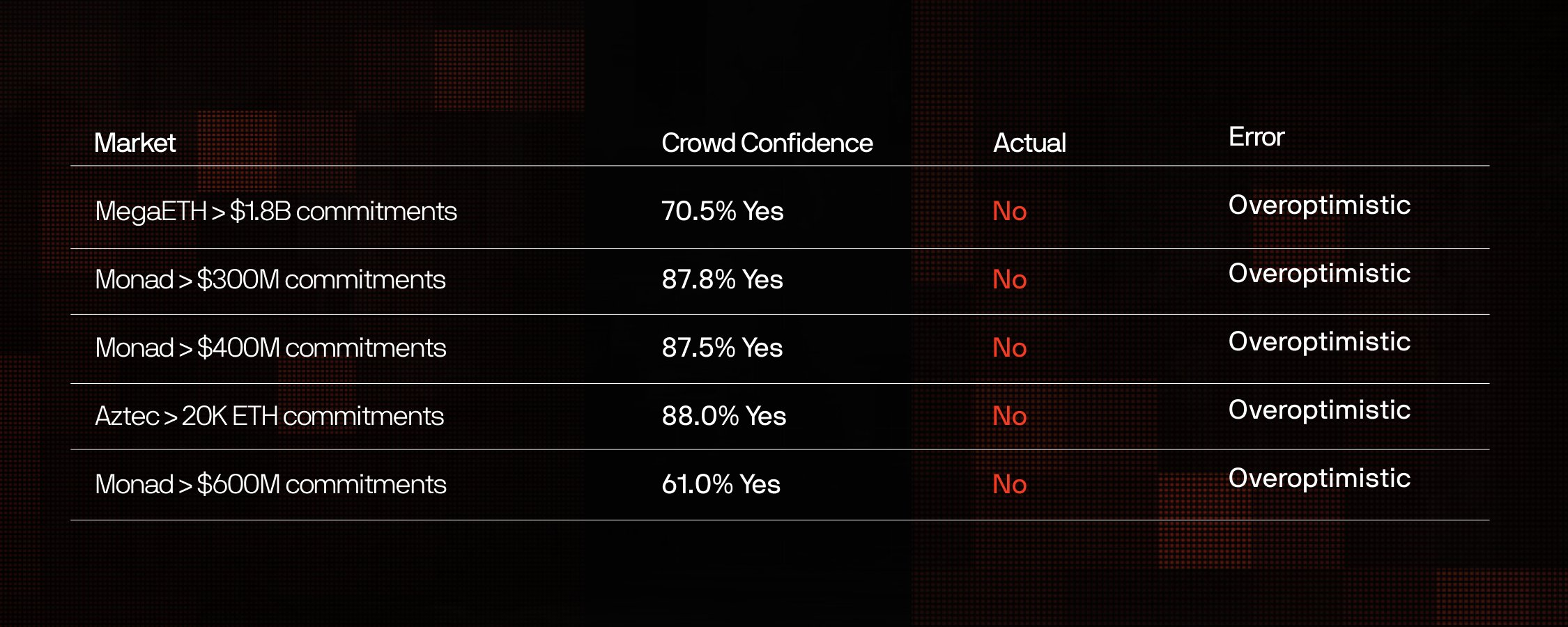
This systematic bias suggests the participants in these markets are optimistic speculators, attracted to token sales precisely because they are bullish.

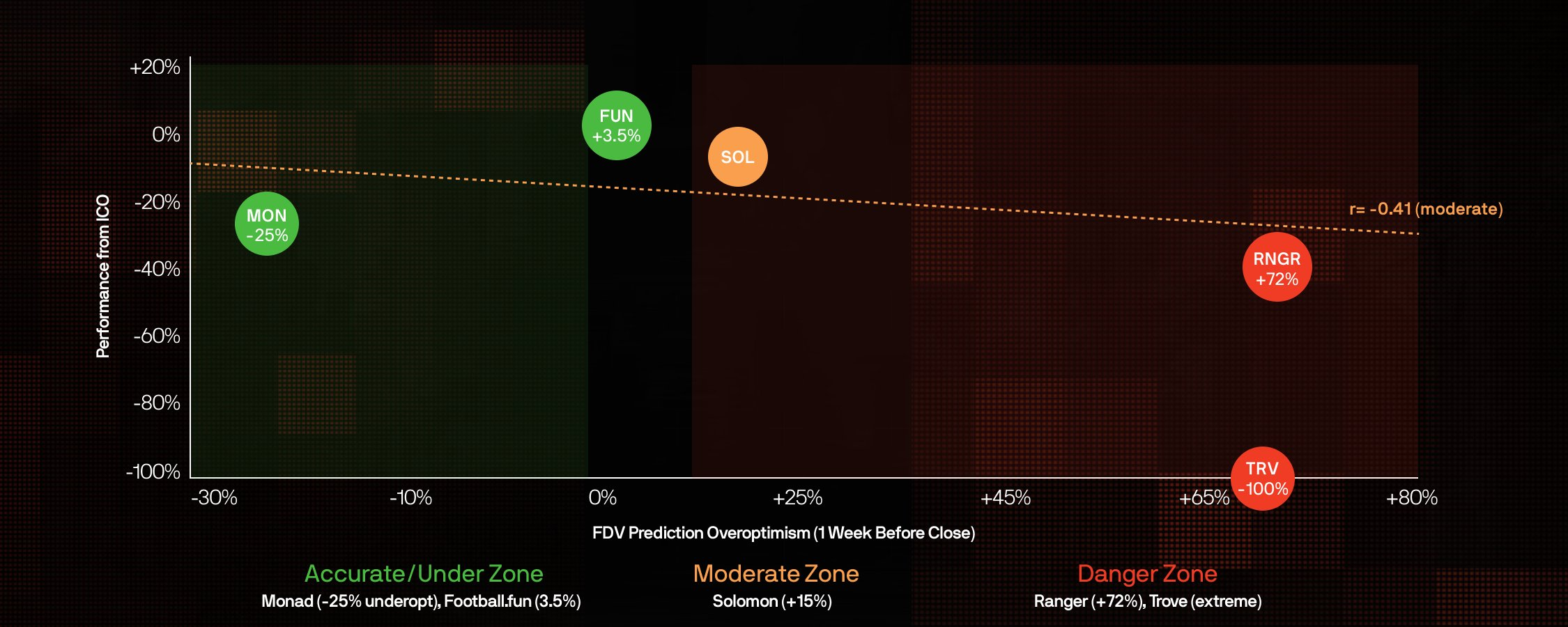
Over-Optimism vs. Token Performance (Based on ICO Data)

Methodology: This analysis only includes markets for projects that conducted a public ICO and have issued a token, using Polymarket odds from one week before market close.

Degree of Over-Optimism = (Polymarket Predicted FDV - Actual 24h FDV) / Actual 24h FDV.

The Y-axis shows price performance from ICO to current.

The data shows a moderate negative correlation (r=-0.41) between the degree of over-optimism and ICO returns. Monad was "underestimated/pessimistic" by the market (-25%), yet its price is still down 24% from ICO. Ranger was the most "over-optimistic" (+72%) and is currently down 32% from its ICO price. Only Football.fun remains above its ICO price (+1%).
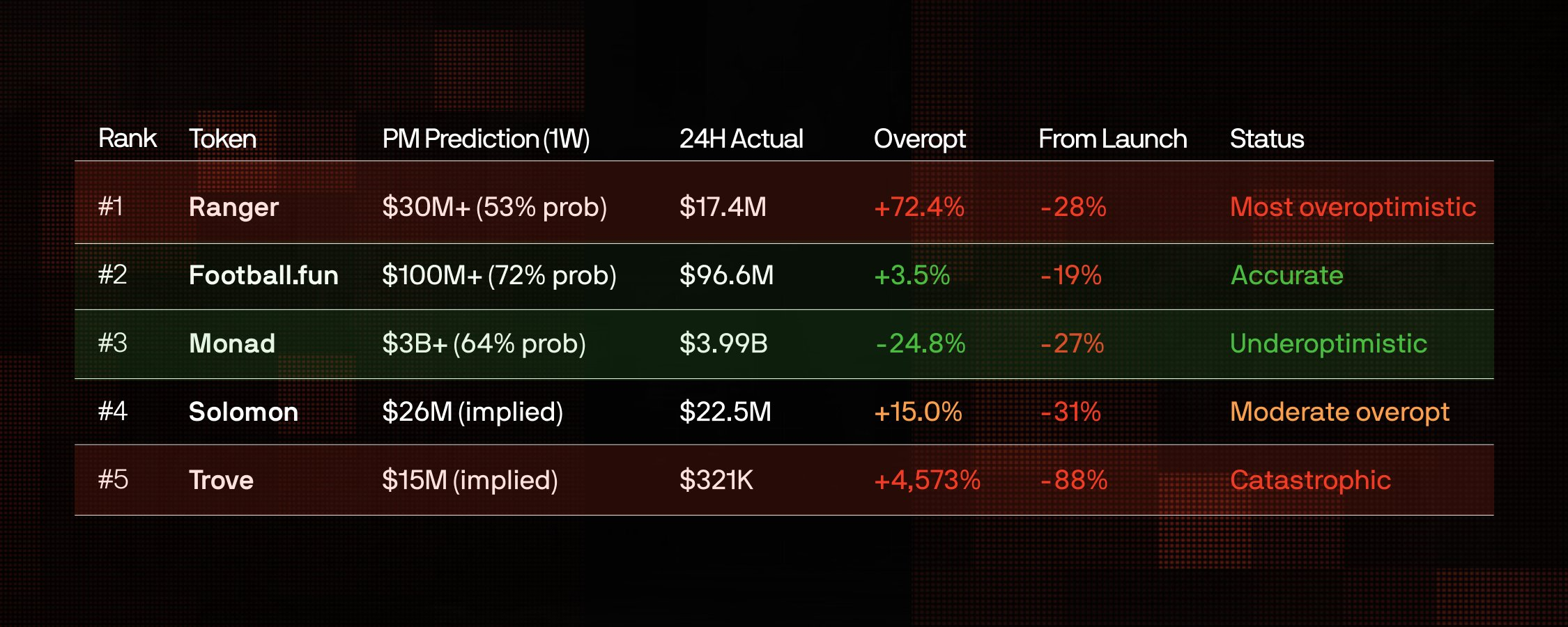
Token Performance Ranking: 40% Launch Below Valuation

The table below, using historical Polymarket odds from one week before close, reveals the true prediction accuracy. The pattern is clear: extreme over-optimism预示 disaster, and high trading volume on Polymarket, even when predictions are correct, is often a contrarian signal.
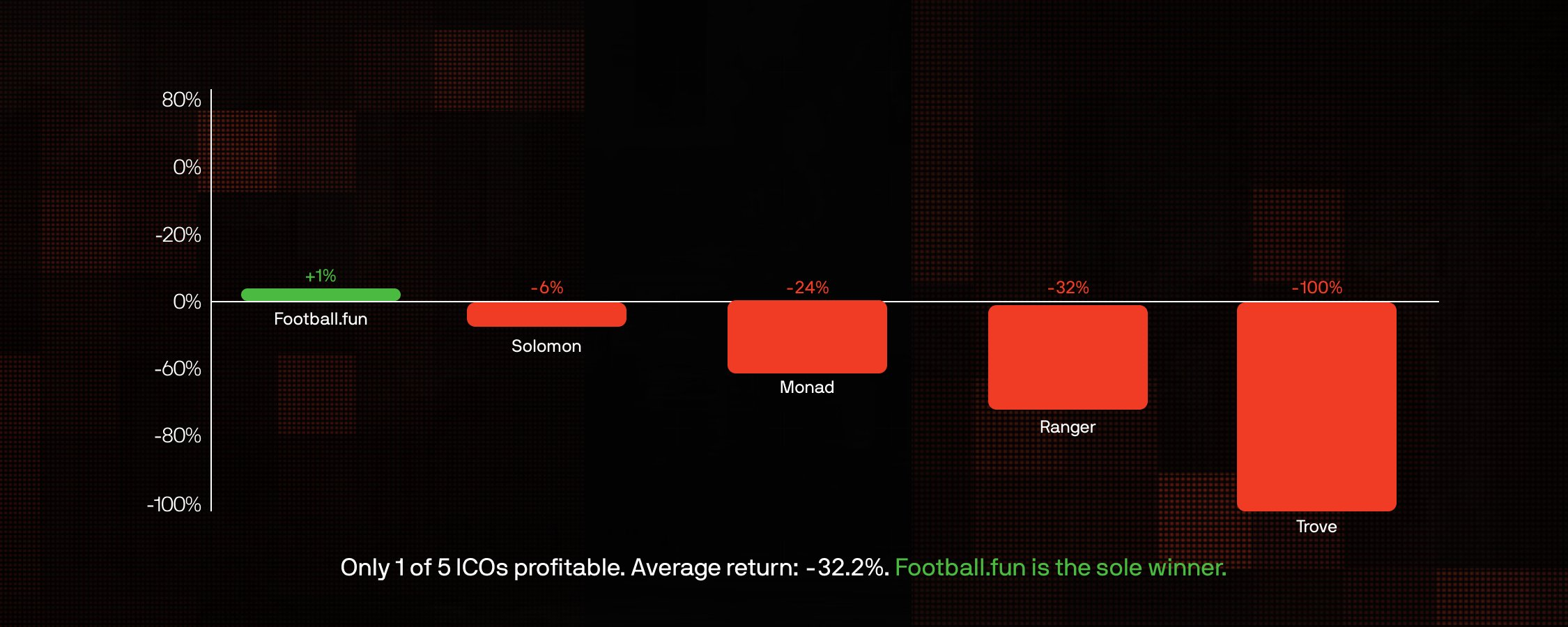
Key Finding: Among tokens with ICO data, 40% launched at a price below their ICO valuation. The average return from ICO to current is -32.2%. Only Football.fun is trading above its ICO price.
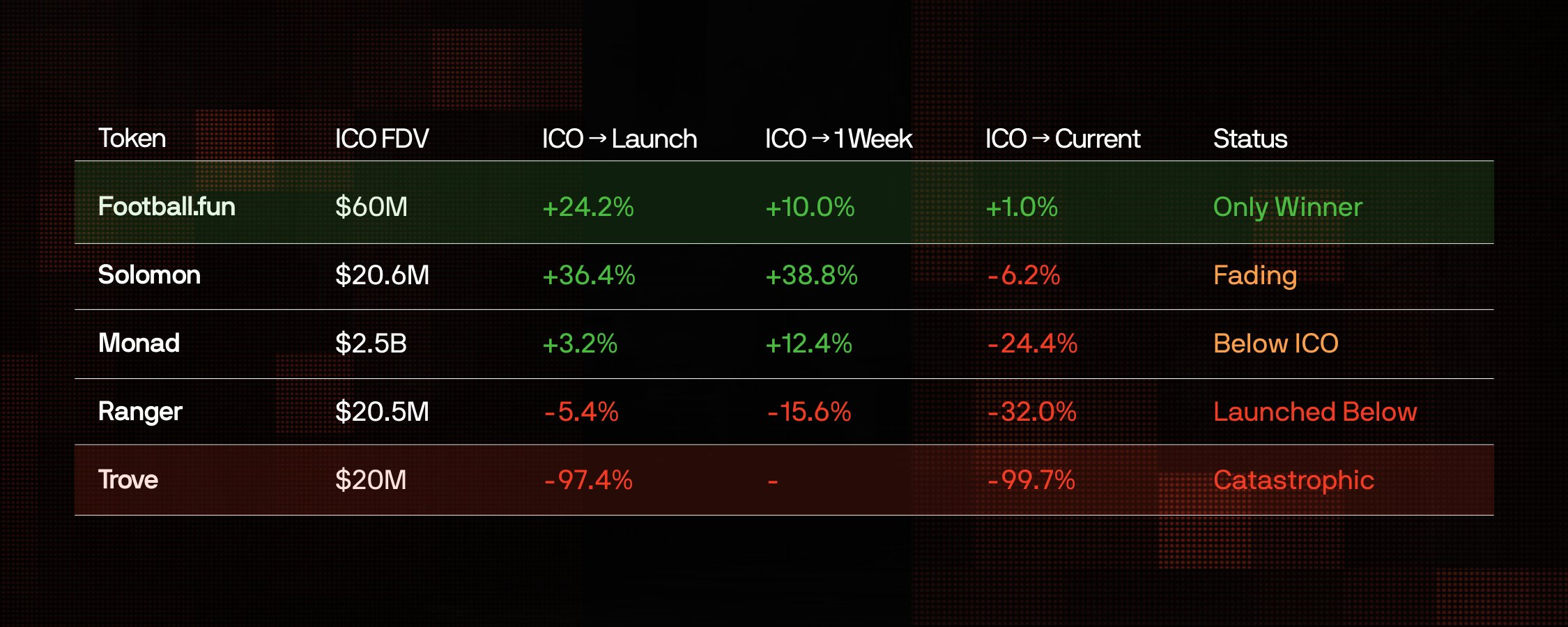
The pattern is brutal: Even tokens that launched above their ICO valuation (e.g., Monad, Solomon) eventually fell below the issue price. Football.fun is the only winner among the 5 ICO tokens in this dataset, currently just 1% above its ICO price.
Core Conclusions:

After analyzing 231 markets, $241.5 million in trading volume, and 8 tokens with verified 24-hour FDV data, several conclusions are clear:

  1. "100% Accuracy" is meaningless. Markets close for settlement *after* the outcome is known (fundraising markets post-sale, FDV markets 24 hours later), so late-stage accuracy unsurprisingly nears 100%. But the real predictive accuracy one week before close is only 66.7%. At the critical moment, the crowd guesses wrong 1/3 of the time.

  2. Systematic Over-Optimism. Among the top 15 markets, 5 markets showed over 60% confidence in thresholds that were never reached. FDV was overestimated by an average of +35%.

  3. High prediction market volume is a contrarian signal. Monad ($89M) and MegaETH ($67M) had the highest degrees of over-optimism. The more money the crowd bets, the more confident they are, and the more wrong they tend to be.

  4. Conservative Predictions = Better Outcomes. Tokens with relatively accurate predictions (Monad, Football.fun) fell less. Low hype and accurate predictions appear to be bullish signals.

Trading Signals:

Based on the analysis, we can distill actionable signals for evaluating future token sales. These are not absolute guarantees but represent patterns that held consistently within the dataset.
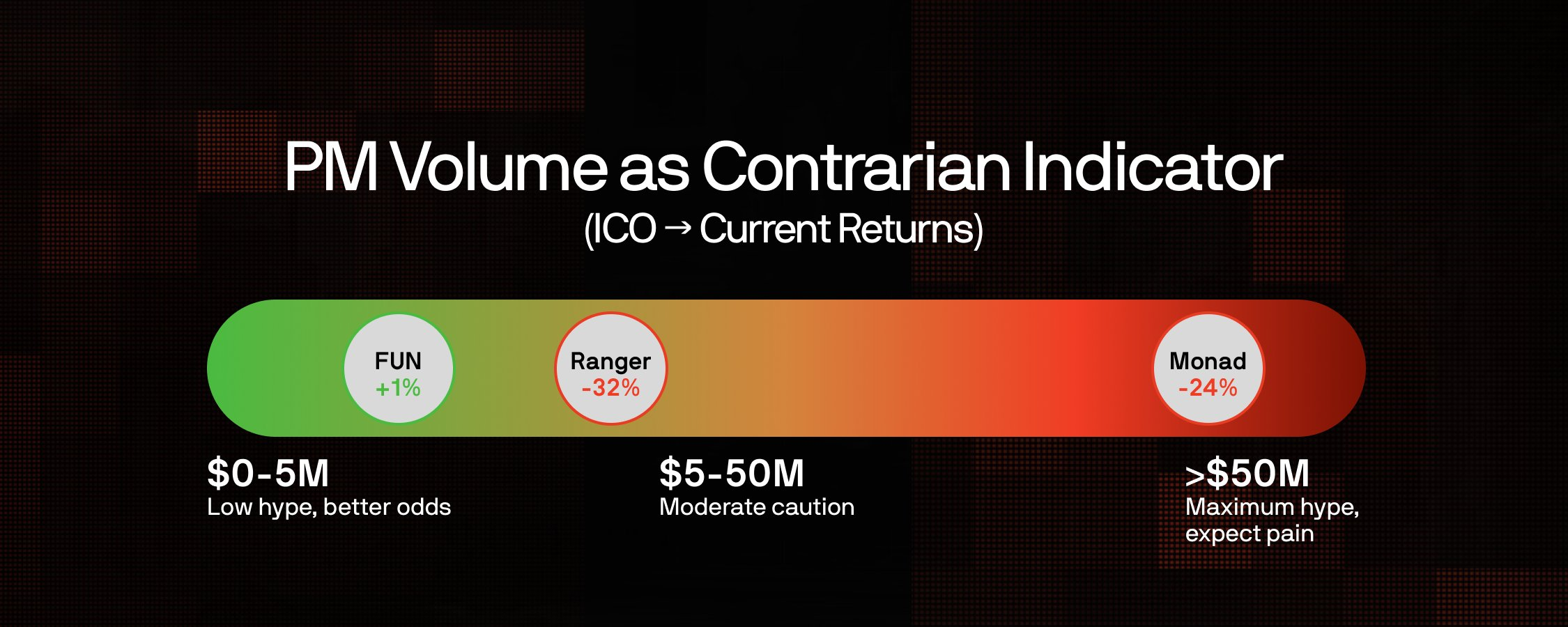
Bearish Signals:

  • Polymarket trading volume > $50 Million

  • FDV Over-Optimism degree > 50%

  • All FDV prediction thresholds are likely to fail

  • Fundraising amount Over-Optimism degree > 30%

Bullish Signals (Relatively)

  • Polymarket trading volume < $5 Million

  • FDV prediction偏差 within 20%

  • Multiple FDV prediction thresholds are met

  • Crowd expectations are relatively conservative

This asymmetry is important. Bearish signals are strong indicators of poor outcomes. Bullish signals are weaker, only suggesting the token might perform "less badly" than over-hyped alternatives. In a market where all tokens are down from their all-time highs (ATH), "losing less" is the best-case scenario.

Summary

Polymarket's token sale section is effectively a Hype Meter. The signal is not in the prediction itself, but in how much it deviates. When the crowd piles money into bets for higher valuations, caution is warranted. Historically, "extreme confidence" from the masses has often meant "maximum pain" for investors.


Preguntas relacionadas

QWhat is the actual prediction accuracy rate of Polymarket's ICO markets one week before closing, according to the analysis?

AThe actual prediction accuracy rate one week before closing is 66.7%, meaning the crowd is wrong one-third of the time.

QWhat systematic bias was identified in the predictions where the crowd had over 60% confidence but was ultimately wrong?

AThe systematic bias identified was consistent over-optimism. The crowd consistently predicted higher fundraising amounts and more expensive valuations than what occurred in reality.

QWhat percentage of tokens analyzed experienced selling pressure within 24 hours of their launch?

A75% of the tokens analyzed experienced selling pressure (were sold off) within 24 hours of their launch.

QAccording to the article, what is a key 'Bearish Signal' for a token sale based on Polymarket data?

AA key bearish signal is Polymarket trading volume exceeding $50 million, which often indicates extreme over-optimism that historically leads to poor outcomes.

QThe article suggests that Polymarket's TokenSale markets are not reliable prediction tools but are instead a measure of what?

AThey are not reliable prediction tools but are instead indicators of market sentiment, or 'Hype Meters,' and often act as a contrarian signal.

Lecturas Relacionadas

Former CFTC Chairman, Circle President Tarbert: Preaching Long-Termism While Cashing Out $30 Million Himself

Former CFTC Chairman and Circle President Heath Tarbert has consistently advocated for a long-term vision in public, urging patience from investors as Circle’s stock price has fallen significantly from its peak. However, it has been revealed that since Circle’s IPO, Tarbert has continuously sold his CRCL shares through pre-arranged trading plans, cashing out approximately $30 million, without making any public market purchases. This contrast between his public messaging and personal actions has drawn criticism. Tarbert joined Circle in July 2023 as Chief Legal Officer, leveraging his regulatory experience to help guide the company through its IPO and expansion. Despite promoting stablecoins as long-term infrastructure, he established a 10b5-1 trading plan just before Circle went public, leading to substantial stock sales over the following year. In March 2026, he initiated another plan to sell more shares. His career trajectory highlights a pattern of moving between high-level regulatory roles and influential positions in the financial sector. After resigning as CFTC Chairman in early 2021, he joined Citadel Securities as Chief Legal Officer just 27 days later, during a period of intense regulatory scrutiny for the firm. He later joined Circle, aiding its efforts to navigate regulatory challenges for its public listing. While Tarbert's expertise in policy and compliance is valuable to companies like Circle, his actions—advocating long-term confidence while personally divesting—raise questions about the alignment between his public statements and his private financial decisions, leaving investors who followed his advice to bear the market risks.

marsbitHace 9 min(s)

Former CFTC Chairman, Circle President Tarbert: Preaching Long-Termism While Cashing Out $30 Million Himself

marsbitHace 9 min(s)

Gate Research Institute: The 'Wall Street-ization' Wave of Crypto Financial Products – Competition or Integration?

The article titled "Gate Research Institute: Are Crypto Financial Products Sparking a 'Wall Street' Wave—Competition or Convergence?" explores the evolving relationship between the crypto ecosystem and traditional finance (TradFi). The piece begins by reflecting on Bitcoin's original 2009 vision of decentralization, disintermediation, and moving away from banks. It then contrasts this with the 2024 landscape, where key crypto assets like Bitcoin are increasingly held through Wall Street products like ETFs issued by giants like BlackRock. The article questions whether this signifies that TradFi is systematically taking over the rights to issue, price, custody, and distribute crypto financial assets. The core argument is that this is not a zero-sum takeover but rather a bidirectional convergence where each side addresses the other's weaknesses. Crypto offers 24/7 global markets, programmable settlement, and open access but lacks compliant channels, institutional-grade custody, deep fiat liquidity, and mainstream distribution. TradFi possesses these but is constrained by legacy systems, limited operating hours, and slow settlement. Two primary convergence paths are highlighted: * **Path A (CEX to TradFi):** Exemplified by Gate, which has progressed from offering tokenized stocks and CFDs to providing direct, real stock trading (US, Hong Kong, South Korea) within its platform, using USDT. * **Path B (TradFi to Crypto):** Exemplified by Robinhood, which has integrated crypto trading, acquired exchanges like Bitstamp, and is moving traditional assets like stocks onto the blockchain via tokenization and its own Layer 2. Both paths are ultimately competing to become the next-generation, unified financial account—a "super account" where users can seamlessly trade cryptocurrencies, stocks, ETFs, RWA (Real World Assets), and tokenized treasury products in one interface. The growth of RWA and tokenized treasuries (e.g., BlackRock's BUIDL) is presented as the asset-layer fusion, providing stable, yield-bearing assets on-chain and acting as a bridge between the two worlds. In conclusion, the "Wall Street-ization" of crypto is framed as a mutual transformation. Decentralized ideals persist in the protocol layer, while at the application layer, a more efficient, global, and accessible unified capital market is emerging from this convergence. The future competition lies not between crypto exchanges and stockbrokers, but between platforms vying to offer the most comprehensive asset coverage, liquidity, and user experience within a single account.

marsbitHace 14 min(s)

Gate Research Institute: The 'Wall Street-ization' Wave of Crypto Financial Products – Competition or Integration?

marsbitHace 14 min(s)

Claude's Major New Feature: Screen Recording + Voice, Distilling Your Skills into AI Tasks in One Click

Claude has introduced a major new feature called "Record a Skill," available for Pro, Max, and Team users. This function, found in the Claude desktop app's CoWork menu, allows users to create reusable AI skills simply by recording their screen and providing voice narration while performing a task. Claude then automatically analyzes the recording and generates a functional Skill. A hands-on test confirmed the feature works seamlessly. Users start recording via the Skills manager, perform their workflow while verbally explaining the steps and logic, and avoid including sensitive information. After recording, Claude processes the content and creates the Skill, which can be saved and later invoked with a slash command (/). This eliminates the need for manual adjustments or writing complex instruction files. The innovation goes beyond mere efficiency. Previously, creating a Skill required writing a detailed SKILL.md file in Markdown—a significant barrier for non-technical users. "Record a Skill" bypasses this by directly capturing both actions and the implicit reasoning shared in the narration. This lowers the barrier to knowledge transfer and automation, addressing a core challenge in corporate knowledge management: the difficulty of getting experts to write and maintain documentation. However, the feature also highlights a shift in the nature of work. A case study from March 2026 showed a freelancer whose five-year client relationship was effectively replaced by a hand-coded Claude Skill automating their content workflow. With the even lower barrier of screen recording, the ability to distill personal expertise into automatable skills accelerates this trend. The "moat" for work is moving from simply knowing how to do a task to mastering tasks that are difficult or impossible to automate.

marsbitHace 18 min(s)

Claude's Major New Feature: Screen Recording + Voice, Distilling Your Skills into AI Tasks in One Click

marsbitHace 18 min(s)

Feeding AI "Noise" Can Also Boost Scores, This Work Enables Positive Transfer with Noise

Feeding "Noise" to AI Can Improve Performance: A Method Enables Positive Transfer from Noise This work, Semi-Supervised Noise Adaptation (SSNA), introduces a Noise Adaptation Framework (NAF) that challenges traditional transfer learning. Instead of requiring a labeled source domain of real data (e.g., images, text), NAF uses randomly generated Gaussian noise as the source. For a target task with C classes, it constructs C noise clusters by sampling from Gaussian distributions. Although this synthetic noise contains no semantic meaning, NAF trains it to form a discriminative class structure in a shared representation space—clustering same-class noise and separating different classes. The key is aligning this learned structure from the noise domain to the real, sparsely labeled target domain. A small number of target labels are still essential to establish the correspondence between noise clusters and actual classes. The training objective combines: 1) supervised loss on the few labeled target samples, 2) classification loss for the noise to build its structure, and 3) a distribution alignment loss (using Negative Domain Similarity) to minimize the gap between the noise and target domains in the shared space. Experiments show significant gains in few-label settings. With just 4 labels per class, NAF with a ResNet-18 backbone improves accuracy over a standard supervised baseline (ERM) by +12.35% on CIFAR-10, +7.61% on CIFAR-100, +4.38% on DTD-47, and +2.74% on Caltech-101. It also benefits fine-grained datasets and scales to ImageNet-1K (with 100 labels/class) and text classification (AG News). NAF can be integrated into existing semi-supervised methods like FixMatch for further gains. Ablation studies confirm the transferred benefit comes from the discriminative structure of the noise, not randomness itself. Collapsing all noise into a single point causes negative transfer, while increasing separation between noise cluster centers improves performance. The amount of noise per class is less critical once a basic structure forms. In conclusion, this work demonstrates that for positive transfer, the semantic content of source data may not be necessary. What can be effectively transferred is the *organizational structure* of categories within a representation space. This offers a promising alternative for scenarios where real source data is unavailable due to privacy, copyright, or procurement constraints.

marsbitHace 19 min(s)

Feeding AI "Noise" Can Also Boost Scores, This Work Enables Positive Transfer with Noise

marsbitHace 19 min(s)

Trading

Spot
活动图片