One Article to Understand $UORE: The V4 Hook Project That Packs Mining, Lottery, and NFT Into a Single Transaction

marsbitPublicado a 2026-05-09Actualizado a 2026-05-09

Resumen

An In-Depth Look at $UORE: The V4 Hook Project Packing Mining, Lotteries, and NFTs into a Single Transaction $UORE is the latest project leveraging the Uniswap V4 Hook mechanism, following in the footsteps of projects like SATO, uPEG, and Slonks. It distinguishes itself by integrating multiple functions—on-chain mining, a buy-to-enter lottery, auto-generated pixel NFTs (Orelings), and a deflationary burn mechanism—all within a single Uniswap V4 liquidity pool transaction. This complexity results in transaction gas fees that are 2-3 times higher than a standard swap. The project's tokenomics are intricate. Each whole $UORE token held automatically mints a corresponding Oreling NFT, a 32x32 pixel miner character with random traits determined by the next block's hash. Each Oreling has a Class (rarity) and Hash value, which combine to form its Mining Power for staking rewards. Rewards are distributed daily from an emission that decays by 1% daily, with an 80/20 split between stakers and a Motherlode lottery pool. A "refined-ore boost" mechanism taxes early reward claims, redistributing 10% to remaining stakers. The Motherlode lottery awards tickets for buys of ≥0.1 ETH, with winning chances scaling up to 1% for 1 ETH purchases. Wins split the pool 50% to the buyer and 50% to a random staker. A 1% buy tax is burned, and a 1% sell tax funds an automatic buyback-and-burn mechanism triggered at 0.1 ETH. The project's code is a fork of uPEG, with claimed fixes for NFT duplication ...

Author: Curry, Shenchao TechFlow

Still FOMOing over yesterday's trending on-chain Ethereum project Slonk? Actually, a new narrative has arrived:

V4 Hook.

Over the past two weeks, Uniswap V4's Hook mechanism suddenly became hot. SATO used Hooks to create an on-chain bonding curve, pushing its market cap to $40 million. uPEG, leveraging the viral story of Uniswap's discarded naming drafts, reached over $30 million in two weeks. Slonks embedded an AI model into a smart contract to mimic CryptoPunks, achieving 586 ETH in trading volume within six days of launch.

While these three projects have different gameplay, they all utilize Uniswap's V4 mechanism.

Now the fourth one is here.
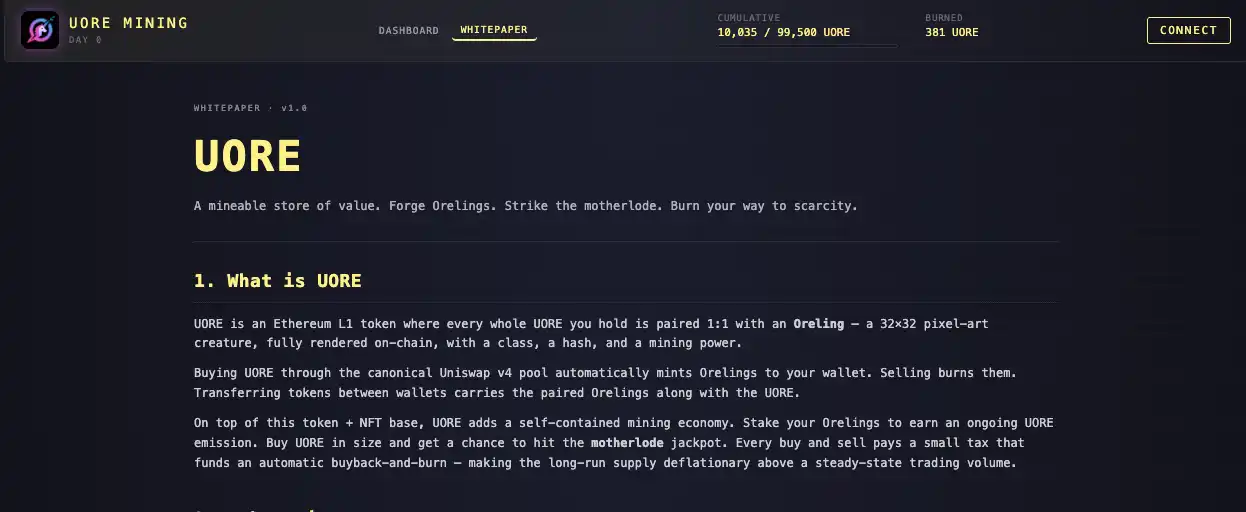
The new project is called $UORE, launched just yesterday. What it does can be summarized in one sentence: It packs on-chain mining, token-buying lottery, pixel NFT auto-generation, and deflationary burning mechanisms, all into a single Uniswap V4 trading pool.

Because buying tokens in this pool triggers the contract to simultaneously perform these six actions in the background, the gas fee for one transaction is two to three times that of a normal swap...

Currently on Crypto Twitter, you'll find everyone complaining about this high gas cost.

Regarding the token, according to GMGN data as of the time of writing, $UORE surged to a market cap of $1.2 million within hours of launch, then quickly dropped back to $440k. The pool liquidity is only $64k, but the 24-hour trading volume is $1.2 million, meaning the money in the pool has been turned over nearly twenty times.

However, there are only 741 holders, and the total supply is less than ten thousand tokens.
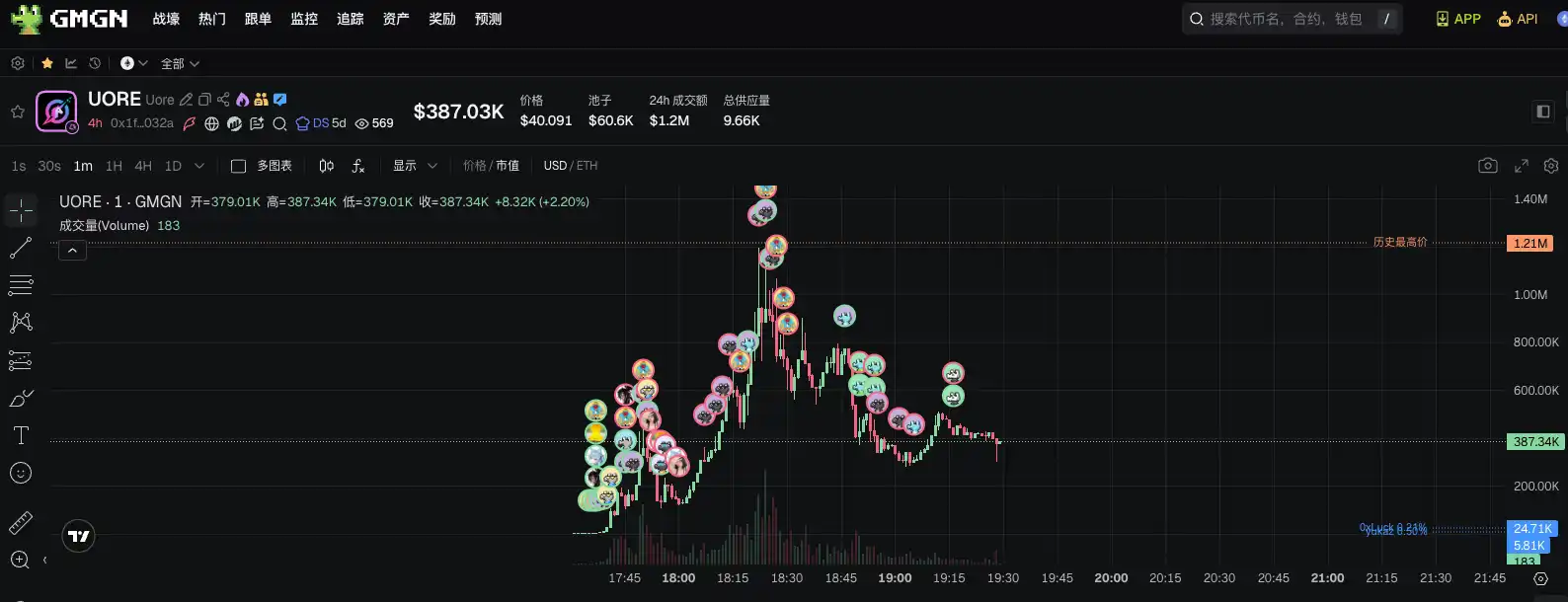
Currently, the risks appear extremely high. After a brief study, I personally think it's the most mechanically complex project in the V4 Hook ecosystem (this round of new on-chain plays tends to be confusing in terms of mechanics...).

It is simultaneously a token, an NFT collection, a staking mining farm, and a lottery system. Moreover, these four things are not independent; they are welded together.

The Four-in-One Mining Farm

In most NFT projects, the token and the NFT are two separate things, bought and sold independently.

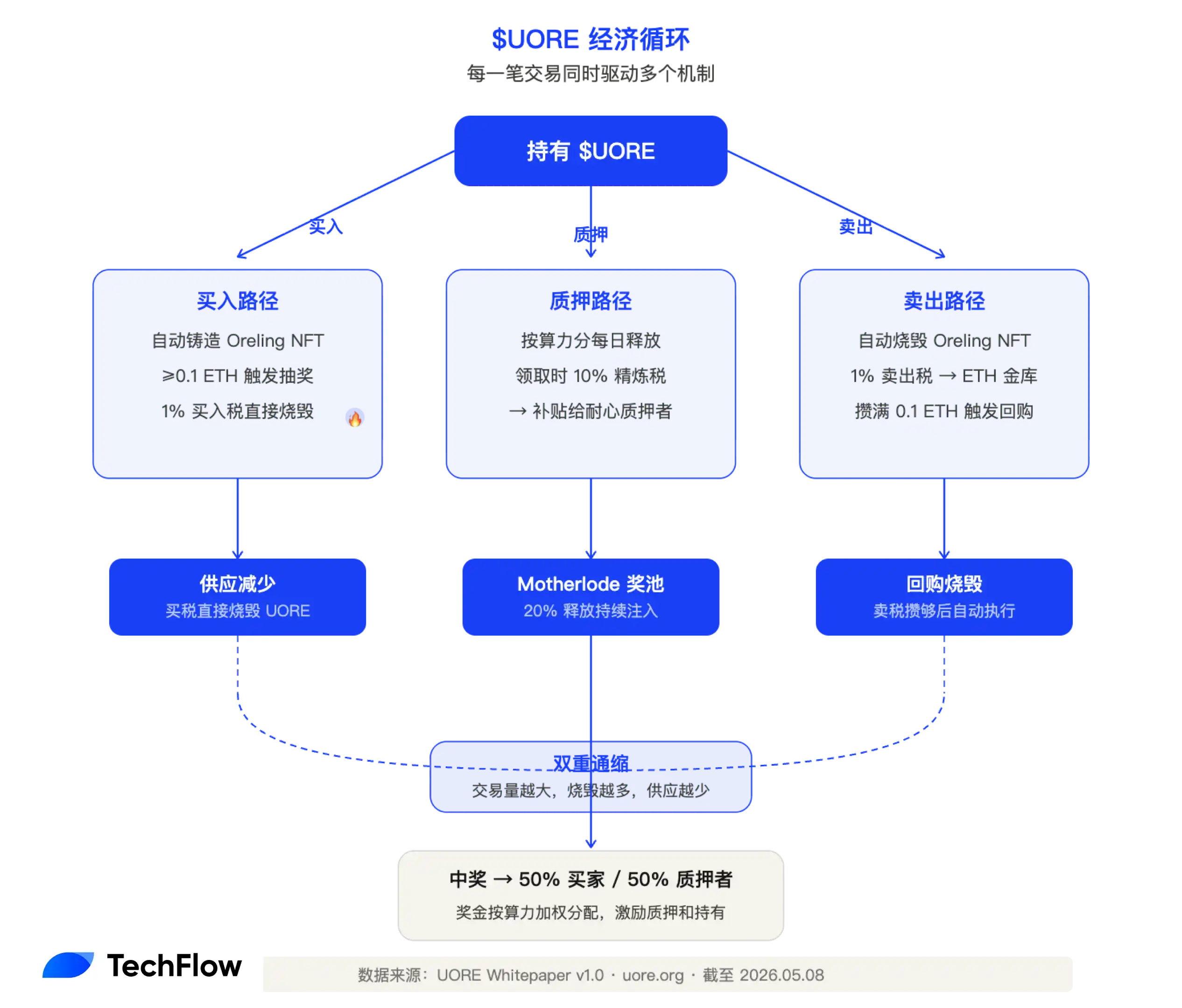
UORE is not. Its NFT is called Oreling, a 32×32 pixel miner character directly embedded into the token. For every full integer UORE you hold in your wallet, you automatically own one corresponding Oreling.
The contract mints it for you when you buy tokens, burns it when you sell tokens, and the Oreling moves with the UORE when you transfer. You cannot buy an Oreling separately, nor can you detach it from UORE.

Each Oreling's traits are determined by the hash of the next block the moment it is minted. This means you don't know what kind of character you'll get when you buy; not even the validator can see the result in advance.

The differences between these characters are not just about appearance.

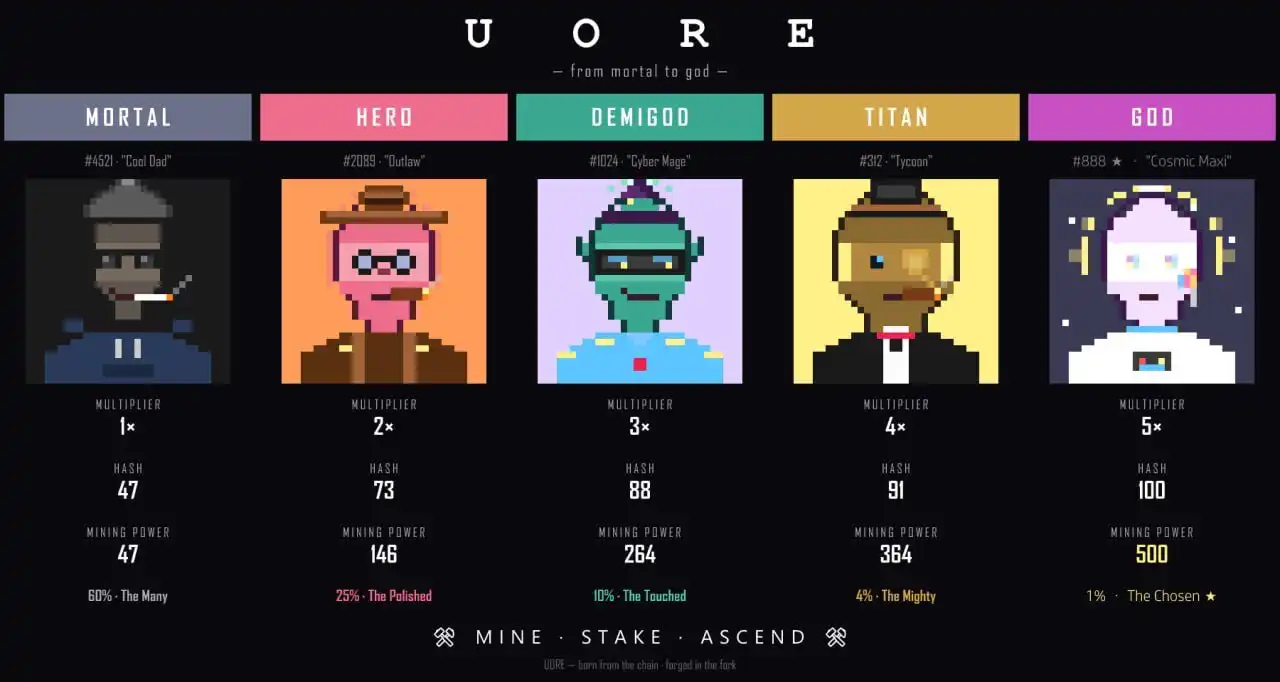
Each Oreling has a Class (rarity) and a Hash (a random number from 1 to 100). Multiplying these two gives its Mining Power.

The most common Mortal class accounts for 60% with a 1x multiplier; the rarest God class has only a 1% probability with a 5x multiplier. If you're lucky and get a God with Hash 100, your mining power is 500, more than ten times that of an ordinary miner.

So what is mining power used for? Old-school play: staking.

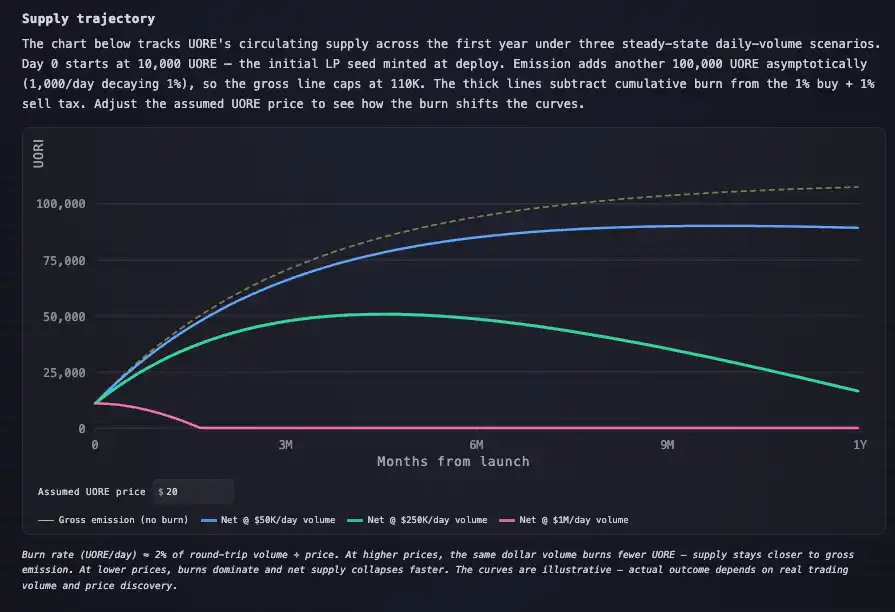
Stake your Oreling into the mining pool, and you start receiving a share of the daily UORE release based on your mining power proportion. According to the official whitepaper, 1000 UORE are released on the first day, decaying by 1% daily thereafter, with a half-life of approximately 69 days. 80% of the release is distributed to stakers, and 20% goes into the Motherlode prize pool.

This decay rate means that within a year, 97% of the total emission will be released. The earlier you enter to mine, the larger the slice you get.

A design worth noting when claiming rewards: a 10% "refining tax" is deducted and redistributed to all stakers who haven't claimed yet. The whitepaper calls this the refined-ore boost.

In plain language, those who claim later receive more of the taxes paid by others. Those in a hurry to claim are subsidizing the patient ones.
Then there's the Motherlode, translated as the "mineral vein jackpot."

Every time you buy ≥ 0.1 ETH worth of UORE through official channels, you automatically get a lottery ticket. The winning probability is tied to the purchase amount: ~1/600 for 0.1 ETH, ~1/200 for 0.5 ETH, and capped at ~1/100 for 1 ETH. Buying more than 1 ETH doesn't increase the probability, preventing whales from spamming.

If you win, the prize pool is split in two: 50% goes directly to the buyer, and 50% is randomly distributed to one staker (weighted by mining power). As of writing, there have only been 4 wins in history, with the largest prize being 6.4 UORE.

Finally, the deflationary flywheel.

A 1% tax on buys is directly burned, and a 1% tax on sells goes into a buyback treasury. When the treasury accumulates 0.1 ETH, anyone can trigger an automatic buyback, and all bought-back UORE are burned. As of writing, 58 buybacks have been executed, cumulatively burning 358 UORE.
Looking at the overall design, it's a small innovation in token-NFT gameplay, an old trick for creating scarcity, yet another Ponzi in economic model design.

The Code is Forked, The Gameplay is Stitched

UORE wasn't written from scratch.

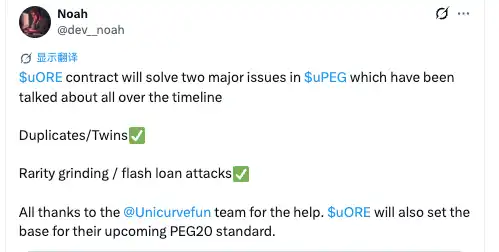
Someone in the community reviewed the source code and found a folder named `reference/unipeg-hook-source/`. The founder, Noah, hasn't hidden it either. He directly stated on Twitter that UORE's contract is forked from uPEG, and it fixed two known issues with uPEG: duplicate NFT generation and flash loan attacks to farm rarity.
Checking out this founder's account, his bio reads "Ethereum dev & BAYC holder." On May 2nd, he posted his first tweet about UORE, saying the project combines the mining concept from Solana's ORE with the V4 Hook architecture of uPEG.

He also proactively @'ed Unicurvefun and Openpeg, asking if they could support Orelings trading after their marketplaces launch.

From this public information, UORE's project lineage is clear:

Solana ORE provided the "on-chain mining + lottery" gameplay template, uPEG provided the V4 Hook code skeleton, and Noah made improvements and assembly on these two foundations.

Forking itself isn't the issue. I think the current problems are:

  1. Gas. People on CT report that each UORE transaction needs to complete six steps within the Hook, consuming two to three times the gas of a normal swap. Swapping back and forth might leave little profit.
  2. Time Window. The V4 Hook narrative, affected by uPEG's decline, will have a lower ceiling for subsequent projects. UORE is the fourth project in this wave of Hook hype, and the heat for the first three is already cooling. The attention window for the track waits for no one.
  3. Complexity. UORE might be the most mechanically intricate of these four projects. For an average user to understand the whole set of rules—Oreling rarity, mining power calculation, staking decay, refining tax, Motherlode probability, buyback trigger conditions—the barrier is high, and the official website is cryptic.

Moreover, the project whitepaper is also interesting:

"Read the contracts and understand the mechanics before deploying capital."

Translated into Chinese, this roughly means "Understand it before you come; don't blame me if you don't."

Combining this with the previous Hook projects, we can see that this wave of on-chain trends features complex mechanism design + immense information asymmetry, having alpha potential, but the shelf life of that alpha is getting shorter and shorter.

SATO gave about a week, uPEG gave a few days, and by the time we get to UORE, the time left for you to understand the rules might be just a few hours...

By the time you understand, the market move might already be over.

Preguntas relacionadas

QWhat is the core concept of the $UORE project, and what makes it unique among other V4 Hook projects?

AThe $UORE project integrates multiple mechanisms into a single Uniswap V4 transaction. Its unique concept is bundling on-chain mining, a buy-to-enter lottery, dynamically generated pixel NFTs (Orelings), and a deflationary burn mechanism all within one trading pool. Each buy/sell transaction automatically handles token purchase, NFT minting/burning, lottery ticket allocation, and tax distribution.

QWhat is an Oreling, and how is it intrinsically linked to the $UORE token?

AAn Oreling is a 32x32 pixel miner NFT. It is directly embedded into the $UORE token: holding one full $UORE automatically grants one Oreling. You cannot buy, sell, or transfer an Oreling separately from its $UORE token. Its features, determined by the next block's hash, dictate its mining power for the staking reward system.

QExplain the staking and mining reward mechanism for $UORE/Orelings.

AUsers stake their Orelings in a mining pool. Each Oreling's mining power (calculated as Class rarity multiplier x Hash value from 1-100) determines the holder's share of daily $UORE emissions. Emission starts at 1,000 tokens per day, decaying by 1% daily. 80% of emissions go to stakers, and 20% goes to the Motherlode lottery pool. A "refined-ore boost" tax of 10% is deducted from claimed rewards and redistributed to unstaked participants, incentivizing delayed claims.

QWhat is the 'Motherlode', and how does the buy-to-enter lottery work?

AThe Motherlode is a lottery prize pool. Buying at least 0.1 ETH worth of $UORE via official channels grants one lottery ticket. The winning probability scales with the purchase amount, capped at a 1% chance for purchases of 1 ETH or more. Upon winning, the prize pool is split: 50% goes to the buyer, and 50% is randomly distributed to one staker (weighted by their mining power).

QWhat are the key risks and challenges mentioned about the $UORE project?

AThe article highlights several risks: 1) High gas fees (2-3x normal swaps) due to complex contract execution. 2) A short attention window as it's the fourth project in a potentially fading V4 Hook narrative trend. 3) High complexity and information asymmetry, making it difficult for average users to understand the full mechanics quickly. 4) Its code is a fork of the uPEG project, raising questions about novelty, though it claims to fix some of uPEG's vulnerabilities.

Lecturas Relacionadas

SpaceX, OpenAI, Anthropic: The Three AI Giants Racing for IPO, Which One Is Worth Betting On?

SpaceX, OpenAI, and Anthropic are poised for historic IPOs within weeks, potentially raising a combined $180 billion—a sum exceeding the entire internet bubble's fundraising. The hosts of the Limitless Podcast argue this isn't just individual company financing but an unprecedented capital concentration for AI infrastructure, driven by an insatiable need for compute, data centers, power, and chips. SpaceX's IPO is notable for reportedly changing market index rules to allow faster inclusion, potentially funneling trillions in passive retirement funds into its stock, despite its unproven space-based data center business model. In contrast, Anthropic demonstrates explosive growth, with ARR reportedly hitting $45 billion and approaching profitability, fueled by strong enterprise adoption of products like Claude Code. Google's separate $80 billion raise highlights the immense capital pressure, even for giants. The discussion acknowledges bubble risks but leans optimistic. The hosts contend the massive spending is building essential physical infrastructure for the next technological era. A key bottleneck isn't capital but the real-world limits of chip manufacturing and construction speed. As long as demand for AI compute outstrips supply, this investment cycle represents a foundational build-out rather than a purely financial bubble. All three companies are seen as foundational bets on the future, with Anthropic often cited as the most immediately compelling due to its proven revenue trajectory.

marsbitHace 31 min(s)

SpaceX, OpenAI, Anthropic: The Three AI Giants Racing for IPO, Which One Is Worth Betting On?

marsbitHace 31 min(s)

From 'Old Guys' to 'New Favorites': How AI Is Revaluing Old Infrastructure from Dell to Nokia?

From "Vintage Tech" to "New AI Darlings": How AI Revalues Old Infrastructure One year ago, tech giants like Dell, Nokia, Cisco, and Western Data were seen as slow-growth, low-valuation stories, far from the AI spotlight dominated by players like Nvidia. Now, these legacy tech stocks are gaining market attention, sparking debate on whether this is genuine industry revaluation or a temporary narrative. As AI moves from model parameters to real-world data centers, the market is recognizing companies with proven delivery and infrastructure capabilities. This shift marks a change in the AI investment thesis: from pure model and GPU focus to the complex systems engineering required for deployment. Companies like Dell, HPE, and Corning are being revalued not for being "sexy" AI innovators, but for their decades of accumulated expertise in supply chains, enterprise delivery, and infrastructure—assets that have become critical in the AI buildout phase. The revaluation is unfolding across three key infrastructure lines: 1. **Servers & System Integration:** Dell and HPE are emerging as crucial system integrators or "general contractors" for AI data centers, translating GPU orders into complete, deployable server racks integrated with power, cooling, and networking. 2. **Networking & Connectivity:** AI's scale demands robust high-speed connections. Corning (fiber optics), Nokia (AI-RAN, 6G), and Cisco (data center switches) are gaining importance for enabling efficient data transfer within and between AI clusters. 3. **Storage:** Beyond high-speed memory (HBM/DRAM), the AI data explosion is driving demand for high-capacity hard drives (HDDs) from companies like Western Digital and Seagate to handle training data, logs, and cold storage cost-effectively. For this revaluation to be substantive and not just a narrative, three criteria are key: 1) Concrete AI-related order and revenue growth (e.g., Dell's AI server sales), 2) Upward revisions to company financial guidance, and 3) Sustainable improvements in profit quality, not just top-line revenue spikes. In essence, AI's transition to a real construction phase is re-pricing "old assets" against "new demand." The opportunity, however, is selective. Only those legacy firms that are demonstrably integrated into the capital expenditure chains of data center and enterprise AI deployment are likely to experience a true "logic re-rating" rather than just a temporary valuation bounce.

marsbitHace 37 min(s)

From 'Old Guys' to 'New Favorites': How AI Is Revaluing Old Infrastructure from Dell to Nokia?

marsbitHace 37 min(s)

The Merger of Codex and ChatGPT Marks the Beginning of a Major Reshuffle in Programming Tools

OpenAI is shifting its strategic focus from ChatGPT to Codex, merging them along with the browser tool Atlas into a unified desktop super-app. This move signals an internal belief that Codex, originally a programming tool, represents the next evolution of AI more than conversational models like ChatGPT. Over the past year, Codex's weekly active users have surged past 5 million. The key distinction is that while ChatGPT answers questions, Codex executes tasks. Enterprises increasingly value this ability to get work done over simply receiving advice. Consequently, Codex is attracting professionals beyond developers, including analysts, bankers, marketers, and product managers. OpenAI's reorganization and increased investment in Codex stem from recognizing that the future of AI competition lies in execution capabilities, not just conversation. The company is launching role-specific plugins (e.g., for data analysis, sales, design) to transform Codex into a broad knowledge work platform that automates and redefines white-collar workflows. Beyond being a tool, Codex reflects OpenAI's ambition to redefine software. New features like "Sites"—which generates interactive websites from documents—and collaborative "Annotations" aim to create a paradigm where the AI understands the goal and handles the tools and steps, functioning more like a digital colleague than traditional software. The ultimate goal is a unified experience where the user cares only about the completed task.

marsbitHace 46 min(s)

The Merger of Codex and ChatGPT Marks the Beginning of a Major Reshuffle in Programming Tools

marsbitHace 46 min(s)

Interpreting Investment Opportunities in the Age of Great Navigation, Invesco Great Wall Fund Releases '2026 Report on Chinese Enterprises Going Global'

Invesco Great Wall Fund has released its "2026 China Corporate Globalization Report," titled "The 'Great Navigation Era' of Chinese Enterprises." The report analyzes the new trends and investment opportunities as Chinese companies expand globally, moving from simple product exports to comprehensive overseas operations involving services, branding, and local production. Driven by factors like trade friction, the pursuit of higher profit margins abroad, and policy support, globalization is becoming essential for Chinese companies. The report outlines an evolution: from early product export ("Globalization 1.0") to the current "Globalization 2.0," characterized by overseas capacity, capital goods investment, consumer brand expansion, and service exports. Chinese firms' competitive advantages are highlighted, including a vast engineer talent pool, low-cost and robust infrastructure, and complete industrial clusters. Specific sectors with significant出海 potential are identified: * **Capital Goods** (e.g., engineering machinery, power equipment): Benefiting from global demand, especially in Belt & Road markets and the AI-driven power grid upgrade cycle. * **Consumer Brands**: Transitioning from cost to brand advantage, leveraging供应链 efficiency. * **Technology & Innovation**: Including AI applications, optical modules within global tech supply chains, and new energy vehicles focusing on local production. * **Pharmaceuticals**: Chinese biotech firms are becoming preferred partners for global pharma, with potential for breakthrough drugs in areas like oncology and weight loss. The report concludes that corporate globalization represents a sustained, core theme for China's capital markets, though companies must navigate challenges like geopolitics and localization.

marsbitHace 58 min(s)

Interpreting Investment Opportunities in the Age of Great Navigation, Invesco Great Wall Fund Releases '2026 Report on Chinese Enterprises Going Global'

marsbitHace 58 min(s)

Trading

Spot
Futuros

Artículos destacados

Cómo comprar ONE

¡Bienvenido a HTX.com! Hemos hecho que comprar Harmony (ONE) sea simple y conveniente. Sigue nuestra guía paso a paso para iniciar tu viaje de criptos.Paso 1: crea tu cuenta HTXUtiliza tu correo electrónico o número de teléfono para registrarte y obtener una cuenta gratuita en HTX. Experimenta un proceso de registro sin complicaciones y desbloquea todas las funciones.Obtener mi cuentaPaso 2: ve a Comprar cripto y elige tu método de pagoTarjeta de crédito/débito: usa tu Visa o Mastercard para comprar Harmony (ONE) al instante.Saldo: utiliza fondos del saldo de tu cuenta HTX para tradear sin problemas.Terceros: hemos agregado métodos de pago populares como Google Pay y Apple Pay para mejorar la comodidad.P2P: tradear directamente con otros usuarios en HTX.Over-the-Counter (OTC): ofrecemos servicios personalizados y tipos de cambio competitivos para los traders.Paso 3: guarda tu Harmony (ONE)Después de comprar tu Harmony (ONE), guárdalo en tu cuenta HTX. Alternativamente, puedes enviarlo a otro lugar mediante transferencia blockchain o utilizarlo para tradear otras criptomonedas.Paso 4: tradear Harmony (ONE)Tradear fácilmente con Harmony (ONE) en HTX's mercado spot. Simplemente accede a tu cuenta, selecciona tu par de trading, ejecuta tus trades y monitorea en tiempo real. Ofrecemos una experiencia fácil de usar tanto para principiantes como para traders experimentados.

275 Vistas totalesPublicado en 2024.12.12Actualizado en 2026.06.02

Cómo comprar ONE

Discusiones

Bienvenido a la comunidad de HTX. Aquí puedes mantenerte informado sobre los últimos desarrollos de la plataforma y acceder a análisis profesionales del mercado. A continuación se presentan las opiniones de los usuarios sobre el precio de ONE (ONE).

活动图片