One Article to Understand the Profit Pools and Industry Landscape of the AI Storage Hierarchy

marsbitPublicado a 2026-05-14Actualizado a 2026-05-14

Resumen

**Deciphering the Profit Pools and Industry Landscape of the AI Storage Hierarchy** AI storage architecture can be divided into six distinct layers based on proximity to computing units: 1) On-chip SRAM, 2) HBM, 3) Motherboard DRAM, 4) CXL pooling layer, 5) Enterprise SSD, and 6) NAS & Cloud Object Storage. In 2025, the total market for these layers (excluding embedded SRAM value) was approximately $229 billion, with DRAM constituting half, HBM 15%, and SSD 11%. The profit landscape is highly concentrated, with over 90% market share in the top three layers for key players. These profit pools are categorized into three types: 1) High-margin, oligopolistic silicon layers (HBM, embedded SRAM, QLC SSD), 2) High-margin, emerging interconnect layers (CXL), and 3) Scalable, recurring-revenue service layers (NAS, Cloud Object Storage). **Key Layers Analysis:** * **On-chip SRAM:** Profits accrue primarily to TSMC via advanced wafer sales for AI chips. * **HBM:** The largest AI-era profit pool, driven by AI accelerator demand. SK Hynix (57-62% share), Samsung, and Micron dominate. HBM boasts exceptionally high margins (e.g., SK Hynix's 72% operating margin in Q1 2026) and is projected to grow at a ~40% CAGR to $100 billion by 2028. * **Motherboard DRAM:** The largest market by revenue ($121.8B in 2025), controlled by Samsung, SK Hynix, and Micron. High profitability is sustained as capacity shifts to HBM. * **CXL Pooling Layer:** Enables rack-level memory sharing for AI work...

Author: Godot

AI storage can be broken down into six layers,

1) On-chip SRAM

2) HBM

3) Motherboard DRAM

4) CXL Pooling Layer

5) Enterprise SSD

6) NAS and Cloud Object Storage

This hierarchy is based on the location of storage; the further down, the farther from the computing unit, and the larger the storage capacity.
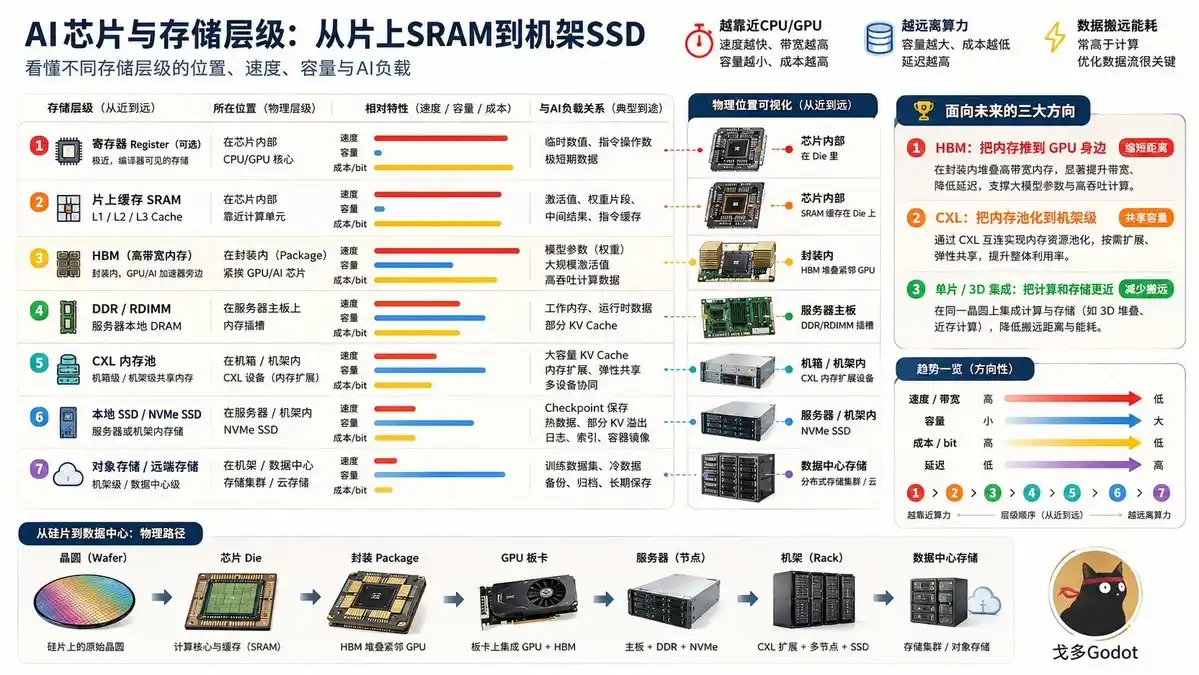
In 2025, the total market for these six layers (SRAM is on compute chips, its embedded value needs to be excluded) was about $229 billion, with DRAM accounting for half, HBM for 15%, and SSD for 11%.

In terms of profit, each layer is highly concentrated among oligopolies, with the top three typically holding over 90% market share.

These profit pools can be divided into three categories,

1) High-margin oligopolistic pools at the silicon layer (HBM, embedded SRAM, QLC SSD)

2) High-margin emerging pools at the interconnect layer (CXL)

3) Scale-compounding pools at the service layer (NAS, Cloud Object Storage)

The three types of pools differ in nature, growth rate, and moats.

Why is Storage Layered?

Because the CPU responsible for control and the GPU responsible for computing only have temporary cache on the chip, namely on-chip SRAM cache. This cache space is too small, only enough to hold temporary parameters, and cannot accommodate large models.

Outside these two chips, larger external memory is needed to store the large models and the context for inference.

Computation is fast. The latency and energy consumption of moving data between different storage layers are the biggest issues.

Therefore, there are currently three main directions,

1) Stack HBM, placing memory next to the GPU to shorten the data transfer distance.

2) Use CXL to pool memory to the rack level, sharing capacity.

3) Integrate computing and storage on the same wafer, achieving compute-in-memory.

These three directions will shape the profit pool of each layer over the next five years.

The specific layers are detailed below,

L0 On-chip SRAM: A Profit Pool Exclusive to TSMC

SRAM (Static Random-access Memory) is the cache inside CPUs/GPUs, embedded in each chip and not traded separately.

The standalone SRAM chip market is only about $1–1.7 billion. Leaders are Infineon (~15%), Renesas (~13%), and ISSI (~10%)—a small market.

The profit pool for this part lies with TSMC. To fit more SRAM into each generation of AI chips, more wafers must be purchased.

Over 70% of the world's advanced process wafers are in TSMC's hands. The SRAM area of every H100, B200, TPU v5, etc., ultimately translates into TSMC's revenue.

L1 HBM: The Largest Profit Pool of the AI Era

HBM (High Bandwidth Memory) is high-bandwidth memory where DRAM (Dynamic Random-access Memory) dies are vertically stacked using TSV (Through-Silicon Via) technology and then attached next to the GPU via CoWoS packaging.

HBM almost single-handedly determines how large a model an AI accelerator can run. SK hynix, Micron, and Samsung have a near 100% market share.

As of Q1 2026, the latest market share breakdown is: SK hynix 57% to 62%, Samsung 22%, Micron 21%. SK hynix has secured significant procurement shares from companies like NVIDIA and is the dominant supplier.

Micron's Q1 FY2026 earnings call mentioned that the HBM TAM (Total Addressable Market) is expected to grow at a CAGR of ~40%, from about $35 billion in 2025 to $100 billion in 2028, reaching the $100 billion mark two years earlier than previous forecasts.

The core advantage of HBM lies in its extremely high profit margins. In Q1 2026, SK hynix's operating profit margin reached a record 72%.

Reasons for high profitability,

1) The TSV manufacturing process sacrifices some traditional DRAM capacity, keeping HBM in a state of supply shortage.

2) Improving advanced packaging yield is difficult; Samsung's previous market share drop from 40% to 22% was also affected by this.

3) Major suppliers have been relatively cautious in capacity expansion, and achieved a DRAM ASP (Average Selling Price) increase of over 60% QoQ in Q1 2026, demonstrating a clear seller's market.

Among the three giants, SK hynix, driven by strong HBM demand, achieved annual operating profit of 47.21 trillion KRW in 2025, surpassing Samsung Electronics for the first time in history. In Q1 2026, with a 72% operating margin, it even exceeded the profitability levels of TSMC (58.1%) and NVIDIA (65%).

Micron has high growth expectations, with Bank of America raising its target price to $950 in May 2026. Samsung, with the continuous progress of HBM4 mass production, has the largest room for market share recovery.

L2 Motherboard DRAM

This layer refers to what we commonly call memory modules (DIMMs).

Motherboard DRAM includes conventional memory products like DDR5, LPDDR, GDDR, MR-DIMM, etc. It is currently the part with the highest market sales share in the AI storage system. The global DRAM market reached approximately $121.83 billion in 2025.

Samsung, SK hynix, and Micron still dominate the vast majority of the market. According to the latest data from Q4 2025, Samsung ranked first with a 36.6% market share, SK hynix second with 32.9%, and Micron third with 22.9%.

The shift in production capacity towards higher-margin HBM has helped maintain high profitability and pricing power for memory. Although the single-product margin of conventional motherboard DRAM is not as high as HBM's, its overall market size is the largest.

L3 CXL Pooling Layer

CXL (Compute Express Link) allows DRAM to be "pooled" from a single server motherboard to the entire rack level.

With CXL 3.x and beyond, all memory in a rack can be shared and scheduled by multiple GPUs in the future, allocated on-demand. This solves the problem of KV cache, vector databases, and RAG indexes not fitting or being too cumbersome to move during AI inference.

The CXL memory module market was only $1.6 billion in 2024, projected to reach $23.7 billion by 2033. It appears the oligopoly of Samsung, SK hynix, and Micron will continue.

In this layer, Astera Labs focuses on Retimers and intelligent memory controllers between CXL and PCIe, holding about 55% share of this sub-market. Latest quarter revenue was $308 million, up 93% YoY; non-GAAP gross margin 76.4%; net profit up 85% YoY. It can be said to be quite lucrative.

L4 Enterprise SSD: The Biggest Beneficiary of the Inference Era

Enterprise NVMe SSDs are the main battleground for AI training checkpoints, RAG indexes, KV cache offloading, and model weight caching. High-capacity QLC SSDs have completely pushed HDDs out of AI data lakes.

The enterprise SSD market was about $26.1 billion in 2025, with a CAGR of 24%, projected to reach $76 billion by 2030.

As for the competitive landscape? Correct, still dominated by the three giants.

Market share by revenue in Q4 2025: Samsung 36.9%, SK hynix (including Solidigm) 32.9%, Micron 14.0%, Kioxia 11.7%, SanDisk 4.4%. The top five account for about 90%.

The biggest change in this layer is the explosion of QLC SSDs in AI inference scenarios. SK hynix's subsidiary Solidigm and Kioxia have already produced single-disk products with 122 TB capacity. AI inference KV cache and RAG indexes are spilling over from HBM to SSDs.

From a profit pool perspective, enterprise SSDs don't have the extreme gross margins of HBM but enjoy dual tailwinds of capacity-driven growth and inference expansion.

SK hynix (via Solidigm) and Kioxia are relatively pure plays. Samsung and SK hynix enjoy triple-layer benefits from HBM + DRAM + NAND, making them more comprehensive AI storage platform companies.

L5 NAS and Cloud Object Storage: The Compounding Pool of Data Gravity

NAS and Cloud Object Storage are the outermost layers for AI data lakes, training corpora, backup/archiving, and cross-team collaboration. In 2025, NAS was about $39.6 billion (CAGR 17%), and Cloud Object Storage about $9.1 billion (CAGR 16%).

Major vendors for enterprise file storage are NetApp, Dell, HPE, Huawei; for SMBs, Synology and QNAP. For Cloud Object Storage, using IaaS share estimates, AWS ~31–32%, Azure ~23–24%, Google Cloud ~11–12%, the three combined ~65–70%.

Profits in this layer mainly come from long-term hosting, data egress fees, and ecosystem lock-in.

To summarize,

1) DRAM has the largest market but the lowest gross margins (30–40%); HBM's market is only one-third of DRAM's, but its gross margin is double (60%+); CXL Retimers have the smallest market but the highest gross margin (76%+). The closer the layer is to computing, the scarcer and more lucrative it is.

2) Incremental profit pool growth primarily comes from three areas: HBM (CAGR 28%), Enterprise SSD (CAGR 24%), and CXL Pooling (CAGR 37%).

3) Each layer has different business barriers: HBM relies on technical barriers (TSV, CoWoS, yield ramp); CXL-type relies on IP and certification (single supply chain for Retimers); service-type relies on switching costs.


Preguntas relacionadas

QHow is the AI storage hierarchy structured, and what are the six layers mentioned in the article?

AThe AI storage hierarchy is divided into six layers based on proximity to the compute unit, with capacity increasing as distance increases. The layers are: 1) On-chip SRAM, 2) HBM, 3) Motherboard DRAM, 4) CXL Pooling Layer, 5) Enterprise SSD, and 6) NAS & Cloud Object Storage.

QWhich layer in the AI storage stack is described as the most lucrative profit pool in the AI era, and what are the market share dynamics among its key players?

AHBM is described as the largest profit pool in the AI era. As of Q1 2026, the market is dominated by SK Hynix (57-62%), Samsung (22%), and Micron (21%). SK Hynix leads, driven by strong demand from customers like NVIDIA.

QWhat are the three primary strategic directions mentioned for optimizing data movement between storage layers, and how do they impact future profit pools?

AThe three primary directions are: 1) Stacking HBM to shorten data transfer distances, 2) Using CXL for rack-level memory pooling and capacity sharing, and 3) Developing in-memory computing (e.g., on the same wafer). These trends will shape the profit pools across the storage hierarchy over the next five years.

QAccording to the article, what are the three distinct categories of profit pools in the AI storage landscape, and what are their key characteristics?

AThe three categories are: 1) High-margin Oligopoly Pools (e.g., HBM, embedded SRAM, QLC SSD) characterized by technological dominance and high margins; 2) High-margin Emerging Pools (e.g., CXL) driven by new interconnects; and 3) Scale & Recurring Revenue Pools (e.g., NAS, Cloud Object Storage) based on data gravity, long-term hosting, and ecosystem lock-in.

QWhich company is highlighted as capturing the profit pool for on-chip SRAM (L0), and what is the underlying reason?

ATSMC captures the profit pool for on-chip SRAM. This is because the need to integrate more SRAM into each new generation of AI chips (like NVIDIA's H100/B200, Google's TPU v5) requires more advanced semiconductor wafers, over 70% of which are supplied by TSMC. The SRAM area directly translates into TSMC's revenue.

Lecturas Relacionadas

GitHub, Transfixed by AI

On the night of February 9th, GitHub suffered a major outage caused by a simple configuration change—reducing a cache refresh interval from 12 to 2 hours—that triggered a cascade of failures. This was not an isolated event, but part of a broader pattern. In early 2026, GitHub experienced at least 8 major incidents, failing to meet its promised 99.9% availability. These outages stemmed from structural issues: explosive growth in load, tight service coupling, and insufficient protection against abnormal traffic. This unprecedented load is driven by AI Agents. In 2025, GitHub handled ~1 billion commits. By 2026, weekly commits reached 275 million, projecting to ~14 billion for the year—a 14x increase. AI tools like Claude Code now contribute 4.5% of all public repository commits, with weekly submissions surging 25x in just three months. AI-generated pull requests jumped from 4 million to 17 million per month in half a year. Unlike human developers, AI Agents work continuously, generating commits at a scale that overwhelms infrastructure designed for human rhythms. The surge also shattered GitHub's business model. Copilot's flat-rate pricing, based on assisting human developers, became unsustainable as Agentic AI sessions consumed resources worth hundreds of dollars for a few dollars in fees. In response, GitHub imposed usage limits and, by June 1st, shifted to a pay-per-use "AI Credits" system. Facing this new reality, GitHub realized a 10x scaling plan was insufficient. It announced a need to *redesign* its architecture for 30x current scale—decoupling services, adding fault isolation, and improving change management to prevent cascading failures. Other platforms like Stripe and AWS are facing similar challenges with AI Agents. Fundamentally, GitHub is transitioning from a human collaboration platform to an "exhaust pipe" for automated AI workflows. Its detailed post-mortem reports aim to maintain trust during this turbulent rebuild. The February outage was not just a technical glitch, but a signal of the software industry's entry into a new, AI-driven era.

marsbitHace 16 min(s)

GitHub, Transfixed by AI

marsbitHace 16 min(s)

Both Suffer Massive Losses Exceeding $90 Billion, Which Is in Greater Peril: Strategy or Bitmine?

Facing massive paper losses exceeding $90 billion each amidst a sharp market downturn, "Digital Asset Treasury" (DAT) giants Strategy and Bitmine find themselves in a precarious position, but with different underlying risks. Strategy, heavily invested in Bitcoin (BTC), faces significant financial strain. Its strategy relies heavily on debt, including convertible notes and preferred stock (STRC) requiring substantial dividend payments. With its cash reserves dwindling and BTC offering no staking yield for cash flow, Strategy's high leverage makes it vulnerable. A continued price decline could force asset sales to meet obligations, potentially creating a negative feedback loop. Its market value has already fallen sharply. In contrast, Bitmine, an Ethereum (ETH) holder, appears on firmer financial ground. It primarily funds its purchases through equity offerings (like ATM programs), avoiding debt pressure. It also generates income by staking a large portion of its ETH holdings. While not immune to market drops and shareholder dilution concerns, Bitmine maintains more flexibility, recently announcing a new preferred share offering to raise further capital. The core divergence lies in their financing: Bitmine uses equity (investor money), while Strategy uses debt (borrowed money). Consequently, Bitmine currently faces less immediate liquidity pressure than Strategy, which must navigate the dual challenge of servicing debt/dividends and a declining core asset (BTC) price.

marsbitHace 23 min(s)

Both Suffer Massive Losses Exceeding $90 Billion, Which Is in Greater Peril: Strategy or Bitmine?

marsbitHace 23 min(s)

Where the AI Bubble Really Is: Which Layer of Players Are Naked

AI Bubble: Where It Really Is and Who's Swimming Naked This analysis dissects the AI industry not as a single entity but as a five-layer pyramid, arguing that bubbles are concentrated in specific tiers, not uniformly distributed. **Key Distinction from the 2000 Dot-com Bubble:** Unlike 2000, where companies had stock prices before revenue, today's leading AI players have massive, contract-backed revenue driving their valuations. Core infrastructure demand is real, with every GPU running at full capacity for paying customers. **The Five-Layer Pyramid & Bubble Assessment:** * **L0 (Fab/Manufacturing) & Top L4 (Leading AI Apps): NO BUBBLE.** Companies like TSMC, NVIDIA, major cloud providers (Microsoft, Google, Meta, Amazon), and top AI labs have real revenues and orders. Supply is tightly constrained by TSMC's disciplined capacity control and physical limits like power/land for data centers, preventing a supply glut. * **L1 (Memory): BATTLEGROUND.** Sky-high HBM margins could signal a new structural cycle or a classic "boom before bust." The oligopoly of three major players may enforce supply discipline, making this a high-stakes bet. * **L2 (Interconnect/Optical Modules): BUBBLE TERRITORY.** Companies like Lumentum and AAOI have seen stock surges (4-10x) far outpacing revenue growth. This hardware segment has lower physical barriers to expansion than fabs, allowing speculation. It mirrors the 2000 bubble's epicenter—optics. * **L3 (Infrastructure/"GPU Landlords"): VULNERABLE.** GPU leasing companies profit from the current compute shortage but own no long-term moat. Their business model relies on a temporary bottleneck that will ease as big tech expands and new tech (e.g., potential space-based data centers) emerges. * **L4 Long Tail (VC-backed Startups): STRONG BUBBLE SIGNALS.** VC funding concentration in AI is twice that of the 1999 peak. Many startups with little revenue use the valuation logic of successful giants to justify their own, creating high risk of a "valuation crunch" when funding dries up. **Critical Risks to Monitor:** 1. **GPU Depreciation & Accounting:** Companies extending the assumed useful life of GPUs artificially boost profits. The true economic life depends on future generational leaps from NVIDIA. 2. **"GPU Credit" & Off-Balance-Sheet Leverage:** Emerging structures where shell companies borrow to buy GPUs and lease them out (with chipmakers sometimes investing) move debt off major balance sheets. This echoes the "vendor financing" of 2000 and the securitization risks of 2008, though currently small-scale. 3. **TSMC Abandoning Caution:** If the primary supply bottleneck (TSMC's conservative capacity planning) breaks, runaway supply could trigger a bust. 4. **Algorithmic Efficiency Breakthrough:** A major leap in software efficiency could drastically reduce the need for raw compute hardware, undermining the investment thesis. **Conclusion:** The AI boom is expensive and has frothy areas, but its core is underpinned by real demand and physical supply constraints. The bubble risk is layered: most present in optical components, GPU leasing, and the long-tail startup ecosystem, while the foundational chip manufacturing and leading application layers remain relatively solid—for now.

marsbitHace 36 min(s)

Where the AI Bubble Really Is: Which Layer of Players Are Naked

marsbitHace 36 min(s)

Trading

Spot
Futuros

Artículos destacados

Cómo comprar ONE

¡Bienvenido a HTX.com! Hemos hecho que comprar Harmony (ONE) sea simple y conveniente. Sigue nuestra guía paso a paso para iniciar tu viaje de criptos.Paso 1: crea tu cuenta HTXUtiliza tu correo electrónico o número de teléfono para registrarte y obtener una cuenta gratuita en HTX. Experimenta un proceso de registro sin complicaciones y desbloquea todas las funciones.Obtener mi cuentaPaso 2: ve a Comprar cripto y elige tu método de pagoTarjeta de crédito/débito: usa tu Visa o Mastercard para comprar Harmony (ONE) al instante.Saldo: utiliza fondos del saldo de tu cuenta HTX para tradear sin problemas.Terceros: hemos agregado métodos de pago populares como Google Pay y Apple Pay para mejorar la comodidad.P2P: tradear directamente con otros usuarios en HTX.Over-the-Counter (OTC): ofrecemos servicios personalizados y tipos de cambio competitivos para los traders.Paso 3: guarda tu Harmony (ONE)Después de comprar tu Harmony (ONE), guárdalo en tu cuenta HTX. Alternativamente, puedes enviarlo a otro lugar mediante transferencia blockchain o utilizarlo para tradear otras criptomonedas.Paso 4: tradear Harmony (ONE)Tradear fácilmente con Harmony (ONE) en HTX's mercado spot. Simplemente accede a tu cuenta, selecciona tu par de trading, ejecuta tus trades y monitorea en tiempo real. Ofrecemos una experiencia fácil de usar tanto para principiantes como para traders experimentados.

274 Vistas totalesPublicado en 2024.12.12Actualizado en 2026.06.02

Cómo comprar ONE

Discusiones

Bienvenido a la comunidad de HTX. Aquí puedes mantenerte informado sobre los últimos desarrollos de la plataforma y acceder a análisis profesionales del mercado. A continuación se presentan las opiniones de los usuarios sobre el precio de ONE (ONE).

活动图片