On the Night of the Fed Rate Cut, the Real Game Is Trump's 'Monetary Power Grab'

marsbitPublicado a 2025-12-11Actualizado a 2025-12-11

Resumen

Tonight marks the Federal Reserve's most anticipated interest rate decision of the year. While a 25-basis-point cut is widely expected, the key variable for risk assets is whether the Fed will restart liquidity injections, potentially through a $45 billion monthly short-term debt purchase program starting in January. This signals a stealth return to quantitative easing. The larger tension stems from an unprecedented shift in monetary power. President Trump is rapidly reshaping the Federal Reserve, not just by replacing its chair but by redrawing the boundaries of monetary authority. The long-held principle of central bank independence is being eroded as the Treasury Department seeks to reclaim control over long-term interest rates, liquidity, and the balance sheet. This transition to a "fiscally dominated monetary era" is the underlying logic connecting recent market events. Despite a 40 billion outflow from Bitcoin ETFs, analysis suggests this was not panic selling but the unwinding of leveraged basis trades, leaving a healthier, less leveraged market. Meanwhile, led by Michael Saylor, made its largest Bitcoin purchase in months ($963 million), and Tom Lee's BitMine significantly increased its Ethereum holdings, signaling strong institutional conviction during the downturn. The macro shift implies higher market volatility as the old order fractures. While improved liquidity may provide a floor for Bitcoin, its longer-term trajectory awaits clarity within this new monetary...

Tonight will bring the most anticipated interest rate cut decision of the year from the Federal Reserve.

The market widely expects a rate cut to be almost a done deal. However, what will truly determine the direction of risk assets in the coming months is not another 25 basis point cut, but a more critical variable: whether the Fed will restart liquidity injections into the market.

This time, Wall Street is not watching interest rates, but the balance sheet.

According to expectations from institutions like Bank of America, Vanguard, and PineBridge, the Fed may announce this week a plan to initiate a $45 billion monthly short-term bond purchase program starting January next year, as a new round of "reserve management operations." In other words, this suggests the Fed might be quietly ushering in an era of "stealth balance sheet expansion," allowing the market to enter a state of liquidity easing even before the rate cut.

But what makes the market nervous is the backdrop against which this is happening—the U.S. is entering an unprecedented period of monetary power restructuring.

Trump is taking over the Fed in a manner far faster, deeper, and more thorough than anyone expected. It's not just about replacing the chair; it's about redrawing the boundaries of power within the monetary system, reclaiming authority over long-term interest rates, liquidity, and the balance sheet from the Fed and handing it back to the Treasury. The independence of the central bank, long considered an "iron law of the system" for decades, is being quietly eroded.

This is also why all seemingly disparate events—from Fed rate cut expectations to ETF fund flows, from MicroStrategy's and Tom Lee's contrarian accumulation, and so on—are actually converging on the same underlying logic: the U.S. is entering a "fiscally dominated monetary era."

And what impact will this have on the crypto market?

MicroStrategy and Others Are Making Their Move

Over the past two weeks, the entire market has been debating the same question: Will MicroStrategy be able to withstand this downturn? Bears have simulated various scenarios of the company's collapse.

But Saylor clearly thinks otherwise.

Last week, MicroStrategy increased its Bitcoin holdings by approximately $963 million, to be precise, 10,624 BTC. This is his largest purchase in recent months, even exceeding the sum of his acquisitions over the past three months.

Consider this: the market had been speculating whether MicroStrategy would be forced to sell coins to avoid systemic risk when its mNAV approached 1. Instead, when the price nearly hit that level, he didn't sell; he doubled down, and on such a large scale.

Meanwhile, a similarly dramatic contrarian move was playing out on the ETH side. Tom Lee's BitMine, despite ETH's price plunge and a 60% drawdown in the company's market cap, managed to continuously tap the ATM (at-the-market offering), raising substantial cash, and last week bought $429 million worth of ETH in one go, pushing its holdings to a $12 billion scale.

Even though BMNR's stock price has fallen more than 60% from its high, the team can still consistently raise money through ATM offerings and keep buying.
CoinDesk analyst James Van Straten put it more bluntly on X: "MSTR can raise $1 billion in a week, while in 2020, it took them four months to do the same. The exponential trend continues."

If we look at market cap impact, Tom Lee's move is even "heavier" than Saylor's. BTC's market cap is five times that of ETH, so Tom Lee's $429 million buy order has the "double impact" in weight equivalent to Saylor buying $1 billion worth of BTC.

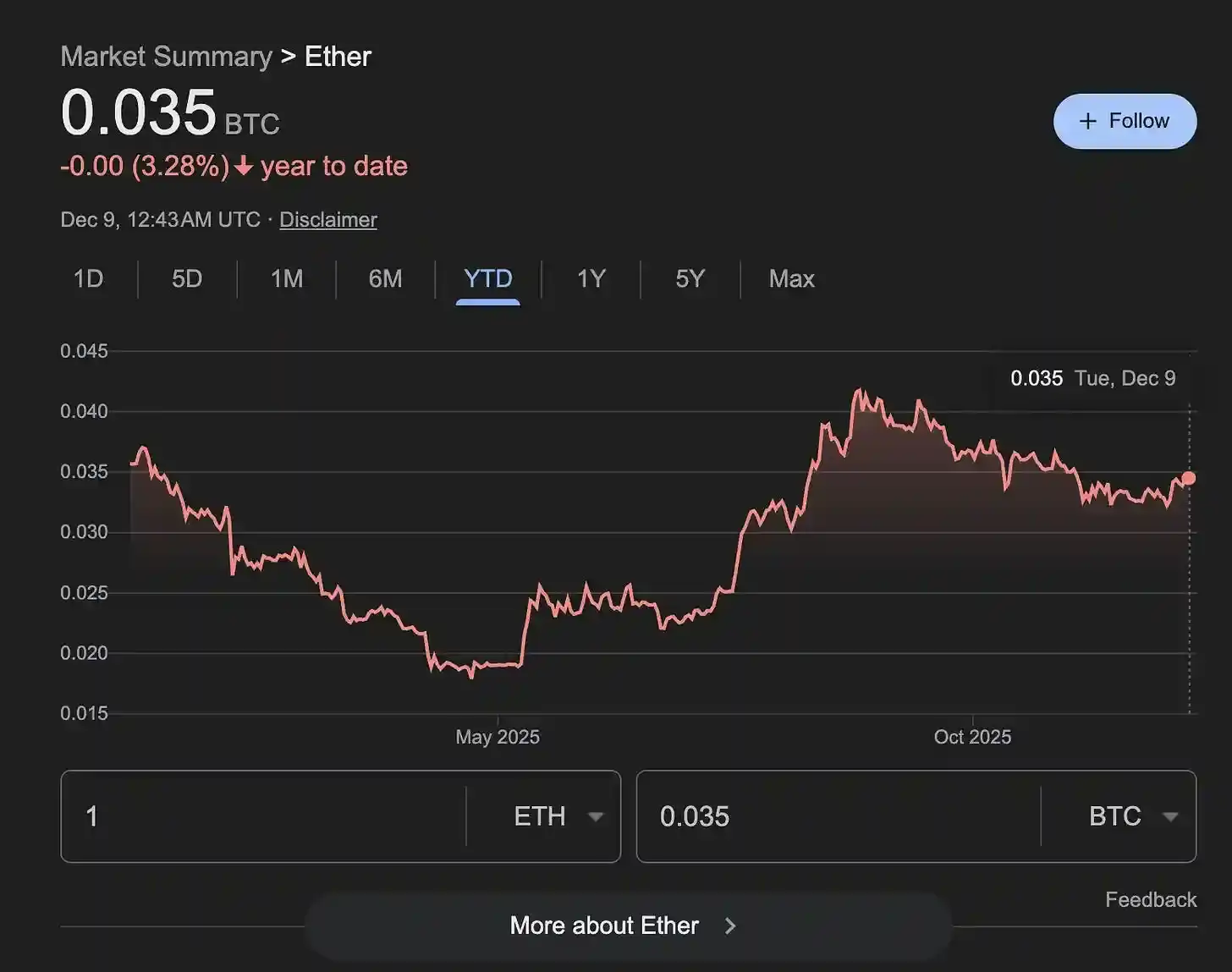
No wonder the ETH/BTC ratio has started to rebound, breaking a three-month downtrend. History has repeated this countless times: whenever ETH leads the recovery, the market enters a brief but fierce "altcoin rebound window."

BitMine now holds $1 billion in cash, and ETH's pullback zone happens to be the perfect place to significantly lower its average cost. In a market where funding is generally tight, institutions that can keep firing are themselves part of the price structure.

ETF Outflows Are Not Flight, But Temporary Withdrawal of Arbitrage Capital

On the surface, Bitcoin ETFs have seen nearly $4 billion in outflows over the past two months, with the price dropping from $125,000 to $80,000, leading the market to quickly draw a crude conclusion: institutions are retreating, ETF investors are panicking, the bull market structure is broken.

But Amberdata offers a completely different explanation.

These outflows are not "value investors fleeing" but "leveraged arbitrage funds being forced to unwind." The primary source is the collapse of a structured arbitrage strategy called the "basis trade." Funds were originally earning a stable spread by "buying spot/shorting futures," but starting in October, the annualized basis fell from 6.6% to 4.4%, spending 93% of the time below the breakeven point, turning arbitrage into losses and forcing the strategy to be dismantled.

This triggered a "two-way action" of ETF selling + futures buybacks.

In traditional terms, capitulation selling typically occurs in extreme emotional environments after continuous declines, where panic peaks, and investors stop trying to cut losses and instead abandon all holdings entirely. Its typical characteristics include: large-scale redemptions across almost all issuers, surging trading volume, cost-indifferent selling pressure, and accompanying extreme sentiment indicators. But this ETF outflow clearly doesn't fit this pattern. Although there were net outflows overall, the direction of funds was inconsistent: for example, Fidelity's FBTC maintained continuous inflows throughout the period, and BlackRock's IBIT even absorbed some incremental funds during the worst phases of net outflows. This shows that the real exodus was only from a minority of issuers, not the entire institutional cohort.

More crucial evidence comes from the distribution of outflows. From October 1 to November 26 (53 days), funds from Grayscale contributed over $900 million in redemptions, accounting for 53% of the total outflow; 21Shares and Grayscale Mini followed closely, together making up nearly ninety percent of the redemption volume. In contrast, BlackRock and Fidelity—the most typical channels for institutional allocation—were net inflows overall. This is completely inconsistent with a true "panic-driven institutional retreat" and looks more like a "localized event."

So, which type of institution was selling? The answer: large funds engaged in basis arbitrage.

The basis trade is essentially a directionally neutral arbitrage structure: funds buy spot Bitcoin (or ETF shares) while shorting futures, profiting from the contango yield. It's a low-risk, low-volatility strategy that attracts significant institutional capital when futures are in contango and funding costs are manageable. However, this model relies on one premise: futures prices must consistently be higher than spot prices, with a stable spread. And starting in October, this premise suddenly disappeared.

According to Amberdata's statistics, the 30-day annualized basis compressed from 6.63% down to 4.46%, with 93% of trading days below the 5% breakeven point required for arbitrage. This meant these trades were no longer profitable, even starting to lose money, forcing funds to exit. The rapid collapse of the basis led to a "systematic unwinding" of arbitrage positions: they had to sell their ETF holdings and simultaneously buy back the futures they had previously shorted to close the arbitrage trade.

This process is clearly visible in market data. The open interest in Bitcoin perpetual contracts fell 37.7% over the same period, a cumulative decrease of over $4.2 billion, with a correlation coefficient of 0.878 to the basis change—almost a synchronous move. This combination of "ETF selling + short covering" is the classic path for basis trade exit; the sudden amplification of ETF outflow规模 was not driven by price panic but was the inevitable result of the arbitrage mechanism collapsing.

In other words, the ETF outflows of the past two months were more like a "liquidation of leveraged arbitrage positions" rather than a "retreat by long-term institutions." It was the unwinding of a highly specialized, structured trade, not panic selling pressure caused by a market sentiment crash.

What's more noteworthy is: after these arbitrage positions are cleared out, the remaining capital structure becomes healthier. Current ETF holdings remain at a high level of approximately 1.43 million Bitcoin, with most shares coming from allocation-oriented institutions, not short-term funds chasing yields. As the leveraged hedging from arbitrageurs is removed, the overall market leverage decreases, there are fewer sources of volatility, and price action will be driven more by "genuine buying and selling forces," not hijacked by forced technical operations.

Amberdata's head of research, Marshall, describes this as a "market reset": after the arbitrage capital retreats, new ETF inflows will be more directional and long-term, structural noise in the market will decrease, and subsequent price movements will more accurately reflect real demand. This means that although it looks like $4 billion flowed out on the surface, it might not be a bad thing for the market itself. On the contrary, it could lay the foundation for the next wave of healthier gains.

If Saylor, Tom Lee, and ETF flows show the attitude of micro-level capital, then the changes happening at the macro level are deeper and more intense. Will the Santa Claus rally come? To find the answer, we might need to look further at the macro picture.

Trump's "Takeover" of the Monetary System

For decades, the Fed's independence has been seen as an "iron law of the system." Monetary power belongs to the central bank, not the White House.

But Trump clearly doesn't agree with this.

Increasing signs show that the Trump team is taking over the Fed in a manner far faster and more thorough than the market expected. It's not just symbolically "replacing the chair with a hawk," but comprehensively rewriting the power distribution between the Fed and the Treasury, changing the balance sheet mechanism, and redefining how the yield curve is priced.

Trump is attempting to restructure the entire monetary system.

Former New York Fed trading desk head Joseph Wang (a long-time researcher of Fed operations) also clearly warned: "The market is clearly underestimating Trump's determination to control the Fed. This change could push the market into a phase of higher risk and higher volatility."

From personnel appointments, policy direction, to technical details, we can see very clear traces.

The most direct evidence comes from personnel arrangements. The Trump camp has placed several key figures in core positions, including Kevin Hassett (former White House economic advisor), James Bessent (key Treasury decision-maker), Dino Miran (fiscal policy智库), and Kevin Warsh (former Fed governor). These individuals share a common trait: they are not traditional "central bank school" and do not insist on central bank independence. Their goal is very clear: to weaken the Fed's monopoly on interest rates, long-term funding costs, and system liquidity, and return more monetary power to the Treasury.

The most symbolic point: it is widely believed that Bessent, considered the most suitable candidate for Fed chair, ultimately chose to remain at the Treasury. The reason is simple: in the new power structure, the Treasury's position can determine the rules of the game more than the Fed chair.

Another important clue comes from changes in term premium.

For the average investor, this indicator might be somewhat unfamiliar, but it is actually the most direct signal for the market to judge "who controls long-term interest rates." Recently, the spread between 12-month and 10-year Treasury yields has approached phase highs again, and this round of increase is not due to an improving economy or rising inflation, but because the market is reassessing: in the future, what determines long-term rates might not be the Fed, but the Treasury.
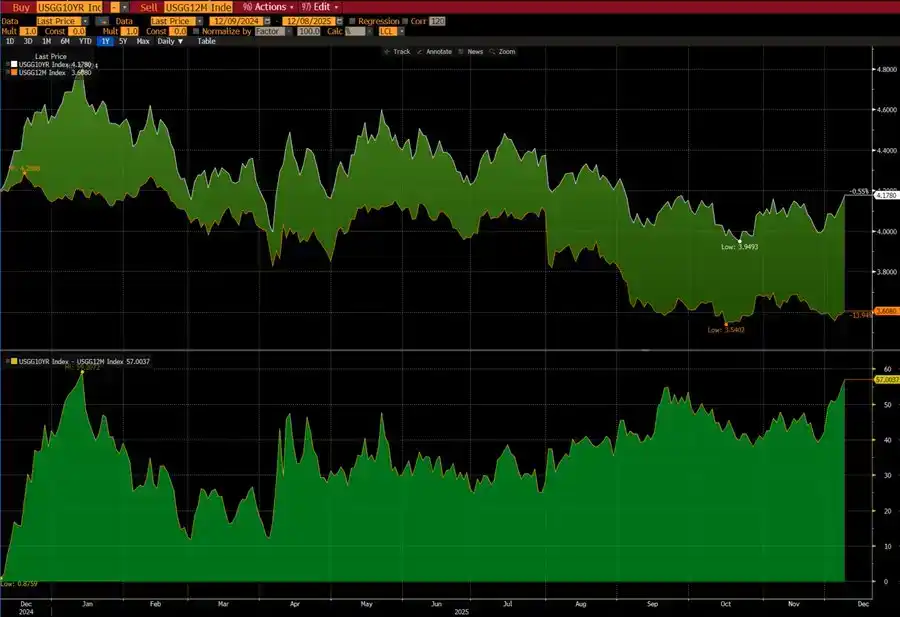
Yields on the 10-year and 12-month Treasury notes are continuing to fall, meaning the market is strongly betting that the Fed will cut rates, and the pace will be faster and more aggressive than previously expected
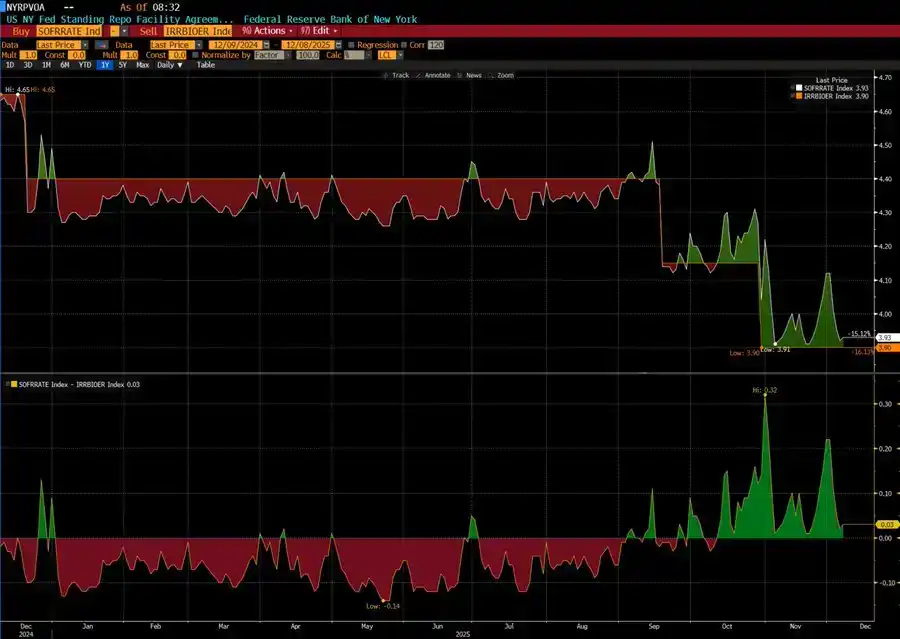
SOFR (Secured Overnight Financing Rate) experienced a cliff-like drop in September, meaning U.S. money market rates suddenly collapsed, signaling a significant loosening in the Fed's policy rate system

The initial spread widening was because the market thought Trump would overheat the economy upon taking office; later, when tariffs and large-scale fiscal stimulus were absorbed by the market, the spread quickly retreated. Now the spread is widening again, reflecting not growth expectations, but uncertainty about the Hassett-Bessent system: if in the future the Treasury controls the yield curve by adjusting debt duration, issuing more short-term debt, compressing long-term debt, etc., then traditional methods of judging long-end rates will become completely obsolete.

More subtle but crucial evidence lies in the balance sheet system. The Trump team frequently criticizes the current "ample reserves system" (where the Fed provides reserves to the banking system by expanding its balance sheet, making the financial system highly dependent on the central bank). But at the same time, they clearly know: current reserves are noticeably tight, and the system actually needs balance sheet expansion to maintain stability.

This contradiction of "opposing balance sheet expansion, yet having to expand" is actually a strategy. They use it as a reason to question the Fed's institutional framework and push for transferring more monetary power back to the Treasury. In other words, they don't want to shrink the balance sheet immediately; they want to use the "balance sheet controversy" as a breakthrough to weaken the Fed's institutional standing.

If we piece these actions together, we see a very clear direction: term premium is compressed, U.S. debt duration is shortened, long-end rates gradually lose independence; banks may be required to hold more U.S. debt; government-sponsored agencies may be encouraged to leverage up and buy mortgage bonds; the Treasury may influence the entire yield structure by increasing short-end debt issuance. Key prices once determined by the Fed will gradually be replaced by fiscal tools.

The result of this might be: gold enters a long-term uptrend, stocks maintain a slow grind higher after volatility, and liquidity gradually improves due to fiscal expansion and repo mechanisms. The market will appear chaotic in the short term, but this is only because the power boundaries of the monetary system are being redrawn.

As for Bitcoin, which the crypto market cares about most, it sits on the periphery of this structural change—not the most direct beneficiary, nor will it be the main battlefield. On the positive side, improved liquidity will put a floor under Bitcoin's price; but looking further out 1-2 years, it will still need to go through a period of re-accumulation, waiting for the framework of the new monetary system to truly become clear.

The U.S. is moving from a "central bank-dominated era" to a "fiscally dominated era."

In this new framework, long-term interest rates may no longer be set by the Fed, liquidity will come more from the Treasury, the central bank's independence will be weakened, market volatility will be greater, and risk assets will face a completely different pricing system.

When the foundation of a system is being rewritten, all prices will behave more "illogically" than usual. But this is a necessary phase as the old order loosens and the new order arrives.

The行情 of the coming months will likely be born from this chaos.

Preguntas relacionadas

QWhat is the main focus of the market regarding the Fed's upcoming interest rate decision, and why?

AThe market is primarily focused not on the interest rate cut itself, but on whether the Federal Reserve will announce a new liquidity injection program, specifically a plan to purchase short-term bonds, which would effectively expand its balance sheet and provide liquidity easing.

QHow are Michael Saylor's MicroStrategy and Tom Lee's BitMine responding to the recent market downturn?

AMicroStrategy made its largest Bitcoin purchase in months, buying approximately $963 million worth of BTC, while BitMine raised cash and purchased $429 million worth of ETH. Both are significantly increasing their crypto holdings despite the price decline, demonstrating a contrarian bullish stance.

QAccording to the analysis, what was the real reason behind the recent outflows from Bitcoin ETFs, and not the reason?

AThe outflows were not due to panic selling or a retreat by long-term institutional investors. Instead, they were primarily caused by the unwinding of 'basis trade' arbitrage strategies, which became unprofitable as the futures premium (contango) collapsed, forcing funds to sell ETF shares and buy back short futures positions.

QWhat fundamental shift in the US monetary system is the article arguing is underway under Trump?

AThe article argues that the US is transitioning from a 'central bank-dominated era' to a 'fiscally dominated monetary era,' where power is shifting from the independent Federal Reserve to the Treasury Department, redefining the control over long-term interest rates, liquidity, and the balance sheet.

QWhat is the expected impact of this potential 'fiscally dominated monetary era' on various asset classes, including Bitcoin?

AGold is expected to enter a long-term upward trend, stocks may maintain a slow grind higher with volatility, and overall liquidity should improve due to fiscal expansion. Bitcoin is on the periphery; it may get a price floor from improved liquidity but likely needs a longer re-accumulation period as the new monetary framework becomes clearer.

Lecturas Relacionadas

Trading

Spot
Futuros

Artículos destacados

Qué es $S$

Entendiendo SPERO: Una Visión General Completa Introducción a SPERO A medida que el panorama de la innovación continúa evolucionando, la aparición de tecnologías web3 y proyectos de criptomonedas juega un papel fundamental en la configuración del futuro digital. Un proyecto que ha atraído la atención en este campo dinámico es SPERO, denotado como SPERO,$$s$. Este artículo tiene como objetivo reunir y presentar información detallada sobre SPERO, para ayudar a entusiastas e inversores a comprender sus fundamentos, objetivos e innovaciones dentro de los dominios web3 y cripto. ¿Qué es SPERO,$$s$? SPERO,$$s$ es un proyecto único dentro del espacio cripto que busca aprovechar los principios de descentralización y tecnología blockchain para crear un ecosistema que promueva la participación, la utilidad y la inclusión financiera. El proyecto está diseñado para facilitar interacciones de igual a igual de nuevas maneras, proporcionando a los usuarios soluciones y servicios financieros innovadores. En su esencia, SPERO,$$s$ tiene como objetivo empoderar a los individuos al proporcionar herramientas y plataformas que mejoren la experiencia del usuario en el espacio de las criptomonedas. Esto incluye habilitar métodos de transacción más flexibles, fomentar iniciativas impulsadas por la comunidad y crear caminos para oportunidades financieras a través de aplicaciones descentralizadas (dApps). La visión subyacente de SPERO,$$s$ gira en torno a la inclusividad, buscando cerrar brechas dentro de las finanzas tradicionales mientras aprovecha los beneficios de la tecnología blockchain. ¿Quién es el Creador de SPERO,$$s$? La identidad del creador de SPERO,$$s$ sigue siendo algo oscura, ya que hay recursos públicos limitados que proporcionan información de fondo detallada sobre su(s) fundador(es). Esta falta de transparencia puede derivarse del compromiso del proyecto con la descentralización, una ética que muchos proyectos web3 comparten, priorizando las contribuciones colectivas sobre el reconocimiento individual. Al centrar las discusiones en torno a la comunidad y sus objetivos colectivos, SPERO,$$s$ encarna la esencia del empoderamiento sin señalar a individuos específicos. Como tal, comprender la ética y la misión de SPERO sigue siendo más importante que identificar a un creador singular. ¿Quiénes son los Inversores de SPERO,$$s$? SPERO,$$s$ cuenta con el apoyo de una diversa gama de inversores que van desde capitalistas de riesgo hasta inversores ángeles dedicados a fomentar la innovación en el sector cripto. El enfoque de estos inversores generalmente se alinea con la misión de SPERO, priorizando proyectos que prometen avances tecnológicos sociales, inclusión financiera y gobernanza descentralizada. Estas fundaciones de inversores suelen estar interesadas en proyectos que no solo ofrecen productos innovadores, sino que también contribuyen positivamente a la comunidad blockchain y sus ecosistemas. El respaldo de estos inversores refuerza a SPERO,$$s$ como un contendiente notable en el dominio de proyectos cripto que evoluciona rápidamente. ¿Cómo Funciona SPERO,$$s$? SPERO,$$s$ emplea un marco multifacético que lo distingue de los proyectos de criptomonedas convencionales. Aquí hay algunas de las características clave que subrayan su singularidad e innovación: Gobernanza Descentralizada: SPERO,$$s$ integra modelos de gobernanza descentralizada, empoderando a los usuarios para participar activamente en los procesos de toma de decisiones sobre el futuro del proyecto. Este enfoque fomenta un sentido de propiedad y responsabilidad entre los miembros de la comunidad. Utilidad del Token: SPERO,$$s$ utiliza su propio token de criptomoneda, diseñado para servir diversas funciones dentro del ecosistema. Estos tokens permiten transacciones, recompensas y la facilitación de servicios ofrecidos en la plataforma, mejorando la participación y la utilidad general. Arquitectura en Capas: La arquitectura técnica de SPERO,$$s$ apoya la modularidad y escalabilidad, permitiendo la integración fluida de características y aplicaciones adicionales a medida que el proyecto evoluciona. Esta adaptabilidad es fundamental para mantener la relevancia en el cambiante paisaje cripto. Participación de la Comunidad: El proyecto enfatiza iniciativas impulsadas por la comunidad, empleando mecanismos que incentivan la colaboración y la retroalimentación. Al nutrir una comunidad sólida, SPERO,$$s$ puede abordar mejor las necesidades de los usuarios y adaptarse a las tendencias del mercado. Enfoque en la Inclusión: Al ofrecer tarifas de transacción bajas e interfaces amigables para el usuario, SPERO,$$s$ busca atraer a una base de usuarios diversa, incluyendo a individuos que anteriormente pueden no haber participado en el espacio cripto. Este compromiso con la inclusión se alinea con su misión general de empoderamiento a través de la accesibilidad. Cronología de SPERO,$$s$ Entender la historia de un proyecto proporciona información crucial sobre su trayectoria de desarrollo y hitos. A continuación se presenta una cronología sugerida que mapea eventos significativos en la evolución de SPERO,$$s$: Fase de Conceptualización e Ideación: Las ideas iniciales que forman la base de SPERO,$$s$ fueron concebidas, alineándose estrechamente con los principios de descentralización y enfoque comunitario dentro de la industria blockchain. Lanzamiento del Whitepaper del Proyecto: Tras la fase conceptual, se lanzó un whitepaper completo que detalla la visión, los objetivos y la infraestructura tecnológica de SPERO,$$s$ para generar interés y retroalimentación de la comunidad. Construcción de Comunidad y Primeras Interacciones: Se realizaron esfuerzos de divulgación activa para construir una comunidad de primeros adoptantes y posibles inversores, facilitando discusiones en torno a los objetivos del proyecto y obteniendo apoyo. Evento de Generación de Tokens: SPERO,$$s$ llevó a cabo un evento de generación de tokens (TGE) para distribuir sus tokens nativos a los primeros seguidores y establecer liquidez inicial dentro del ecosistema. Lanzamiento de la dApp Inicial: La primera aplicación descentralizada (dApp) asociada con SPERO,$$s$ se puso en marcha, permitiendo a los usuarios interactuar con las funcionalidades centrales de la plataforma. Desarrollo Continuo y Alianzas: Actualizaciones y mejoras continuas a las ofertas del proyecto, incluyendo alianzas estratégicas con otros actores en el espacio blockchain, han moldeado a SPERO,$$s$ en un jugador competitivo y en evolución en el mercado cripto. Conclusión SPERO,$$s$ se erige como un testimonio del potencial de web3 y las criptomonedas para revolucionar los sistemas financieros y empoderar a los individuos. Con un compromiso con la gobernanza descentralizada, la participación comunitaria y funcionalidades diseñadas de manera innovadora, allana el camino hacia un paisaje financiero más inclusivo. Como con cualquier inversión en el espacio cripto que evoluciona rápidamente, se anima a los posibles inversores y usuarios a investigar a fondo y participar de manera reflexiva con los desarrollos en curso dentro de SPERO,$$s$. El proyecto muestra el espíritu innovador de la industria cripto, invitando a una mayor exploración de sus innumerables posibilidades. Mientras el viaje de SPERO,$$s$ aún se desarrolla, sus principios fundamentales pueden, de hecho, influir en el futuro de cómo interactuamos con la tecnología, las finanzas y entre nosotros en ecosistemas digitales interconectados.

72 Vistas totalesPublicado en 2024.12.17Actualizado en 2024.12.17

Qué es $S$

Qué es AGENT S

Agent S: El Futuro de la Interacción Autónoma en Web3 Introducción En el paisaje en constante evolución de Web3 y las criptomonedas, las innovaciones están redefiniendo constantemente cómo los individuos interactúan con las plataformas digitales. Uno de estos proyectos pioneros, Agent S, promete revolucionar la interacción humano-computadora a través de su marco agente abierto. Al allanar el camino para interacciones autónomas, Agent S busca simplificar tareas complejas, ofreciendo aplicaciones transformadoras en inteligencia artificial (IA). Esta exploración detallada profundizará en las complejidades del proyecto, sus características únicas y las implicaciones para el dominio de las criptomonedas. ¿Qué es Agent S? Agent S se presenta como un marco agente abierto innovador, diseñado específicamente para abordar tres desafíos fundamentales en la automatización de tareas informáticas: Adquisición de Conocimiento Específico del Dominio: El marco aprende inteligentemente de diversas fuentes de conocimiento externas y experiencias internas. Este enfoque dual le permite construir un rico repositorio de conocimiento específico del dominio, mejorando su rendimiento en la ejecución de tareas. Planificación a Largo Plazo de Tareas: Agent S emplea planificación jerárquica aumentada por la experiencia, un enfoque estratégico que facilita la descomposición y ejecución eficiente de tareas complejas. Esta característica mejora significativamente su capacidad para gestionar múltiples subtareas de manera eficiente y efectiva. Manejo de Interfaces Dinámicas y No Uniformes: El proyecto introduce la Interfaz Agente-Computadora (ACI), una solución innovadora que mejora la interacción entre agentes y usuarios. Utilizando Modelos de Lenguaje Multimodal de Gran Escala (MLLMs), Agent S puede navegar y manipular diversas interfaces gráficas de usuario sin problemas. A través de estas características pioneras, Agent S proporciona un marco robusto que aborda las complejidades involucradas en la automatización de la interacción humana con las máquinas, preparando el terreno para una multitud de aplicaciones en IA y más allá. ¿Quién es el Creador de Agent S? Si bien el concepto de Agent S es fundamentalmente innovador, la información específica sobre su creador sigue siendo elusiva. El creador es actualmente desconocido, lo que resalta ya sea la etapa incipiente del proyecto o la elección estratégica de mantener a los miembros fundadores en el anonimato. Independientemente de la anonimidad, el enfoque sigue siendo en las capacidades y el potencial del marco. ¿Quiénes son los Inversores de Agent S? Dado que Agent S es relativamente nuevo en el ecosistema criptográfico, la información detallada sobre sus inversores y patrocinadores financieros no está documentada explícitamente. La falta de información disponible públicamente sobre las bases de inversión u organizaciones que apoyan el proyecto plantea preguntas sobre su estructura de financiamiento y hoja de ruta de desarrollo. Comprender el respaldo es crucial para evaluar la sostenibilidad del proyecto y su posible impacto en el mercado. ¿Cómo Funciona Agent S? En el núcleo de Agent S se encuentra una tecnología de vanguardia que le permite funcionar de manera efectiva en diversos entornos. Su modelo operativo se basa en varias características clave: Interacción Humano-Computadora Similar a la Humana: El marco ofrece planificación avanzada de IA, esforzándose por hacer que las interacciones con las computadoras sean más intuitivas. Al imitar el comportamiento humano en la ejecución de tareas, promete elevar las experiencias de los usuarios. Memoria Narrativa: Empleada para aprovechar experiencias de alto nivel, Agent S utiliza memoria narrativa para hacer un seguimiento de las historias de tareas, mejorando así sus procesos de toma de decisiones. Memoria Episódica: Esta característica proporciona a los usuarios una guía paso a paso, permitiendo que el marco ofrezca apoyo contextual a medida que se desarrollan las tareas. Soporte para OpenACI: Con la capacidad de ejecutarse localmente, Agent S permite a los usuarios mantener el control sobre sus interacciones y flujos de trabajo, alineándose con la ética descentralizada de Web3. Fácil Integración con APIs Externas: Su versatilidad y compatibilidad con varias plataformas de IA aseguran que Agent S pueda encajar sin problemas en ecosistemas tecnológicos existentes, convirtiéndolo en una opción atractiva para desarrolladores y organizaciones. Estas funcionalidades contribuyen colectivamente a la posición única de Agent S dentro del espacio cripto, ya que automatiza tareas complejas y de múltiples pasos con una intervención humana mínima. A medida que el proyecto evoluciona, sus posibles aplicaciones en Web3 podrían redefinir cómo se desarrollan las interacciones digitales. Cronología de Agent S El desarrollo y los hitos de Agent S pueden encapsularse en una cronología que resalta sus eventos significativos: 27 de septiembre de 2024: El concepto de Agent S fue lanzado en un documento de investigación integral titulado “Un Marco Agente Abierto que Usa Computadoras Como un Humano”, mostrando las bases del proyecto. 10 de octubre de 2024: El documento de investigación fue puesto a disposición del público en arXiv, ofreciendo una exploración profunda del marco y su evaluación de rendimiento basada en el benchmark OSWorld. 12 de octubre de 2024: Se lanzó una presentación en video, proporcionando una visión visual de las capacidades y características de Agent S, involucrando aún más a posibles usuarios e inversores. Estos marcadores en la cronología no solo ilustran el progreso de Agent S, sino que también indican su compromiso con la transparencia y la participación comunitaria. Puntos Clave Sobre Agent S A medida que el marco Agent S continúa evolucionando, varios atributos clave destacan, subrayando su naturaleza innovadora y potencial: Marco Innovador: Diseñado para proporcionar un uso intuitivo de las computadoras similar a la interacción humana, Agent S aporta un enfoque novedoso a la automatización de tareas. Interacción Autónoma: La capacidad de interactuar de manera autónoma con las computadoras a través de GUI significa un salto hacia soluciones informáticas más inteligentes y eficientes. Automatización de Tareas Complejas: Con su metodología robusta, puede automatizar tareas complejas y de múltiples pasos, haciendo que los procesos sean más rápidos y menos propensos a errores. Mejora Continua: Los mecanismos de aprendizaje permiten a Agent S mejorar a partir de experiencias pasadas, mejorando continuamente su rendimiento y eficacia. Versatilidad: Su adaptabilidad en diferentes entornos operativos como OSWorld y WindowsAgentArena asegura que pueda servir a una amplia gama de aplicaciones. A medida que Agent S se posiciona en el paisaje de Web3 y criptomonedas, su potencial para mejorar las capacidades de interacción y automatizar procesos significa un avance significativo en las tecnologías de IA. A través de su marco innovador, Agent S ejemplifica el futuro de las interacciones digitales, prometiendo una experiencia más fluida y eficiente para los usuarios en diversas industrias. Conclusión Agent S representa un audaz avance en la unión de la IA y Web3, con la capacidad de redefinir cómo interactuamos con la tecnología. Aunque aún se encuentra en sus primeras etapas, las posibilidades para su aplicación son vastas y atractivas. A través de su marco integral que aborda desafíos críticos, Agent S busca llevar las interacciones autónomas al primer plano de la experiencia digital. A medida que nos adentramos más en los reinos de las criptomonedas y la descentralización, proyectos como Agent S sin duda desempeñarán un papel crucial en la configuración del futuro de la tecnología y la colaboración humano-computadora.

355 Vistas totalesPublicado en 2025.01.14Actualizado en 2025.01.14

Qué es AGENT S

Cómo comprar S

¡Bienvenido a HTX.com! Hemos hecho que comprar Sonic (S) sea simple y conveniente. Sigue nuestra guía paso a paso para iniciar tu viaje de criptos.Paso 1: crea tu cuenta HTXUtiliza tu correo electrónico o número de teléfono para registrarte y obtener una cuenta gratuita en HTX. Experimenta un proceso de registro sin complicaciones y desbloquea todas las funciones.Obtener mi cuentaPaso 2: ve a Comprar cripto y elige tu método de pagoTarjeta de crédito/débito: usa tu Visa o Mastercard para comprar Sonic (S) al instante.Saldo: utiliza fondos del saldo de tu cuenta HTX para tradear sin problemas.Terceros: hemos agregado métodos de pago populares como Google Pay y Apple Pay para mejorar la comodidad.P2P: tradear directamente con otros usuarios en HTX.Over-the-Counter (OTC): ofrecemos servicios personalizados y tipos de cambio competitivos para los traders.Paso 3: guarda tu Sonic (S)Después de comprar tu Sonic (S), guárdalo en tu cuenta HTX. Alternativamente, puedes enviarlo a otro lugar mediante transferencia blockchain o utilizarlo para tradear otras criptomonedas.Paso 4: tradear Sonic (S)Tradear fácilmente con Sonic (S) en HTX's mercado spot. Simplemente accede a tu cuenta, selecciona tu par de trading, ejecuta tus trades y monitorea en tiempo real. Ofrecemos una experiencia fácil de usar tanto para principiantes como para traders experimentados.

728 Vistas totalesPublicado en 2025.01.15Actualizado en 2025.03.21

Cómo comprar S

Discusiones

Bienvenido a la comunidad de HTX. Aquí puedes mantenerte informado sobre los últimos desarrollos de la plataforma y acceder a análisis profesionales del mercado. A continuación se presentan las opiniones de los usuarios sobre el precio de S (S).

活动图片