On the Eve of the Quantum Computing Wave: Why Nvidia Might Emerge as the Biggest Winner?

比推Publicado a 2026-02-09Actualizado a 2026-02-09

Resumen

Amidst the prevailing market perception that quantum computing remains a distant, sci-fi concept, Barclays' latest research challenges this view, arguing that the technology is on the verge of transitioning from a "lab toy" to a commercial tool. The report highlights several key misconceptions: First, quantum computing is not "too early"; the industry is approaching a watershed moment around 2026–2027 when "quantum advantage" is expected to be demonstrated, requiring stable operation of 100 logical qubits. Second, quantum computers will not replace classical systems like GPUs but instead complement them. Each logical qubit may require a GPU for error correction and control, potentially driving significant demand for chips from companies like NVIDIA and AMD, with projected incremental value exceeding $100 billion by 2040. Third, hardware approaches are not equal. Trapped ions currently lead in precision, silicon spin offers scalability potential, and neutral atoms excel in qubit count. Fourth, quantum computers are not yet powerful enough to break modern encryption, requiring thousands of logical qubits—far beyond current capabilities. Finally, the investment landscape is broader than often assumed, with opportunities across quantum processors, supply chains, semiconductor manufacturing, and enabling infrastructure, spanning both public and private companies.

Author: Long Yue

Original Title: The Biggest Misconception About "Quantum Computing": It's Still "Too Early"


Investors generally believe that quantum computing is still in the realm of science fiction, but Barclays' latest research note points out that this "too early" illusion might cause you to miss the most critical trend in the next 12 months.

According to news from the trading desk, Barclays' analyst team has recently released a research report titled "Quantum Computing: Correcting Investors' Biggest Misconception".

The core logic is very straightforward: Wall Street is underestimating the speed of the technology explosion and completely misunderstanding the relationship between quantum and classical computing power (like Nvidia's). Barclays believes we are on the eve of transitioning from a "lab toy" to a "commercial tool".

Misconception 1: Quantum Computing is "Too Early"

Barclays' first correction is: Don't treat quantum computing as a purely long-term theme that "won't yield results for another decade".

The current market consensus is that perfectly functioning "Fault-Tolerant Quantum Computing" (FTQC) won't arrive until after 2030. This is correct, but Barclays reminds investors not to ignore the intermediate "tipping point".

Barclays points out that 2026 to 2027 will be the industry's watershed moment, achieving "Quantum Advantage".

More importantly is "how to define advantage". Barclays believes that "advantage is only proven when a system targets 100 logical qubits". It also cautions that any "claim of advantage" needs to be backed by "strong technical data"; otherwise, it's more like marketing than an inflection point.

"We expect major announcements within the next 12 months...... Quantum advantage will be proven when a system can stably run 100 logical qubits."

This is like the Wright brothers' first flight; although it couldn't carry passengers (commercialization), it proved that airplanes were better than horse-drawn carriages (quantum advantage). Once this signal appears, the valuation logic of the capital market will be instantly reshaped.
Misconception 2: Quantum is coming, it will replace classical computing, so Nvidia is finished?

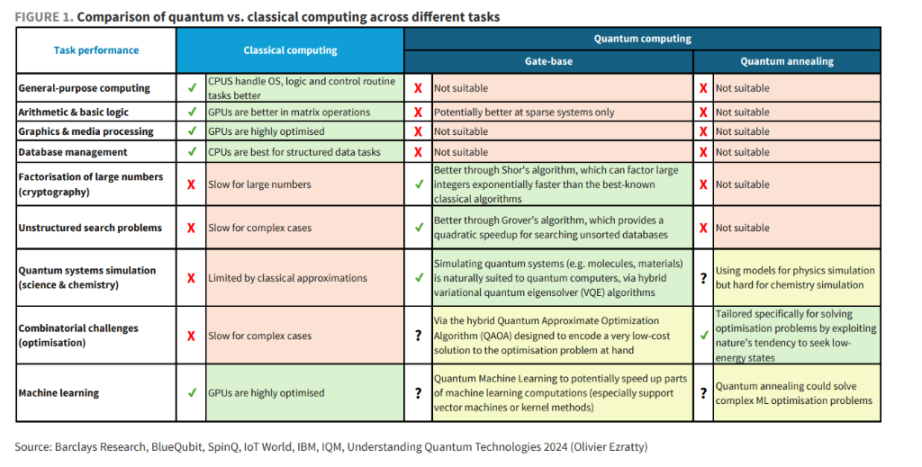
This is the market's biggest cognitive bias. The report points out that many people think quantum computers are so powerful they will replace current CPUs and GPUs. Barclays refutes this: it's not a replacement relationship, but a "strongest assistant" relationship.

"Quantum computers will not replace classical computers as general-purpose machines but will complement them."

The core logic behind this is "error correction": Qubits are very fragile and unstable (prone to errors). To make them work properly, an extremely powerful classical computing system is needed to monitor and correct them in real-time.

Barclays' research reveals a startling data relationship:

"Each logical qubit might require one GPU for error correction and control."

What does this mean? If you build a quantum computer with 1000 logical qubits, you would need to purchase 500 to 2000 GPUs to support it.

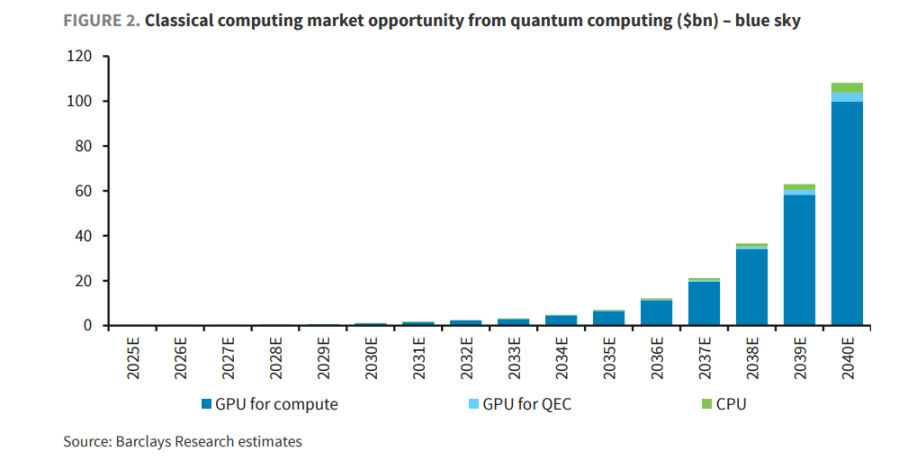
This is no longer competition; it's symbiosis. The stronger the quantum computer, the more explosive the demand for chips from Nvidia and AMD. Barclays calculates that this "derived demand" could bring over $100 billion in incremental value to the classical computing market by 2040 in a blue-sky scenario.
Misconception 3: Quantum hardware is all similar, like buying a lottery ticket?

The truth about this misconception is that the field has already diverged, with clear leaders and laggards.

Quantum hardware paths are not singular. Barclays categorizes mainstream physical qubit paths into electronic (superconducting, electron spin), atomic (trapped ions, neutral atoms), and photonic, among others, noting that their pros and cons stem from trade-offs between speed, accuracy, coherence time, external infrastructure (cryogenics, lasers, vacuum), and scalability.

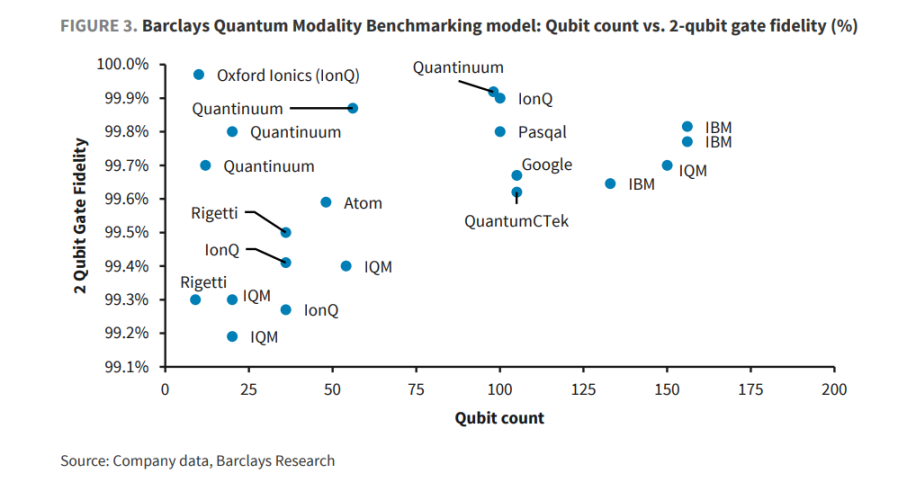
Using a "quantum benchmarking model," Barclays highlights the key points in the currently chaotic hardware landscape:

  • Current "Accuracy King" — Trapped Ions: Represented by companies like Quantinuum and IonQ. Their advantage is accuracy, low error rates, and relatively mature technology.

  • Future "Mass Production Dark Horse" — Silicon Spin: The direction Intel is pursuing. Although performance is currently average, it can leverage existing semiconductor fabs for manufacturing. Once it breaks through, it's the easiest to mass-produce.

  • Winning by Numbers — Neutral Atoms: Have a natural advantage in stacking large numbers of qubits.

Barclays concludes:

"Our testing indicates that trapped ions are currently in the lead...... but the scalability of silicon spin deserves long-term attention."
Misconception 4: Passwords are about to be cracked?

Regarding the panic that "quantum computers will crack bank passwords tomorrow," Barclays pours cold water on it: Think again, the computing power isn't there yet.

Cracking current RSA encryption requires thousands of perfect logical qubits, while humanity's top equipment currently only has a few dozen. Barclays states bluntly:

"Quantum computers are not yet powerful enough...... modern encryption standards are not yet under threat."

Misconception 5: The quantum theme has "only two or three companies worth investing in"

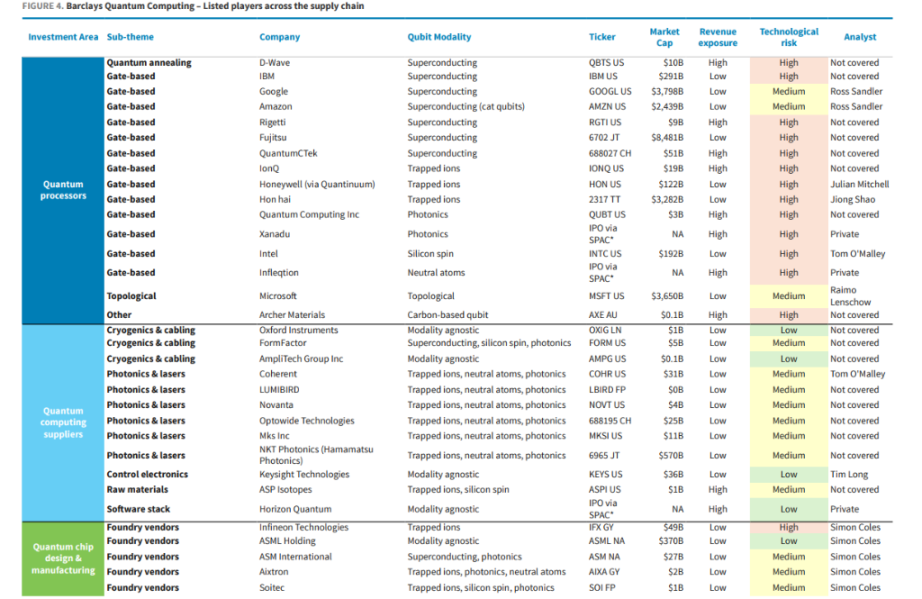
The market often believes investment targets in this field are scarce, limited to a few well-known companies. But Barclays梳理ed the entire industry chain, identifying 45 listed companies and over 80 private companies. They are mainly distributed across four areas:

1) Quantum Processors (system sales or QCaaS cloud access)

2) Quantum Supply Chain (cryogenics, lasers/optics, control electronics, materials, etc.)

3) Quantum Chip Design and Manufacturing (overlap with traditional semiconductor manufacturing)

4) Ecosystem Enablers (cloud, data center infrastructure, quantum simulators, quantum-classical integration: GPU/CPU/servers, etc.)

The framework provided by the report leans more towards "risk pricing": short-term often means "higher revenue exposure" corresponds to "higher technical risk". It roughly categorizes technical risk as high (single path), medium (few paths), low (path agnostic) based on whether the business model is tied to a single path.

This also explains why the quantum narrative easily "focuses solely on pure quantum hardware stocks": their revenue exposure is most direct, but their path uncertainty is also greatest; whereas the supply chain, semiconductor equipment & EDA, cloud & data centers, and hybrid integration segments might better capture the transmission of "quantum progress → capital expenditure and supporting demand".

Twitter:https://twitter.com/BitpushNewsCN

Bitpush TG Discussion Group:https://t.me/BitPushCommunity

Bitpush TG Subscription: https://t.me/bitpush

Original link:https://www.bitpush.news/articles/7610362

Preguntas relacionadas

QWhat is the core argument of Barclays' report regarding the timeline for quantum computing?

ABarclays argues that the market underestimates the speed of quantum computing's development, with the 'quantum advantage' expected to be demonstrated between 2026 and 2027 when systems can stably run 100 logical qubits, a critical inflection point that is not a distant future event.

QAccording to Barclays, what is the relationship between quantum computers and classical computing hardware like GPUs?

AIt is a symbiotic, not competitive, relationship. Quantum computers require powerful classical systems for error correction and control, with each logical qubit potentially needing one GPU. This creates massive demand for GPUs from companies like NVIDIA and AMD as quantum computing scales.

QWhich quantum hardware technology is currently leading in terms of 'precision' according to the Barclays benchmark model?

ATrapped ions, represented by companies like Quantinuum and IonQ, are currently the 'precision king' due to their low error rates and relative technological maturity.

QDoes Barclays report suggest that current encryption standards are immediately threatened by quantum computers?

ANo, it states that quantum computers are not yet powerful enough to threaten modern encryption standards like RSA, as this would require thousands of perfect logical qubits, far beyond current capabilities of a few dozen.

QHow does Barclays categorize the investment landscape for quantum computing beyond just hardware companies?

ABarclays identifies a broad ecosystem of over 45 public and 80 private companies across four main areas: quantum processors, the quantum supply chain (cryogenics, lasers, etc.), quantum chip design/manufacturing, and ecosystem enablers (cloud, data centers, integration hardware like GPUs).

Lecturas Relacionadas

Cyclical Stock or Growth Stock? Coinbase's Q2 Earnings Report Reveals 'Valuation Disagreement'

Coinbase's Q2 2026 financial results revealed a mixed performance, reigniting debate over whether the company should be valued as a cyclical stock tied to crypto markets or a growth stock with future potential. Total revenue missed expectations at $1.22 billion, down 19% year-over-year. Transaction revenue fell to $599 million, with retail crypto spot trading revenue dropping 30% to $452 million, back to 2023 levels. The company reported a net loss of $359 million, marking its third consecutive quarterly loss. Despite CEO Brian Armstrong's positive commentary on metrics like a 10.3% overall crypto trading market share and 106% growth in prediction markets, the market reacted negatively, with shares dropping over 5% after-hours. A key issue is the decline in core retail trading. While Coinbase touted record market share, this figure includes derivatives and new products. Its traditional crypto spot trading share is likely shrinking. New ventures like prediction markets, while growing, contributed less than $30 million, insufficient to offset the core revenue decline. The valuation debate hinges on perspective. As a cyclical stock, Coinbase remains deeply tied to the crypto bear market, with user attrition and competitive pressures justifying a lower valuation. The company's strategy appears focused on surviving until the next bull cycle. Viewed as a growth stock, however, Coinbase shows promising diversification. Subscription and service revenue reached $555 million, nearly matching transaction revenue. Stablecoin revenue, its second-largest source at $292 million, remains strong through its partnership with Circle. Critically, Coinbase is positioning itself as a leader in the emerging on-chain "agent economy." Over 90% of agent-based stablecoin transactions occur on its Base network, which it believes could handle trillions in future agent transactions. The recent acquisition of Deribit also aims to boost its international derivatives offering. In summary, Coinbase's present struggles are clear, but its future hinges on whether its investments in revenue diversification, stablecoins, and the agent economy can ultimately transform its business model and justify a growth premium.

Odaily星球日报Hace 6 min(s)

Cyclical Stock or Growth Stock? Coinbase's Q2 Earnings Report Reveals 'Valuation Disagreement'

Odaily星球日报Hace 6 min(s)

Global Market Share Survey: Japanese Firms Lead in Semiconductor Materials

Global Market Share Survey: Japanese Firms Lead in Semiconductor Materials According to the 2025 "Major Goods and Services Market Share Survey" by Nikkei, Japanese companies maintain strong positions in semiconductor-related materials. In silicon wafers, Shin-Etsu Chemical ranks first with a 26.3% share, followed by SUMCO at 17.8%. Together, they hold 44.1% of the market, widening their lead over competitors from Taiwan, Germany, and South Korea. In photoresists, Tokyo Ohka Kogyo, JSR, and Shin-Etsu Chemical occupy the top three spots, with a combined share of 60.5%. Despite their strength in materials, Japanese firms have a weaker presence in core semiconductor segments like DRAM and NAND flash memory, where South Korean and U.S. companies dominate. For instance, SK Hynix and Samsung lead in DRAM, while China’s CXMT doubled its share to 6% in 2025. The semiconductor market is projected to grow rapidly, with WSTS forecasting a 90% increase to $1.5112 trillion by 2026. Major players like Samsung, SK Hynix, and Micron are making massive investments to expand capacity. To maintain their edge in materials, Japanese companies must similarly commit to large-scale, risk-taking investments. In contrast, Japan’s automotive sector shows stagnation. Toyota remains the global leader but with only a slight share increase to 12.3%, while Japanese brands are absent from the top five in the EV market. In shipbuilding, Imabari Shipbuilding rose to third place globally with a 7.2% share, benefiting from large container ship deliveries. However, Chinese and South Korean firms dominate the sector, holding the top two positions. Japan aims to revitalize its shipbuilding industry through government and corporate efforts, targeting a near doubling of output by 2035. Addressing labor shortages and adopting advanced technologies like physical AI will be critical for competitiveness.

marsbitHace 31 min(s)

Global Market Share Survey: Japanese Firms Lead in Semiconductor Materials

marsbitHace 31 min(s)

Trading

Spot
活动图片