On-Chain Migration of Precious Metal Assets: WEEX Expands Tokenized Gold and Silver Trading Layout Amid Rising RWA Narrative

marsbitPublicado a 2025-12-31Actualizado a 2025-12-31

Resumen

Amidst global financial market volatility driven by high interest rates and geopolitical uncertainties, gold and silver are gaining renewed attention as stable value assets. This cycle, however, extends beyond traditional finance into the crypto market through the tokenization of real-world assets (RWA). Precious metals tokenization, exemplified by projects like PAX Gold (PAXG), Tether Gold (XAUt), and silver ETF token SLVON, enables 24/7 trading on blockchain. This shift enhances price discovery, liquidity, and accessibility while maintaining 1:1 backing with physical assets. WEEX Exchange has expanded its offerings to include spot and合约 trading for these tokenized metals, positioning itself as a neutral infrastructure provider focused on robust risk management and continuous trading capabilities. The platform emphasizes that RWA integration requires mature technical and operational frameworks to support all-hour markets. Beyond precious metals, this trend signals a broader move toward diversified RWA adoption, with future expansion likely to include more asset types. The focus is shifting from mere on-chain representation to trading depth, liquidity quality, and risk control—key factors in the evolving crypto-traditional finance bridge.

Over the past period, global financial markets have continued to fluctuate in an environment intertwined with high interest rates, geopolitical tensions, and macroeconomic uncertainties. In contrast to the volatility of risk assets, the market has been reassessing stable value assets and real-world asset-anchored targets. Precious metals such as gold and silver, as some of the oldest value storage assets, have once again become a key focus for institutions and investors.

Unlike previous cycles, this wave of attention is not confined to the traditional financial system but is extending into the crypto market. As blockchain infrastructure gradually matures, the tokenization of real-world assets (RWA) is moving from concept to practice, with precious metals being regarded as one of the most representative early adoption scenarios.
From "Holding Physical Gold and Silver" to "On-Chain Mapping," Precious Metals Are Undergoing Structural Changes

In the traditional financial system, precious metal investments have long faced issues such as limited trading hours, fragmented liquidity, and high交割 and custody costs. Even participation through financial instruments like ETFs relies on specific market hours and makes it difficult to manage alongside other assets in a unified manner.

The emergence of precious metal tokenization is not fundamentally about reshaping the attributes of gold and silver but rather about upgrading the trading form and market structure. By anchoring physical gold and silver to on-chain tokens in a 1:1 ratio, these assets can enter the crypto market system, which operates 24/7, showcasing new possibilities in price discovery efficiency, liquidity, and composability.

The emergence of precious metal tokenization does not alter the value attributes of gold and silver but instead incorporates them into the 7×24-hour continuously operating crypto market system through on-chain mapping. This means that precious metal prices are no longer passively reflected during limited trading windows but can continuously undergo price discovery and trading matching in the global market.

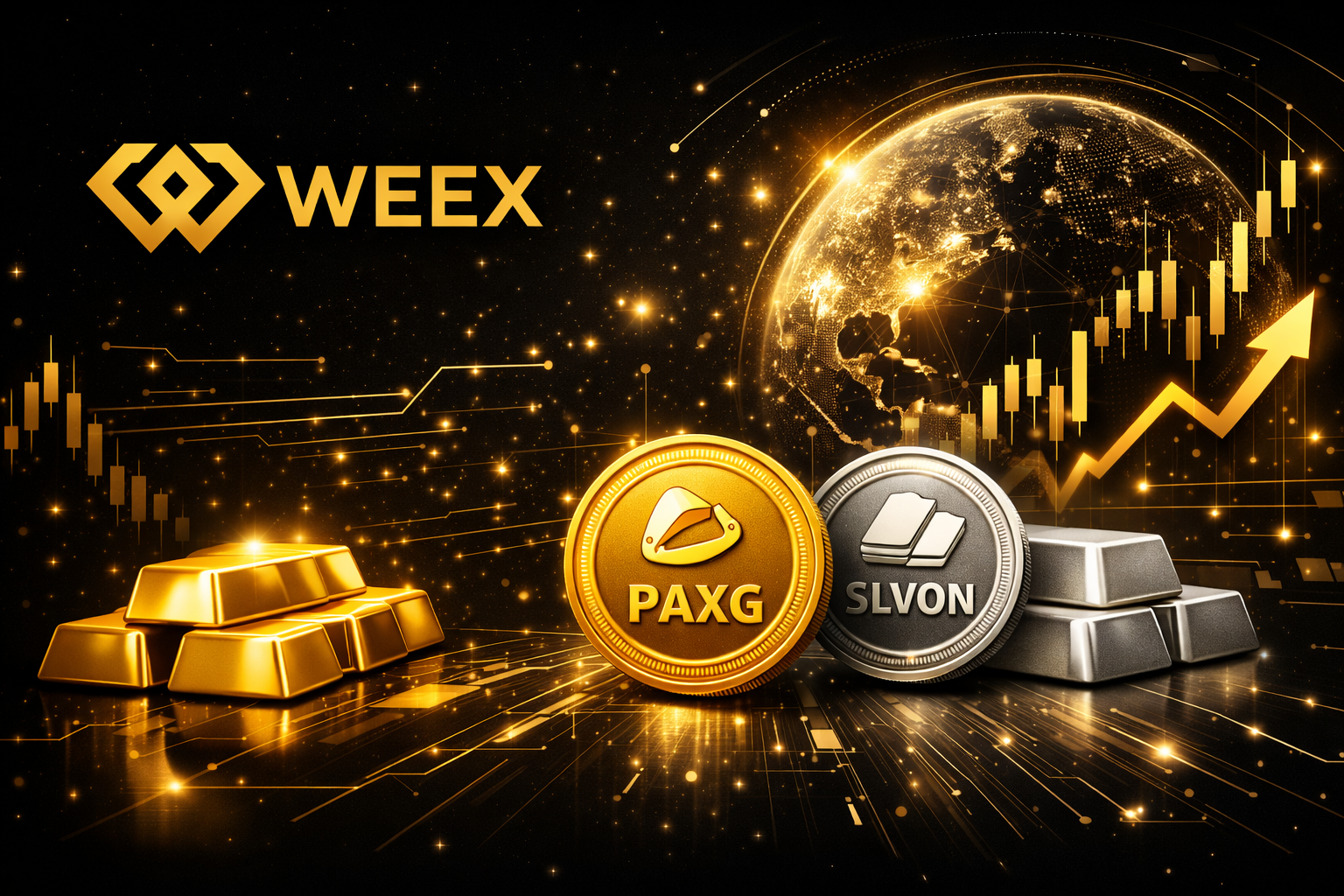
Taking the relatively mature tokenized gold projects PAX Gold (PAXG) and Tether Gold (XAUt), currently listed on WEEX Exchange, as examples, their core value does not lie in the "decentralization narrative" but in providing a higher-frequency, more transparent, and more accessible trading form for precious metals. The tokenized silver project SLVON further extends this logic to the precious metal ETF space, enabling traditional financial assets to participate in global trading in digital form.

It is widely believed within the industry that the emergence of such assets represents a relatively low-risk and low-cognitive-cost step in the process of RWA entering the crypto market.

WEEX: Building a Complete 7×24-Hour Trading Scenario for Precious Metal Tokens

As RWA assets gradually enter the on-chain market, the role of trading platforms is also evolving. Platforms are no longer merely "asset listing parties" but need to strike a balance between asset screening, trading structure design, risk control, and user awareness.

WEEX Exchange recently announced the listing of spot and contract trading for tokenized gold PAXG, XAUt, and tokenized silver ETF project SLVON, covering various trading scenarios and providing users with more comprehensive trading options for precious metal assets.

Unlike the listing of a single asset, the core of WEEX's current layout lies in the systematic introduction of stable-value assets and their integration into a 7×24-hour trading system. By combining spot and contract trading, users can not only participate in precious metal price fluctuations at any time but also conduct more flexible risk management and strategy adjustments during market changes.

Ethan, Co-founder and Chief Security Officer of WEEX, stated in a previous public exchange that RWA is not a short-term narrative but a long-term project with extremely high requirements for trading infrastructure. "When real-world assets enter the on-chain market, and trading hours shift from 'limited periods' to '24/7 operation,' platforms need to possess more stable system architectures and more mature risk control mechanisms to sustain the continuous trading demand for such assets."

In his view, trading platforms should play the role of neutral infrastructure providers in the RWA process, rather than merely pursuing the expansion of asset quantities. This also means that when introducing real-world assets like precious metals, platforms need to maintain a balance between liquidity, trading continuity, and risk control.

Starting with Precious Metals, RWA Asset Trading Is Moving Towards Diversification

From a longer-term perspective, precious metal tokenization is not the end goal but rather a "stress test" for RWA assets entering the crypto market. Their trading activity, user participation, and risk performance are providing reference samples for the subsequent onboarding of more real-world assets.

Based on this assessment, WEEX Exchange is simultaneously advancing the construction of a precious metals trading zone and may gradually launch more types of precious metal token projects in the future, expanding the coverage of real-world asset trading.
From the industry's perspective, as RWA-related products gradually increase, the market's focus will shift from "whether assets are on-chain" to trading depth, liquidity quality, and risk management capabilities. This also places higher demands on trading platforms.

In the evolving crypto market, tokenized precious metals may represent not a short-term hot asset but a transitional form connecting traditional finance and the crypto market. The infrastructure development围绕 this form is becoming an important direction for the differentiated competition among trading platforms.


Preguntas relacionadas

QWhat is the core value proposition of tokenized gold and silver assets like PAXG, XAUt, and SLVON according to the article?

AThe core value proposition is not about decentralization, but about providing a higher-frequency, more transparent, and more accessible trading form for precious metals, integrating them into a 7x24-hour continuous crypto market system for more efficient price discovery and liquidity.

QHow does the article describe the role of trading platforms like WEEX in the RWA tokenization process?

AThe article states that platforms are evolving from being mere 'asset listing parties' to acting as neutral infrastructure providers. They must balance asset selection, trading structure design, risk control, and user understanding, requiring stable system architecture and mature risk mechanisms to handle continuous trading.

QWhat are the traditional challenges of investing in precious metals that tokenization aims to solve?

ATraditional challenges include limited trading hours, fragmented liquidity, and high costs associated with physical delivery and custody. Even participation through ETFs is restricted to specific market hours and is difficult to manage alongside other assets in a unified way.

QWhat broader trend does the tokenization of precious metals represent beyond just a new asset class?

AIt represents a 'stress test' and a transitional form connecting traditional finance with crypto markets. It is seen as a relatively low-risk, lower-cognitive-cost step for RWA entering the crypto space, paving the way for more diverse real-world assets to be tokenized.

QWhat future developments does the article mention for WEEX's involvement in RWA trading?

AThe article mentions that WEEX is advancing the construction of a precious metals trading zone and may subsequently launch more types of precious metal token projects, gradually expanding the coverage of real-world asset trading on its platform.

Lecturas Relacionadas

How Does Codex Use a Computer? Three Entry Points and Permission Boundaries

This article explains the three primary methods for Codex to interact with a computer, each with distinct use cases, permission boundaries, and trust levels. **1. Computer Use:** This offers the broadest access, allowing Codex to visually control and interact with the graphical user interface of authorized macOS/Windows apps, system settings, and even iOS simulators. It's ideal for tasks lacking APIs or structured tools, such as operating legacy software or multi-app workflows. However, it's the slowest method and has the widest permission scope, requiring careful supervision for sensitive actions. **2. Chrome Extension:** This grants Codex access to the user's logged-in Chrome browser state, including cookies, profiles, and open tabs. It's best for tasks requiring user identity across websites like Gmail, LinkedIn, Salesforce, or internal dashboards. Its key advantage is multi-tab control for complex workflows. While more powerful for browser-based tasks than Computer Use, it carries higher sensitivity as actions are performed under the user's identity. **3. In-App Browser:** This is a browser isolated within the Codex thread, separate from the user's personal browsing data. It excels in web development and debugging scenarios—previewing local servers, testing responsive layouts, or annotating designs directly on the page. Its isolation is a strength for development but a limitation for tasks requiring login sessions. The core principle is to choose the narrowest, safest, and most structured interface for the task. Use plugins or MCPs first, resort to visual control (Computer Use) only for GUI-dependent tasks, employ the Chrome extension for identity-reliant browser work, and prefer the In-App Browser for isolated development. **Appshots** are clarified as a fourth, complementary tool for *inputting* context—capturing a screenshot of a window to point Codex to something—rather than a method for Codex to *act*. Together, this layered approach highlights a key to AI agent productization: not granting unlimited permissions, but constraining them within clear boundaries for specific tasks while preserving user oversight.

marsbitHace 42 min(s)

How Does Codex Use a Computer? Three Entry Points and Permission Boundaries

marsbitHace 42 min(s)

The "Iron Rule" of Chip Equipment Is Being Broken

For years, the semiconductor equipment industry followed an unwritten "iron rule": suppliers offered steep discounts for new tool introductions (Design-in) and faced consistent price pressure during repeat orders, especially during market downturns. This long-standing buyer's market dynamic is now being upended. Recently, SK Hynix's primary equipment suppliers have reportedly requested a 3-4% price *increase*, a nearly unprecedented move. This shift is driven by a severe supply-demand imbalance fueled by the AI compute boom. Securing equipment has become an urgent arms race as chipmakers' expansion speed dictates their ability to fulfill massive AI chip orders. Key areas feeling the strain include: **TCB (Thermal Compression Bonding) Equipment:** Demand is exploding, driven by the simultaneous needs of HBM4 memory stacking, AI chip Chip-on-Substrate (C2S), and logic Chiplet Chip-on-Wafer (C2W) packaging. Players like Hanmi Semiconductor, Hanwha Semitech, and ASMPT are receiving major orders. While hybrid bonding is seen as the future, TCB remains the pragmatic choice for HBM4 mass production, with its lifecycle extended by relaxed specifications and ongoing technological upgrades. **Test Equipment Bottlenecks:** Ironically, AI-driven shortages are now crippling test equipment manufacturing. Critical components like FPGAs, Driver ICs, and CPUs face severe shortages and extended lead times (up to 52 weeks for FPGAs), as AI data center and server vendors prioritize supply. This creates a paradoxical cycle: AI chip shortages drive fab expansion, which requires more test equipment, whose production is delayed because its key parts are diverted to make AI chips. The industry is entering a broad, AI-powered upcycle. SEMI forecasts global semiconductor equipment sales to hit a record $156 billion by 2027, fueled by investment in advanced logic/foundry, HBM-driven DRAM, and advanced packaging (like CoWoS). Major players like TSMC, SK Hynix, and Micron are aggressively ramping capital expenditure. In conclusion, leading equipment vendors are no longer just selling tools; they are selling the critical capability to deliver AI-era capacity. Pricing power is shifting decisively to those with indispensable technology in key process nodes like advanced logic, HBM, and advanced packaging, rewriting the industry's traditional power structure.

marsbitHace 55 min(s)

The "Iron Rule" of Chip Equipment Is Being Broken

marsbitHace 55 min(s)

Trading

Spot
Futuros
活动图片