On-Chain Data Analysis of Tudou Guarantee's Shutdown Event: A Chain-Based 'Black Industry Migration' Triggered by US Sanctions

marsbitPublicado a 2026-01-19Actualizado a 2026-01-19

Resumen

On January 16, Tudou Guarantee announced the cessation of its services and the closure of all public groups. Beosin Trace conducted an on-chain data analysis of the incident, revealing that Tudou was a major black/grey market escrow platform on Telegram. After the shutdown of Huione Guarantee in May 2025, Tudou became its main successor, experiencing a significant increase in transaction volume. However, from December 2025, Tudou's deposit activities declined sharply, with almost no activity after January 10, 2026. A refund address saw a spike in outflows on January 11, aligning with the platform’s shutdown preparations. Many former Tudou merchants migrated to Xinbi Guarantee, which saw a surge in USDT deposits, averaging 2,700–2,800 transactions per day between January 8–16. These addresses have been flagged as high-risk by Beosin KYT. The shutdown is linked to increased U.S. sanctions targeting Southeast Asian cybercrime throughout 2025, including actions against entities in the Philippines, Cambodia, and Myanmar, which disrupted illegal operations and forced platforms like Huione and Tudou to cease operations.

On January 16, Tudou Guarantee announced that it would cease operations and disband all public groups effective immediately. Regarding this Tudou Guarantee shutdown event, the Beosin team conducted a statistical analysis of transaction data from related addresses using the blockchain tracking and analysis tool Beosin Trace, and shares the results as follows:
Tudou Guarantee: One of the Largest Escrow Platforms

In various illegal/suspicious transaction scenarios, the two parties involved often require an "escrow" middleman role to facilitate and complete the transaction. The core function of an escrow platform is to act as an intermediary guarantor throughout the entire transaction process, providing a trust guarantee for both parties.

As an emerging type of matching platform, escrow platforms have seen rapid growth in both user base and capital volume in recent years. According to statistics from Beosin, in 2025, the number of users placing deposits on mainstream escrow platforms exceeded 330,000, the number of deposit transactions exceeded 1.26 million, and the total deposit transaction volume exceeded 8.7 billion USDT.

Tudou Guarantee was a platform providing black and gray market escrow services via Telegram. After Huione Guarantee was shut down by Telegram in May 2025, it became the primary successor to Huione Guarantee. Huione Guarantee transferred its business to Tudou Guarantee through means such as acquiring shares and redirecting customers. The deposit transaction volumes for the two platforms in 2025 are shown in the figure below:
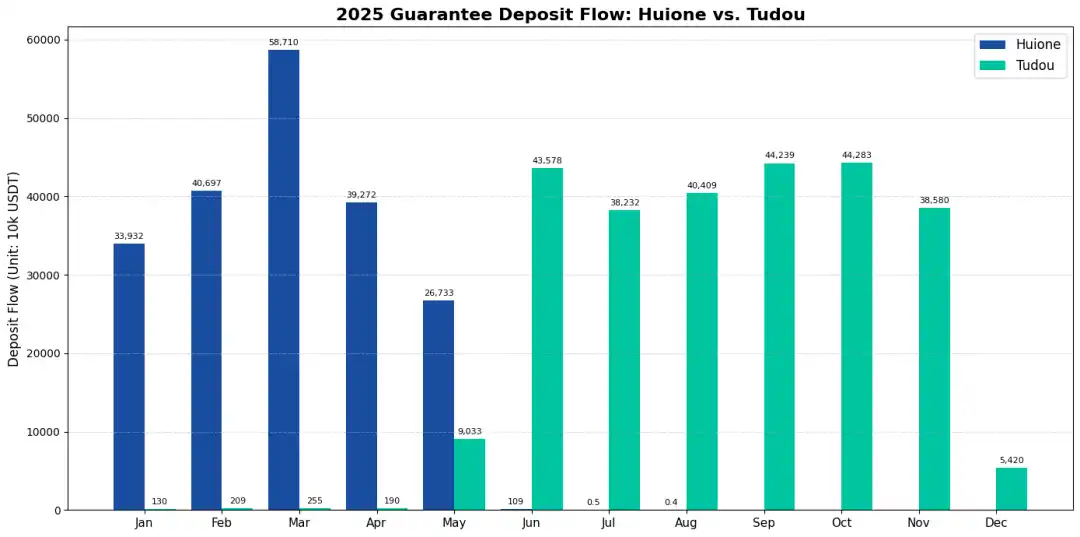
As can be seen from the figure, after Huione Guarantee was banned in May 2025, Tudou Guarantee's transaction volume began to rise significantly, before seeing a sharp decline in December. On January 16, 2026, Tudou Guarantee officially announced it was ceasing operations.

Significant Business Contraction Since December Last Year

By analyzing Tudou Guarantee's deposit addresses and refund addresses using Beosin Trace, we can observe that starting from December 2025, the number of transactions on its deposit addresses decreased sharply, with almost no activity after January 10, 2026.
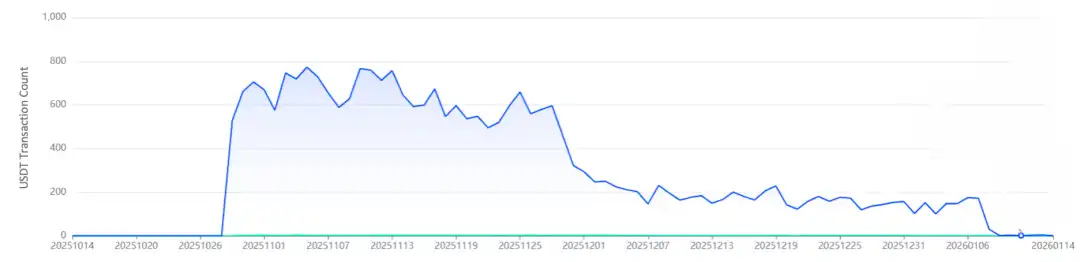
Beosin Trace Statistical Data

On January 11, 2026, Tudou Guarantee's refund addresses experienced a peak in the number of fund outflows, coinciding with the period when Tudou Guarantee was preparing to cease operations and refund users.
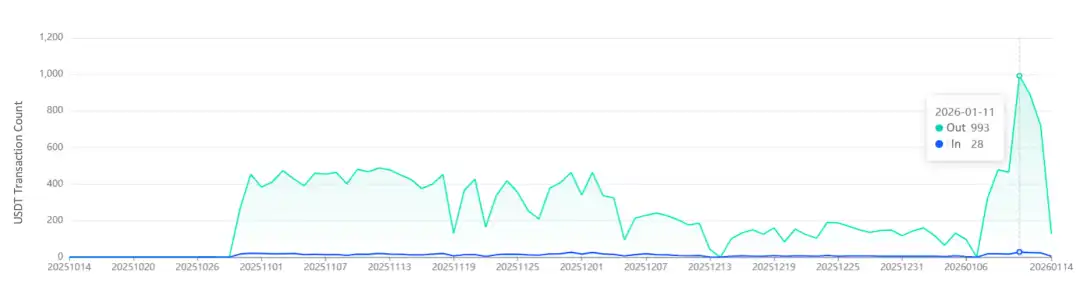
Beosin Trace Statistical Data

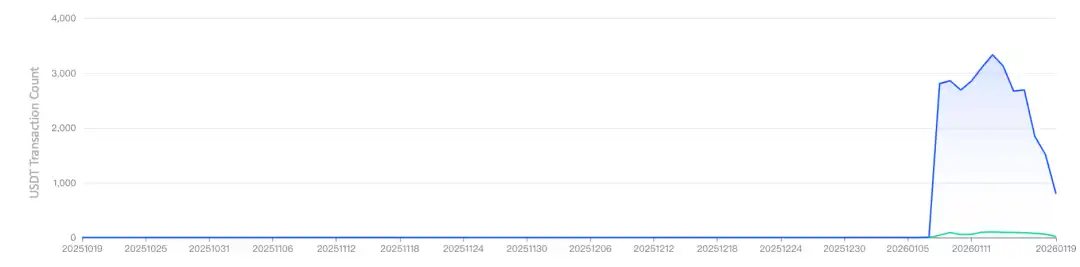
Currently, some merchants formerly with Tudou Guarantee, after receiving refunds, have directly moved to Xinbi Guarantee to place deposits and continue their operations. The on-chain activity data for its deposit addresses is shown below. From January 8 to 16, the number of daily USDT inflow transactions to Xinbi Guarantee's deposit addresses remained at 2700-2800/day, indicating a surge in business volume:
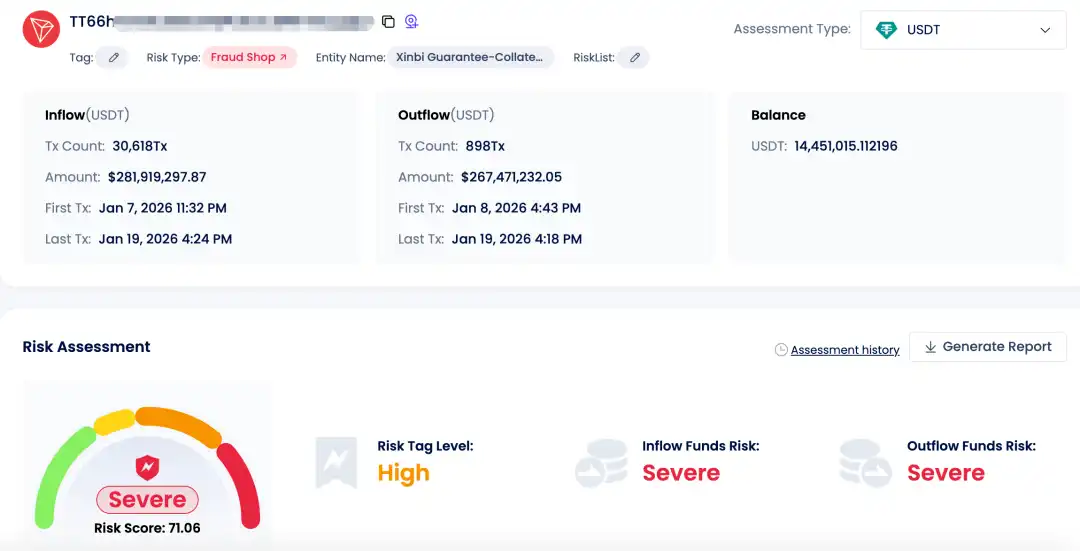
Beosin Trace Statistical Data. The addresses of the above escrow platforms have all been identified and flagged as high-risk addresses by Beosin KYT. Taking the currently active Xinbi Guarantee deposit address as an example:

Beosin KYT Risk Assessment Result

Conclusion

In 2025, the United States increased sanctions against cybercrime in Southeast Asia. In May, the US announced sanctions against the Philippines-based Funnull Technology Inc. and its principals involved in virtual asset pig-butchering scams; in October, sanctions were imposed on Cambodia's Prince Group and 146 related individuals, freezing and seizing 127,271 Bitcoin (valued at approximately $15 billion at the time), and formally cutting off the Huione Group's access to the US financial system; in November, sanctions were imposed on organizations in Myanmar involved in online fraud. This series of sanctions forced various criminal organizations in Southeast Asia to either cease operations or make adjustments and relocate. Among them, Huione Pay announced a suspension of operations, and now Tudou Guarantee has announced it is shutting down.


Preguntas relacionadas

QWhat was the main reason for Tudou Guarantee to announce its shutdown on January 16th?

ATudou Guarantee announced its shutdown and began clearing all public groups due to increased U.S. sanctions on Southeast Asian cybercrime, which pressured illegal or suspicious operations to cease or relocate.

QHow did Tudou Guarantee's transaction volume change after Huione Guarantee was banned in May 2025?

AAfter Huione Guarantee was banned in May 2025, Tudou Guarantee's transaction volume significantly increased as it became the main successor, absorbing Huione's business through share acquisitions and customer referrals.

QWhat significant trend was observed in Tudou Guarantee's deposit address activity starting December 2025?

AStarting December 2025, Tudou Guarantee's deposit address transactions decreased sharply, with almost no activity after January 10, 2026, indicating a major contraction in operations.

QWhich担保平台 did some merchants from Tudou Guarantee migrate to after its shutdown, and what was its activity like?

AAfter Tudou Guarantee's shutdown, some merchants migrated to Xinbi Guarantee, where deposit address activity surged to 2,700-2,800 USDT transactions per day from January 8 to 16, 2026.

QWhat actions did the U.S. take against Southeast Asian cybercrime in 2025 that impacted担保平台 like Tudou?

AIn 2025, the U.S. imposed measures including sanctions on entities like Funnull Technology Inc. in the Philippines, the Prince Group in Cambodia (freezing 127,271 BTC), and cutting off Huione Group from the U.S. financial system, forcing platforms like Tudou Guarantee to shut down or relocate.

Lecturas Relacionadas

Google and Amazon Simultaneously Invest Heavily in a Competitor: The Most Absurd Business Logic of the AI Era Is Becoming Reality

In a span of four days, Amazon announced an additional $25 billion investment, and Google pledged up to $40 billion—both direct competitors pouring over $65 billion into the same AI startup, Anthropic. Rather than a typical venture capital move, this signals the latest escalation in the cloud wars. The core of the deal is not equity but compute pre-orders: Anthropic must spend the majority of these funds on AWS and Google Cloud services and chips, effectively locking in massive future compute consumption. This reflects a shift in cloud market dynamics—enterprises now choose cloud providers based on which hosts the best AI models, not just price or stability. With OpenAI deeply tied to Microsoft, Anthropic’s Claude has become the only viable strategic asset for Google and Amazon to remain competitive. Anthropic’s annualized revenue has surged to $30 billion, and it is expanding into verticals like biotech, positioning itself as a cross-industry AI infrastructure layer. However, this funding comes with constraints: Anthropic’s independence is challenged as it balances two rival investors, its safety-first narrative faces pressure from regulatory scrutiny, and its path to IPO introduces new financial pressures. Globally, this accelerates a "tri-polar" closed-loop structure in AI infrastructure, with Microsoft-OpenAI, Google-Anthropic, and Amazon-Anthropic forming exclusive model-cloud alliances. In contrast, China’s landscape differs—investments like Alibaba and Tencent backing open-source model firm DeepSeek reflect a more decoupled approach, though closed-source models from major cloud providers still dominate. The $65 billion bet is ultimately about securing a seat at the table in an AI-defined future—where missing the model layer means losing the cloud war.

marsbitHace 58 min(s)

Google and Amazon Simultaneously Invest Heavily in a Competitor: The Most Absurd Business Logic of the AI Era Is Becoming Reality

marsbitHace 58 min(s)

Computing Power Constrained, Why Did DeepSeek-V4 Open Source?

DeepSeek-V4 has been released as a preview open-source model, featuring 1 million tokens of context length as a baseline capability—previously a premium feature locked behind enterprise paywalls by major overseas AI firms. The official announcement, however, openly acknowledges computational constraints, particularly limited service throughput for the high-end DeepSeek-V4-Pro version due to restricted high-end computing power. Rather than competing on pure scale, DeepSeek adopts a pragmatic approach that balances algorithmic innovation with hardware realities in China’s AI ecosystem. The V4-Pro model uses a highly sparse architecture with 1.6T total parameters but only activates 49B during inference. It performs strongly in agentic coding, knowledge-intensive tasks, and STEM reasoning, competing closely with top-tier closed models like Gemini Pro 3.1 and Claude Opus 4.6 in certain scenarios. A key strategic product is the Flash edition, with 284B total parameters but only 13B activated—making it cost-effective and accessible for mid- and low-tier hardware, including domestic AI chips from Huawei (Ascend), Cambricon, and Hygon. This design supports broader adoption across developers and SMEs while stimulating China's domestic semiconductor ecosystem. Despite facing talent outflow and intense competition in user traffic—with rivals like Doubao and Qianwen leading in monthly active users—DeepSeek has maintained technical momentum. The release also comes amid reports of a new funding round targeting a valuation exceeding $10 billion, potentially setting a new record in China’s LLM sector. Ultimately, DeepSeek-V4 represents a shift toward open yet realistic infrastructure development in the constrained compute landscape of Chinese AI, emphasizing engineering efficiency and domestic hardware compatibility over pure model scale.

marsbitHace 1 hora(s)

Computing Power Constrained, Why Did DeepSeek-V4 Open Source?

marsbitHace 1 hora(s)

Trading

Spot
Futuros
活动图片