Author: Willo, Arkham
Compiled by: Yuliya, PANews
Editor's Note: Zcash, a cryptocurrency launched in 2016 focused on privacy protection, is built on the codebase of Bitcoin. Despite its core vision of concealing transaction information, in practical application, the majority of ZEC transactions can still be traced on-chain. This article will analyze how Zcash works and explore why most ZEC on-chain transactions are still traceable, illustrating that the actual degree of privacy protection Zcash can provide depends entirely on how users choose to use it.
Zcash is a digital currency built on Bitcoin's underlying technology, but its design goal was to address what its creators saw as Bitcoin's biggest flaw: the complete transparency of transaction information. Like Bitcoin, Zcash has a hard cap of 21 million coins, halves its block reward every four years, and operates on a Proof-of-Work (PoW) consensus mechanism. At the underlying architectural level, it also shares Bitcoin's UTXO transaction model. In most cases, Zcash transactions look identical to Bitcoin transactions. The difference is that part of Zcash's transactions are designed to be completely invisible.
In the current crypto cycle, privacy is one of the most emblematic themes. As global regulatory pressure intensifies and on-chain monitoring tools become increasingly powerful, more retail and institutional users are beginning to question whether public blockchains expose too much information about users and their transactions? In this context, privacy coins have leaped from a niche area of the market to a high-profile focal category. Because of this, Zcash has become one of the best-performing assets of 2025.
History and Evolution
Zcash was launched in October 2016 by the Electric Coin Company (ECC), founded by cryptographer Zooko Wilcox-O'Hearn, and co-developed by an experienced team of academic cryptographers. The project's origins can be traced back to a 2014 paper introducing the Zerocash protocol, co-authored by researchers from MIT, Johns Hopkins University, and Tel Aviv University. The paper theoretically proposed a protocol that would allow users to make private payments while maintaining processing speeds comparable to Bitcoin.
The core zk-SNARK cryptography technology of Zcash did not originate with cryptocurrency but stems from decades of theoretical research in computer science. The contribution of the Electric Coin Company was to transform this theory into practical technology capable of running efficiently on a real blockchain. In 2016, the team held a cryptographic setup ceremony to generate system parameters; subsequently, in 2018, a second ceremony called Sapling was held. This upgrade significantly improved the efficiency of shielded transactions, making them practical for everyday use.
Zcash's governance system consists of two organizations: the Electric Coin Company, responsible for protocol development and maintenance, and the independent non-profit Zcash Foundation, responsible for overseeing the broader ecosystem development. A portion of newly mined ZEC coins is allocated as funding for these two organizations, ensuring the project's continued development without relying on external investment.
Zero-Knowledge Proofs
The core technology enabling Zcash's privacy protection is called "zero-knowledge proofs." Specifically, Zcash employs a derivative technology known as zk-SNARKs (Zero-Knowledge Succinct Non-Interactive Argument of Knowledge).
This concept may sound abstract, but its core idea is actually very easy to understand. A zero-knowledge proof allows one party to prove to another that something is true without revealing any specific information. In the case of Zcash, network nodes can verify whether a transaction is legal and valid (e.g., confirming that the sender indeed has sufficient funds and did not forge coins out of thin air) without needing to know who the sender is, who the recipient is, or the specific transaction amount.
This technology is a major breakthrough in cryptography. Bitcoin's transparent nature, while beneficial for auditing and tracing, is a major pain point for users who desire financial privacy. The Zcash development team cleverly layered zk-SNARK technology on top of Bitcoin's codebase, providing users with an optional layer of privacy protection.
Transaction Types
The Zcash system includes two types of addresses: transparent addresses (t-addresses) and shielded addresses (z-addresses).
-
Transparent addresses operate exactly like Bitcoin addresses; all transaction activity is publicly visible on the blockchain.
-
Shielded addresses exist in an encrypted pool of funds, where the sender, recipient, and transaction amount are hidden from external observers.
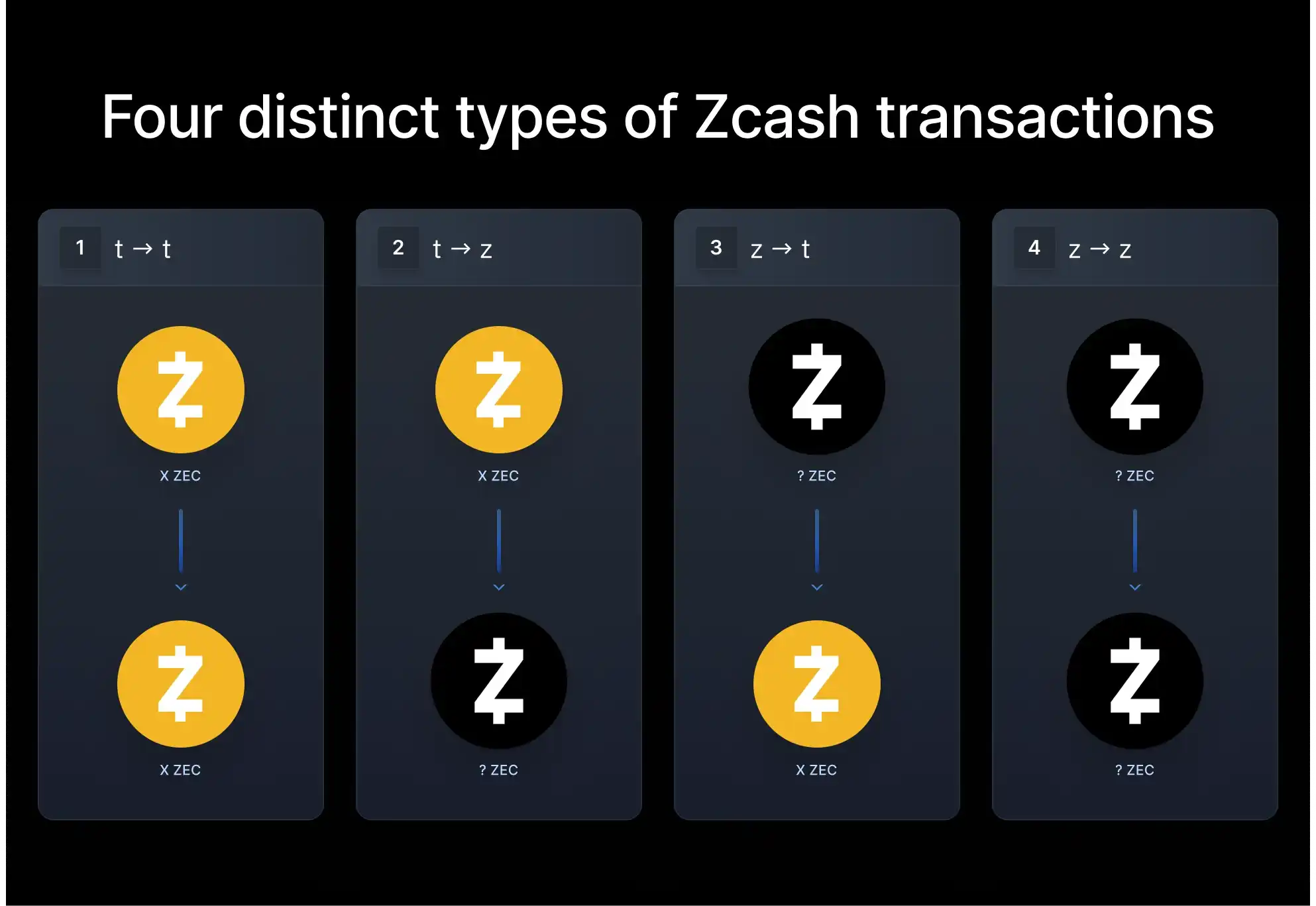
The combination of these two address types produces four different transaction types, each with different levels of privacy protection:
-
t → t (Transparent to Transparent): Completely Public. The sender, recipient, and amount are clearly visible on the blockchain. This is indistinguishable from a standard Bitcoin transaction.
-
t → z (Transparent to Shielded): The amount of funds entering the shielded pool is public, but the recipient is hidden. It's like watching money go through a door: you can see it went in, but you don't know into whose hands it ultimately went.
-
z → t (Shielded to Transparent): The recipient and amount are public, but the sender is hidden. The funds flow out of the encrypted pool, but their ultimate origin cannot be traced by outsiders.
-
z → z (Shielded to Shielded): Completely Private. The only publicly visible data on the blockchain is the transaction fee. The sender, recipient, and amount are all thoroughly hidden through cryptography.
In practical application, historically, the vast majority of Zcash transaction activity remains transparent. Due to compliance requirements, most cryptocurrency exchanges and institutional participants default to using transparent addresses (t-addresses). This means the proportion of publicly readable data in Zcash's transaction history is far greater than one might expect from a "privacy coin."
ZEC Transaction Types
Tracking Zcash with Arkham
Conventional wisdom holds that privacy coins are untraceable, but the reality of Zcash challenges this perception.
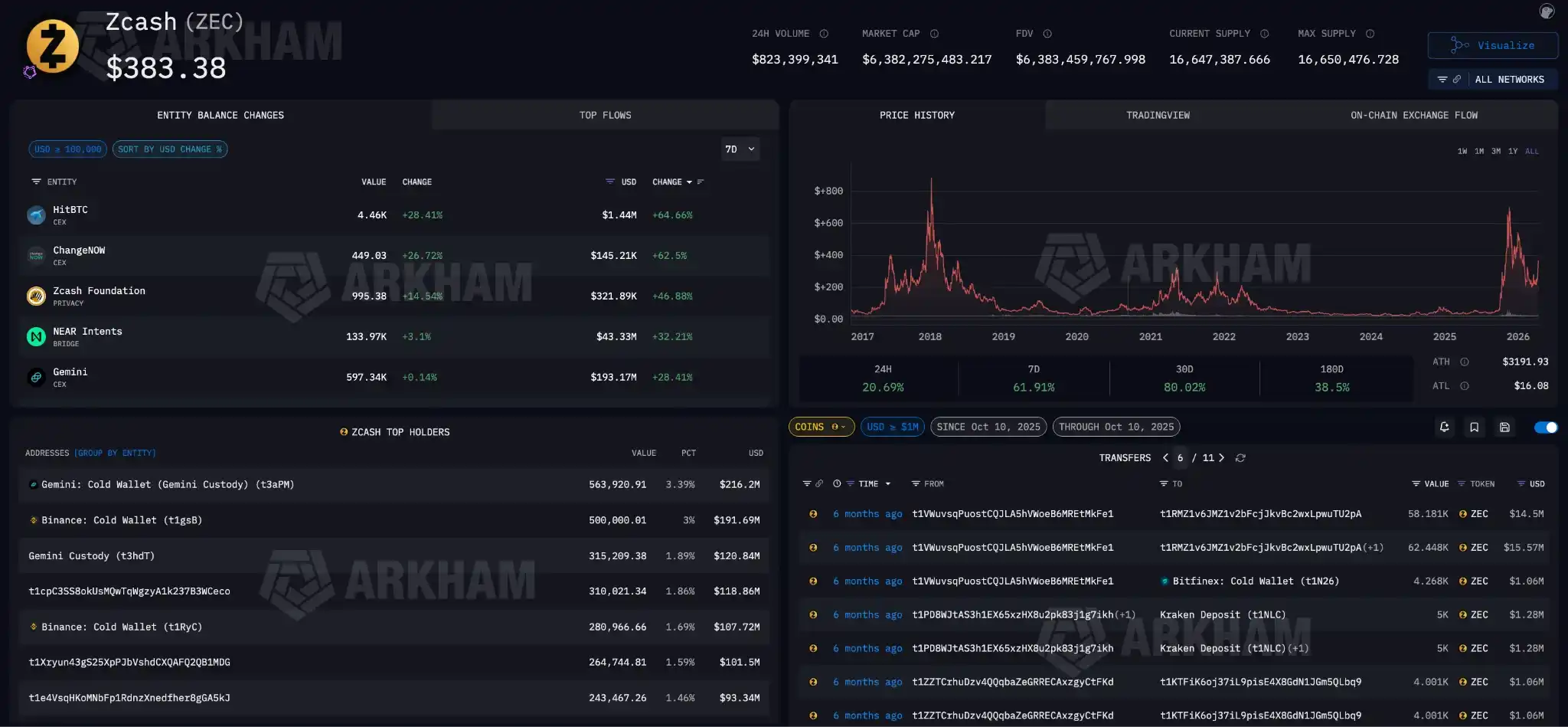
Currently, the blockchain data analytics platform Arkham has successfully labeled over half of Zcash's on-chain activity and identified the individuals and institutions behind a staggering $420 billion in transaction volume. This is a shocking statistic for a blockchain network specifically designed to hide transaction data. This tracing is possible fundamentally because most Zcash transactions still use the transparent mode. Furthermore, as gateways for funds entering and exiting the system, cryptocurrency exchanges, custodians, and major financial institutions typically retain and use transparent addresses for ease of fund transfer and management.
Of course, shielded transactions themselves remain highly opaque: z→z (shielded to shielded) transaction activity is untraceable; such shielded addresses are simply labeled as "SHIELDED" on the Arkham platform. However, the points where funds enter and leave the encrypted pool are often publicly visible, and this is the breakthrough point for data intelligence analysis.
Zcash on Arkham
Case Study: The U.S. Government's Zcash Holdings
In Arkham's Zcash data records, one particularly notable entity is the United States Government. The U.S. government's wallet holds Zcash seized from Alexandre Cazes, the founder of the darknet marketplace AlphaBay, who was arrested in 2017. At the time of seizure, this Zcash was worth approximately $737,000. For eight years, this asset remained unmoved, and its market value has since doubled. The public can track this wallet's activity in real-time on the Arkham platform.
Case Study: A $6.6 Million Profit Trade
Arkham's data can also reveal large fund movements by individual traders. For example, an address purchased $4.49 million worth of Zcash during the market crash on October 10th. After holding for five and a half weeks, this address transferred the tokens to the Gemini exchange. Assuming the trader immediately sold upon depositing the tokens to the exchange, this trade would have generated a net profit of $6.6 million, meaning their initial investment more than doubled. On the Arkham platform, the complete history of this trade is clearly visible, including the specific times of each fund transfer and the name of the exchange where the tokens ultimately flowed.
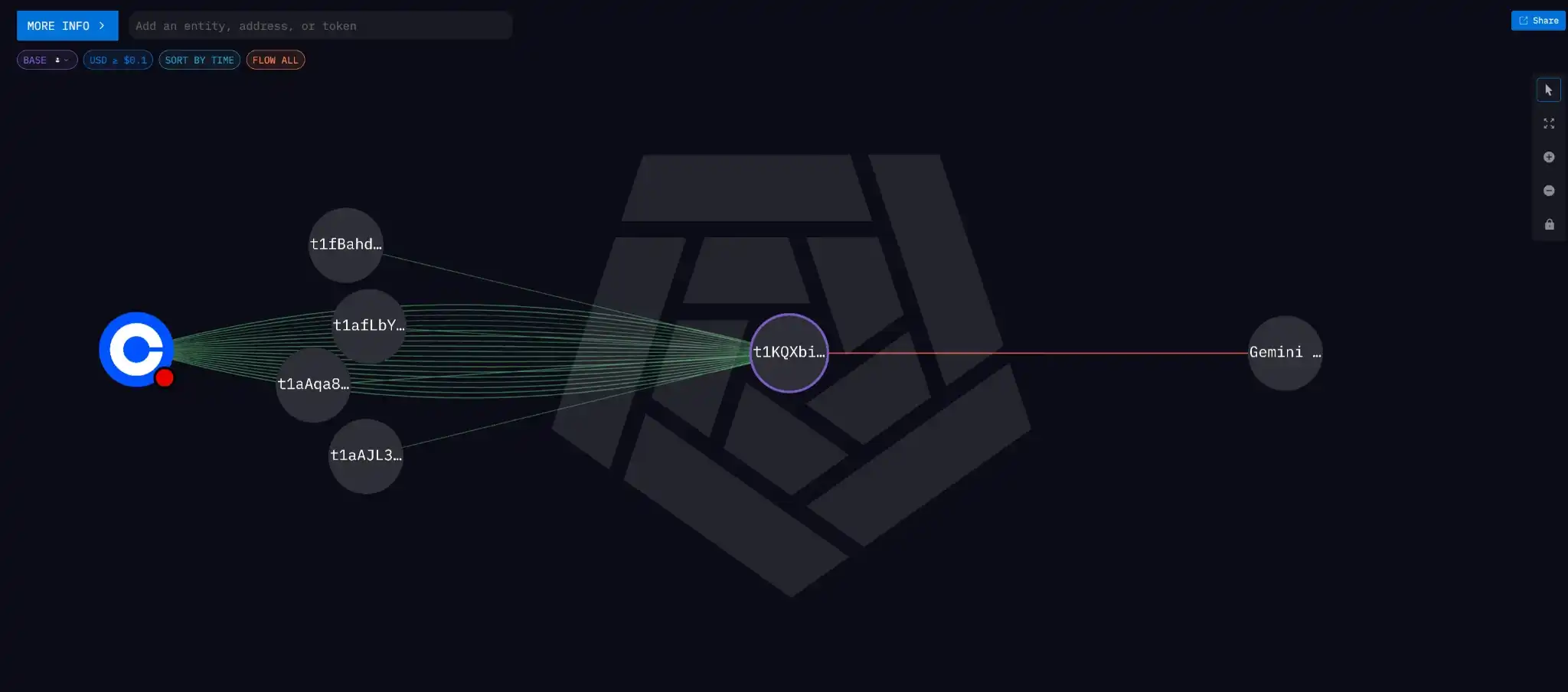
Arkham Visualization Tool
Conclusion
Zcash occupies a very unique position. It is one of the most technologically complex privacy tools in the cryptocurrency space, yet also one of the most misunderstood projects. People often assume that privacy coins are completely untraceable by default, but this is not accurate. In practice, the vast majority of Zcash fund flows pass through transparent addresses; to comply with regulations, major exchanges also default to using public, transparent addresses. It is precisely because of this that blockchain intelligence platforms like Arkham can successfully associate over $420 billion in transaction volume with known entities on a blockchain explicitly designed to resist data analysis.
This does not mean Zcash's privacy capabilities are flawed. Pure shielded transactions (z to z) remain cryptographically impregnable and unobservable. All of this shows that the actual degree of privacy protection Zcash can provide depends entirely on how users choose to use it.
For any user wishing to explore Zcash's on-chain activity firsthand, Arkham's extensive data coverage provides the most comprehensive information picture available today. Users can use it to track ZEC transaction history, entity identities, and account balances, set alerts for significant fund movements, and leverage Arkham's AI technology to deeply mine potential information across the entire blockchain network.