Oil Price Forecast: Risks in the Strait of Hormuz Push WTI and Brent Prices Towards Key Breakout Levels

Publicado a 2026-08-20Actualizado a 2026-08-20

Resumen

The outlook for oil prices remains optimistic, but the next move will depend on supply risks and technical breakouts. Tensions in the Middle East and slow shipping in the Strait of Hormuz have pushed oil prices higher. However, unless the conflict causes a significant supply disruption, increasing US inventories may limit the upside for prices.

Key Points:

Tensions in the Strait of Hormuz continue to support oil prices.

Rising US inventories may limit further gains.

WTI and Brent prices are approaching significant breakout zones.

Oil prices stabilized near recent highs as traders assessed the risks of further turmoil in the Middle East. Shipping in the Strait of Hormuz remains slow, with many shipowners choosing to avoid the route. Conflicting signals from the US and Iran have also added to market confusion. Persistent tensions due to sporadic attacks involving Iran, the UAE, and Oman have kept a risk premium in oil prices. However, the absence of any major escalation has limited fresh buying interest.

Rising US inventories could also cap further oil price gains. As shown in the chart below, crude inventories increased by 4.4 million barrels. Gasoline stocks also rose. These figures suggest US supply remains relatively ample, and demand may not be strong enough to drive prices significantly higher. Oil prices may grind higher as long as war and shipping risks persist. But a major market move likely requires a significant disruption to supplies via the Strait of Hormuz.

WTI Oil Price Forecast: Break above $87-$89 Targets $105

The 4-hour chart below shows WTI oil prices forming a constructive structure above $70. A rounded bottom pattern has formed above $70. A break above $87 would target a further move towards the $93.80 and $97 zones.
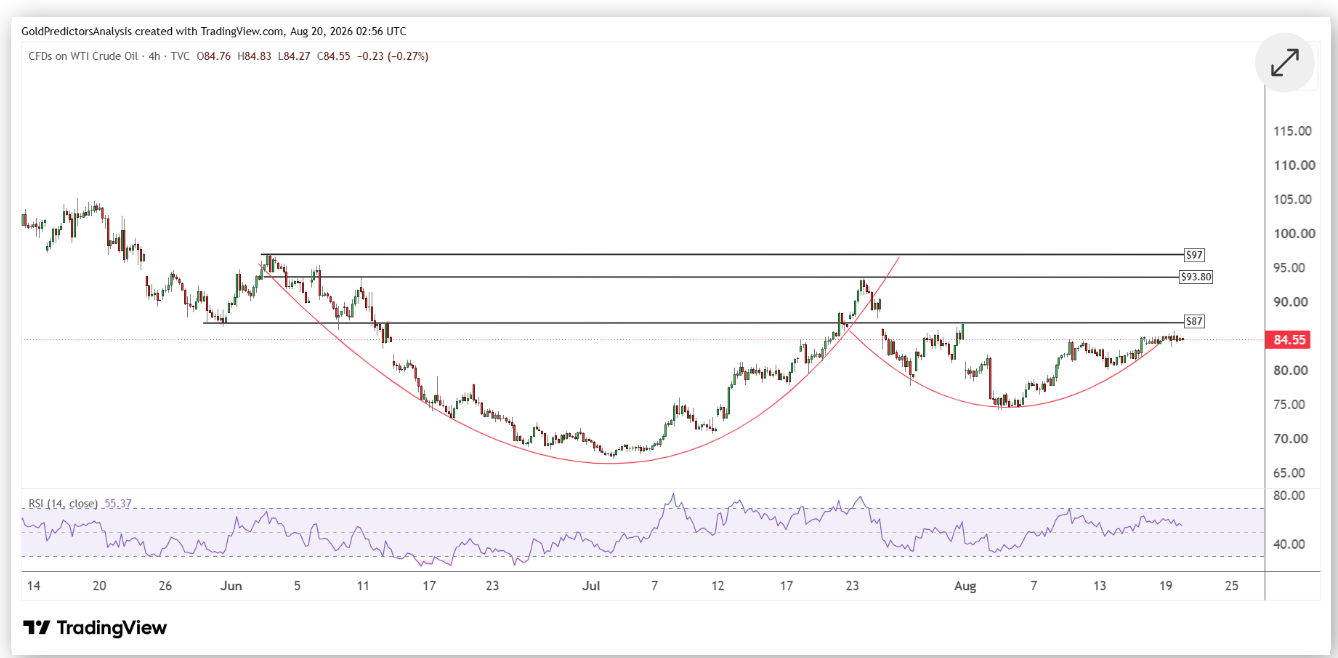
Notably, the price action from May appears more bullish. A rounded bottom has formed just below a descending trendline. This trendline will be broken around $89.

A break above this descending trendline would likely confirm a bottom and target a move towards the $105 zone. The Relative Strength Index (RSI) is also consolidating above the midline, indicating potential for further upside in the WTI market. However, a break below $66 would invalidate the bullish structure and could lead to further declines.
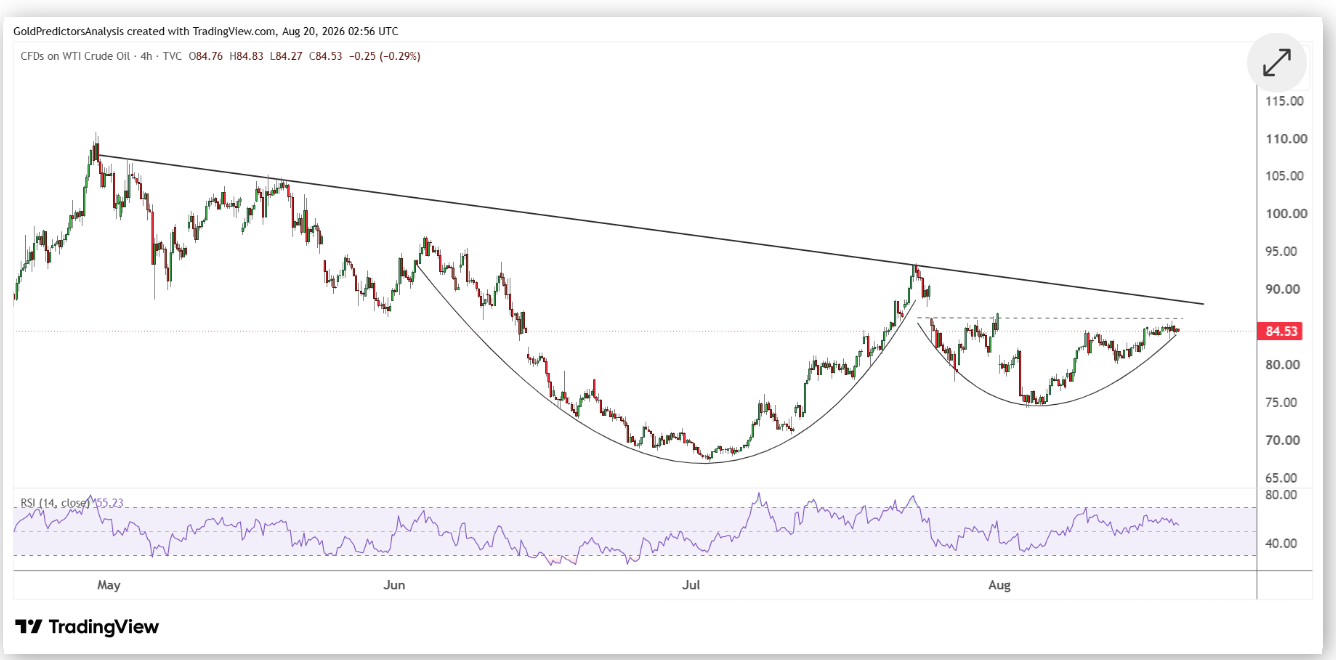
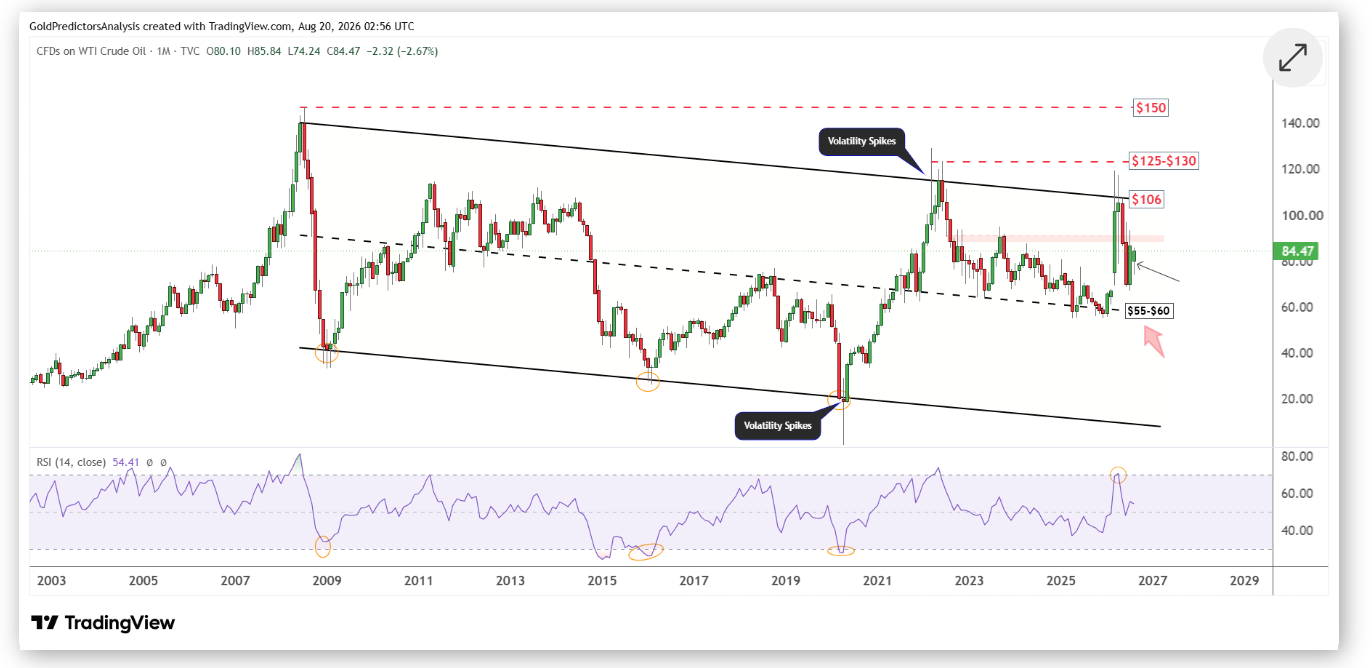
The long-term outlook for WTI remains optimistic. After the US-Iran war, prices surged from around $66 to near $120 but failed to break the channel's descending trendline. A sharp sell-off from $120 to around $67 followed, driven by this strong resistance.

But WTI prices found a bottom after July's decline. Prices are now retracing back towards the $100 zone. This suggests a potential move to the $125-$130 zone if the price breaks out of this descending channel. On the other hand, a break above $130 could target the $150 zone. The Relative Strength Index (RSI) is also rebounding from the midline, indicating positive momentum for WTI prices.
Brent Oil Price Forecast: Break above $100 Opens Path to $120-$127

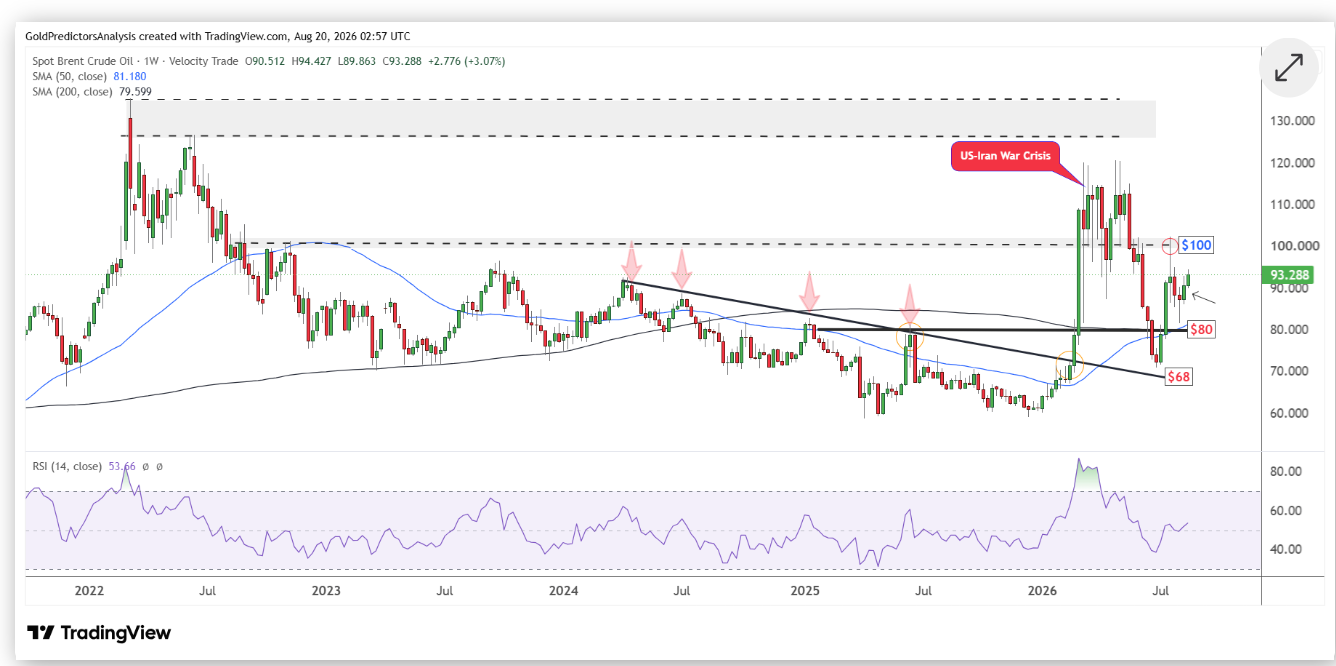
Compared to the WTI market, Brent oil price action is stronger. The price held above $80 after declines. A strong rebound in the first week of August 2026 triggered a solid weekly bullish candle, signaling a potential move towards the $100 zone.

On the weekly chart, the 50-day Simple Moving Average has crossed above the 200-day SMA. The RSI is also holding above the midline, indicating strong bullish momentum in the Brent market. A break above the $100 zone could target the $120 area for Brent. Conversely, a break above $120 could aim for further gains towards $135.
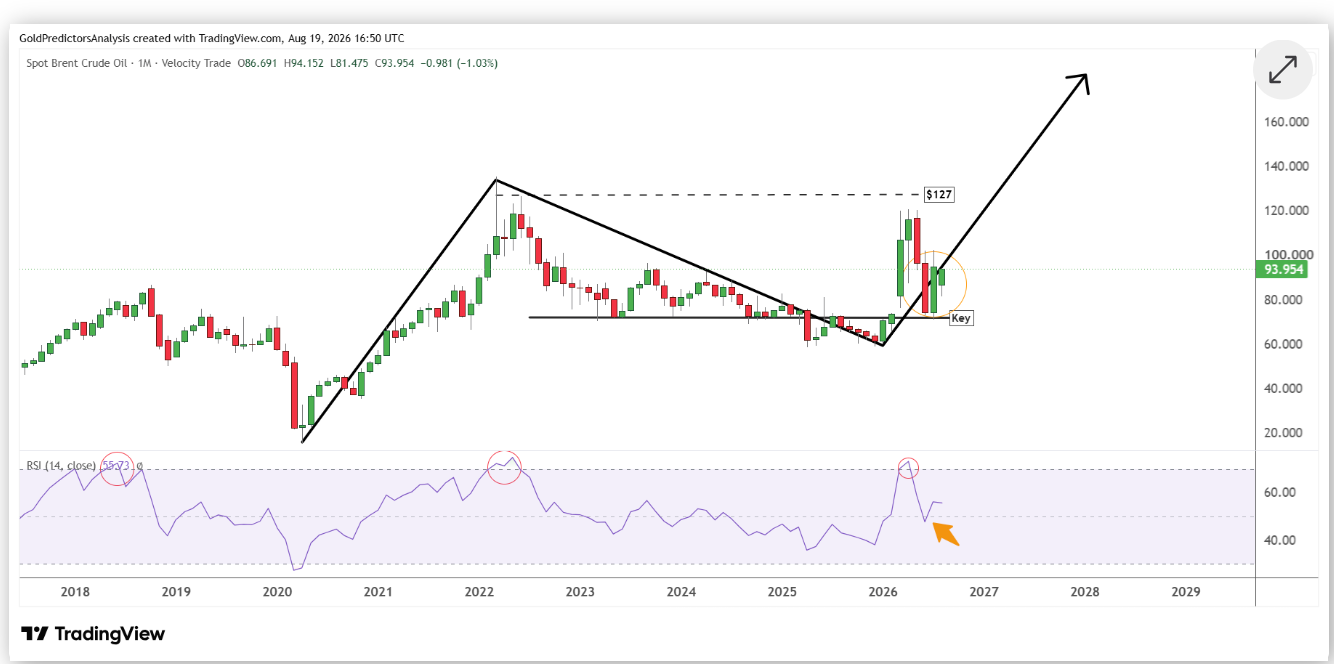
The monthly chart for Brent also shows positive price action. A strong rally is evident from the April 2020 lows to the March 2022 highs, followed by a correction from the March 2022 highs to the December 2025 lows, forming a robust, positive bullish structure.

Recent declines in Brent in June 2026 failed to break the key $70 level, followed by a strong rebound. The July monthly candle suggests Brent could target the $127 mark. A break above $127 could pave the way for a strong rally towards the $160-$180 zone.

The RSI is also rebounding from the midline as Brent bounced from the key $70 level. This indicates potential for continued gains in the near term.
Conclusion

The oil price outlook remains optimistic, but the next move hinges on supply risks and technical breakouts. Middle East tensions and slow shipping in the Strait of Hormuz have pushed prices higher. However, rising US inventories may limit gains unless conflict causes a severe supply disruption.

WTI must break above the $87-$89 resistance to target $100-$105. But a break below $66 would weaken the bullish view. Brent shows stronger upside momentum and could target $120-$127 if it breaks above $100. Brent must hold the key $70 level to maintain its upward momentum. Therefore, oil prices may continue to rise gradually, but a stronger rally would require a clear technical breakout or a significant regional supply disruption.


Lecturas Relacionadas

Jameson Lopp's BIP-110 Postmortem: Bitcoin Is Driven by Game Theory, Not Morality

Jameson Lopp's analysis concludes that BIP-110, a proposal to restrict arbitrary data (like inscriptions) on Bitcoin, failed due to economic and technical realities, not moral arguments. The proposal, championed by Luke Dashjr and others, aimed to "cleanse" the chain but never reached its 55% miner activation threshold. Upon its forced signaling deadline in August, only the OCEAN pool (with ~1% hash rate) supported it, creating a short-lived fork that quickly died as miners faced unredeemable block rewards. Lopp's earlier predictions about its economic infeasibility were proven correct. Technically, BIP-110 was flawed; workarounds to embed data compliant with its rules were demonstrated almost immediately, proving it couldn't achieve its stated goal. The debate often devolved into moralistic rhetoric, with supporters accusing opponents of supporting child exploitation material—a tactic Lopp criticizes as ineffective for building consensus. Lopp argues Bitcoin is driven by incentives and game theory, not morality. Past forks like Bitcoin Cash promised economic benefits, while BIP-110 offered only restrictions and reduced miner fees, gaining no substantial support from major economic players. He predicts the "puritans" behind the failed fork will continue complaining but their new chain will remain insignificant. The episode reaffirms that attempting to censor data on a permissionless, anti-censorship network like Bitcoin is a futile battle.

marsbitHace 7 min(s)

Jameson Lopp's BIP-110 Postmortem: Bitcoin Is Driven by Game Theory, Not Morality

marsbitHace 7 min(s)

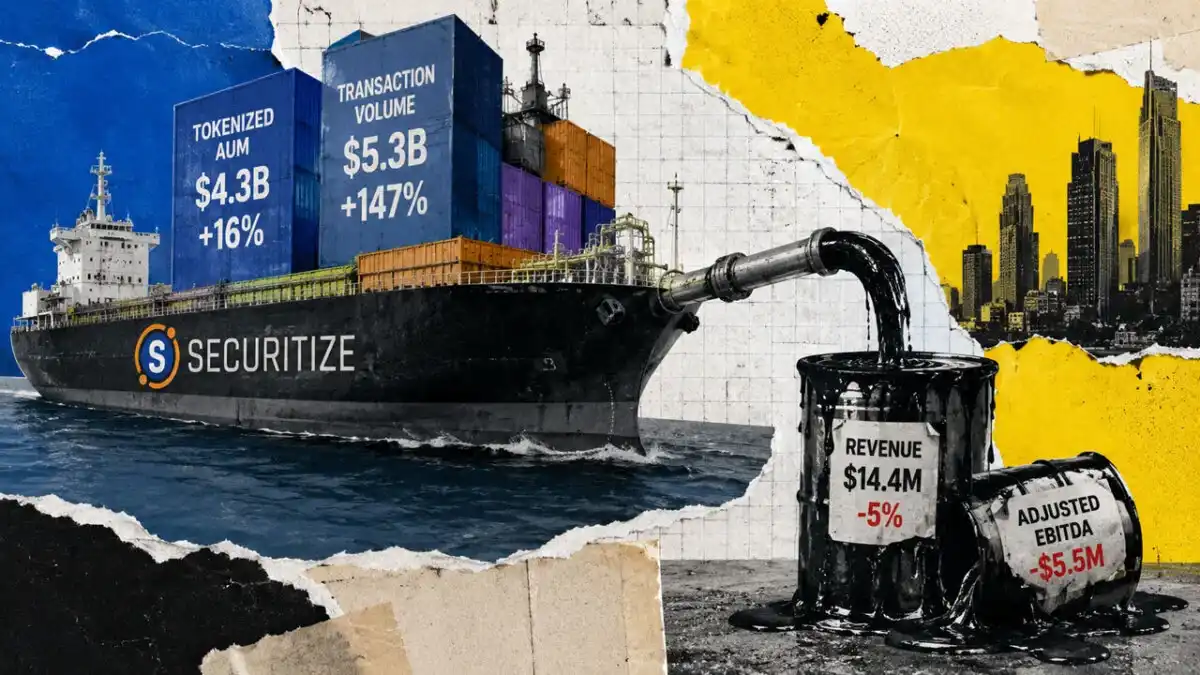
Tokenization Scale Soars to $4.3 Billion, But Why Did Securitize Incur a $5.5 Million Loss?

Securitize's first quarterly report post-IPO reveals a paradox: while its tokenized assets under management hit a record $4.3 billion (up 16% YoY) and platform trading volume surged 147% to $5.3 billion, total revenue fell 5% to $14.4 million. Tokenization revenue specifically dropped ~12% to $7.8 million, leading to an adjusted EBITDA loss of $5.5 million. CFO Francisco Flores explained that most trading volume is not yet monetized, with the majority of tokenization revenue still coming from one-time projects like new protocol integrations. In contrast, asset servicing revenue, a more recurring stream, grew slightly to $6.6 million. The company has lowered its full-year revenue guidance to $70-$80 million from an initial projection of $110 million. Industry experts note this highlights a structural challenge for the tokenization sector. Scaling assets on-chain doesn't automatically scale a profitable business model. Current implementations often rely on costly, customized projects for each new asset or jurisdiction. The future, they argue, lies in building standardized infrastructure that generates recurring "infrastructure revenue" from post-issuance activities like compliance, distributions, and secondary trading—similar to enterprise software. Analysts caution against misinterpreting high trading volumes as indicative of a mature fee-based model, as Securitize's broad volume metric includes many non-monetized actions. The key test for the industry is whether adding billions in new assets can generate sustainable revenue without constant new custom projects.

marsbitHace 9 min(s)

Tokenization Scale Soars to $4.3 Billion, But Why Did Securitize Incur a $5.5 Million Loss?

marsbitHace 9 min(s)

The Five Paradoxes of Artificial Intelligence

**Five Paradoxes of Artificial Intelligence** Artificial intelligence (AI) is an era filled with paradoxes, which we navigate as we advance. **1. The Prediction Paradox** AI experts, from pioneers like Marvin Minsky to contemporary figures like Geoffrey Hinton and Demis Hassabis, have a history of inaccurate forecasts regarding AI's capabilities and timelines, such as achieving human-level machine intelligence or surpassing radiologists. Predictions about Artificial General Intelligence (AGI) vary wildly between optimistic entrepreneurs and skeptical academics, highlighting the inherent unpredictability of technological futures. **2. The Employment Quantification Paradox** Despite numerous studies from institutions like the OECD, IMF, and McKinsey attempting to quantify AI's impact on jobs, estimates of affected employment range from 0.4% to 67%, revealing vast inconsistencies. This paradox arises because isolating AI's effect from other economic, social, and technological factors is virtually impossible, and forecasts depend on static assumptions about a dynamically evolving technology. **3. The Productivity Paradox** While AI is a transformative General Purpose Technology, significant productivity growth has not yet materialized in major economies like the EU and has only matched historical averages in the US. This disconnect between rapid innovation and slow productivity gains, reminiscent of the "Solow Paradox" from the computer age, is often explained by time lags. History shows it takes decades for such technologies to diffuse and trigger complementary innovations that boost productivity. **4. The Data Value Paradox** Data is hailed as the "new oil" and critical for AI, yet its economic value is paradoxical. Its worth is realized only in use, not in straightforward trade. Despite policy emphasis and initiatives for data asset recognition on corporate balance sheets in China, the monetized value remains negligible—accounting for only about 0.06% of major telecom operators' total assets—highlighting the gap between perceived utility and financial valuation. **5. The Industrial Revolution Paradox** For decades, nearly every major new technology, from the internet and nanotechnology to blockchain and now AI, has been proclaimed as the driver of a "Fourth Industrial Revolution." This constant reassignment suggests prior labels were premature. True industrial revolutions are typically identified in hindsight, not in real-time. Furthermore, the coexistence of such a proclaimed transformative revolution with ongoing economic crises would be historically anomalous. Whether AI truly defines a new industrial revolution remains a narrative for the future to decide.

marsbitHace 12 min(s)

The Five Paradoxes of Artificial Intelligence

marsbitHace 12 min(s)

Trading

Spot
活动图片