Off-Court "Financing" of $65 Million: Is World Brewing a Big Move in the Deep Bear Market?

marsbitPublicado a 2026-03-30Actualizado a 2026-03-30

Resumen

World Foundation announced the completion of a $65 million WLD token OTC sale at an average price of $0.2719. The transaction involved four counterparties, with $25 million worth of tokens subject to a 6-month lock-up. Proceeds will support core operations, R&D, Orb hardware manufacturing, and ecosystem growth. WLD’s price has declined over 97% from its all-time high of $11.8 in March 2024, currently trading around $0.27. The token has faced pressure from market conditions, regulatory scrutiny, and ongoing token unlocks—approximately $14.79 million worth of WLD is unlocked daily. Amid the downturn, World published a research paper highlighting its privacy-preserving human identity system, combining iris-scanning Orb hardware with SMPC and ZKP to create a "Proof of Human" infrastructure. The project also introduced AgentKit, which uses World ID to verify human agents in AI applications. On April 17, World will host the "Lift Off" global launch event in San Francisco, featuring Sam Altman and CEO Alex Blania, focusing on World ID advancements and AI-era use cases.

Original Author: Ma He, Foresight News

On March 28, the World Foundation announced that it had completed an over-the-counter (OTC) sale of WLD tokens totaling $65 million, with an average transaction price of $0.2719. This transaction involved four counterparties, with the first settlement completed on March 20, 2026. Among these, $25 million worth of WLD tokens are subject to a 6-month lock-up period. The official statement indicated that the proceeds will be directly used for the project's core operations, research and development, Orb hardware manufacturing, and ecosystem development. All settlements were executed through the multi-signature address 0xE797 of World Assets.

In the current deep bear market environment, completing a token transaction of tens of millions of dollars is quite rare. The last major token financing by the World Foundation dates back to May 2025, when its subsidiary World Assets sold $135 million worth of WLD tokens to early supporters a16z and Bain Capital Crypto at market prices.
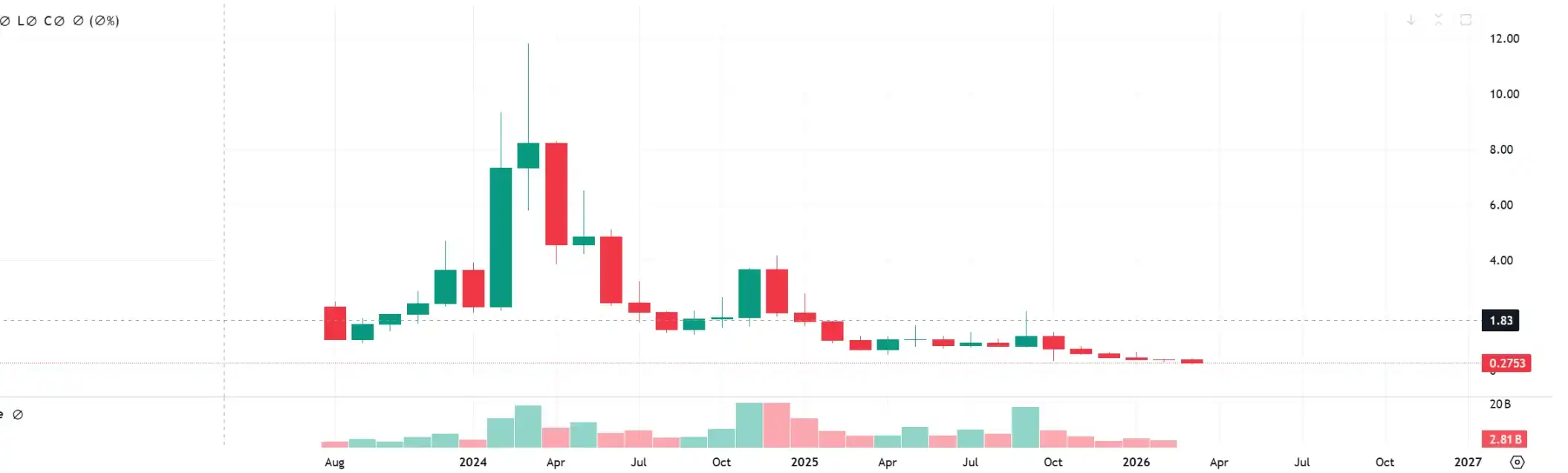
Looking back at the complete price trajectory of WLD in this cycle, it can be described as a textbook case from frenzy to reality. In July 2023, Worldcoin (now renamed World) officially launched WLD. With Sam Altman's personal endorsement, the AI large model boom, and the unique narrative of "Proof of Human Uniqueness," it quickly became a market focus.

In March 2024, driven by the Bitcoin halving cycle and the resonance of AI concepts, the price of WLD surged within a single month, reaching an all-time high of approximately $11.8. Its market capitalization once approached $10 billion. That year, global users showed unprecedented enthusiasm for registering World ID through Orb iris scanning, and the project was regarded as the top contender for Web3 identity infrastructure.

However, after the peak, it soon fell into silence. In the second half of 2024, with the overall crypto market correction, strict scrutiny from regulatory bodies like the EU on biometric data, and the emergence of the project's own large-scale unlocking pressure, the price of WLD began to plummet.

Throughout 2025, the price of WLD fluctuated repeatedly in the range of $0.5 to $1.5. Although the adoption rate of iris scanning steadily advanced, it fell far short of early expectations, and user growth significantly decoupled from narrative hype. Entering 2026, WLD continued to bottom out, recently hitting a new low of $0.2433 and currently hovering around $0.27, with a cumulative decline of over 97% from its all-time high.

In this cycle, the price trend of WLD resembles the trilogy of most altcoins: concept-driven → supply pressure →落地考验 (landing test). Early premiums were mainly driven by Altman's IP and the AI trend, while later stages were suppressed by continuous unlocking and macro tightening.

Interestingly, just before announcing the large OTC sale, on March 25, World's official website released a research report titled "Private Proof of Human: Critical Infrastructure for Humanity in a World with Advanced AI." The article directly addresses the core pain point of the AI agent era: how to establish a reliable and privacy-protecting "Proof of Human" infrastructure in a digital world flooded with machines.

The paper elaborates on the technical solution combining Orb iris scanning hardware with Secure Multi-Party Computation (SMPC) and Zero-Knowledge Proofs (ZKP). This approach not only efficiently verifies human uniqueness but also completely avoids the leakage of personal biometric data, making it more forward-looking and secure than traditional facial recognition or passport verification. This solution is positioned as the future foundation of internet trust, effectively countering deepfakes and AI bot attacks.

On March 26, Marc Andreessen, co-founder of a16z, shared this paper on platform X with a brief yet highly significant comment: It's time to prove human.
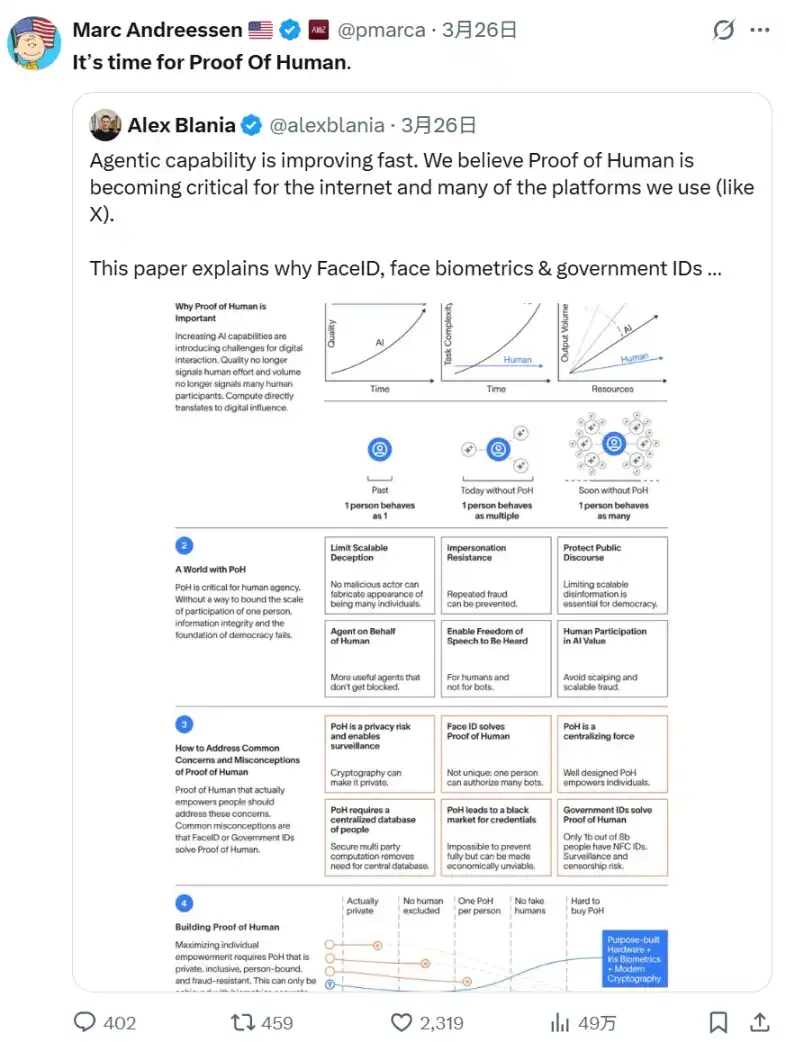
In the current era where AI is reshaping productivity, PoH (Proof of Human) will become a necessity to distinguish humans from machines and rebuild the trust layer of the digital economy.

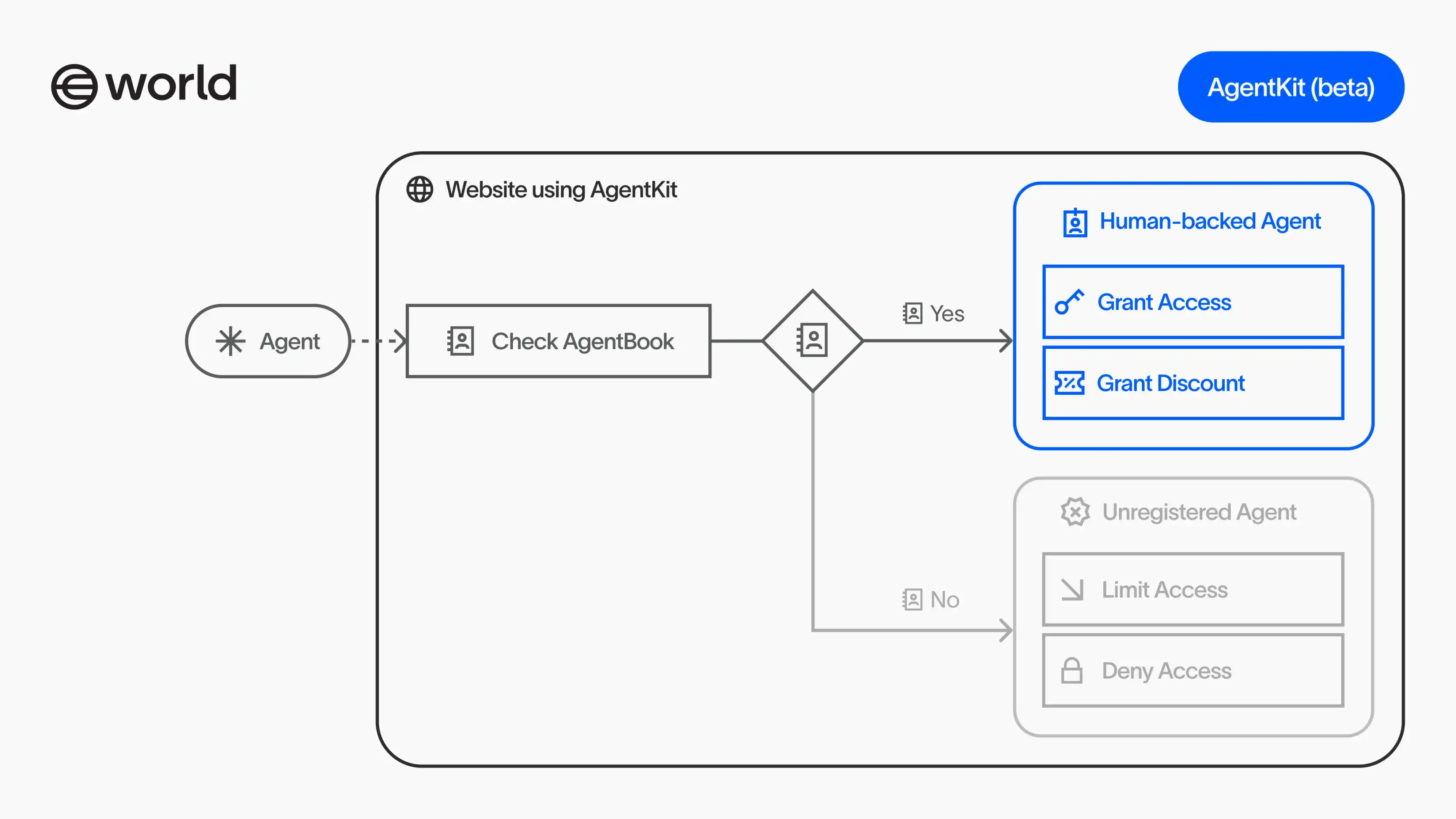
On March 17, World launched AgentKit. Its working principle involves Agents completing registration through World ID proof, linking wallets with anonymous human identities. The agent signs a standard identity verification challenge at a protected endpoint, and the agent's signature is matched with its associated human identity. Access is authorized upon successful matching. The official application scenarios state that AgentKit agents can also be applied to privacy protection, ticketing systems, access frequency limiting, and preventing Sybil attacks.
On April 17, World will host the "Lift Off" World ID global launch event in San Francisco, with Sam Altman personally attending and co-hosting alongside World CEO Alex.
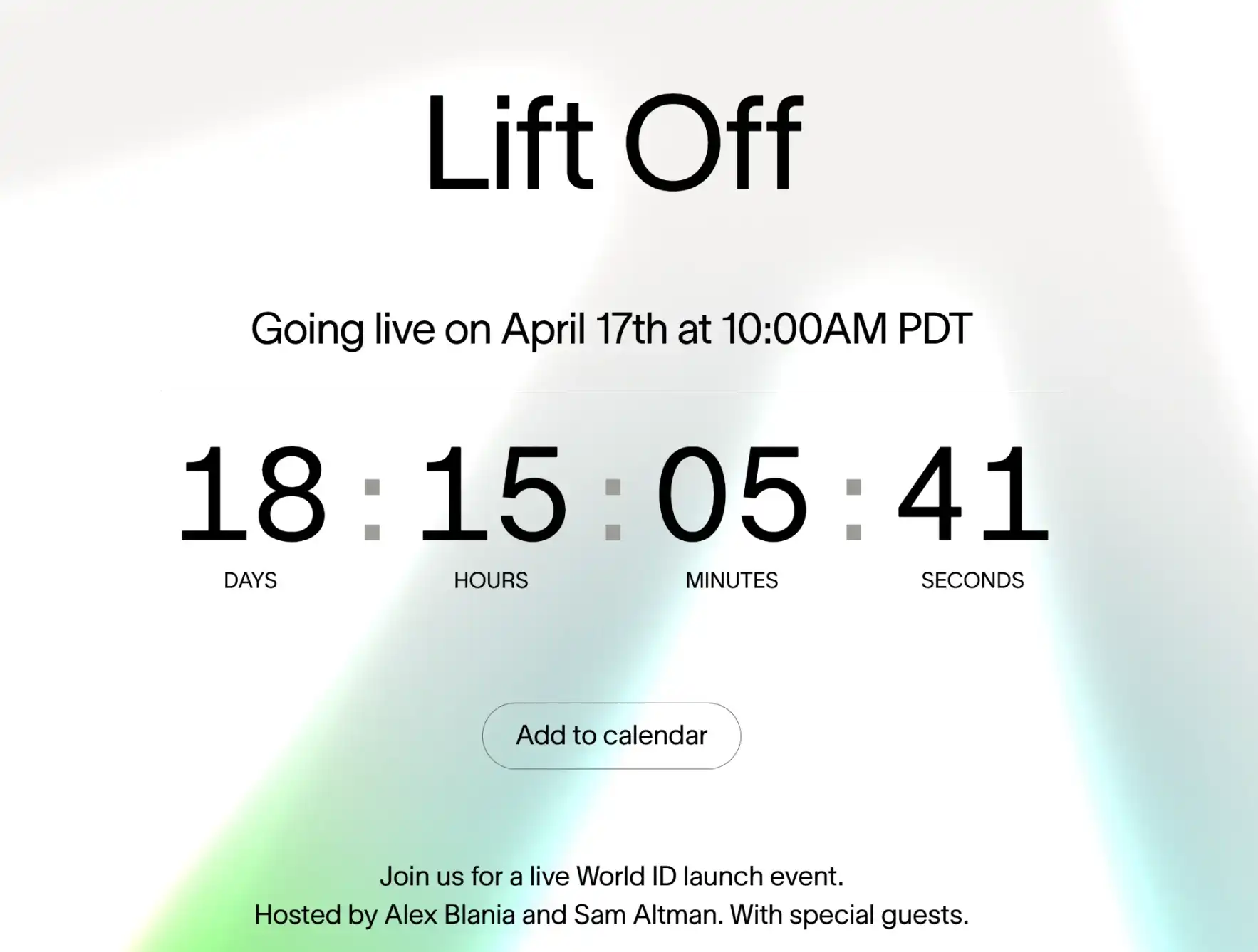
The conference theme focuses on the latest progress of World ID, Orb hardware iterations, and application scenarios for human verification in the AI era. Altman's presence itself symbolizes top-tier influence and confidence and may signal potential synergy between OpenAI and World—AI agents need authentic human identity endorsement, and World ID正好 (just) provides a decentralized solution.

Currently, WLD's market capitalization is $1.346 billion, with an FDV (Fully Diluted Valuation) of $2.758 billion. The proportion of unlocked tokens is 48.80%.
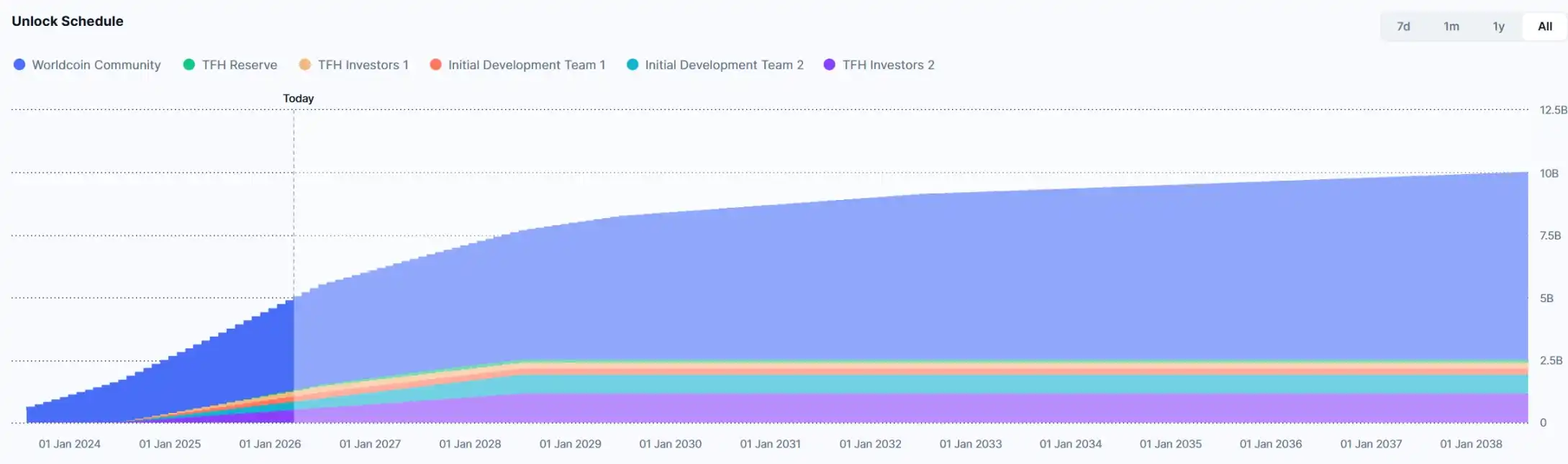
Additionally, WLD continues to unlock 0.05% of the maximum supply daily, approximately 5.32 million tokens, valued at about $1.479 million. Calculated at this rate, the value of tokens unlocked monthly is approximately $44.369 million, which is expected to continue exerting significant selling pressure on the market.


Preguntas relacionadas

QWhat was the total amount raised by the World Foundation through the OTC sale of WLD tokens, and at what average price?

AThe World Foundation raised a total of $65 million through the OTC sale of WLD tokens at an average price of $0.2719 per token.

QWhat are the primary uses of the funds raised from the WLD token sale, as stated by the official announcement?

AThe funds will be used for the project's core operations, research and development, Orb hardware manufacturing, and ecosystem growth.

QWhat significant event is scheduled for April 17th in San Francisco, and who are the key figures expected to attend?

AOn April 17th, World will host the 'Lift Off' global launch event for World ID in San Francisco, which will be co-hosted by Sam Altman and World CEO Alex Blania.

QWhat technological solution does World's research paper propose to verify human uniqueness while protecting biometric data?

AThe research paper proposes a solution that combines Orb iris-scanning hardware with Secure Multi-Party Computation (SMPC) and Zero-Knowledge Proofs (ZKP) to verify human uniqueness without storing or leaking raw biometric data.

QWhat is the current fully diluted valuation (FDV) of WLD, and what percentage of the total token supply has been unlocked so far?

AThe current fully diluted valuation (FDV) of WLD is $2.758 billion, and 48.80% of the total token supply has been unlocked to date.

Lecturas Relacionadas

GitHub, Transfixed by AI

On the night of February 9th, GitHub suffered a major outage caused by a simple configuration change—reducing a cache refresh interval from 12 to 2 hours—that triggered a cascade of failures. This was not an isolated event, but part of a broader pattern. In early 2026, GitHub experienced at least 8 major incidents, failing to meet its promised 99.9% availability. These outages stemmed from structural issues: explosive growth in load, tight service coupling, and insufficient protection against abnormal traffic. This unprecedented load is driven by AI Agents. In 2025, GitHub handled ~1 billion commits. By 2026, weekly commits reached 275 million, projecting to ~14 billion for the year—a 14x increase. AI tools like Claude Code now contribute 4.5% of all public repository commits, with weekly submissions surging 25x in just three months. AI-generated pull requests jumped from 4 million to 17 million per month in half a year. Unlike human developers, AI Agents work continuously, generating commits at a scale that overwhelms infrastructure designed for human rhythms. The surge also shattered GitHub's business model. Copilot's flat-rate pricing, based on assisting human developers, became unsustainable as Agentic AI sessions consumed resources worth hundreds of dollars for a few dollars in fees. In response, GitHub imposed usage limits and, by June 1st, shifted to a pay-per-use "AI Credits" system. Facing this new reality, GitHub realized a 10x scaling plan was insufficient. It announced a need to *redesign* its architecture for 30x current scale—decoupling services, adding fault isolation, and improving change management to prevent cascading failures. Other platforms like Stripe and AWS are facing similar challenges with AI Agents. Fundamentally, GitHub is transitioning from a human collaboration platform to an "exhaust pipe" for automated AI workflows. Its detailed post-mortem reports aim to maintain trust during this turbulent rebuild. The February outage was not just a technical glitch, but a signal of the software industry's entry into a new, AI-driven era.

marsbitHace 17 min(s)

GitHub, Transfixed by AI

marsbitHace 17 min(s)

Both Suffer Massive Losses Exceeding $90 Billion, Which Is in Greater Peril: Strategy or Bitmine?

Facing massive paper losses exceeding $90 billion each amidst a sharp market downturn, "Digital Asset Treasury" (DAT) giants Strategy and Bitmine find themselves in a precarious position, but with different underlying risks. Strategy, heavily invested in Bitcoin (BTC), faces significant financial strain. Its strategy relies heavily on debt, including convertible notes and preferred stock (STRC) requiring substantial dividend payments. With its cash reserves dwindling and BTC offering no staking yield for cash flow, Strategy's high leverage makes it vulnerable. A continued price decline could force asset sales to meet obligations, potentially creating a negative feedback loop. Its market value has already fallen sharply. In contrast, Bitmine, an Ethereum (ETH) holder, appears on firmer financial ground. It primarily funds its purchases through equity offerings (like ATM programs), avoiding debt pressure. It also generates income by staking a large portion of its ETH holdings. While not immune to market drops and shareholder dilution concerns, Bitmine maintains more flexibility, recently announcing a new preferred share offering to raise further capital. The core divergence lies in their financing: Bitmine uses equity (investor money), while Strategy uses debt (borrowed money). Consequently, Bitmine currently faces less immediate liquidity pressure than Strategy, which must navigate the dual challenge of servicing debt/dividends and a declining core asset (BTC) price.

marsbitHace 24 min(s)

Both Suffer Massive Losses Exceeding $90 Billion, Which Is in Greater Peril: Strategy or Bitmine?

marsbitHace 24 min(s)

Where the AI Bubble Really Is: Which Layer of Players Are Naked

AI Bubble: Where It Really Is and Who's Swimming Naked This analysis dissects the AI industry not as a single entity but as a five-layer pyramid, arguing that bubbles are concentrated in specific tiers, not uniformly distributed. **Key Distinction from the 2000 Dot-com Bubble:** Unlike 2000, where companies had stock prices before revenue, today's leading AI players have massive, contract-backed revenue driving their valuations. Core infrastructure demand is real, with every GPU running at full capacity for paying customers. **The Five-Layer Pyramid & Bubble Assessment:** * **L0 (Fab/Manufacturing) & Top L4 (Leading AI Apps): NO BUBBLE.** Companies like TSMC, NVIDIA, major cloud providers (Microsoft, Google, Meta, Amazon), and top AI labs have real revenues and orders. Supply is tightly constrained by TSMC's disciplined capacity control and physical limits like power/land for data centers, preventing a supply glut. * **L1 (Memory): BATTLEGROUND.** Sky-high HBM margins could signal a new structural cycle or a classic "boom before bust." The oligopoly of three major players may enforce supply discipline, making this a high-stakes bet. * **L2 (Interconnect/Optical Modules): BUBBLE TERRITORY.** Companies like Lumentum and AAOI have seen stock surges (4-10x) far outpacing revenue growth. This hardware segment has lower physical barriers to expansion than fabs, allowing speculation. It mirrors the 2000 bubble's epicenter—optics. * **L3 (Infrastructure/"GPU Landlords"): VULNERABLE.** GPU leasing companies profit from the current compute shortage but own no long-term moat. Their business model relies on a temporary bottleneck that will ease as big tech expands and new tech (e.g., potential space-based data centers) emerges. * **L4 Long Tail (VC-backed Startups): STRONG BUBBLE SIGNALS.** VC funding concentration in AI is twice that of the 1999 peak. Many startups with little revenue use the valuation logic of successful giants to justify their own, creating high risk of a "valuation crunch" when funding dries up. **Critical Risks to Monitor:** 1. **GPU Depreciation & Accounting:** Companies extending the assumed useful life of GPUs artificially boost profits. The true economic life depends on future generational leaps from NVIDIA. 2. **"GPU Credit" & Off-Balance-Sheet Leverage:** Emerging structures where shell companies borrow to buy GPUs and lease them out (with chipmakers sometimes investing) move debt off major balance sheets. This echoes the "vendor financing" of 2000 and the securitization risks of 2008, though currently small-scale. 3. **TSMC Abandoning Caution:** If the primary supply bottleneck (TSMC's conservative capacity planning) breaks, runaway supply could trigger a bust. 4. **Algorithmic Efficiency Breakthrough:** A major leap in software efficiency could drastically reduce the need for raw compute hardware, undermining the investment thesis. **Conclusion:** The AI boom is expensive and has frothy areas, but its core is underpinned by real demand and physical supply constraints. The bubble risk is layered: most present in optical components, GPU leasing, and the long-tail startup ecosystem, while the foundational chip manufacturing and leading application layers remain relatively solid—for now.

marsbitHace 36 min(s)

Where the AI Bubble Really Is: Which Layer of Players Are Naked

marsbitHace 36 min(s)

Trading

Spot
Futuros

Artículos destacados

Cómo comprar MOVE

¡Bienvenido a HTX.com! Hemos hecho que comprar Movement (MOVE) sea simple y conveniente. Sigue nuestra guía paso a paso para iniciar tu viaje de criptos.Paso 1: crea tu cuenta HTXUtiliza tu correo electrónico o número de teléfono para registrarte y obtener una cuenta gratuita en HTX. Experimenta un proceso de registro sin complicaciones y desbloquea todas las funciones.Obtener mi cuentaPaso 2: ve a Comprar cripto y elige tu método de pagoTarjeta de crédito/débito: usa tu Visa o Mastercard para comprar Movement (MOVE) al instante.Saldo: utiliza fondos del saldo de tu cuenta HTX para tradear sin problemas.Terceros: hemos agregado métodos de pago populares como Google Pay y Apple Pay para mejorar la comodidad.P2P: tradear directamente con otros usuarios en HTX.Over-the-Counter (OTC): ofrecemos servicios personalizados y tipos de cambio competitivos para los traders.Paso 3: guarda tu Movement (MOVE)Después de comprar tu Movement (MOVE), guárdalo en tu cuenta HTX. Alternativamente, puedes enviarlo a otro lugar mediante transferencia blockchain o utilizarlo para tradear otras criptomonedas.Paso 4: tradear Movement (MOVE)Tradear fácilmente con Movement (MOVE) en HTX's mercado spot. Simplemente accede a tu cuenta, selecciona tu par de trading, ejecuta tus trades y monitorea en tiempo real. Ofrecemos una experiencia fácil de usar tanto para principiantes como para traders experimentados.

264 Vistas totalesPublicado en 2024.12.13Actualizado en 2026.06.02

Cómo comprar MOVE

Discusiones

Bienvenido a la comunidad de HTX. Aquí puedes mantenerte informado sobre los últimos desarrollos de la plataforma y acceder a análisis profesionales del mercado. A continuación se presentan las opiniones de los usuarios sobre el precio de MOVE (MOVE).

活动图片