OCC Proposes Framework To Implement GENIUS Act, Targets Stablecoin Yield Workarounds

bitcoinistPublicado a 2026-02-27Actualizado a 2026-02-27

Resumen

The Office of the Comptroller of the Currency (OCC) has released a proposed framework to implement the GENIUS Act, a landmark stablecoin regulation signed into law in 2025. The 376-page proposal outlines rules for stablecoin issuers under OCC jurisdiction, including reserve standards, liquidity requirements, and risk management controls. A key focus is addressing potential workarounds to the Act’s ban on interest payments for stablecoin holders. The OCC warns that issuers might use third-party arrangements to circumvent the prohibition and proposes a presumption that certain deals with affiliates or related parties would be considered illegal yield payments. The agency is seeking public feedback on the proposal to shape the final rule.

The Office of the Comptroller of the Currency (OCC) has asked the public for feedback on its proposed framework to regulate stablecoins under the landmark crypto regulation, including proposals to address potential workaround on the interest payments ban.

OCC Lays Out Framework For GENIUS Act Implementation

On Wednesday, the OCC issued a proposed rulemaking to implement the landmark stablecoin legislation, the Guiding and Establishing National Innovation for U.S. Stablecoins (GENIUS) Act.

The GENIUS Act was signed into law by US President Donald Trump on July 18, 2025. The legislation establishes a regulatory framework for payment stablecoin activities in the US.

In the 376-page document, the agency included regulations for permitted payment stablecoin issuers and foreign payment stablecoin issuers under the OCC’s jurisdiction and certain custody activities conducted by OCC-supervised entities.

Notably, the OCC will have regulatory authority over certain issuers, such as subsidiaries of national banks or federal savings associations, federal qualified issuers, state qualified issuers, and foreign issuers.

The proposed rules cover all regulations the OCC is required to promulgate under the GENIUS Act, including reserve asset standards, liquidity and custody requirements, risk management controls, audits, and supervisory examinations.

However, it exempts rules related to the Bank Secrecy Act, Anti-Money Laundering, and Office of Foreign Assets Control sanctions, which will be addressed in a separate rulemaking alongside the Department of the Treasury.

“The OCC has given thoughtful consideration to a proposed regulatory framework in which the stablecoin industry can flourish in a safe and sound manner,” said Comptroller of the Currency Jonathan Gould in a statement.

“We welcome feedback on the proposal to inform a final rule that is effective, practical and reflects broad industry perspective. The OCC will continue its work to implement the GENIUS Act and provide OCC regulated entities with more opportunities to meet the needs of their customers and communities,” he added.

Rules To Address Stablecoin Yield Workarounds

The proposed draft also tackled a key issue related to the regulation of these assets: the payments of interest or yield on stablecoins. For context, the legislation prohibits interest payments on the holding or use of payment-purpose stablecoins, but only addresses permitted issuers.

Based on this, the banking sector has argued that the GENIUS Act has “loopholes” that could pose risks to the financial system and has urged senators to include language in the crypto market structure bill, known as the CLARITY Act, that also bans digital asset exchanges, brokers, dealers, and related entities from offering yield.

The OCC expanded on the GENIUS Act ban, highlighting potential areas that must be addressed to prevent these “loopholes.” The agency argued that issuers could attempt workarounds to “make prohibited payments of interest or yield to payment stablecoin holders through arrangements with third parties.”

However, it noted that due to the large and changing variety of such arrangements, it would be impossible to identify and address all of them. Therefore, it proposed to include a presumption that “certain types of arrangements with certain types of persons” would be prohibited payments of yield or interest by the issuer.

The OCC would presume that an issuer is paying the holder any form of interest or yield if: the issuer “has a contract, agreement, or other arrangement with an affiliate or a related third party to pay interest or yield to the affiliate or related third party;” and if the affiliate or related third party “has a contract, agreement, or other arrangement to pay interest or yield (...) to a holder of any payment stablecoin issued” by the permitted issuer “solely in connection with the holding, use, or retention” of these tokens.

Nonetheless, the OCC clarified that the prohibition is not intended to prevent a merchant from independently offering a discount to a holder for using payment stablecoins. It is also not intended to prevent an issuer “from sharing in the profits derived from the payment stablecoin with a non-affiliate partner in a white-label arrangement.”
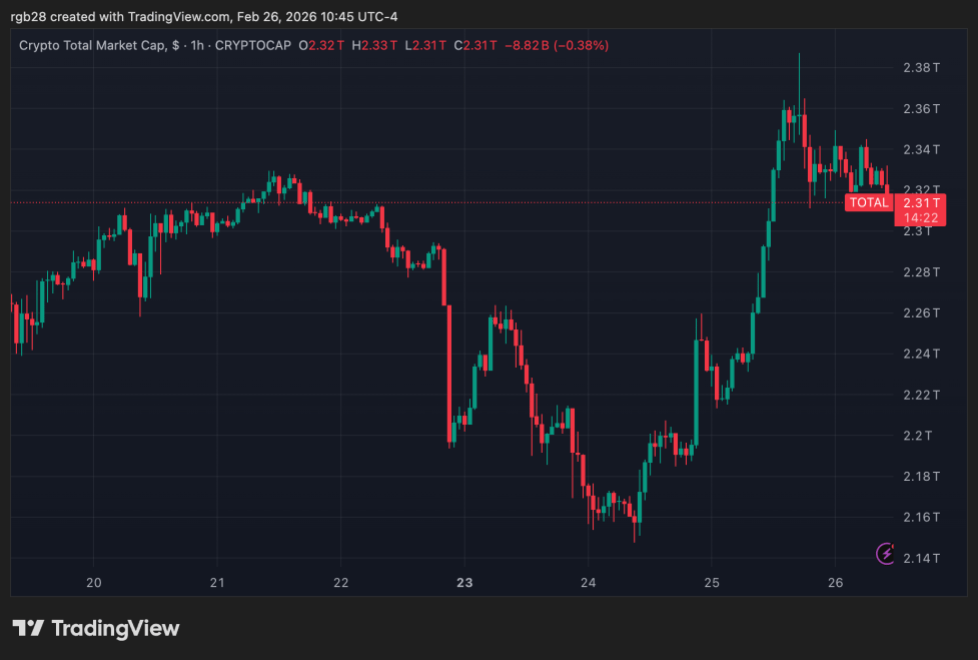
The total crypto market capitalization is at $2.31 trillion in the one-week chart. Source: TOTAL on TradingView


Preguntas relacionadas

QWhat is the main purpose of the OCC's proposed framework?

AThe main purpose of the OCC's proposed framework is to implement the GENIUS Act and establish regulations for stablecoin activities, including reserve asset standards, liquidity requirements, and measures to address potential workarounds on the interest payments ban.

QWhat specific entities will the OCC have regulatory authority over under the proposed rules?

AThe OCC will have regulatory authority over subsidiaries of national banks or federal savings associations, federal qualified issuers, state qualified issuers, and foreign issuers of payment stablecoins.

QWhat key issue related to stablecoin yield does the OCC's proposal specifically address?

AThe proposal specifically addresses the issue of potential workarounds where issuers might attempt to pay prohibited interest or yield to stablecoin holders through arrangements with third parties, such as affiliates.

QAccording to the OCC, what two conditions would lead to a presumption that an issuer is paying prohibited yield?

AThe OCC would presume an issuer is paying yield if: 1) it has an arrangement with an affiliate or related third party to pay them interest, and 2) that affiliate or third party has an arrangement to pay that interest to a stablecoin holder solely in connection with holding or using the tokens.

QWhat types of activities are NOT intended to be prevented by the OCC's proposed rules on yield?

AThe rules are not intended to prevent a merchant from independently offering a discount for using stablecoins, or to prevent an issuer from sharing profits with a non-affiliate partner in a white-label arrangement.

Lecturas Relacionadas

The Entire Internet Hails Noam's Joining, But OpenAI's Loss Bill Just Got Thicker

While the AI community celebrates Noam Shazeer, co-author of the "Attention Is All You Need" paper, joining OpenAI as Head of Architectural Research, the company's audited financials reveal a starkly different reality. In 2025, OpenAI reported $13.07 billion in revenue but a massive $20.92 billion operating loss. Even excluding a one-time accounting charge, the cash burn is severe, with $3.7 billion consumed in Q1 2026 alone. This high-profile hiring occurs against a backdrop of significant internal research talent drain, with key founders and researchers departing as the company's focus shifts from exploratory research to product iteration. Meanwhile, OpenAI's fundamental business model faces a deep crisis. It paid Microsoft $10.59 billion for compute in 2025, while its vast user base of 9 billion weekly actives includes only 50 million paying customers, making growth a direct driver of escalating costs. The article argues Shazeer's recruitment is less about technical necessity and more about crafting a compelling narrative for OpenAI's upcoming IPO, aiming to justify a rumored $1 trillion valuation to future public market investors. It contrasts OpenAI's strategy with Anthropic's reported path to profitability, which relies on a strong enterprise customer base and cost control, rather than star-powered narratives. Ultimately, the piece concludes that while Shazeer's architectural work may take 1-2 years to materialize, OpenAI's financial clock is ticking much faster, with its massive losses undercutting the celebratory headlines.

marsbitHace 1 hora(s)

The Entire Internet Hails Noam's Joining, But OpenAI's Loss Bill Just Got Thicker

marsbitHace 1 hora(s)

Market Trend (June 19): US-Iran Deal Drives Out Geopolitical Premium; Chip Stocks Soar to New Highs; Energy Sector Leads Declines

U.S. Market Trends (June 19): U.S.-Iran Deal Eases Tensions, Chip Stocks Soar, Energy Sector Leads Declines. U.S. stocks rallied on Thursday as the signing of a temporary U.S.-Iran deal in Geneva de-escalated Middle East tensions, with Saudi oil tankers transiting the Strait of Hormuz. This geopolitical relief helped markets recover from recent Fed-driven volatility. The S&P 500 rose over 1%, the Nasdaq gained nearly 2%, and the Dow Jones Industrial Average closed at another record high. The Philadelphia Semiconductor Index surged over 6% to a historic peak. Chip stocks were the standout performers. Reports of an Apple-Intel design and foundry deal for certain products, alongside mentions of potential Nvidia and SpaceX collaborations with Intel, propelled the sector. Intel surged ~10.5%, while memory chip makers like Micron also saw significant gains, highlighting sustained confidence in long-term AI capital expenditure. In contrast, the energy sector was the day's sole loser, with the S&P 500 energy sub-index declining as WTI crude fell ~2% to around $74.29/barrel. The reopening of key shipping routes erased prior geopolitical risk premiums. SpaceX extended losses for a second day on news of a potential large bond offering. Market volatility (VIX) dropped sharply, indicating a swift reversal of post-Fed jitters. Treasury yields dipped slightly but remained elevated. The focus now shifts to upcoming economic data, including next week's PCE inflation report and Micron's earnings, which will serve as a key test for the AI trade's durability.

marsbitHace 1 hora(s)

Market Trend (June 19): US-Iran Deal Drives Out Geopolitical Premium; Chip Stocks Soar to New Highs; Energy Sector Leads Declines

marsbitHace 1 hora(s)

Trading

Spot
Futuros
活动图片