OCC boss says ‘no justification’ to judge banks and crypto differently

cointelegraphPublished on 2025-12-09Last updated on 2025-12-09

Abstract

OCC Acting Comptroller Jonathan Gould stated that crypto companies seeking federal bank charters should be treated equally with traditional financial institutions, arguing there is "no justification" for differential treatment of digital assets. He emphasized that banks should not be confined to outdated technologies and noted that custody services have long been electronic. Gould revealed the OCC received 14 new bank applications this year, including from digital asset firms, nearly matching the total from the past four years. He dismissed concerns from traditional banks about crypto charters, stating such opposition risks stifling innovation, and expressed confidence in the OCC's ability to supervise crypto-native banks fairly.

Crypto companies seeking a US federal bank charter should be treated no differently than other financial institutions, says Jonathan Gould, the head of the Office of the Comptroller of the Currency (OCC).

Gould told a blockchain conference on Monday that some new charter applicants in the digital or fintech spaces could be seen as offering novel activities for a national trust bank, but noted “custody and safekeeping services have been happening electronically for decades.”

“There is simply no justification for considering digital assets differently,” he added. “Additionally, it is important that we do not confine banks, including current national trust banks, to the technologies or businesses of the past.”

The OCC regulates national banks and has previously seen crypto companies as a risk to the banking system. Only two crypto banks are OCC-licensed: Anchorage Digital, which has held a charter since 2021, and Erebor, which got a preliminary banking charter in October.

Crypto “should have” a way to supervision

Gould said that the banking system has the “capacity to evolve from the telegraph to the blockchain.”

He added that the OCC had received 14 applications to start a new bank so far this year, “including some from entities engaged in novel or digital asset activities,” which was nearly equal to the number of similar applications that the OCC received over the last four years.
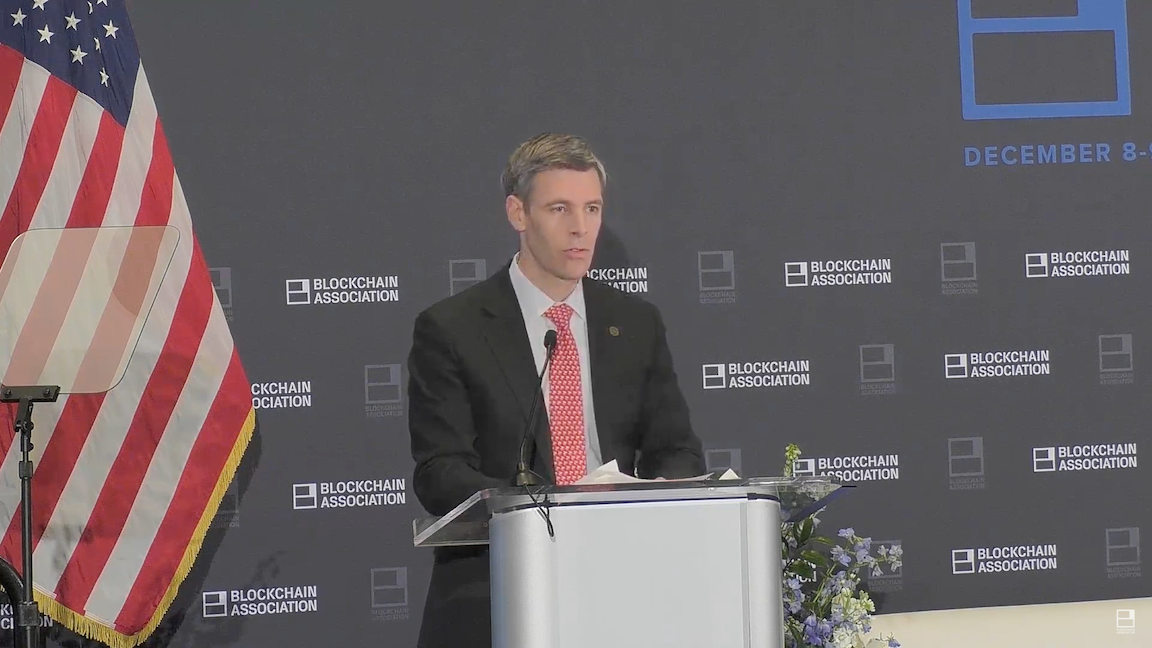
Comptroller of the Currency Jonathan Gould giving remarks at the 2025 Blockchain Association Policy Summit. Source: YouTube

“Chartering helps ensure that the banking system continues to keep pace with the evolution of finance and supports our modern economy,” he added. “That is why entities that engage in activities involving digital assets and other novel technologies should have a pathway to become federally supervised banks.”

Gould brushes off banks’ concerns

Gould noted that banks and financial trade groups had raised concerns about crypto companies getting banking charters and the OCC’s ability to oversee them.

Related: Argentina weighs letting traditional banks trade crypto: Report

“Such concerns risk reversing innovations that would better serve bank customers and support local economies,” he said. “The OCC has also had years of experience supervising a crypto-native national trust bank.”

Gould said the regulator was “hearing from existing national banks, on a near daily basis, about their own initiatives for exciting and innovative products and services.”

“All of this reinforces my confidence in the OCC’s ability to effectively supervise new entrants as well as new activities of existing banks in a fair and even-handed manner,” he added.

Legal Panel: Crypto wanted to overthrow banks, now it’s becoming them in stablecoin fight

Related Reads

How to Build a Polymarket Passive Income Bot from Scratch

Polymarket, a leading prediction market platform on Polygon, allows users to bet on real-world events using USDC. Its open API, transparent order book, low fees, and numerous human traders making errors create a fertile ground for automated trading bots. This article breaks down bot strategies from basic to advanced. Beginner-level bots include airdrop farming bots that generate volume by repeatedly buying and selling the same position, and volatility捕捉 bots that bet on mean reversion after sharp price swings. Intermediate strategies involve market-making bots, which profit from bid-ask spreads and liquidity rewards by placing limit orders, though they require significant capital and risk losses during sudden market moves. Advanced bots include arbitrage bots that exploit pricing inefficiencies between related outcomes (e.g., YES/NO shares summing under 100%), and AI-powered bots that integrate multiple data sources—historical prices, news, on-chain activity, social sentiment—to identify mispriced probabilities and execute trades across hundreds of markets. All bots require access to Polymarket’s API, a Polygon wallet for USDC transactions, historical data storage (e.g., PostgreSQL), and a Python-based toolchain. Bots succeed due to their speed, discipline, scalability, and data-processing capabilities. However, effective risk management is crucial, as strategies can fail due to liquidity issues, unexpected news, or intense competition. Building a profitable AI bot is particularly resource-intensive, akin to running a startup.

Odaily星球日报Hace 1 min(s)

How to Build a Polymarket Passive Income Bot from Scratch

Odaily星球日报Hace 1 min(s)

Fed Rate Cut Tonight Almost Certain, This Meeting More Like a 'Political Pressure Test'!

This week's Federal Reserve policy meeting is set to be one of the most contentious in recent years. With key economic data missing due to a 43-day U.S. government shutdown, the meeting has evolved into a stress test of the Fed’s independence and decision-making process. Market expectations for a rate cut have surged from 30% to 97%, reflecting both data uncertainty and growing political influence. Internally, the Fed is deeply divided, with a 4-4 split among key officials between holding rates and cutting. The dot plot shows a rare "bimodal distribution," with 7 officials favoring no change and 8 supporting a 50-basis-point cut. Doves point to a weakening labor market—unemployment rose to 4.3% in August, a four-year high—while hawks emphasize persistent inflation, with core PCE at 2.7%, above the 2% target. Political pressure has intensified, notably through appointments like Stephen Milan, who voted for a deeper cut just one day into his role, aligning with former President Trump’s public demands. The upcoming Fed leadership transition adds further uncertainty, as officials may be positioning for future roles. Amid data gaps and political interference, the Fed faces a complex risk-management dilemma: balancing concerns over slowing employment against inflation risks and soaring government debt interest costs. Communication challenges are heightened by internal divisions, forcing the Fed to rely more on high-frequency and alternative data. This meeting may mark a shift toward a new monetary policy framework where data scarcity and political pressure become persistent challenges to the Fed’s independence.

marsbitHace 47 min(s)

Fed Rate Cut Tonight Almost Certain, This Meeting More Like a 'Political Pressure Test'!

marsbitHace 47 min(s)

Trading

Spot
Futures
活动图片