NVIDIA Team Enables Programming Agent to Take Over Real Robot Experiments, Achieves 99% Success Rate

marsbitPublicado a 2026-06-18Actualizado a 2026-06-18

Resumen

NVIDIA's ENPIRE project demonstrates fully automated robotic research where AI agents, given only high-level goals, autonomously manage the entire loop—from literature search and code development to training, deployment, and hardware iteration—on a fleet of physical robots. The system achieves 99% success rates on dexterous real-world tasks like cable tying and peg sorting. Key insights include the discovery of a "physical scaling law" where more parallel robots speed up task resolution, and the observation that resetting an environment is often easier than the main task. The framework introduces metrics like Mean Robot Utilization (MRU) to measure efficiency, with robots often idle half the time, waiting for agent decisions. The long-term vision is a lab that runs autonomously, even without human oversight. The project will be open-sourced, allowing developers to build similar systems.

Automated research has truly stepped out of the code sandbox and into the real physical world.

Recently, Jim Fan, lead of NVIDIA's GEAR lab, introduced a new project called ENPIRE. This marks their first implementation of automated research on robot hardware.
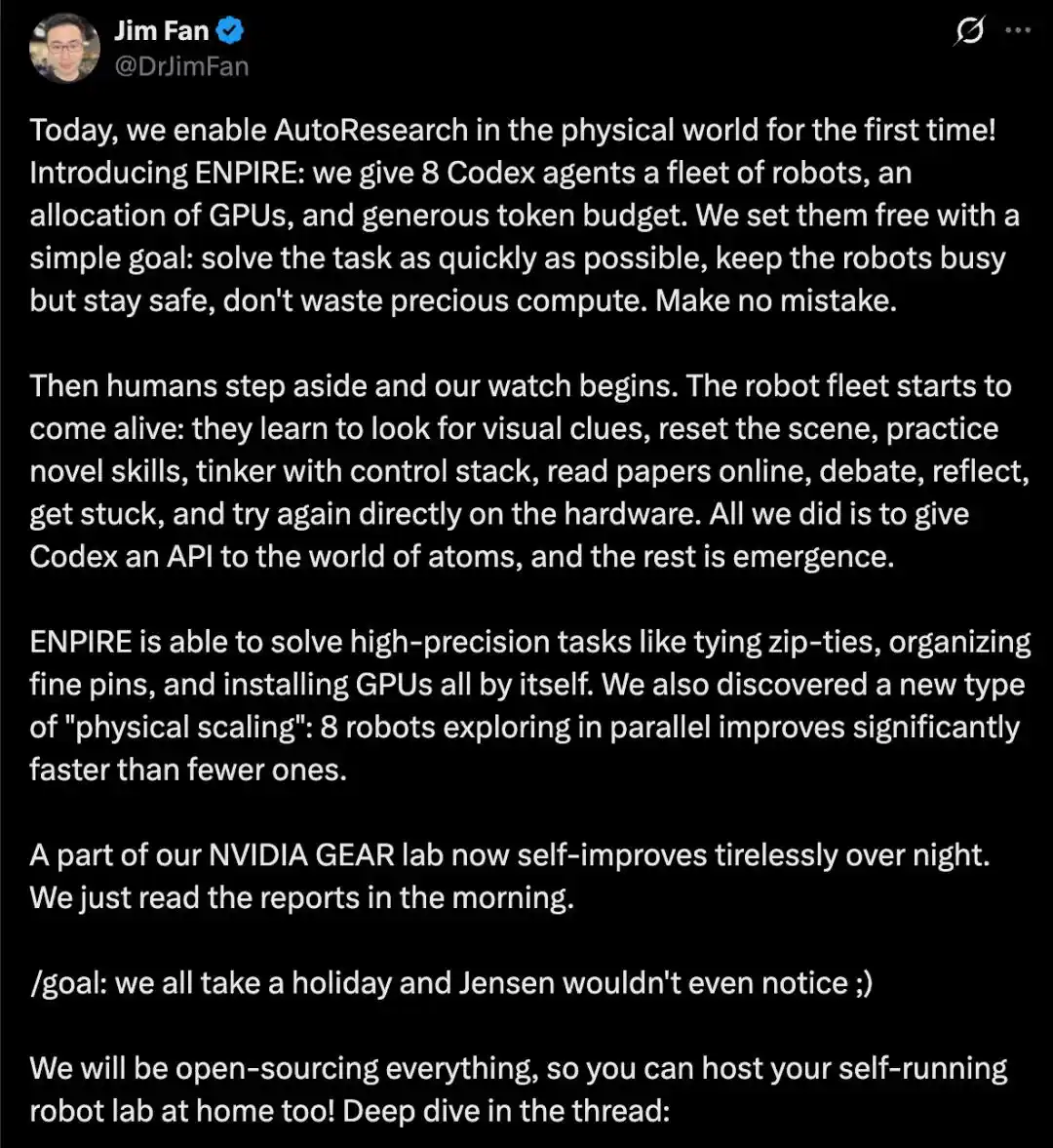
They placed 8 Codex Agents into a robot fleet, allocated GPU computing power and ample token budgets, and gave a simple goal: solve the task as quickly as possible, keep the robots busy but safe, and avoid wasting computing power.

After that, human intervention was largely withdrawn. The Agents autonomously drove the entire closed loop, including automatic scene resetting, literature review, idea implementation and infrastructure setup, policy training and deployment, self-verification, log analysis and code improvement, iterating continuously until high-precision dexterous tasks were reliably completed on real hardware, such as fastening cable ties, organizing pins into a box, installing GPUs, etc.

They also observed a "physical scaling law": increasing the number of parallel robots (e.g., from a few to 8) significantly sped up task resolution.

Currently, part of the lab's systems can perform self-iteration overnight without human intervention, with researchers only needing to check reports in the morning.

Jim Fan stated that the future goal is to allow team members to go on vacation with peace of mind, with even NVIDIA CEO Jensen Huang unaware that the lab is still running autonomously.

The ENPIRE project plans to be fully open-sourced, potentially enabling regular developers to set up similar autonomous robot research systems at home.
Project address: https://research.nvidia.com/labs/gear/enpire/

ENPIRE System Architecture: Four Modules Forming a Closed Loop

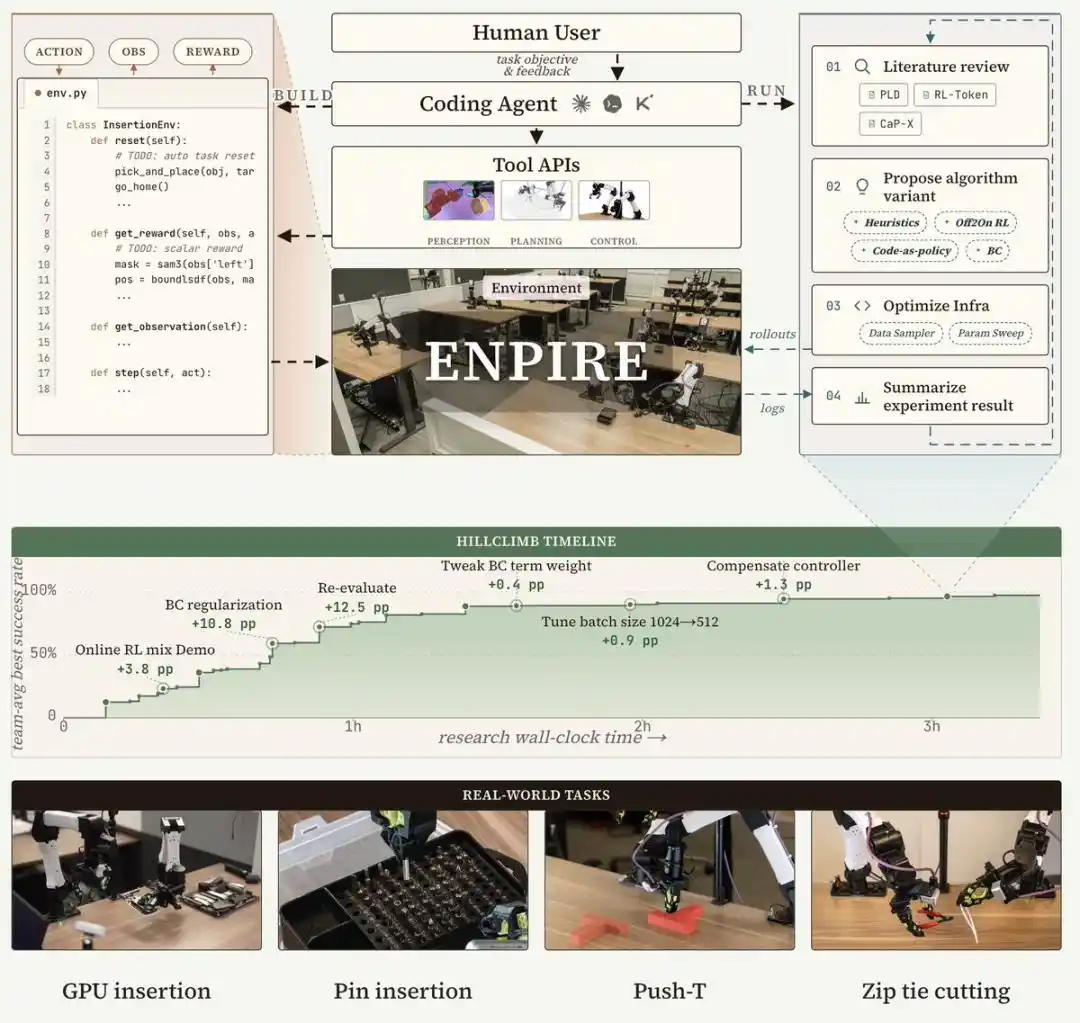
ENPIRE is a framework system designed for coding Agents, constructing a repeatable physical feedback loop through four core modules: the Environment module (EN) handles automatic resetting and verification; the Policy Improvement module (PI) initiates policy optimization; the Rollout module (R) supports policy evaluation on single or multiple robots in parallel; and the Evolution module (E) enables coding Agents to analyze logs, review literature, and improve training infrastructure and algorithm code to address failure modes.

This closed-loop system transforms real-world robot learning into an Agent-managed, controllable optimization process, thereby minimizing manual input while supporting fair ablation experiments across different training recipes and Agent variants.

Supported by ENPIRE, cutting-edge programming Agents can autonomously develop policies and achieve a 99% success rate on challenging real-world dexterous manipulation tasks like PushT, organizing pins into a pin box, and cutting cable ties with a cutter.

Key Finding: Resetting the Environment is Often Easier Than Completing the Task Itself

One key observation is: For many robot tasks, resetting the environment is often easier than completing the task itself.

Therefore, ENPIRE's approach is to first let the Agent build an automatic resetting environment via Code-as-Policy. Often, the so-called reset is essentially a pick-and-place task, solvable by Cap-X.

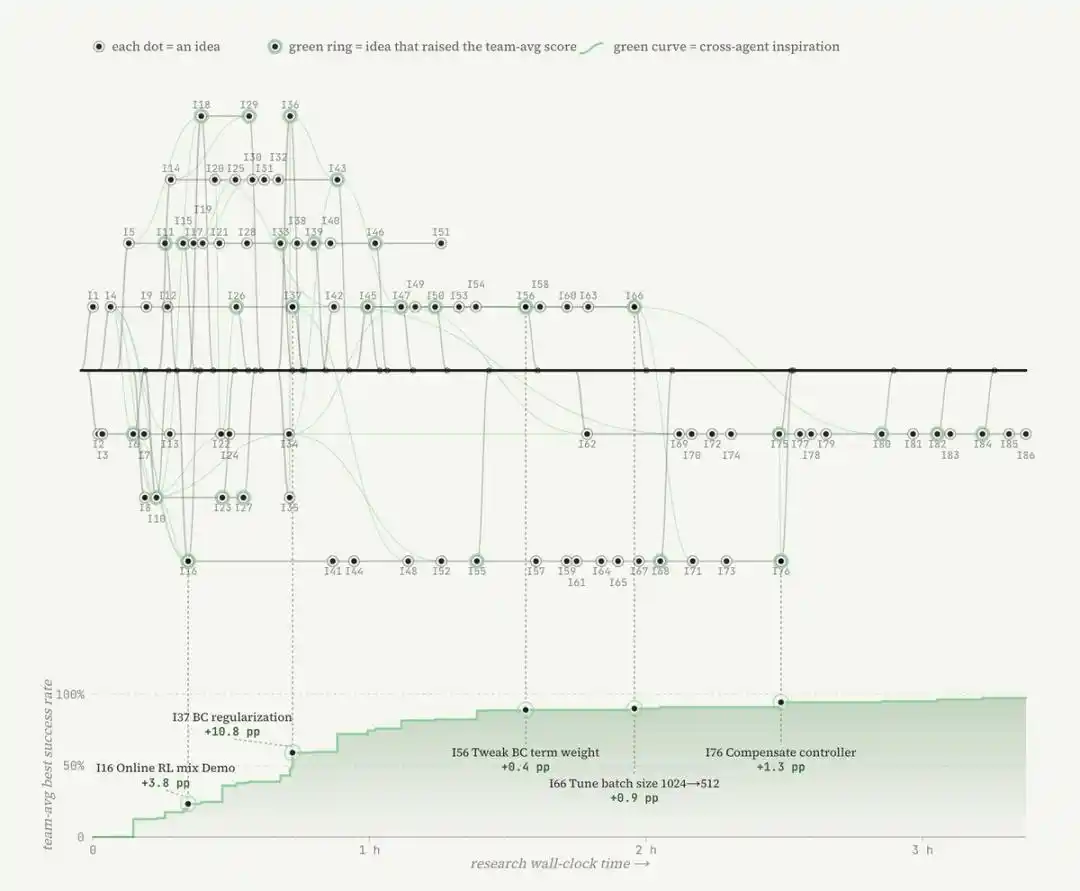
Subsequently, the agent writes a heuristic rule-based reward function. The research team then places this environment into a sandbox and initiates automated research by the Agent centered around scoring.

This also echoes Karpathy's definition of automated research: automated research here is not simply tuning a hyperparameter or modifying a small piece of code. The Agent explores different paradigms from the internet and rewrites anything that could potentially boost performance, including algorithms, training objectives, and even the data loader.

In the pin task, one Agent even wrote its own contact force safety controller, which proved more effective than merely adjusting several reinforcement learning parameters.
New Metrics MRU and MTU

ENPIRE's scalability depends on the size of the Agent team and computing resources, but here, the truly scarce resource is not GPUs, but robot time.

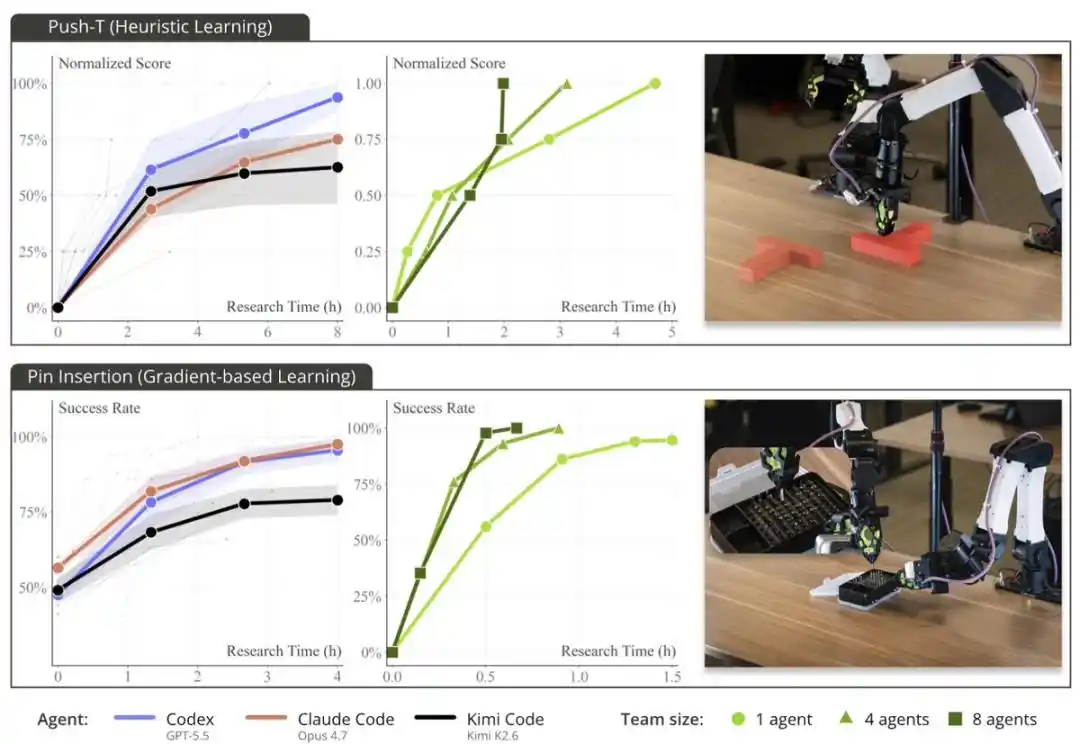
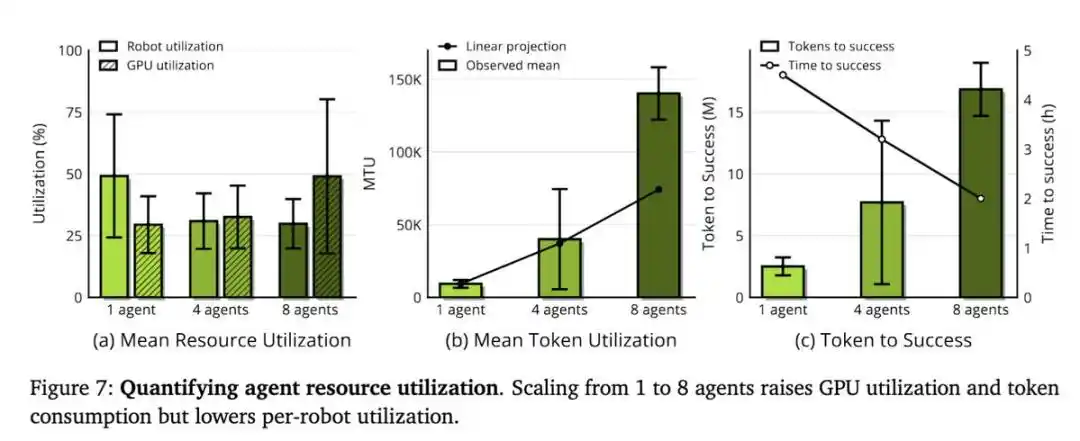
When the research team provided Agents with 8 robots instead of 1, the time needed for the pin task to achieve near-perfect performance was reduced from over 1.5 hours to about 40 minutes. These Agents coordinate via Git: sharing code, discarding suboptimal ideas, and autonomously selecting each other's best-performing runs.
This points to a larger shift: robotics research is becoming a work of environment design—building environments where coding Agents can conduct automated research; algorithmic work is shifting to a higher layer, towards constructing feedback loops that Agents can autonomously close.

And this loop compounds continuously: a skill mastered by an Agent today becomes the building block for constructing and resetting environments for more difficult tasks tomorrow. Capabilities bootstrap new capabilities.
Under this paradigm, the true hard constraint is the budget for real-world interaction.

Therefore, the research team proposed two metrics:

  • Mean Robot Utilization (MRU): The proportion of time robots are actually running experiments relative to total elapsed real-world time.
  • Mean Token Utilization (MTU): Measures the efficiency of Agents in converting tokens into research progress.

In their experiments, MRU consistently remained below 50%. That means the robots were idle half the time, waiting for the Agents to think. Therefore, a better harness and faster models directly translate into tangible benefits.
PushT is a long-standing robot manipulation benchmark. Typically, completing this task requires extensive human demonstration data plus hours of behavior cloning training.

However, they observed that Codex, Claude Code, and Kimi Code all "solved" this task in under 2 hours using a rule-based heuristic approach: without neural networks, without training, and without relying on any human data.

To enable more people to experiment with automated research in the physical world at home, they developed a full-stack system based on the @LeRobotHF SO-101 kit + NVIDIA Jetson Thor. This system can perform the PushT task.

Reference Links:

https://x.com/_wenlixiao/status/2066913334994358342

https://x.com/DrJimFan/status/2066921736369766762

This article is from the WeChat public account "Machine Heart" (ID: almosthuman2014), author: Yang Wen


Preguntas relacionadas

QWhat is the key achievement of the ENPIRE project as described in the article?

AThe ENPIRE project by NVIDIA's GEAR lab has, for the first time, successfully implemented automated research on physical robot hardware. This involved 8 Codex Agents autonomously driving a closed-loop process to solve complex, high-precision dexterous manipulation tasks like tying zip ties and organizing a pin box, achieving a success rate of 99% with minimal human intervention.

QWhat are the four core modules that make up the ENPIRE system's closed-loop architecture?

AThe four core modules are: the Environment (EN) module for automatic resetting and validation, the Policy Improvement (PI) module for initiating policy optimization, the Rollout (R) module for evaluating policies on single or multiple robots, and the Evolution (E) module where coding agents analyze logs, consult literature, and improve infrastructure and code to address failure modes.

QWhat key insight regarding task difficulty did the researchers discover, and how did ENPIRE leverage it?

AA key observation was that resetting a robot environment is often easier than completing the main task itself. ENPIRE leverages this by first having agents build an automatic reset environment (often a simple pick-and-place task) using Code-as-Policy. This automated reset capability is crucial for enabling continuous, unattended experimentation.

QAccording to the article, what new metrics were proposed to measure the efficiency of this automated research paradigm, and what does a low MRU indicate?

ATwo new metrics were proposed: Mean Robot Utilization (MRU), which measures the proportion of time robots are actively running experiments, and Mean Token Utilization (MTU), which measures how efficiently agent tokens are converted into research progress. In their experiments, MRU was below 50%, indicating robots spent over half their time idle, waiting for the agents to think, highlighting a bottleneck.

QWhat future vision did Jim Fan, leader of the NVIDIA GEAR lab, describe for the ENPIRE system?

AJim Fan's stated future goal is for the lab team to be able to go on vacation comfortably, with the system running so autonomously that even NVIDIA's CEO, Jensen Huang, would be unaware that the laboratory continues to operate and conduct research on its own.

Lecturas Relacionadas

Why Bitcoin Holds Above $64,000 After Fed's Hard Pause

**Bitcoin Stabilizes Near $64,000 Following Hawkish Fed Pause** The cryptocurrency market, led by Bitcoin, remained stable around $64,000 despite a volatile reaction to the latest U.S. Federal Reserve meeting. The Fed paused interest rates but signaled a hawkish stance, with three committee members voting for an increase—the highest dissent since 2016. This limits risk appetite but hasn't triggered panic selling. Key market highlights include Bitcoin ETFs seeing a net inflow of $32.1 million, breaking a streak of outflows, while Ethereum ETFs experienced outflows of $18.65 million. Liquidations affected about 90,000 traders. Technically, Bitcoin finds support around $63,000-$63,500, with major resistance near $66,000. While its price is about 49% below its all-time high, institutional demand via ETFs and the absence of mass capitulation support a potential recovery scenario in the second half of the year. Major altcoins showed mixed movements, with Solana attracting capital while Ethereum faced selling pressure despite strong on-chain metrics like a growing staking queue. Regulatory news took a pause as the U.S. Senate delayed the CLARITY Act vote until at least autumn. For the final trading day of July, U.S. inflation and consumer spending data will be crucial. Bitcoin's key levels to watch are $63,000 support and $66,000 resistance. Sustained ETF inflows and Bitcoin holding above $63,000 are seen as positive signs for a potential market recovery later in the year.

cryptonews.ruHace 53 min(s)

Why Bitcoin Holds Above $64,000 After Fed's Hard Pause

cryptonews.ruHace 53 min(s)

Participants in XRP Fraud Scheme That Stole $9 Million from 71 Investors Arrested

South Korean police have arrested three individuals accused of operating a fraudulent investment platform that stole approximately 3.4 million XRP (worth about $9 million) from 71 investors between October 16 and 23. The suspects promoted the site Fxrpntwork.com through blogs, online articles, and YouTube videos, promising guaranteed principal and monthly returns of 1.5% to 1.8%. Investors were instructed to transfer XRP from Korean exchanges to overseas platforms and then to wallets controlled by the group before the site was shut down. The scammers copied the branding of legitimate projects Flare Network and FXRP to appear credible. Authorities warn that such impersonation frauds, which use familiar branding and urgent promises of guaranteed profits, are a common red flag. Legitimate companies do not solicit cryptocurrency transfers through unsolicited promotions. Seoul police have issued an Interpol Red Notice for a fourth suspect abroad and are investigating others involved in creating and promoting the fraudulent website. While investigators froze 17.3 billion won in assets, approximately 10 billion won was moved during the probe, with wallet analysis revealing transfers totaling 27.3 billion won, suggesting there may be additional unidentified victims and accomplices. The case underscores the organized, cross-border nature of crypto investment fraud.

cryptonews.ruHace 56 min(s)

Participants in XRP Fraud Scheme That Stole $9 Million from 71 Investors Arrested

cryptonews.ruHace 56 min(s)

Trading

Spot
活动图片




