New revenue hierarchy? How Hyperliquid is outpacing legacy chains

ambcryptoPublicado a 2026-04-06Actualizado a 2026-04-06

Resumen

The blockchain value capture model is shifting from passive transfers to active trading, with perpetual trading volume ($8.4B) far exceeding spot DEX activity ($3.7B). Hyperliquid exemplifies this trend, capturing 36.4% of DeFi fees by March 2026, while Ethereum and Solana see declining shares. Its derivatives platform generated $154.95B in total volume from 212,843 traders, driving $12.43M in fees. A key mechanism redirects fees—$403,475 in 24 hours—to buybacks, removing 10,794 HYPE tokens from circulation. This creates a feedback loop where trading activity fuels fees, buy pressure, and token value appreciation, highlighting how specialized trading platforms now dominate value capture over general-purpose chains.

The way blockchains capture value is shifting, as activity moves from passive transfers toward active trading flows. Earlier models relied on broad usage, where simple transactions supported network value.

Now, trading dominates the landscape.

Perpetual volume hovered around about $8.4 billion in 24 hours, far exceeding the $3.7 billion seen across Spot DEX activity. This shows capital now concentrates around continuous trading rather than one-time transfers.

Fee distribution follows this shift, with Hyperliquid contributing about $618,377 out of $41.45million total DeFi fees. This evolution reshapes the market, where value depends more on trading intensity, which favors specialized platforms over general-purpose networks.

Hyperliquid dominance signals a new revenue hierarchy

A clear shift is unfolding in how blockchains earn, and it starts with where user activity is actually happening.

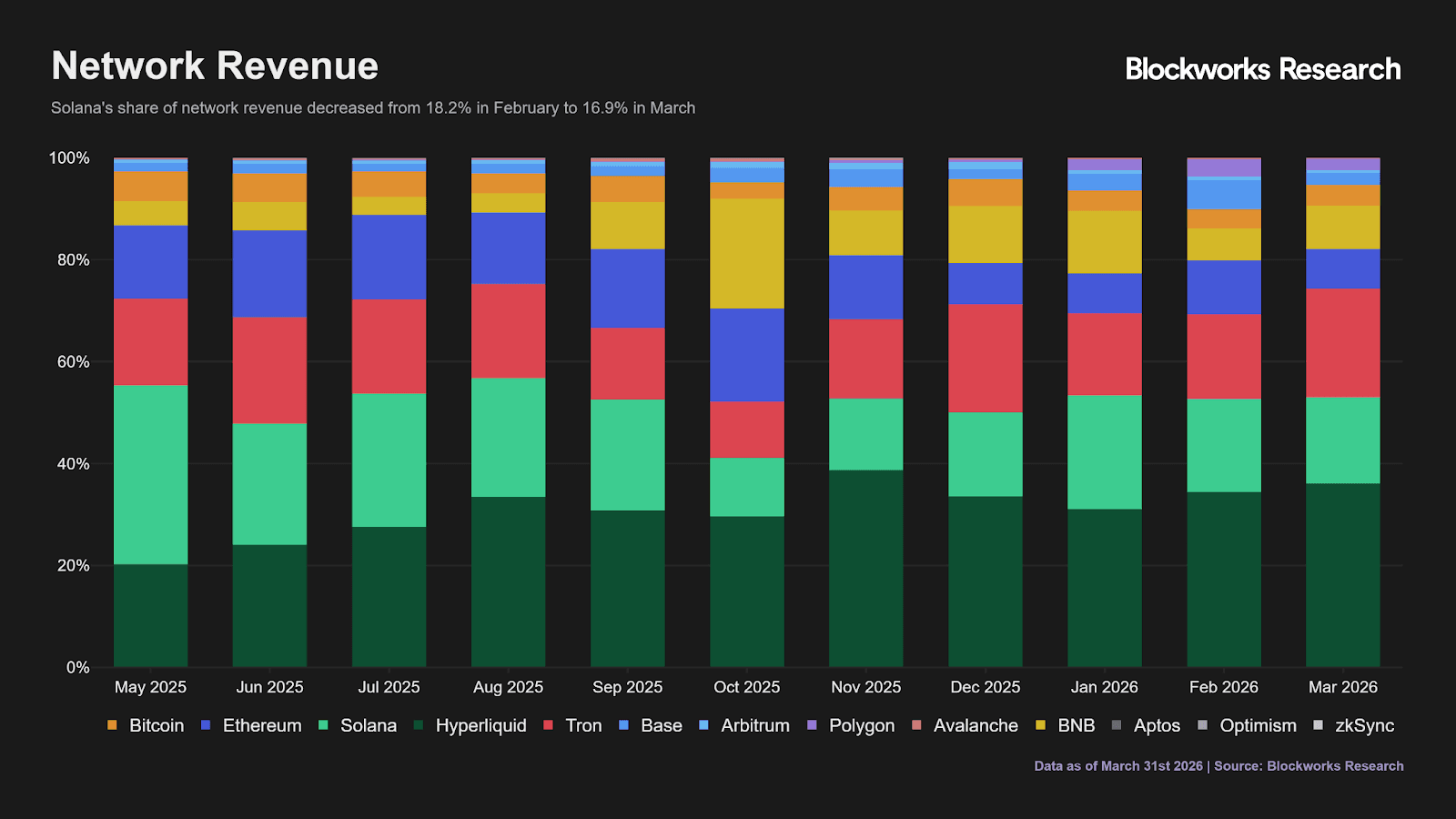
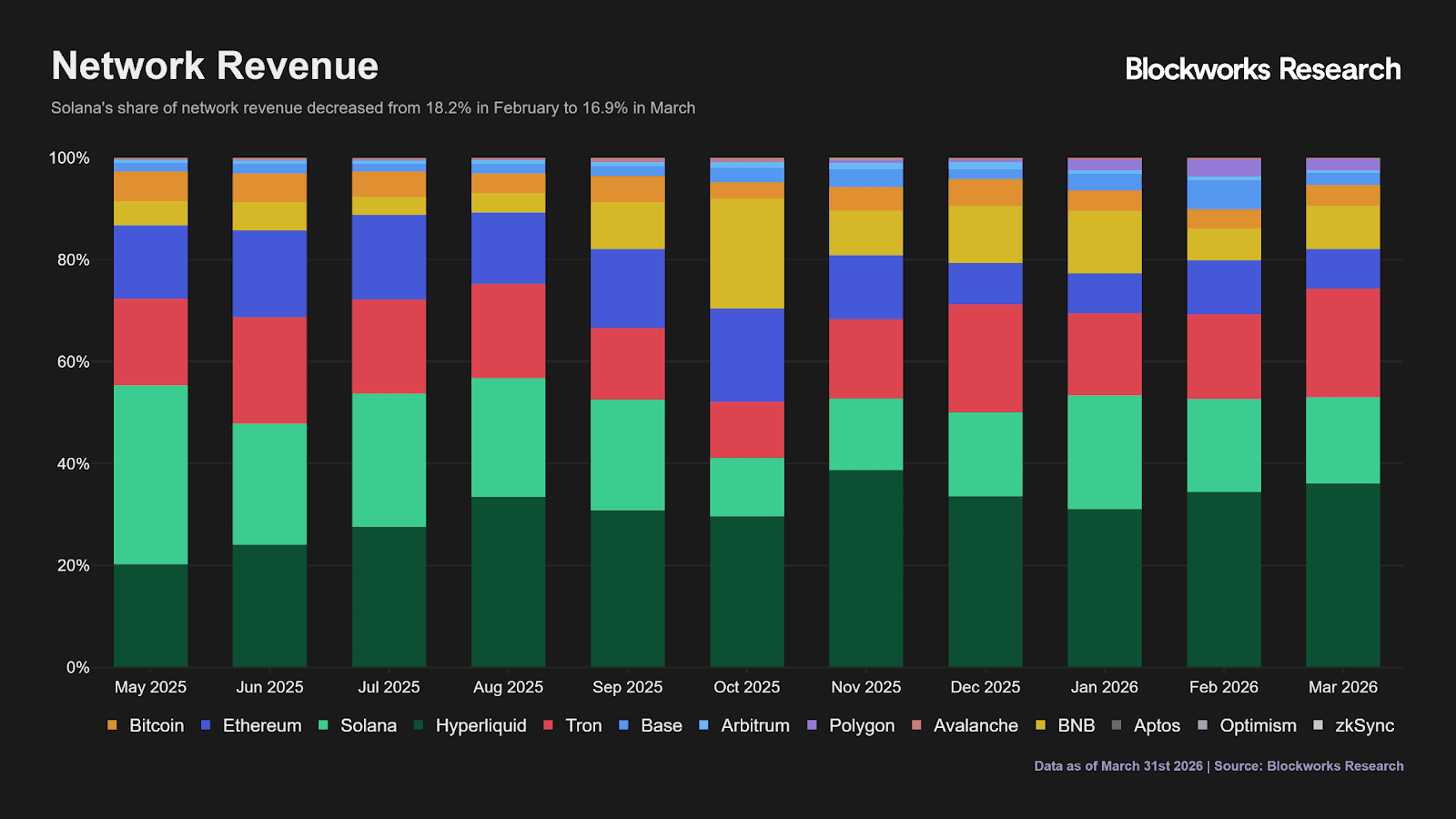
Hyperliquid’s share rose steadily through 2025, reaching about 36.4% by March 2026, which shows traders are concentrating on derivatives platforms.

Source: Blockworks Research

This shift builds as perpetual trading creates continuous fee flow rather than one-off transactions. Capital prefers environments where it can rotate quickly, which naturally pushes revenue toward trading-focused chains.

Solana [SOL] holds near 16%, slipping from 18%, which suggests usage remains strong but loses share as competition intensifies. Meanwhile, Ethereum [ETH] drops toward 7.7%, and Base near 2.4%, showing that broad activity does not translate into fee capture.

This changes market dynamics, where value follows trading intensity, pushing users and liquidity toward platforms that monetize activity more efficiently.

Hyperliquid turns trading activity into direct value capture

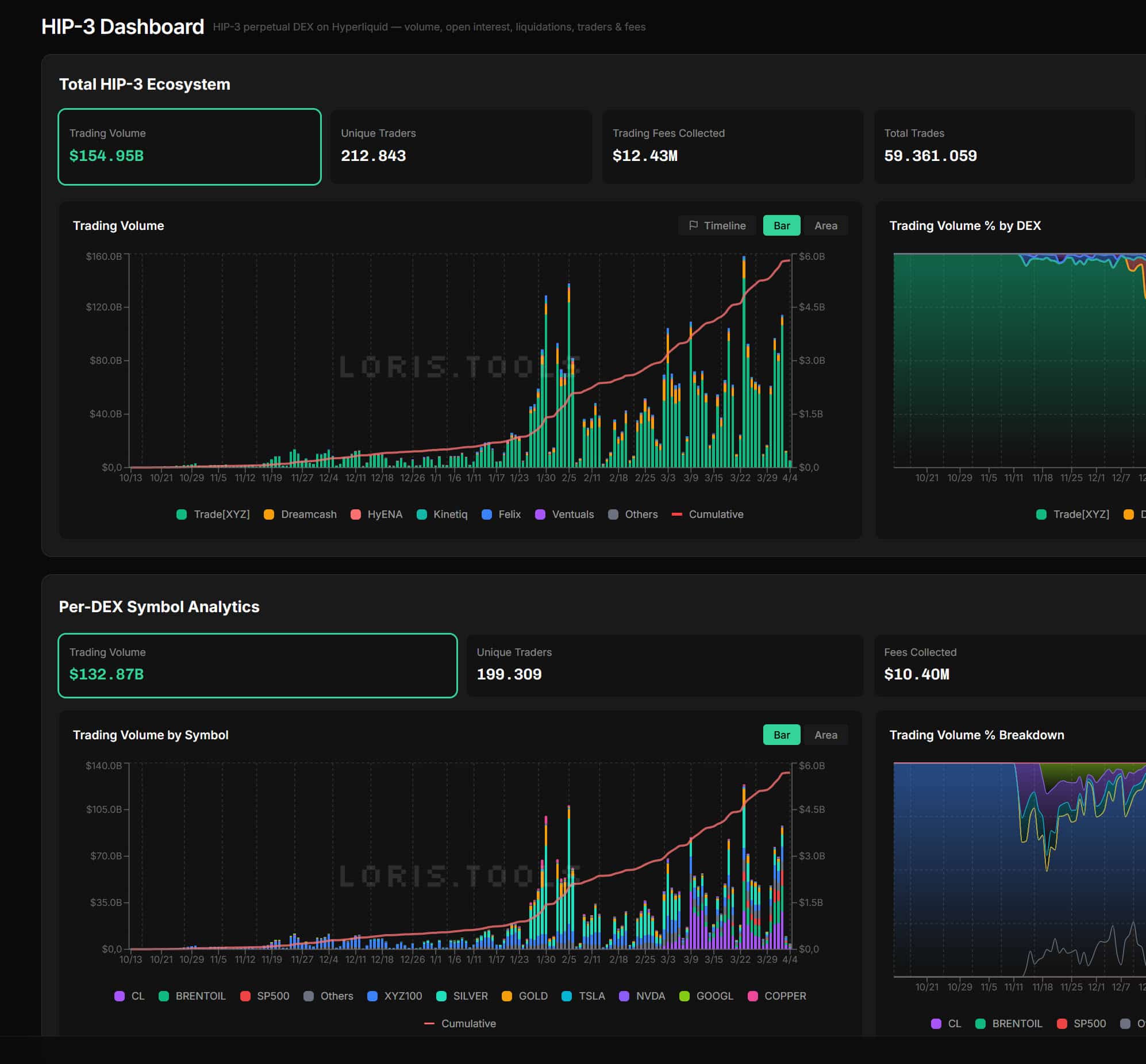
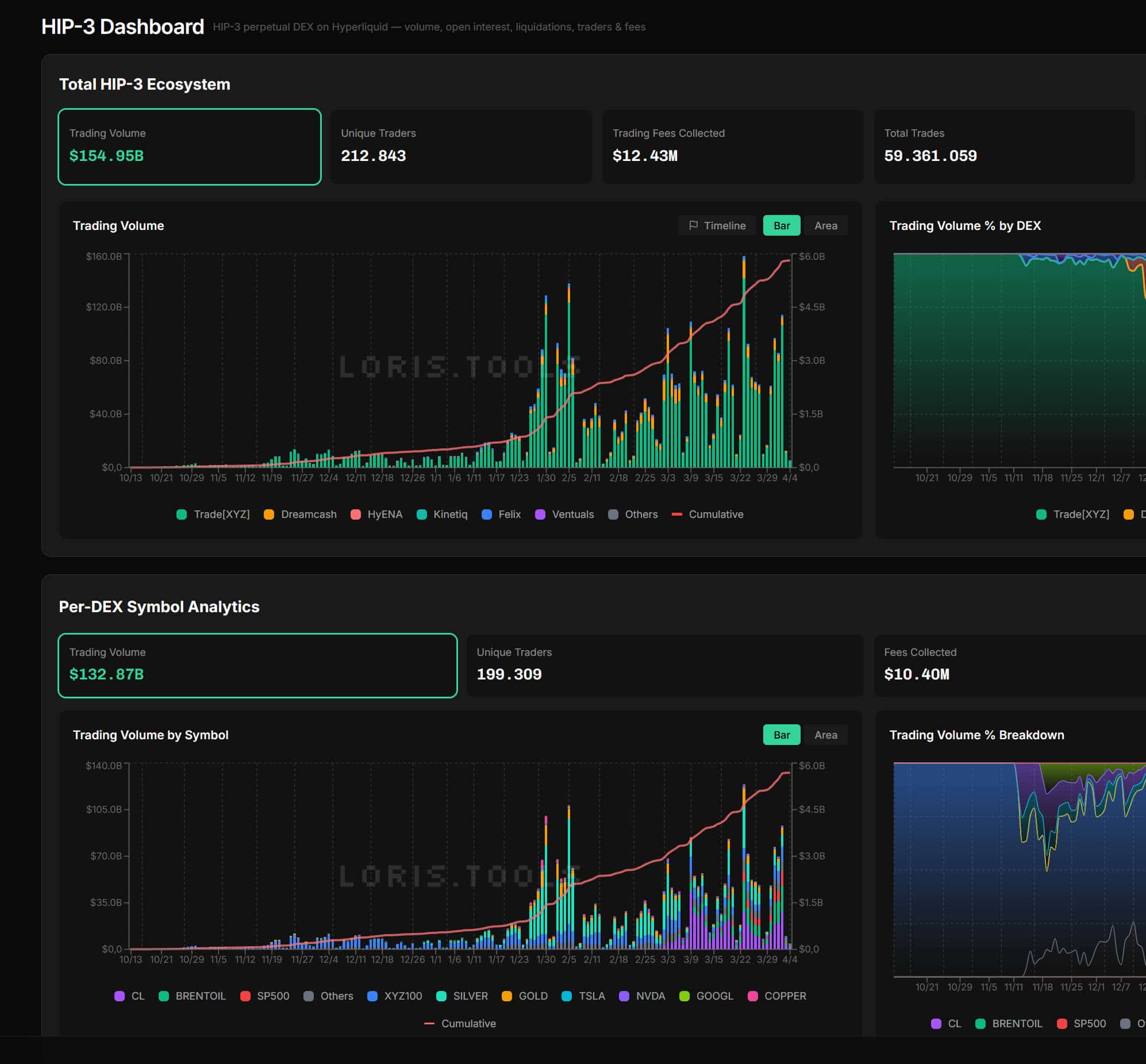
HIP-3’s growth shows how quickly derivatives activity can scale when real trading demand enters the system. Total volume reaches about $154.95 billion, supported by 212,843 traders executing roughly 59.36 million trades.

Source: X

This progression builds gradually, then accelerates into sharp spikes from January, where daily volumes expand and cumulative growth trends higher.

As participation increases, fees rise to about $12.43 million, confirming steady monetization alongside activity.

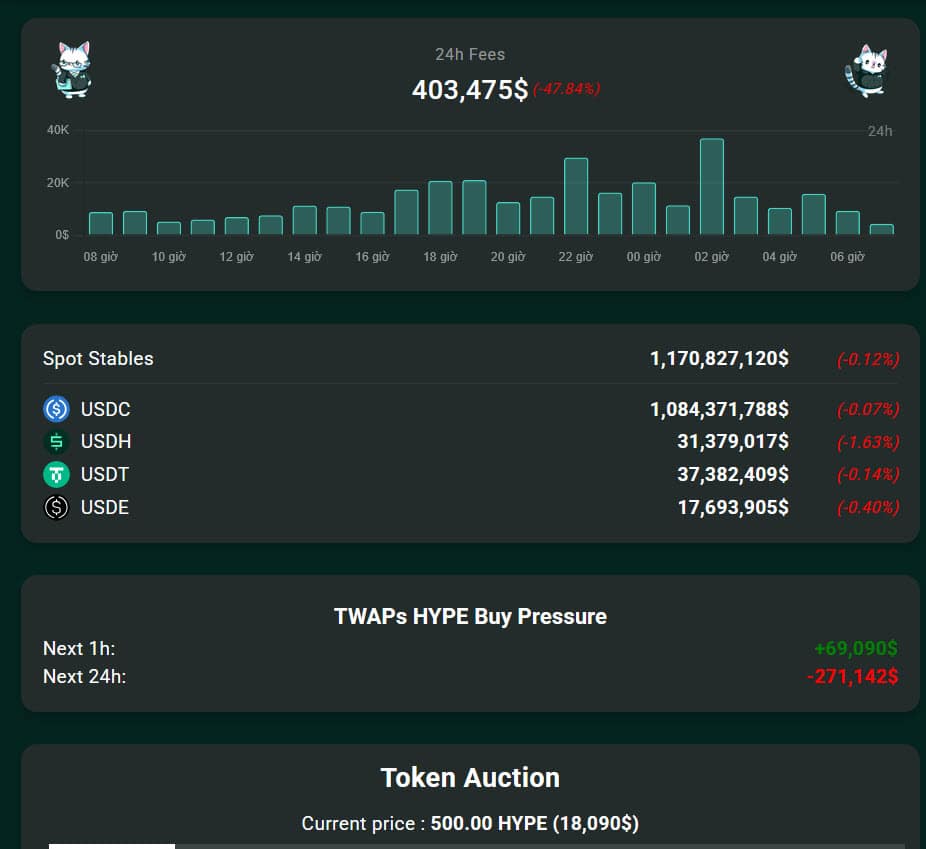
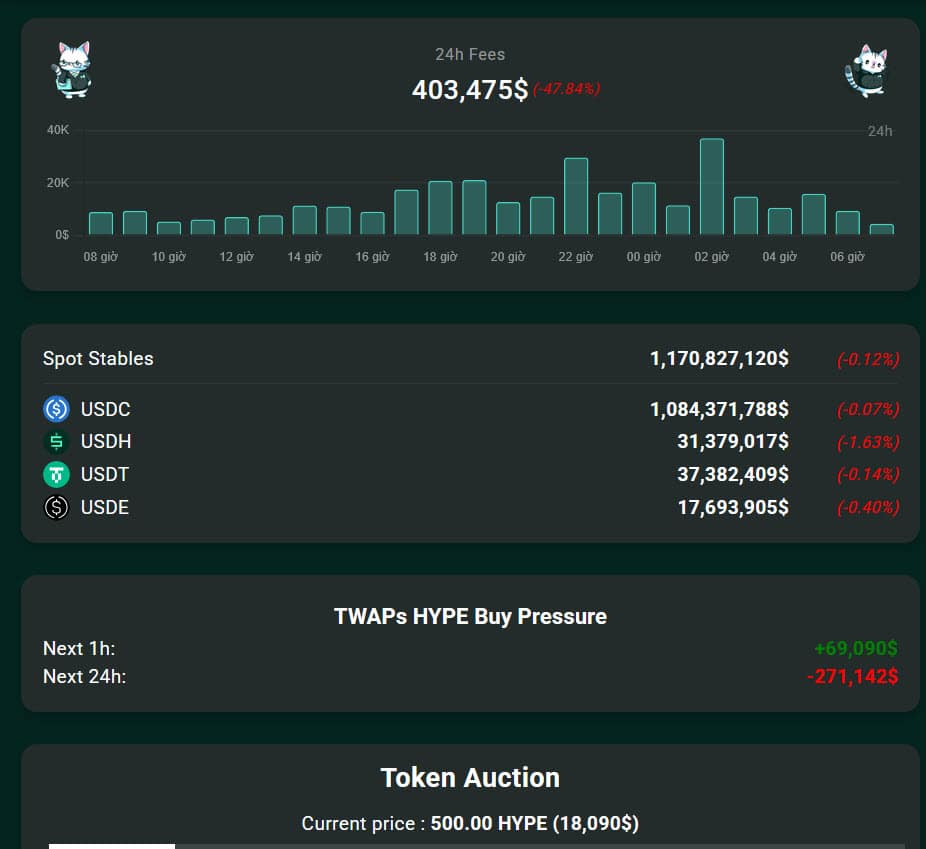
That activity does not remain abstract, as it feeds directly into token dynamics. Over the last 24 hours, fees reached about $403,475, all redirected into buybacks that remove roughly 10,794 HYPE from circulation.

Source: X

This creates a continuous loop, where trading drives fees, fees drive buy pressure, and reduced supply begins to support value as activity deepens.


Final Summary

  • Hyperliquid [HYPE] shows how trading-driven activity now dominates value capture, as continuous derivatives flow converts volume directly into fees and supply reduction.
  • Hyperliquid strengthens its market position as revenue concentration shifts toward specialized platforms, where sustained trading activity supports both liquidity and token value.

Preguntas relacionadas

QWhat is the main shift in how blockchains capture value according to the article?

AThe main shift is from passive transfers toward active trading flows, with perpetual trading now dominating and creating continuous fee generation rather than one-off transactions.

QHow much of the total DeFi fees did Hyperliquid contribute, as mentioned in the article?

AHyperliquid contributed about $618,377 out of a total of $41.45 million in DeFi fees.

QWhat percentage of the market share did Hyperliquid reach by March 2026?

AHyperliquid reached about 36.4% of the market share by March 2026.

QHow does Hyperliquid's fee mechanism directly impact its token (HYPE)?

AFees generated from trading activity are used for buybacks, which remove HYPE tokens from circulation, creating buy pressure and supporting token value through supply reduction.

QWhat does the comparison between perpetual volume and Spot DEX activity indicate about capital concentration?

APerpetual volume of $8.4 billion far exceeded Spot DEX activity of $3.7 billion in 24 hours, showing capital now concentrates around continuous trading rather than one-time transfers.
Lecturas Relacionadas

Bitcoin Mining Farms Are Becoming AI Factories

Bitcoin mines are transforming into AI factories. This shift is driven by the convergence of three key assets from the previous crypto cycle: infrastructure, talent, and capital. Crypto mining companies like Crusoe, CoreWeave, and Bitdeer are repurposing their core competency—securing power, land, and grid connections in remote locations—to build data centers for AI clients. These firms are signing multi-billion dollar, long-term contracts with companies like Anthropic, AWS, and Microsoft, as AI's demand for reliable, high-capacity compute surpasses the profitability of Bitcoin mining. Simultaneously, crypto entrepreneurs and engineers are applying their skills to new AI ventures. Examples include OpenSea's co-founder launching OpenRouter (an AI model aggregator), and former Coinbase engineers building Fal.ai (a generative media infrastructure platform). Their experience in building scalable, global software networks translates effectively to the AI space. Furthermore, capital accumulated during the crypto boom is now fueling AI. Figures like Jed McCaleb (co-founder of Ripple) funded Voltage Park, a large-scale GPU cloud provider. Notably, some crypto investments, like FTX's early bets on Anthropic and Cursor, have generated astronomical paper returns, demonstrating how high-risk crypto capital flowed into AI before it became mainstream. The transition is not just about repurposing hardware, but about redirecting critical resources—power infrastructure, distributed systems expertise, and venture funding—to the next technological frontier: artificial intelligence.

链捕手Hace 17 min(s)

Bitcoin Mining Farms Are Becoming AI Factories

链捕手Hace 17 min(s)

Morpho Launches Fixed-Rate Product Midnight: Lenders and Borrowers Set Their Own Rates, Ending the Era of Interest Rate Models

Morpho Launches Fixed-Rate Product Midnight: Lenders and Borrowers Set Their Own Rates, Ending the Era of Algorithmic Interest Models On-chain lending has grown to $60 billion but remains minuscule compared to traditional finance's $200 trillion annual credit volume. Morpho identifies the lack of fixed rates and maturity dates as key bottlenecks. Institutions need predictability, not the passive floating rates set by algorithmic models. Midnight allows lenders and borrowers to directly quote rates, set terms, and become price makers, not takers. Fixed-rate lending is now viable due to cheaper, faster blockchains and the entry of institutions demanding control and certainty over returns, costs, and duration. Morpho Blue previously gave users control over risk; Midnight adds control over interest rates. Past attempts at on-chain fixed-rate lending failed primarily because they were built on top of floating-rate pools (creating unpredictability) or lacked sufficient active participants. Midnight avoids these pitfalls as a standalone primitive with fixed rates at its core, built upon Morpho Blue's existing large and active user base. Midnight offers distinct value: institutions gain predictable term structures and full control; fintech companies can offer tailored fixed-rate products; lenders/borrowers achieve predictability and efficiency; and curators can now differentiate by configuring both risk and interest rates. Morpho Midnight is not a replacement for Morpho Blue. The Morpho network will now feature two complementary market structures: floating-rate/open-term (Blue) for flexibility and fixed-rate/fixed-term (Midnight) for predictability. Liquidity can flow between them. The launch will be gradual, prioritizing security. Initially, it will support direct lending on Base network with one trading pair (cbBTC/USDC) and limited maturity dates. Advanced features like auto-rollovers will be introduced later.

marsbitHace 17 min(s)

Morpho Launches Fixed-Rate Product Midnight: Lenders and Borrowers Set Their Own Rates, Ending the Era of Interest Rate Models

marsbitHace 17 min(s)

human.tech Launches Clean SDK for Privacy-First Web3 Apps

human.tech has launched the Clean SDK, a toolkit enabling developers to build privacy-first Web3 applications with transparent accountability. Released alongside Aztec's version 5, the SDK provides components for integrating zero-knowledge identity verification, sanctions screening, and private transactions, without developers handling sensitive user data or building compliance infrastructure from scratch. It uses zero-knowledge proofs and programmable verification to allow apps to confirm user legitimacy and sanctions compliance while keeping identities confidential. The first application built on the SDK, Shield, a privacy bridge to Aztec, also launched. It allows users to transfer assets privately while proving a unique human is behind each transfer and that funds have passed sanctions checks, as verified by a May 2026 audit. The SDK offers three core verification techniques: Proof of Innocence (sanctions screening against 23 sources), Proof of Personhood (simpler verification via Human Passport), and Proof of Clean Hands (higher-assurance zero-knowledge government ID checks). This allows apps to authenticate users and transactions without exposing personal data. Designed for Aztec builders, the SDK lets developers add programmable privacy to decentralized apps, eliminating the need to create their own verification and ZK infrastructure. Shield demonstrates its practical use for private bridges, but the SDK aims to enable a wider ecosystem of private, accountable financial apps and services. The launch addresses growing demand for infrastructure that balances privacy and accountability. The SDK avoids traditional identity databases, storing encrypted data off-chain, screening at both entry and exit points, and including a gated disclosure mechanism for legal requests. human.tech's products, including the Clean SDK, focus on using zero-knowledge technology to enable verifiable personhood and privacy in digital systems.

TheNewsCryptoHace 54 min(s)

human.tech Launches Clean SDK for Privacy-First Web3 Apps

TheNewsCryptoHace 54 min(s)

Trading

Spot
活动图片