New Crypto Buyer Enters the Market: Kazakhstan Plans to Invest Up to $350 Million

marsbitPublicado a 2026-03-09Actualizado a 2026-03-09

Resumen

Kazakhstan's central bank, under Governor Timur Suleimanov, plans to invest up to $350 million from its gold and foreign exchange reserves into the crypto asset sector, with investments set to begin between April and May. The move, which represents a cautious 0.5% of the country's total reserves, will include not only cryptocurrencies but also stocks of high-tech companies, index funds, and other crypto-related financial instruments. The National Investment Corporation (NIC) will also incorporate confiscated crypto assets from law enforcement operations into the national crypto fund. This decision follows eased regulations in January, which recognized digital financial assets as a new asset class and allowed licensed crypto exchanges. Kazakhstan currently holds 3,544 bitcoins, ranking eighth globally in government crypto holdings.

By: Felix, PANews

On March 6, Timur Suleimanov, the Governor of the National Bank of Kazakhstan, stated that the central bank plans to use part of its gold and foreign exchange reserves to invest in the crypto asset sector, with an amount of up to $350 million.

Although the specific asset categories and timeline for the investment have not yet been disclosed, according to Aliya Moldabekova, Deputy Governor of the National Bank of Kazakhstan, the investment will begin between April and May.

Pilot Phase Allocation Accounts for 0.5% of Reserves

Despite the high-profile announcement of the purchase, Kazakhstan has demonstrated a cautious approach in every aspect of its national reserve plan for crypto assets.

The consideration phase alone took six months. As early as last July, Governor Timur Suleimenov indicated that the central bank was considering investing part of its foreign exchange reserves and national fund assets into crypto assets, emphasizing that this is a complex issue requiring careful handling due to the high volatility of such assets, despite their potential for high returns.

It was not until January of this year that Timur Suleimenov announced that an initial fund of $350 million had been allocated for this special purpose. This fund will be deployed using part of the foreign exchange and gold reserves.

Additionally, the investment approach is relatively diversified. Suleimanov stated during an interest rate briefing: "We are currently compiling a list of investments, which includes not only cryptocurrencies themselves but also high-tech company stocks related to cryptocurrencies and digital financial assets, index funds, and other instruments with dynamics similar to crypto assets."

Deputy Governor Aliya Moldabekova emphasized, "We are not making large-scale investments in cryptocurrencies. We are currently screening companies engaged in the digital asset business, such as those involved in building cryptocurrency infrastructure. We are in the process of selecting such companies."

Furthermore, the scale of the investment reflects a "cautious" approach, with the $350 million allocation accounting for only 0.5% of the country's total reserves. As of February 1, the National Bank of Kazakhstan's gold and foreign exchange reserves stood at $69.4 billion, while the assets of the national fund totaled $65.23 billion.

Easing Crypto Regulations and Incorporating Seized Assets into Crypto Fund

It is worth noting that not all of the reserved crypto assets will come from purchases; proceeds from law enforcement actions will also be a source.

In January of this year, the National Investment Corporation (NIC), the investment arm of the National Bank of Kazakhstan, announced plans to use cryptocurrencies seized by law enforcement agencies, along with foreign exchange and gold reserves, to enhance the national crypto reserve.

Kassym-Jomart Tokayev, President of Kazakhstan, revealed that during operations to "crack down on illegal mining farms," law enforcement agencies have shut down 130 illegal exchanges and seized assets worth over $5 million. These seized crypto assets, such as Bitcoin, will no longer serve merely as evidence but will be fully incorporated into the national crypto fund.

According to data from Bitcoin Treasuries, Kazakhstan currently ranks eighth in the global ranking of national crypto reserves (including law enforcement seizures), holding 3,544 BTC.
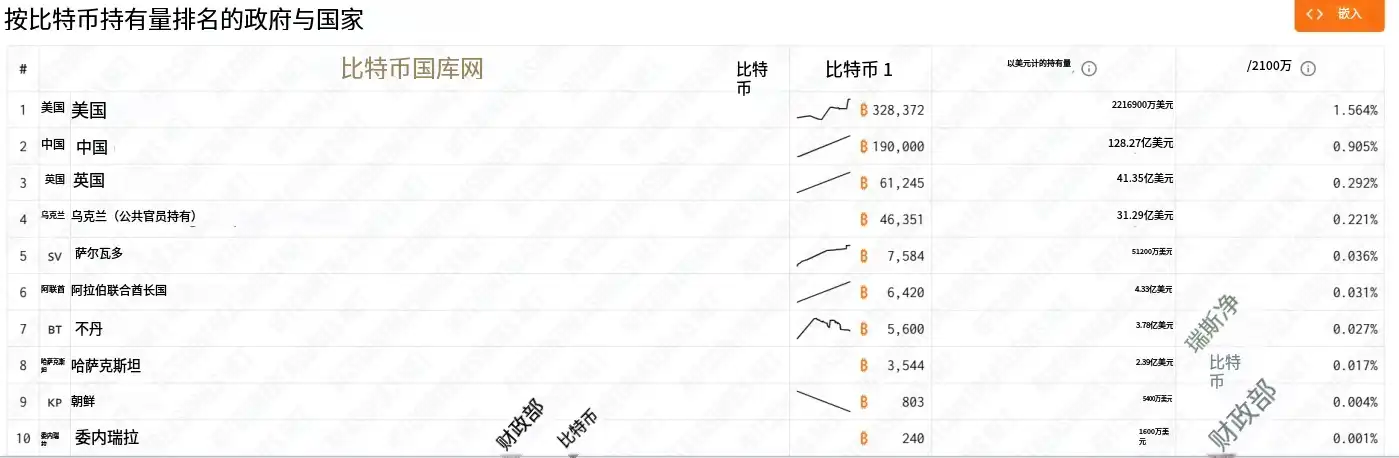
Governments and Countries Ranked by Bitcoin Holdings

Kazakhstan eased cryptocurrency regulations in January of this year, explicitly classifying digital financial assets (DFA) as a new asset category under regulation and allowing their circulation within the country. It also permitted the establishment of crypto exchanges licensed by the central bank. Additionally, the central bank will formulate a list of approved cryptocurrencies for circulation and impose certain restrictions on cryptocurrency trading activities.

Against the current macroeconomic backdrop of a crypto bear market, Kazakhstan's use of up to $350 million in reserve funds to invest in crypto assets not only reflects further recognition of cryptocurrencies by sovereign states but also provides a certain boost to the market. PANews will continue to monitor the specific allocation of subsequent funds.

Related reading: Is Venezuela's $60 Billion Bitcoin Shadow Reserve Real or Fake?

Criptos en tendencia

Preguntas relacionadas

QWhat is the maximum amount Kazakhstan's central bank plans to invest in crypto assets from its reserves?

AKazakhstan's central bank plans to invest up to $350 million from its gold and foreign exchange reserves into the crypto asset sector.

QWhen is the investment in crypto assets scheduled to begin, according to the Deputy Governor of the National Bank of Kazakhstan?

AAccording to Deputy Governor Aliya Moldabekova, the investment is scheduled to begin between April and May.

QWhat percentage of Kazakhstan's total reserves does the initial $350 million crypto investment represent?

AThe initial $350 million allocation represents 0.5% of Kazakhstan's total reserves.

QBesides purchasing crypto directly, what is another source of crypto assets for Kazakhstan's national fund?

AAnother source of crypto assets for the national fund is from assets seized by law enforcement agencies during operations against illegal mining and exchanges.

QWhat regulatory change did Kazakhstan implement regarding digital financial assets in January?

AIn January, Kazakhstan relaxed its cryptocurrency regulations by officially recognizing digital financial assets (DFA) as a new asset class, allowing their circulation within the country, and permitting the establishment of licensed crypto exchanges.

Lecturas Relacionadas

Annual Salary of Millions Competing for Electricians, Meta Rushes to Open Its Own Technical School

The AI boom is facing an unexpected bottleneck: a severe shortage of skilled construction workers and electricians. As tech giants like Meta, OpenAI, and Alphabet race to build massive data centers—such as OpenAI's $16 billion "Stargate" project—they are hitting a critical labor wall. The U.S. needs an estimated 130,000 more electricians, 240,000 construction workers, and 150,000 supervisors by 2030 for AI infrastructure alone, but tens of thousands of electrician jobs go unfilled each year. While AI companies offer high premiums, with electricians earning up to $280,000 annually, worker scarcity still causes massive losses—delays on a single project can cost $14.2 million per month. The complexity of building AI data centers, which require immense power (equivalent to powering hundreds of thousands of homes), sophisticated electrical systems, and advanced liquid cooling solutions, demands highly skilled technicians who are in short supply. To combat this, companies are investing heavily in training. Meta has committed $115 million to a free training school offering tuition, housing, and stipends, targeting 5,000 new workers. OpenAI is partnering with unions to secure skilled labor. These efforts are paying off, with a significant rise in Gen Z interest in trade schools over college. However, the power demands are staggering. AI data centers are driving a rapid surge in electricity consumption, projected to account for up to 12% of U.S. power use by 2028 and raising costs for consumers. Furthermore, the construction boom is project-based, leading to a potential future glut of trained workers once building peaks, which could depress wages industry-wide. The race for AI supremacy now depends as much on skilled hands as on advanced chips.

marsbitHace 1 hora(s)

Annual Salary of Millions Competing for Electricians, Meta Rushes to Open Its Own Technical School

marsbitHace 1 hora(s)

OpenAI No Longer Sells Its Most Expensive Model for Profit

OpenAI is shifting its business strategy away from promoting its most expensive, flagship models for every task. Recent price cuts—80% for GPT-5.6 Luna and 20% for Terra—signal a deeper change: the company now actively advises users that many tasks don't require the most powerful model. Instead, OpenAI recommends a tiered approach: use the high-end GPT-5.6 Sol for complex planning and analysis, then delegate execution to cheaper models like Luna. This mirrors moves by Anthropic, which recently launched Claude Opus 5 at half the price of its top model, Fable 5. Both companies are de-emphasizing flagship models as primary revenue drivers, using them instead for brand prestige and technological showcases. The industry is entering a "mass-market" phase, similar to automotive, where high-volume, cost-effective models handle daily operations and drive scale. OpenAI's price reductions are partly enabled by AI models themselves optimizing underlying code and infrastructure, creating a self-reinforcing cycle of efficiency gains and cost reduction. Competition is shifting from "who is smartest" to "who offers the best value." The goal is no longer selling individual models but fostering widespread API adoption and ecosystem lock-in. By making AI calls cheap and ubiquitous, companies like OpenAI aim to become the indispensable, utility-like infrastructure powering automated workflows—the "water and electricity" of software, quietly embedded everywhere.

marsbitHace 1 hora(s)

OpenAI No Longer Sells Its Most Expensive Model for Profit

marsbitHace 1 hora(s)

Trading

Spot

Artículos destacados

Cómo comprar BAN

¡Bienvenido a HTX.com! Hemos hecho que comprar Comedian (BAN) sea simple y conveniente. Sigue nuestra guía paso a paso para iniciar tu viaje de criptos.Paso 1: crea tu cuenta HTXUtiliza tu correo electrónico o número de teléfono para registrarte y obtener una cuenta gratuita en HTX. Experimenta un proceso de registro sin complicaciones y desbloquea todas las funciones.Obtener mi cuentaPaso 2: ve a Comprar cripto y elige tu método de pagoTarjeta de crédito/débito: usa tu Visa o Mastercard para comprar Comedian (BAN) al instante.Saldo: utiliza fondos del saldo de tu cuenta HTX para tradear sin problemas.Terceros: hemos agregado métodos de pago populares como Google Pay y Apple Pay para mejorar la comodidad.P2P: tradear directamente con otros usuarios en HTX.Over-the-Counter (OTC): ofrecemos servicios personalizados y tipos de cambio competitivos para los traders.Paso 3: guarda tu Comedian (BAN)Después de comprar tu Comedian (BAN), guárdalo en tu cuenta HTX. Alternativamente, puedes enviarlo a otro lugar mediante transferencia blockchain o utilizarlo para tradear otras criptomonedas.Paso 4: tradear Comedian (BAN)Tradear fácilmente con Comedian (BAN) en HTX's mercado spot. Simplemente accede a tu cuenta, selecciona tu par de trading, ejecuta tus trades y monitorea en tiempo real. Ofrecemos una experiencia fácil de usar tanto para principiantes como para traders experimentados.

682 Vistas totalesPublicado en 2024.12.11Actualizado en 2026.06.02

Cómo comprar BAN

Discusiones

Bienvenido a la comunidad de HTX. Aquí puedes mantenerte informado sobre los últimos desarrollos de la plataforma y acceder a análisis profesionales del mercado. A continuación se presentan las opiniones de los usuarios sobre el precio de BAN (BAN).

活动图片













