New Capital Favors 'Old Altcoins'

marsbitPublicado a 2026-01-21Actualizado a 2026-01-21

Resumen

New capital is increasingly flowing towards established "old guard" cryptocurrencies, leading to a significant market structure shift. Bitcoin's dominance has surged to 65%, its highest since 2021, driven by institutional adoption via ETFs which attracted over $150 billion. Stablecoins and on-chain derivatives now represent 12.5% of the total crypto market cap, further squeezing altcoins. Within the altcoin sector, capital is concentrating heavily. The top 10 altcoins now constitute 82% of the altcoin market cap, up from 64% in 2021. The number of altcoins with a market cap over $1 billion has nearly halved, indicating a focus on larger, more mature assets with clear use cases and regulatory paths. Performance data confirms this trend. Since January 2023, large-cap assets have significantly outperformed mid and small-caps, with returns of ~365% compared to ~70% and ~55%, respectively. This highlights a investor preference for liquidity and lower volatility, a trend likely reinforced by recent market sell-offs. The market is maturing, with capital becoming highly selective and favoring established players and critical infrastructure.

The landscape of crypto investment continues to expand. Hundreds of new tokens are launched each year, the number of equity stocks related to digital asset businesses is increasing, and tokenization technology is gradually bringing traditional assets like stocks and commodities on-chain. While investment choices are becoming more abundant, market capital is also becoming more selective.

Bitcoin's market dominance has rebounded to around 65%, reaching its highest level since early 2021; at the same time, the combined market capitalization of stablecoins and on-chain derivatives (such as wrapped tokens, staked tokens, cross-chain bridge tokens, etc.) now accounts for nearly 12.5% of the total crypto market cap. As a result, altcoins are facing a double squeeze—despite the growing number of tokens, their overall market share is shrinking.

This issue of the "State of the Network Market" report explores whether the crypto market is undergoing a structural shift towards capital concentration. We will analyze trends in market dominance and returns across assets of different market cap tiers and sectors to investigate whether capital is consistently aggregating towards fewer, larger, and more mature tokens, or if investment opportunities remain widely distributed.

Evolution of Market Cap Dominance

First, we begin our analysis from market cap dominance. Bitcoin's market dominance (i.e., Bitcoin's market cap as a percentage of the total crypto market cap) climbed to 65% in 2025, hitting a new high since 2021. Notably, this growth is not a short-term spike but a long-term, steady upward trend since its trough in 2022.

The launch of Bitcoin spot ETFs has deepened institutionalization, attracting over $150 billion in long-term capital, further driving the sustained rise in its market dominance. This trend solidifies Bitcoin's position as a "safe-haven asset" in the crypto market and makes it a highly liquid, standardized entry point for traditional institutional investors. Compared to previous bull markets where "altcoin seasons" quickly diluted Bitcoin's market share, Bitcoin's dominance in this cycle is more enduring.
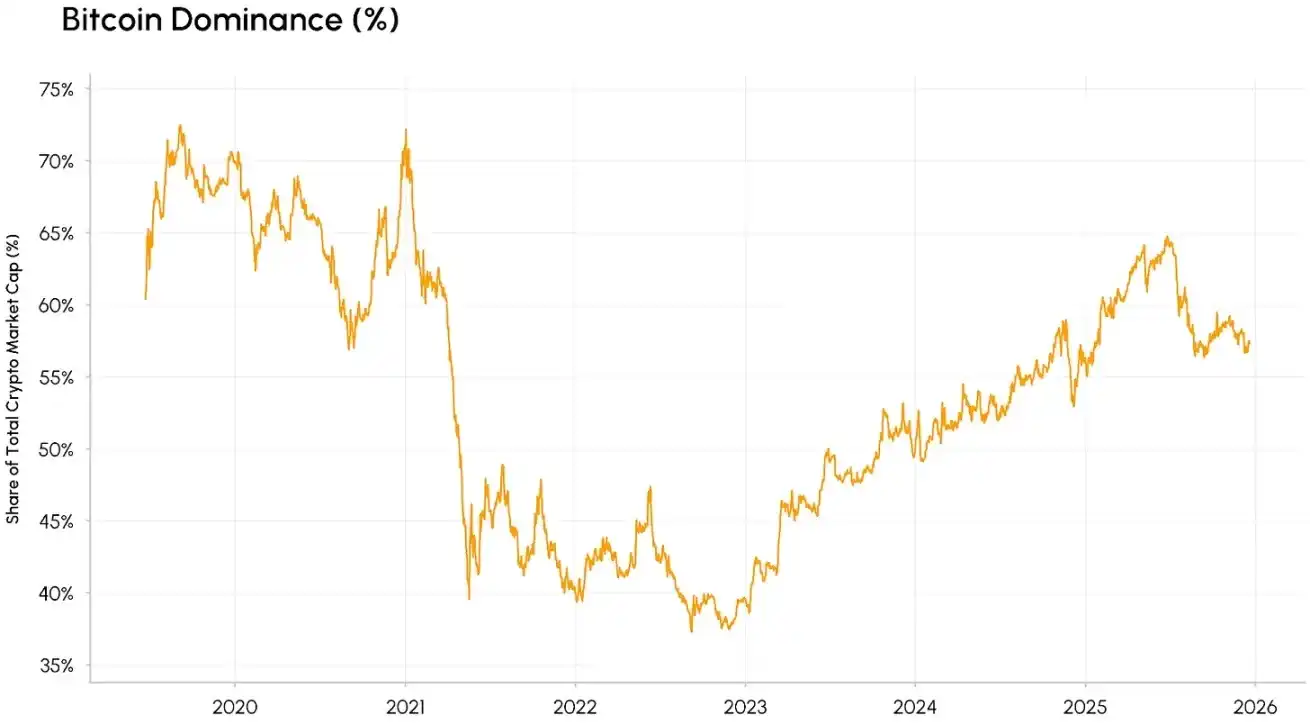
Bitcoin Dominance, Data Source: Coin Metrics

The structure of other assets in the crypto market is also changing. Stablecoins, with a current market cap exceeding $300 billion, and on-chain derivatives are increasingly accounting for a larger share of the total market capitalization. These tokens serve different functions within the crypto ecosystem: stablecoins are the primary medium of exchange in the market, while on-chain derivatives provide investors with claims on the returns of underlying assets or channels for generating yield.
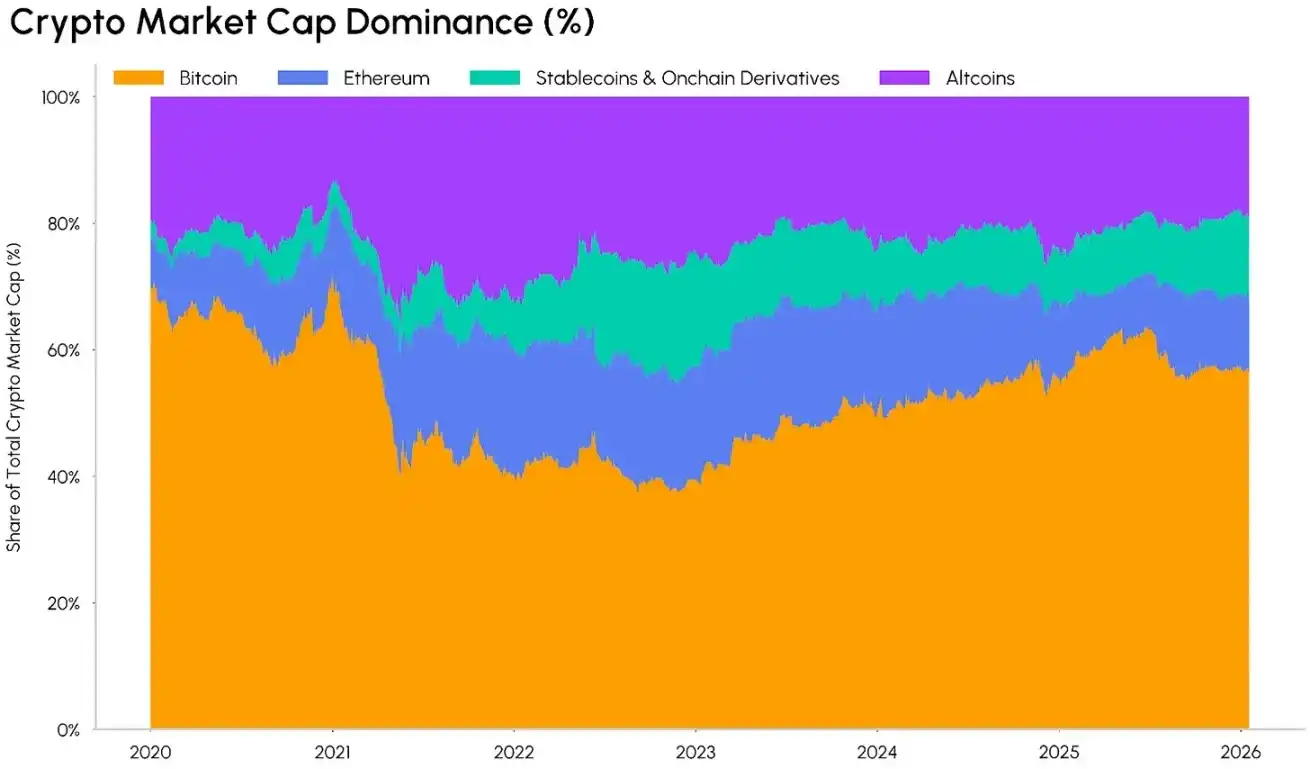
Crypto Market Dominance Distribution, Data Source: Coin Metrics

As a result, the altcoin market is facing a dilemma. The range of investable targets is continuously narrowing, and the concentration effect at the top is becoming more pronounced: market value is consistently aggregating towards more liquid and mature assets, which often have clear use cases, defined regulatory development paths, and can fully benefit from the growth waves of stablecoins, decentralized finance (DeFi), and asset tokenization.

Unlike previous market cycles, the speed of capital rotation from major coins to altcoins has significantly slowed in this cycle. ETFs and various institutional investment tools have locked market liquidity firmly in top-tier assets. However, this market structure may change with the implementation of universal listing standards, the launch of altcoin and multi-asset ETFs broadening investment channels for more large-cap altcoins, and the advancement of market structure-related legislation.

The 'Giant Monopoly' Trend Within the Altcoin Sector

Even within the altcoin sector itself, the trend of capital concentration is intensifying. The current top 10 altcoins by market cap (excluding Bitcoin) account for about 82% of the sector's total market value, a significant increase from 64% during the 2021 bull market. In the previous bull cycle, a large number of small-cap altcoins that briefly created value have gradually exited the market, replaced by a sector structure with stronger top-heavy effects, and the lifecycle of various short-term market narratives has shortened, making it difficult to sustain the continued rise in asset value.
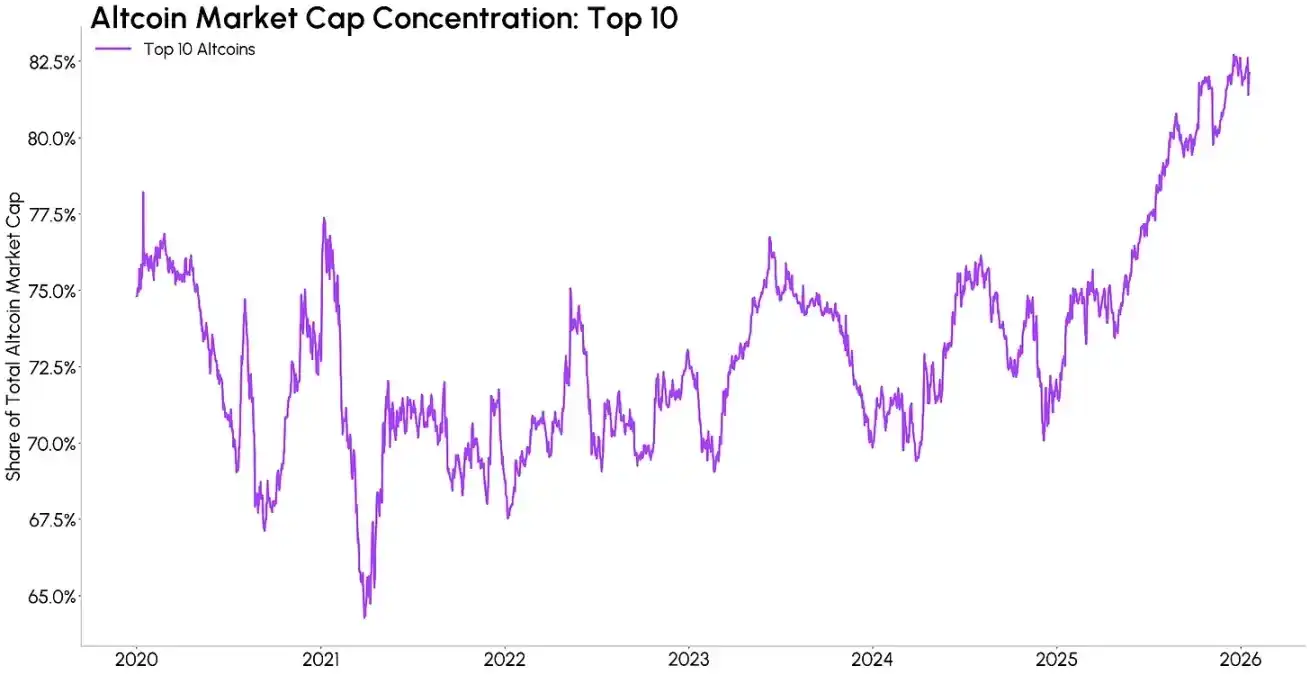
Top 10 Altcoin Market Cap Share, Data Source: Coin Metrics

We can also observe this concentration trend by looking at the number of tokens breaking through specific market cap thresholds. Although the total crypto market cap has repeatedly reached new all-time highs, the number of altcoins with a market cap exceeding $1 billion has shrunk from about 105 at the peak in 2021 to about 58 currently. This means that even as the total number of assets in the market increases, the number of truly "investable" altcoins is decreasing. While this does not necessarily mean the altcoin sector is declining, the focus of market funds may further aggregate towards targets with solid fundamentals and stronger risk resistance.
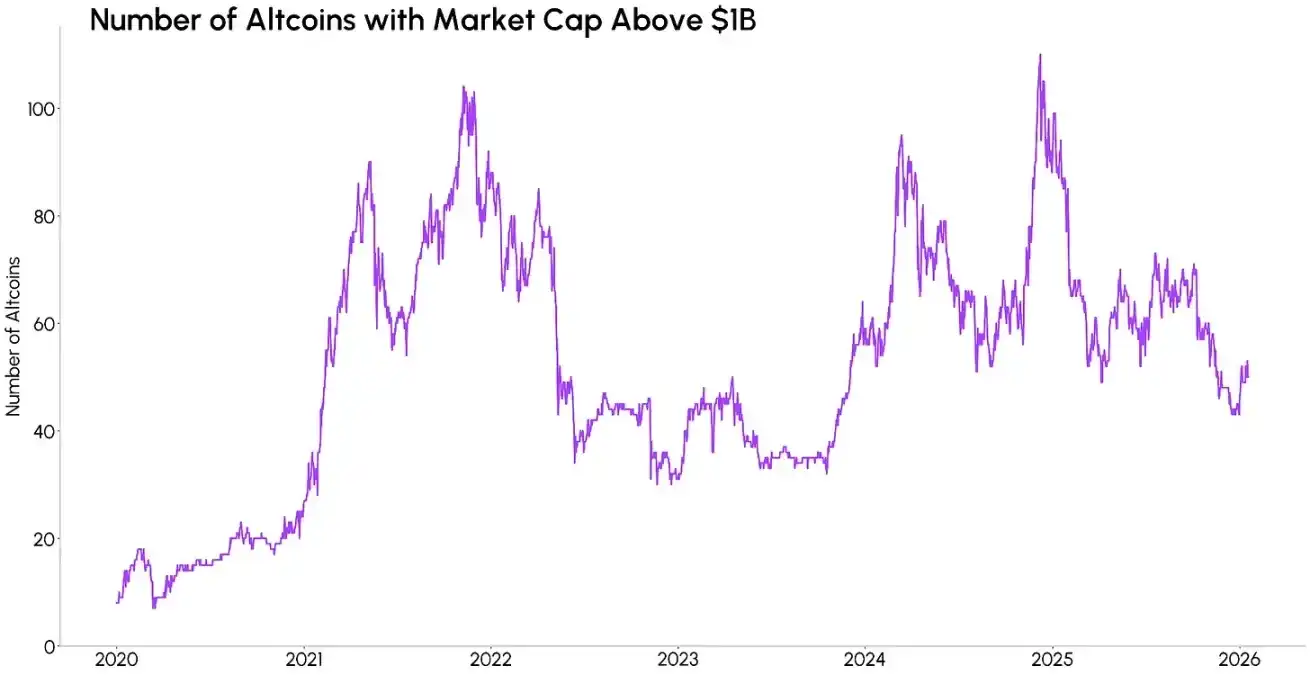
Number of Altcoins with Market Cap Over $1 Billion, Data Source: Coin Metrics

The table below summarizes the annual evolution characteristics of the aforementioned market trends. Some indicators still show cyclical features, such as Bitcoin's market dominance falling in bull markets and rising in bear markets, but the market share of the top 10 altcoins has shown a different trend: from 2020 to 2024, regardless of market conditions, this ratio remained stable between 69%-73%, but it surged to 82% in 2025. This change indicates a structural shift tilting towards mature leading assets, rather than merely short-term "chasing quality assets" behavior.
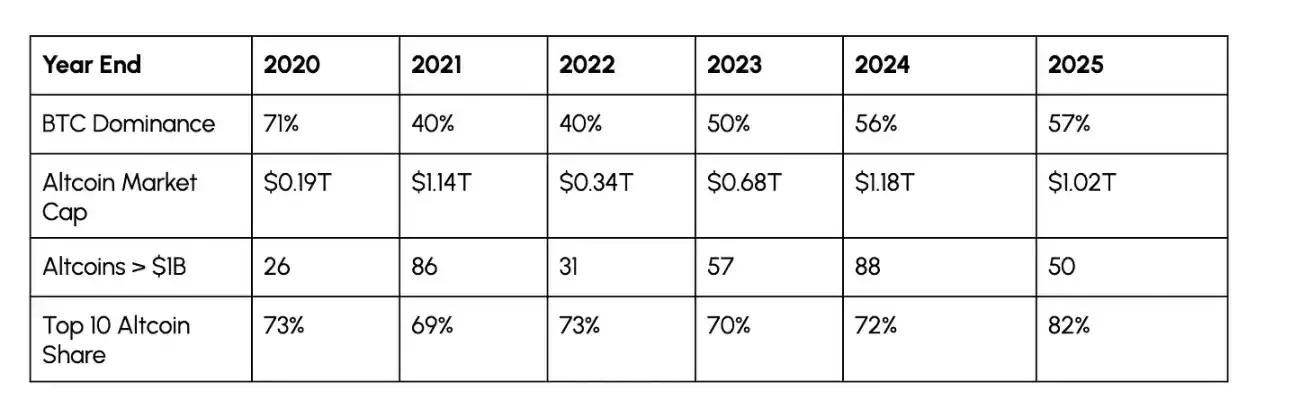
Data Source: Coin Metrics

Capital Flows to Major Coins

This capital concentration trend is also reflected in asset return performance. Since 2023, mid-cap coins (market cap $1B - $10B) and especially small-cap coins (market cap < $1B) had outperformed large-cap coins (market cap > $10B) during early and late phases of 2024, but this trend reversed sharply in 2025, driven by a rapid fading of market sentiment towards Meme coins and other short-term narrative rotations.

Calculated on an equal-weight basis, from January 2023 to the present, the overall return of crypto large-cap coins is approximately 365%, while the returns of mid-cap and small-cap coins are only about 70% and 55% respectively, with most of the earlier gains being given back. This divergence in returns fully demonstrates that market performance is increasingly tilting towards developed, liquid assets, and the gains of small-cap tokens are unlikely to replicate the sustainability seen in previous cycles.
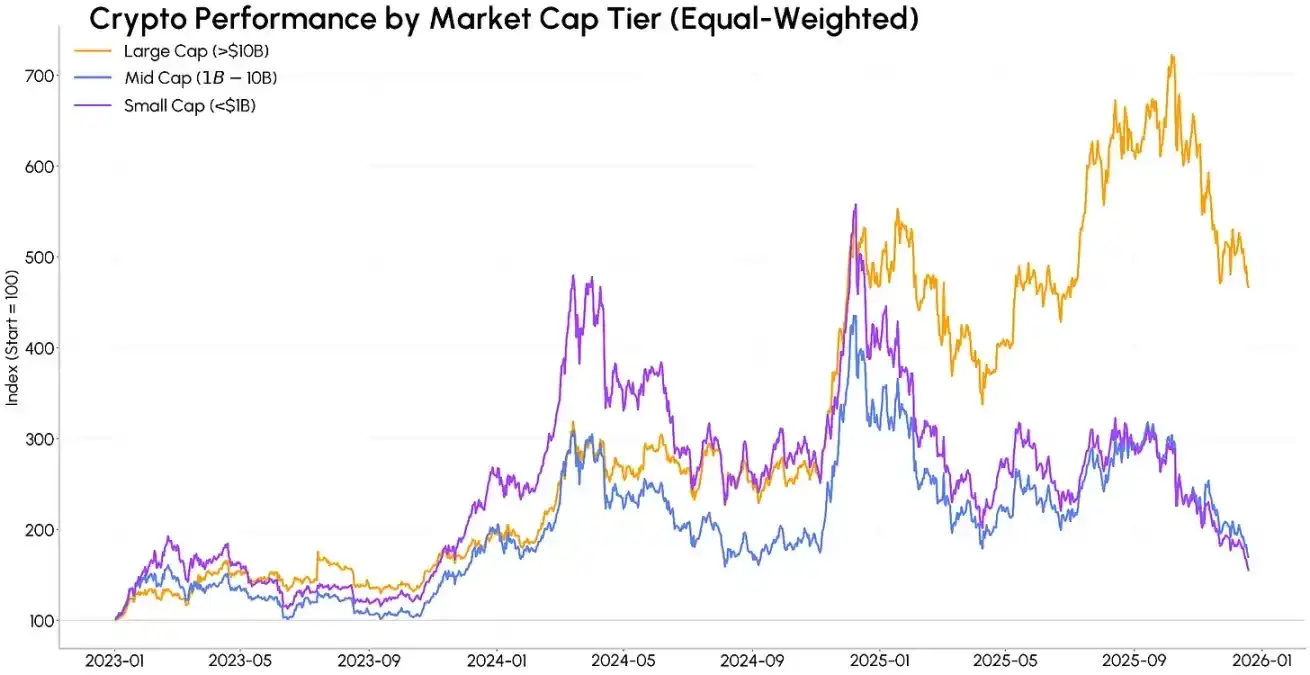
Market Performance of Tokens by Market Cap Sizes, Data Source: Coin Metrics

On October 10, 2025, the market experienced a large-scale liquidation event triggered by high leverage and liquidity drying up. This event may further strengthen the trend of capital shifting towards defensive assets, with investors increasingly favoring highly liquid assets over significantly more volatile small-cap assets.

Conclusion

Various data indicate that the crypto market is in a stage of structural change, gradual maturation, and consolidation. Although the number of crypto assets continues to increase, and as underlying infrastructure, the types of traditional assets being onboarded are becoming richer, the overall liquidity of the market is limited. Furthermore, within multi-asset portfolios, crypto assets must also compete for space with popular investment themes in the stock market and traditional safe-haven assets like gold.

Currently, capital is continuously aggregating towards crypto large-cap coins and the infrastructure sectors supporting stablecoins, tokenized assets, and decentralized finance. The importance of liquidity and scale has increased further compared to the past, and the threshold for altcoins to attract long-term capital has risen significantly.

Of course, if market structure-related rules become clearer, altcoin and multi-asset ETFs continue to gain popularity, coupled with improved market liquidity conditions, a new altcoin season could still be catalyzed. However, it is foreseeable that the beneficiaries among altcoins in this cycle will be more concentrated, and capital's choices will be more selective than in any previous cycle.


Preguntas relacionadas

QWhat is the main trend observed in the cryptocurrency market regarding capital allocation, according to the article?

ACapital is increasingly concentrating towards larger, more established assets like Bitcoin and top-tier altcoins, rather than being widely distributed across newer or smaller tokens.

QHow has Bitcoin's market dominance changed recently, and what contributed to this trend?

ABitcoin's market dominance has risen to around 65%, its highest level since early 2021, driven by institutional adoption via Bitcoin ETFs, which attracted over $150 billion in long-term capital.

QWhat impact have stablecoins and on-chain derivatives had on the altcoin market?

AStablecoins and on-chain derivatives now account for nearly 12.5% of the total crypto market capitalization, squeezing the altcoin market by reducing the share of investable altcoins and intensifying competition for capital.

QHow has the concentration of capital within the altcoin sector itself evolved?

AThe top 10 altcoins now represent about 82% of the total altcoin market cap, up from 64% during the 2021 bull market, indicating stronger capital concentration towards mature, high-liquidity assets.

QWhat does the performance data reveal about returns for large-cap vs. small-cap cryptocurrencies since January 2023?

ALarge-cap cryptocurrencies have significantly outperformed, with returns of about 365%, while mid-cap and small-cap tokens returned only approximately 70% and 55%, respectively, highlighting a shift towards safer, more liquid assets.

Lecturas Relacionadas

Has the 'Digital Gold' Narrative for BTC Failed?

**Title: Has the "Digital Gold" Narrative for Bitcoin Failed?** The article argues that Bitcoin's "digital gold" narrative remains valid despite a recent sharp price decline (from a peak near $126k in Oct 2025 to briefly under $61k in Feb 2026). It presents a long-term investment framework based on three core points: **1. Viewing Bitcoin as an Asset:** Bitcoin is presented as a superior potential store of value compared to gold. Key arguments are its absolute scarcity (21 million cap), superior portability, and transparent auditability via its public ledger. While acknowledging its current use in early, volatile stages (~3-4% global adoption), the author draws parallels to the early, disruptive phases of the internet and e-commerce. **2. Understanding the Recent Downturn:** The current ~50% correction is framed as a predictable, consensus-driven cycle following its post-halving peak (the 2024 halving preceded the Oct 2025 high). A crucial factor is a historic "changing of hands": the influx of new institutional buyers via ETFs allowed early, low-cost holders (miners, OG believers) to take profits. The author notes that while severe, Bitcoin's historical drawdowns (e.g., 93% in 2011, 77% in 2021-22) have been progressively smaller, suggesting maturing holder structure and decreasing volatility over time. **3. The Long-Term Perspective:** The long-term thesis hinges on Bitcoin capturing a portion of gold's market value. With Bitcoin's market cap at ~$1.4 trillion (at $70k) versus gold's ~$20 trillion, significant upside potential exists if the "digital gold" narrative is partially realized. However, the author strongly cautions that short-term risks remain, the bottom is unpredictable, and high volatility is inherent. The real risk is not Bitcoin failing but poor personal position management (over-leverage, wrong capital) and a lack of deep understanding, which can force investors out during severe downturns. The conclusion uses Amazon's 95% crash post-2000 dot-com bubble and subsequent 42x recovery as an analogy. The ultimate question is not if Bitcoin's price will rise, but if an investor's strategy and conviction can withstand the volatility to see the long-term play out. The recent divergence (gold up, Bitcoin down) is posed not as a narrative failure, but as potential evidence of this ongoing, painful transition from a speculative asset to a mainstream allocation.

marsbitHace 7 hora(s)

Has the 'Digital Gold' Narrative for BTC Failed?

marsbitHace 7 hora(s)

Has BTC's 'Digital Gold' Narrative Failed?

The article discusses Bitcoin's "digital gold" narrative, its recent price drop, and long-term outlook through the perspective of "Jason". It argues the narrative is not a failure but that Bitcoin represents a superior, new asset class due to its fixed supply (21 million), portability, and auditability. The piece compares its current ~3-4% global adoption rate to early internet/e-commerce, suggesting significant growth potential. Regarding the 2025-2026 price decline (from ~$126k to briefly under $61k), the author views it as a predictable, consensus-driven sell-off within Bitcoin's ~4-year cycle post-halving, exacerbated by a major "handover" from early, low-cost holders to new institutional buyers via ETFs. A key observation is that historical peak-to-trough drawdowns have lessened over time (e.g., 93% in 2011 to ~50% in 2026), indicating maturing volatility as holder structure changes. For the long term, the author uses a simple framework: Bitcoin's total market cap (~$1.4T at $70k) is only about 7% of gold's (~$20T). Even capturing 30-50% of gold's value would imply substantial upside. However, the article strongly cautions against viewing this as investment advice, emphasizing extreme volatility and the critical importance of risk management, position sizing, and deep fundamental understanding to survive severe drawdowns. It concludes by drawing a parallel to Amazon's 95% crash in 2000 and subsequent 42x recovery, stressing that the key is surviving market cycles to realize long-term potential.

链捕手Hace 7 hora(s)

Has BTC's 'Digital Gold' Narrative Failed?

链捕手Hace 7 hora(s)

From Code to Cognition: A Ten-Thousand-Word Guide to the Evolution of the Robot Brain

"From Code to Cognition: The Evolution of Robot Brains" The journey of robotic intelligence has shifted dramatically from manually coded systems to AI-driven brains. For decades, robots relied on layered software stacks—perception, state estimation, planning, control—each handcrafted. While predictable, they lacked adaptability. The 2010s saw deep learning revolutionize perception (e.g., object detection) and control (via reinforcement learning), but learned skills remained narrow. The arrival of Large Language Models (LLMs) marked a turning point. LLMs acted as high-level planners, interpreting natural language instructions and generating sequences of actions for traditional robotic systems to execute. However, true integration came with Visual-Language-Action (VLA) models, which fused vision, language, and motion prediction into a single network. Pioneered by models like RT-2 and open-source projects like OpenVLA, VLAs enable robots to reason and act directly from visual input and commands. The most advanced humanoid robots now employ a "dual-brain" architecture: a slow-thinking, large VLA (System 2) for reasoning and planning, and a fast-reacting, small network (System 1) for high-frequency motion control, sometimes with an even lower-level System 0 for balance. This split balances cognition with the physics of real-time movement. Computation is split between onboard hardware (e.g., NVIDIA Jetson) for safety-critical control loops and cloud/edge servers for non-critical tasks like learning and interfaces. A crucial driver is the open-source ecosystem—models like GR00T and OpenVLA allow startups to build upon pre-trained brains and fine-tune them with their own data, accelerating development. Despite progress, current systems struggle with recovery from errors, sample inefficiency, and long-horizon tasks. This has spurred the rise of **World Models**—neural networks that predict the consequences of actions. By simulating possible futures before acting (like NVIDIA Cosmos or Meta V-JEPA), robots can plan, recover, and generalize better. This represents the next frontier: shifting intelligence from learned reactions to an internal model of physics and cause-and-effect. The field is rapidly evolving. While not yet at its "ChatGPT moment," the convergence of cheaper hardware, scalable simulation, and world models points toward robots that are increasingly capable, adaptive, and useful. The question is shifting from "what can robots do?" to "what *should* they do?"

marsbitHace 8 hora(s)

From Code to Cognition: A Ten-Thousand-Word Guide to the Evolution of the Robot Brain

marsbitHace 8 hora(s)

Trading

Spot
Futuros
活动图片