New AMD Paper Overturns Conventional Wisdom: FP4 Training Instability's Cause Is Not Insufficient Randomness

marsbitPublicado a 2026-05-27Actualizado a 2026-05-27

Resumen

AMD's new research challenges the conventional understanding of FP4 training instability. While reducing precision from FP8 to FP4 promises doubled computational throughput and is supported by new hardware like NVIDIA Blackwell and AMD MI350 series, training large language models natively with FP4 has been notoriously unstable, often attributed to insufficient stochasticity. The paper "Pretraining large language models with MXFP4 on Native FP4 Hardware" demonstrates successful end-to-end FP4 pre-training of Llama 3.1-8B on AMD MI355X GPUs using the MXFP4 format, achieving a 9-10% overall speedup over FP8. Crucially, it identifies the root cause of instability: not randomness, but the accumulation of *structural micro-scaling errors* along the sensitive weight gradient (Wgrad) path. Through controlled experiments, researchers found that quantizing the Wgrad operation to FP4 caused significant convergence degradation. Counterintuitively, common stochasticity-based mitigation techniques like stochastic rounding and randomized Hadamard transforms worsened performance. In contrast, applying a *deterministic* Hadamard transform successfully stabilized training by ensuring consistent error patterns, reducing the extra token cost from 26-27% to just 8-9%. This work has significant implications: 1) It provides a clear diagnostic for low-precision training instability, steering focus towards structural errors. 2) It pushes FP4 from a primarily inference-focused format into the realm...

As is well known, training large models is extremely costly.

However, it's also widely understood that reducing training precision can significantly lower training costs. DeepSeek-V3's use of FP8 training brought the cost down to $5.6 million, already capturing the attention of the entire industry.

Following the success of FP8, the industry continues to explore the boundaries of lower precision: from FP8 down to FP4, how much more can training costs be reduced?

Theoretically, FP4 computational throughput could be twice that of FP8. Both NVIDIA's Blackwell and AMD's MI350 series have already natively supported FP4 operations at the hardware level, with the former claiming FP4 performance up to 4500 TOPS (sparse) on the B200. The hardware is ready, but the software and algorithm side has been stuck on one problem:

Training large models from scratch with FP4 is highly unstable.

Over the past two years, works like LLM-FP4 and NVFP4 pre-training have attempted this path, but few solutions have cleanly and efficiently executed full pipeline pre-training at 4-bit precision while maintaining convergence quality close to FP8.

More troublesome is that the cause of the collapse has been unclear. Analysis suggested the instability in FP4 training was likely due to insufficient randomness.

But recently, AMD, in collaboration with Pennsylvania State University, published a paper that overturns this traditional understanding, offering a new and clear diagnosis for native FP4 training.
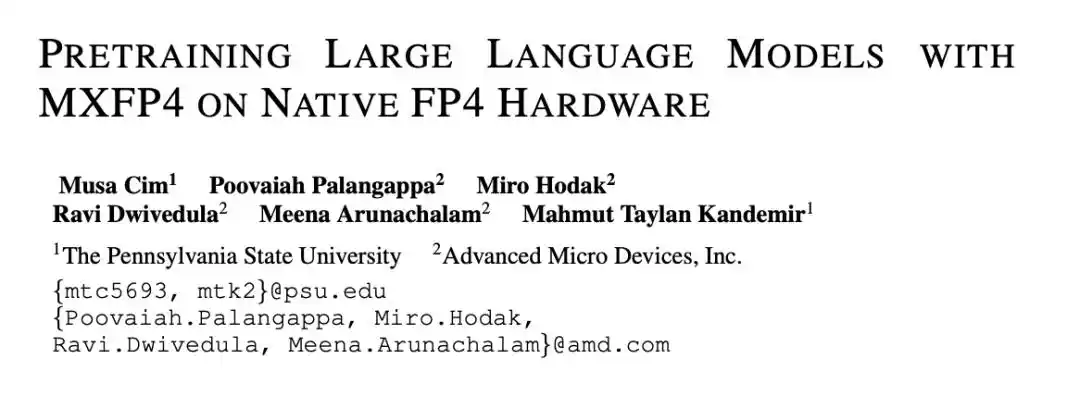
  • Paper Title: Pretraining large language models with MXFP4 on Native FP4 Hardware
  • Paper Link: https://arxiv.org/abs/2605.09825

This paper successfully completed the full-pipeline pre-training of Llama 3.1-8B using the MXFP4 format on AMD Instinct MI355X GPUs, achieving 9-10% faster end-to-end training speed compared to the FP8 baseline, with only an 8-9% additional token cost. This is the first complete experiment to finish large model pre-training on native FP4 hardware (not software simulation).

More importantly, the paper reveals the core issue: The source of FP4 training instability is not insufficient randomness, but the cumulative amplification of structural microscaling errors along sensitive gradient paths.

What is MXFP4

Before dissecting the paper, it's necessary to understand the MXFP4 data format.

Traditional integer quantization typically uses a single scaling factor for an entire tensor. The core design of MXFP4 is called "Micro-scaling": splitting a tensor into small blocks (e.g., groups of 32 elements), assigning a shared exponent (E8M0 format) to each block, where each element within the block is represented by a 4-bit floating-point number. The reconstruction formula can be written as:

Where E_shared is the maximum exponent within the block, and Q_FP4 is the value rounded to the nearest representable 4-bit floating-point value.

The benefit of micro-scaling is that each small block has its own dynamic range and won't be "held hostage" by global outliers. This significantly improves the representational quality of 4-bit floating-point numbers compared to naive global quantization.

However, even with micro-scaling, FP4 training remains unstable.

Troubleshooting Experiments: The Root of Instability

The research team first designed a step-by-step controlled troubleshooting experiment.

A complete Transformer linear layer computation involves three general matrix multiplication operations:

Fprop (Forward Propagation): Computes Y = XW^T, producing activation values.

Dgrad (Activation Gradient): Computes ∇X = ∇Y · W, propagating gradients back to the input.

Wgrad (Weight Gradient): Computes ∇W = (∇Y)^T · X, producing the gradient used to update the weights.

Keeping all other factors constant, the research team gradually replaced these three operations from FP8 to MXFP4, observing the impact of each step on convergence. All experiments were executed using native FP4 tensor cores on AMD Instinct MI355X, without relying on software simulation.

The training task followed the MLPerf standard setup, pre-training Llama 3.1-8B on the C4 dataset, with a convergence target of achieving a validation perplexity of 3.3.

The first two steps only incurred a modest additional token cost. However, once Wgrad was also switched to MXFP4, the cost directly jumped to 26-27%.

Wgrad is the bottleneck for FP4 training. Forward propagation and activation gradient have considerable tolerance for FP4 quantization, but once the weight gradient is quantized to 4 bits, convergence quality degrades significantly.

The industry's prevailing intuition was that FP4 quantization error is essentially a noise problem, which could be "smoothed" by injecting randomness. Two common strategies are:

Stochastic Rounding: Introduces randomness during quantization to make the expected value of rounding error zero.

Randomized Hadamard Rotation: Uses a Hadamard transform with random sign flips to scatter the data distribution before quantization.
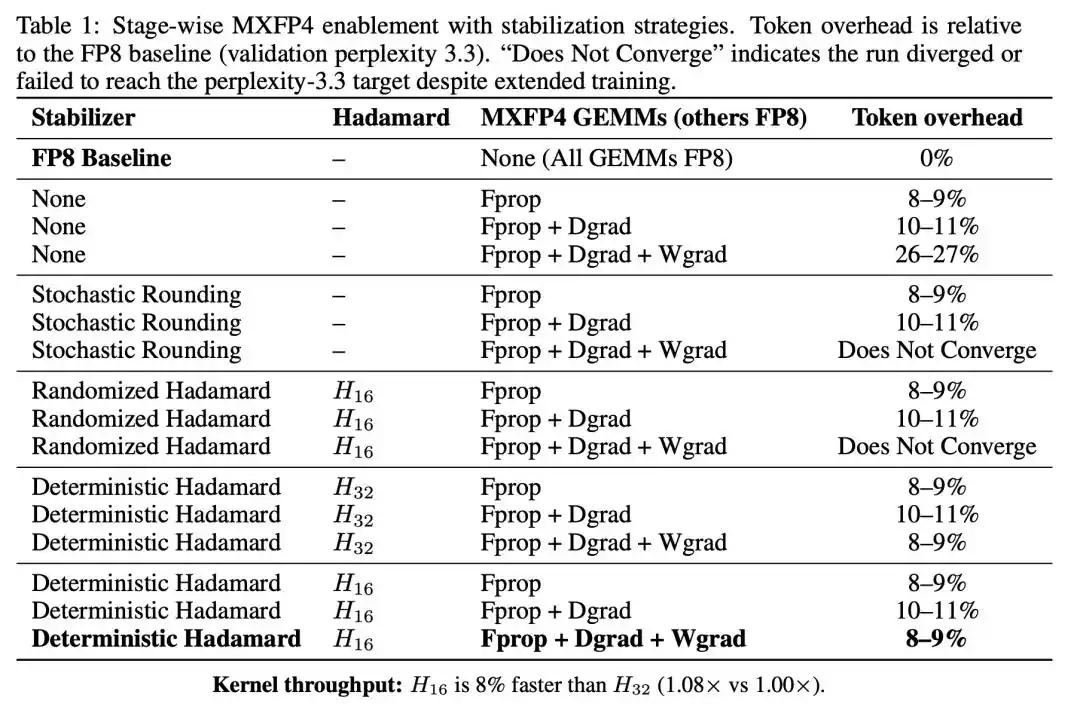
When Wgrad is quantized, both randomness strategies not only failed to stabilize training but directly caused non-convergence. Randomness didn't help; instead, it introduced more effective quantization error on the critical gradient path.

In contrast, deterministic Hadamard rotation dramatically reduced the full-pipeline token cost from 26-27% back to 8-9%, with the training trajectory closely tracking the FP8 baseline.

This is a highly diagnostic result. Both random and deterministic Hadamard rotations are orthogonal transformations that can scatter outlier energy distribution; theoretically, their effects on mitigating quantization error should be similar. Yet, their performance in the Wgrad scenario is completely opposite, revealing the nature of the problem:

FP4 training instability is driven by structural errors generated by MXFP4 micro-scaling on sensitive gradient paths. Randomness strategies failed because they introduced varying error patterns at each step, and these changing patterns accumulated along the gradient path, amplifying instability. Deterministic rotation was effective precisely because it applied the same transformation at every step, keeping the error pattern consistent and preventing error accumulation.

End-to-End Efficiency: Training Step Throughput +20%, Comprehensive Speedup 9-10%

After applying deterministic Hadamard rotation to the full-pipeline MXFP4, the efficiency data is as follows:
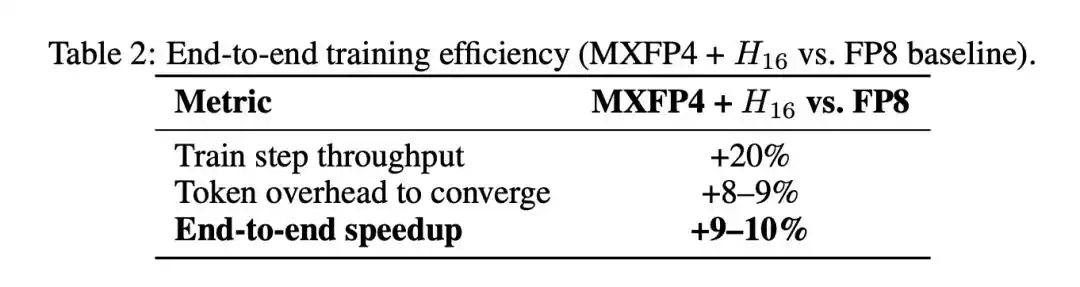
Training step throughput increased by 20%. After accounting for the additional 8-9% token cost, the end-to-end comprehensive speedup remains 9-10%.

Considering this directly halves precision from 8 bits to 4 bits, this convergence quality and speedup magnitude are quite significant.
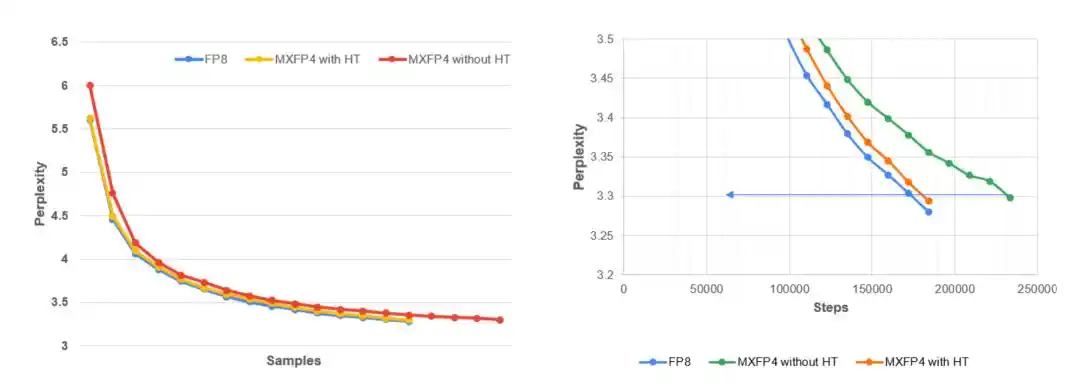
Left: Curve showing the validation perplexity of Llama 3.1–8B versus training token count during MLPerf pre-training on the C4 dataset. Results show MXFP4 + deterministic Hadamard performs very close to FP8, while unstabilized full-pipeline MXFP4 converges slower and is less stable. Right: Zoomed-in view of the later training stage. The MLPerf target perplexity is 3.3. Compared to the unstabilized MXFP4 run, deterministic Hadamard (H16) maintains much tighter alignment with the FP8 baseline.

Notably, the authors explicitly emphasize an important limitation in the paper: The effectiveness of this FP4 training scheme (MLPerf C4 dataset + Llama 3.1-8B) has been verified, but it cannot be assumed to seamlessly transfer to all models, all datasets, and all training methods. FP4 training behavior might be highly setting-dependent, and specific stabilization strategies need re-validation per scenario.

Conclusion

Placing this paper within the broader industry context reveals at least three layers of significance.

First layer: It answers a fundamental "why". Previous FP4 training work mostly focused on "how to make it not crash." This paper provides the first clear causal diagnosis: collapse stems from structural microscaling errors on the Wgrad path, not insufficient randomness. This diagnosis itself holds methodological value, telling subsequent researchers that when encountering instability in low-precision training, they should prioritize investigating structural error sources rather than blindly adding randomness.

Second layer: It pushes FP4 from "inference-only" towards "usable for training". Previously, the industry consensus was that FP4 was only suitable for inference quantization, with FP8 being the minimum for training. NVIDIA's emphasis on FP4 inference rather than training on Blackwell also reflects this judgment. This paper successfully ran full-pipeline pre-training on native FP4 hardware, meaning that the FP4 compute power prepared for inference on MI355X and Blackwell could theoretically also be used for training. If FP4 training proves viable on larger models and more scenarios, it effectively doubles the usable training compute of existing hardware.

Third layer: It utilizes the OCP open standard. MXFP4 is part of the OCP Microscaling format standard, jointly supported by seven companies: AMD, NVIDIA, Intel, Meta, Microsoft, Arm, and Qualcomm. Basing on an open standard means this method has portability across different vendors' hardware and won't be locked into a single ecosystem.

From FP16 to FP8, DeepSeek-V3 has already proven that halving precision can dramatically reduce training costs. From FP8 to FP4, this paper takes the critical first step. With each slash in precision, the entire economics of large model training are shifting.

This article is from the WeChat public account "Machine Heart" (ID: almosthuman2014), edited by Leng Mao.


Preguntas relacionadas

QAccording to AMD's new research, what is the root cause of training instability when using FP4 precision for large language models, and why do common randomization strategies fail to address it?

AAccording to the AMD and Penn State University paper, the root cause of instability in native FP4 training is not insufficient randomness, but rather the amplification of structural microscaling error accumulation along the sensitive gradient path, specifically the weight gradient (Wgrad) path. Common randomization strategies like stochastic rounding and randomized Hadamard transforms fail because they introduce varying error patterns at each step. When these inconsistent patterns accumulate along the gradient path, they amplify instability instead of mitigating it. In contrast, a deterministic Hadamard transform is effective because it applies the same consistent transformation at every step, preventing the accumulation of divergent error patterns.

QWhat is MXFP4, and how does its 'micro-scaling' design differ from traditional quantization methods?

AMXFP4 is a 4-bit floating-point data format part of the OCP Microscaling (MSFP) standard. Its core design feature is 'micro-scaling', which differs from traditional tensor-level quantization that uses a single scaling factor for an entire tensor. In MXFP4, a tensor is divided into small blocks (e.g., groups of 32 elements). Each block is assigned a shared exponent (E8M0 format), and each element within the block is represented by a 4-bit mantissa. This approach allows each block to have its own dynamic range, preventing the representation quality of the entire block from being 'held hostage' by a few global outliers, thereby improving representation quality compared to naive global quantization.

QIn the diagnostic experiment, which specific operation (Fprop, Dgrad, or Wgrad) was identified as the bottleneck when quantized to MXFP4, and what was the observed impact on training efficiency?

AIn the step-by-step diagnostic experiment, quantizing the Weight Gradient (Wgrad) operation to MXFP4 was identified as the bottleneck. While replacing the Forward Propagation (Fprop) and Activation Gradient (Dgrad) operations with MXFP4 incurred only a modest additional token overhead, replacing Wgrad with MXFP4 caused the token overhead to jump significantly to 26-27%, indicating a substantial degradation in convergence quality and training stability.

QWhat were the key performance results of the end-to-end MXFP4 training with the deterministic Hadamard stabilization on the Llama 3.1-8B model?

AThe end-to-end MXFP4 training with deterministic Hadamard stabilization on the Llama 3.1-8B model achieved a 20% improvement in training step throughput. After accounting for the additional 8-9% token overhead required for convergence compared to the FP8 baseline, the net end-to-end training speedup was 9-10%. The validation perplexity curve closely tracked that of the FP8 baseline, successfully meeting the MLPerf target perplexity of 3.3 on the C4 dataset.

QWhat are the broader implications of this research for the AI hardware and training ecosystem, according to the article's conclusion?

AThe research has three key broader implications for the ecosystem. First, it provides a fundamental diagnostic methodology, shifting the focus from adding randomness to identifying and addressing structural error sources in low-precision training. Second, it potentially moves FP4 from a 'inference-only' to a 'training-viable' precision, effectively doubling the usable training compute on native FP4 hardware like AMD MI355X and NVIDIA Blackwell if validated at scale. Third, by building on the OCP Microscaling (MXFP) open standard supported by multiple major companies, the approach promotes hardware portability and avoids vendor lock-in, benefiting the wider industry.

Lecturas Relacionadas

Trump, the "Stock Market Manipulator" in U.S. Stocks, Lifts Up the Entire Quantum Computing Sector

"Trump, the 'U.S. Stock Market Mastermind,' Boosts the Entire Quantum Computing Sector" This article details how former U.S. President Donald Trump's policies and public statements have significantly influenced the stock market, particularly in the quantum computing sector. A key example is the U.S. government's direct investment in Intel stock in August 2025, which yielded over $45 billion in gains within seven months. Trump publicly credited himself for this profit. Recently, the Trump administration announced a new $2 billion initiative. Through the Department of Commerce, funding from the CHIPS and Science Act will be provided to nine quantum computing companies in exchange for minority, non-controlling equity stakes. The recipients include IBM ($1B for its subsidiary Anderon), GlobalFoundries ($375M), and listed companies like D-Wave, Infleqtion, and Rigetti ($100M each). Private firms such as Atom Computing and PsiQuantum also received $100M. This "investment-for-equity" strategy marks a shift from pure subsidies to an "active investor" model under the CHIPS Act. The announcement immediately boosted quantum computing stocks. The article frames this as part of Trump's "America First" industrial policy, aimed at securing U.S. technological leadership, similar to past investments in semiconductors, rare earths, and lithium. The author suggests this pattern of government-backed market intervention, alongside Trump's personal stock endorsements, is a hallmark of his approach to driving market gains and may continue in sectors like defense and advanced energy.

marsbitHace 16 min(s)

Trump, the "Stock Market Manipulator" in U.S. Stocks, Lifts Up the Entire Quantum Computing Sector

marsbitHace 16 min(s)

2-Year Return of 225x? Uncovering Mysterious Researcher Serenity's AI 'Choke Point' Investment Strategy

"2 Years, 225x Returns? Decoding Serenity's AI 'Chokepoint' Investment Strategy" This article profiles Serenity (formerly AleaBito on Reddit's WallStreetBets), a pseudonymous researcher known for exceptional returns by applying a "Chokepoint Theory" to AI investments. His methodology involves a bottom-up, reverse-engineering approach of the AI hardware supply chain. He identifies critical, irreplaceable physical bottlenecks (chokepoints) that could cripple entire AI systems if disrupted, bypassing Wall Street's top-down focus on major tech firms. Key examples include pinpointing essential suppliers in the emerging Silicon Photonics and Co-Packaged Optics (CPO) sector—components vital for next-generation AI data center interconnects—such as niche companies providing external laser sources, molecular beam epitaxy equipment, or ultra-pure raw materials. Similarly, he highlights geopolitical "chokepoints" in the humanoid robotics supply chain, where key hardware components and rare earth elements are concentrated in Asia. Serenity validates his investment theses through rigorous adversarial AI debates before publication. He leverages institutional blind spots, directing a sophisticated network of retail followers toward undervalued, under-covered micro-cap stocks across global exchanges, driving significant price movements in names like Sivers ($SIVE), Soitec, and Raspberry Pi ($RPI). While presenting a powerful framework for finding critical system dependencies, the strategy carries inherent risks: extreme concentration on specific technological paths, liquidity issues in small-cap stocks, and accusations of market manipulation. Ultimately, the core takeaway is not to copy his trades, but to adopt his analytical lens: to ask which silent, physical switches hold irreplaceable power within a complex system and invest ahead of the market's recognition of their value.

链捕手Hace 18 min(s)

2-Year Return of 225x? Uncovering Mysterious Researcher Serenity's AI 'Choke Point' Investment Strategy

链捕手Hace 18 min(s)

Bitroot Public Chain Invited to Attend Tencent Cloud Singapore AI Conference, Discussing the Future Alongside Solana

On May 19, Bitroot, an emerging Layer 1 blockchain, participated in the Tencent Cloud AI Summit in Singapore alongside key industry players like Solana Foundation. The event explored the intersection of AI infrastructure, enterprise applications, AI Agents, and Web3. Bitroot's invitation, despite being pre-mainnet, highlights industry interest in its focus on high-performance, AI-native architecture tailored for future AI Agent execution and verifiable on-chain automation. Bitroot CEO Juan Jose emphasized that AI competition is shifting from model performance to data, real-world application scenarios, and trust infrastructure. He argued that for AI Agents to evolve from assistants to autonomous executors managing transactions and assets, they require low-latency, low-cost, and high-throughput blockchain environments. Bitroot aims to address this through its EVM-compatible design, optimistic parallel execution, and a consensus mechanism targeting high scalability. Currently in its Testnet 5.0 phase, Bitroot reports metrics like over 50,000 peak TPS and sub-0.3 second average block time. Its narrative positions it within a growing landscape where next-generation Layer 1s like Monad and Aptos also compete on performance, while Bitroot differentiates by integrating AI computational capabilities natively across its stack. The summit underscored that the fusion of AI and Web3 is moving from concept to infrastructure competition, where networks balancing performance, security, and verifiability will be crucial for enabling scalable AI-driven applications.

marsbitHace 1 hora(s)

Bitroot Public Chain Invited to Attend Tencent Cloud Singapore AI Conference, Discussing the Future Alongside Solana

marsbitHace 1 hora(s)

Hedge Fund Q1 Interpretation: Everyone Is Selling Software, Buying Chips

Hedge Funds and Mutual Funds Aligned in Q1: Dumping Software, Buying Chips A clear consensus emerged among major U.S. hedge funds and mutual funds in Q1: they were simultaneously selling software stocks and pouring capital into the semiconductor sector. This aggressive rotation pushed semiconductor exposure in hedge fund long portfolios to a record high. Hedge funds delivered a 7% return year-to-date, while only 30% of large-cap active mutual funds outperformed their benchmarks. The average short interest for S&P 500 constituents rose to 3% of market cap, the highest since 2011. Within technology, the structural shift was stark. Hedge funds' semiconductor weighting hit an all-time high, while software fell to its lowest since 2019. Excluding Microsoft, mutual funds' relative overexposure to semis vs. software was the largest since 2012. Microsoft was among the most net-sold stocks by both groups. Hedge funds net purchased semiconductor names like LRCX and AMAT. Strategies diverged on leverage and cash. Hedge funds increased their net exposure to near a one-year high after an initial cut. Mutual funds raised their cash allocation, though it remains historically low at 1.4%. Sector alignment was high in Industrials (both overweight) but divergent in Tech: hedge funds increased their Tech net tilt by a record 853 basis points, while mutual funds reduced theirs. Clear splits also appeared in Financials and Consumer Discretionary. Four stocks appeared on both Goldman's hedge fund VIP and mutual fund overweight lists: BA, MA, MRVL, and V. This "shared favorites" basket has returned 10% YTD, outperforming the equal-weight S&P 500. Notably, all "Magnificent Seven" stocks are on the hedge fund VIP list but are uniformly underweighted by mutual funds.

marsbitHace 1 hora(s)

Hedge Fund Q1 Interpretation: Everyone Is Selling Software, Buying Chips

marsbitHace 1 hora(s)

Trading

Spot
Futuros

Artículos destacados

Qué es $S$

Entendiendo SPERO: Una Visión General Completa Introducción a SPERO A medida que el panorama de la innovación continúa evolucionando, la aparición de tecnologías web3 y proyectos de criptomonedas juega un papel fundamental en la configuración del futuro digital. Un proyecto que ha atraído la atención en este campo dinámico es SPERO, denotado como SPERO,$$s$. Este artículo tiene como objetivo reunir y presentar información detallada sobre SPERO, para ayudar a entusiastas e inversores a comprender sus fundamentos, objetivos e innovaciones dentro de los dominios web3 y cripto. ¿Qué es SPERO,$$s$? SPERO,$$s$ es un proyecto único dentro del espacio cripto que busca aprovechar los principios de descentralización y tecnología blockchain para crear un ecosistema que promueva la participación, la utilidad y la inclusión financiera. El proyecto está diseñado para facilitar interacciones de igual a igual de nuevas maneras, proporcionando a los usuarios soluciones y servicios financieros innovadores. En su esencia, SPERO,$$s$ tiene como objetivo empoderar a los individuos al proporcionar herramientas y plataformas que mejoren la experiencia del usuario en el espacio de las criptomonedas. Esto incluye habilitar métodos de transacción más flexibles, fomentar iniciativas impulsadas por la comunidad y crear caminos para oportunidades financieras a través de aplicaciones descentralizadas (dApps). La visión subyacente de SPERO,$$s$ gira en torno a la inclusividad, buscando cerrar brechas dentro de las finanzas tradicionales mientras aprovecha los beneficios de la tecnología blockchain. ¿Quién es el Creador de SPERO,$$s$? La identidad del creador de SPERO,$$s$ sigue siendo algo oscura, ya que hay recursos públicos limitados que proporcionan información de fondo detallada sobre su(s) fundador(es). Esta falta de transparencia puede derivarse del compromiso del proyecto con la descentralización, una ética que muchos proyectos web3 comparten, priorizando las contribuciones colectivas sobre el reconocimiento individual. Al centrar las discusiones en torno a la comunidad y sus objetivos colectivos, SPERO,$$s$ encarna la esencia del empoderamiento sin señalar a individuos específicos. Como tal, comprender la ética y la misión de SPERO sigue siendo más importante que identificar a un creador singular. ¿Quiénes son los Inversores de SPERO,$$s$? SPERO,$$s$ cuenta con el apoyo de una diversa gama de inversores que van desde capitalistas de riesgo hasta inversores ángeles dedicados a fomentar la innovación en el sector cripto. El enfoque de estos inversores generalmente se alinea con la misión de SPERO, priorizando proyectos que prometen avances tecnológicos sociales, inclusión financiera y gobernanza descentralizada. Estas fundaciones de inversores suelen estar interesadas en proyectos que no solo ofrecen productos innovadores, sino que también contribuyen positivamente a la comunidad blockchain y sus ecosistemas. El respaldo de estos inversores refuerza a SPERO,$$s$ como un contendiente notable en el dominio de proyectos cripto que evoluciona rápidamente. ¿Cómo Funciona SPERO,$$s$? SPERO,$$s$ emplea un marco multifacético que lo distingue de los proyectos de criptomonedas convencionales. Aquí hay algunas de las características clave que subrayan su singularidad e innovación: Gobernanza Descentralizada: SPERO,$$s$ integra modelos de gobernanza descentralizada, empoderando a los usuarios para participar activamente en los procesos de toma de decisiones sobre el futuro del proyecto. Este enfoque fomenta un sentido de propiedad y responsabilidad entre los miembros de la comunidad. Utilidad del Token: SPERO,$$s$ utiliza su propio token de criptomoneda, diseñado para servir diversas funciones dentro del ecosistema. Estos tokens permiten transacciones, recompensas y la facilitación de servicios ofrecidos en la plataforma, mejorando la participación y la utilidad general. Arquitectura en Capas: La arquitectura técnica de SPERO,$$s$ apoya la modularidad y escalabilidad, permitiendo la integración fluida de características y aplicaciones adicionales a medida que el proyecto evoluciona. Esta adaptabilidad es fundamental para mantener la relevancia en el cambiante paisaje cripto. Participación de la Comunidad: El proyecto enfatiza iniciativas impulsadas por la comunidad, empleando mecanismos que incentivan la colaboración y la retroalimentación. Al nutrir una comunidad sólida, SPERO,$$s$ puede abordar mejor las necesidades de los usuarios y adaptarse a las tendencias del mercado. Enfoque en la Inclusión: Al ofrecer tarifas de transacción bajas e interfaces amigables para el usuario, SPERO,$$s$ busca atraer a una base de usuarios diversa, incluyendo a individuos que anteriormente pueden no haber participado en el espacio cripto. Este compromiso con la inclusión se alinea con su misión general de empoderamiento a través de la accesibilidad. Cronología de SPERO,$$s$ Entender la historia de un proyecto proporciona información crucial sobre su trayectoria de desarrollo y hitos. A continuación se presenta una cronología sugerida que mapea eventos significativos en la evolución de SPERO,$$s$: Fase de Conceptualización e Ideación: Las ideas iniciales que forman la base de SPERO,$$s$ fueron concebidas, alineándose estrechamente con los principios de descentralización y enfoque comunitario dentro de la industria blockchain. Lanzamiento del Whitepaper del Proyecto: Tras la fase conceptual, se lanzó un whitepaper completo que detalla la visión, los objetivos y la infraestructura tecnológica de SPERO,$$s$ para generar interés y retroalimentación de la comunidad. Construcción de Comunidad y Primeras Interacciones: Se realizaron esfuerzos de divulgación activa para construir una comunidad de primeros adoptantes y posibles inversores, facilitando discusiones en torno a los objetivos del proyecto y obteniendo apoyo. Evento de Generación de Tokens: SPERO,$$s$ llevó a cabo un evento de generación de tokens (TGE) para distribuir sus tokens nativos a los primeros seguidores y establecer liquidez inicial dentro del ecosistema. Lanzamiento de la dApp Inicial: La primera aplicación descentralizada (dApp) asociada con SPERO,$$s$ se puso en marcha, permitiendo a los usuarios interactuar con las funcionalidades centrales de la plataforma. Desarrollo Continuo y Alianzas: Actualizaciones y mejoras continuas a las ofertas del proyecto, incluyendo alianzas estratégicas con otros actores en el espacio blockchain, han moldeado a SPERO,$$s$ en un jugador competitivo y en evolución en el mercado cripto. Conclusión SPERO,$$s$ se erige como un testimonio del potencial de web3 y las criptomonedas para revolucionar los sistemas financieros y empoderar a los individuos. Con un compromiso con la gobernanza descentralizada, la participación comunitaria y funcionalidades diseñadas de manera innovadora, allana el camino hacia un paisaje financiero más inclusivo. Como con cualquier inversión en el espacio cripto que evoluciona rápidamente, se anima a los posibles inversores y usuarios a investigar a fondo y participar de manera reflexiva con los desarrollos en curso dentro de SPERO,$$s$. El proyecto muestra el espíritu innovador de la industria cripto, invitando a una mayor exploración de sus innumerables posibilidades. Mientras el viaje de SPERO,$$s$ aún se desarrolla, sus principios fundamentales pueden, de hecho, influir en el futuro de cómo interactuamos con la tecnología, las finanzas y entre nosotros en ecosistemas digitales interconectados.

72 Vistas totalesPublicado en 2024.12.17Actualizado en 2024.12.17

Qué es $S$

Qué es AGENT S

Agent S: El Futuro de la Interacción Autónoma en Web3 Introducción En el paisaje en constante evolución de Web3 y las criptomonedas, las innovaciones están redefiniendo constantemente cómo los individuos interactúan con las plataformas digitales. Uno de estos proyectos pioneros, Agent S, promete revolucionar la interacción humano-computadora a través de su marco agente abierto. Al allanar el camino para interacciones autónomas, Agent S busca simplificar tareas complejas, ofreciendo aplicaciones transformadoras en inteligencia artificial (IA). Esta exploración detallada profundizará en las complejidades del proyecto, sus características únicas y las implicaciones para el dominio de las criptomonedas. ¿Qué es Agent S? Agent S se presenta como un marco agente abierto innovador, diseñado específicamente para abordar tres desafíos fundamentales en la automatización de tareas informáticas: Adquisición de Conocimiento Específico del Dominio: El marco aprende inteligentemente de diversas fuentes de conocimiento externas y experiencias internas. Este enfoque dual le permite construir un rico repositorio de conocimiento específico del dominio, mejorando su rendimiento en la ejecución de tareas. Planificación a Largo Plazo de Tareas: Agent S emplea planificación jerárquica aumentada por la experiencia, un enfoque estratégico que facilita la descomposición y ejecución eficiente de tareas complejas. Esta característica mejora significativamente su capacidad para gestionar múltiples subtareas de manera eficiente y efectiva. Manejo de Interfaces Dinámicas y No Uniformes: El proyecto introduce la Interfaz Agente-Computadora (ACI), una solución innovadora que mejora la interacción entre agentes y usuarios. Utilizando Modelos de Lenguaje Multimodal de Gran Escala (MLLMs), Agent S puede navegar y manipular diversas interfaces gráficas de usuario sin problemas. A través de estas características pioneras, Agent S proporciona un marco robusto que aborda las complejidades involucradas en la automatización de la interacción humana con las máquinas, preparando el terreno para una multitud de aplicaciones en IA y más allá. ¿Quién es el Creador de Agent S? Si bien el concepto de Agent S es fundamentalmente innovador, la información específica sobre su creador sigue siendo elusiva. El creador es actualmente desconocido, lo que resalta ya sea la etapa incipiente del proyecto o la elección estratégica de mantener a los miembros fundadores en el anonimato. Independientemente de la anonimidad, el enfoque sigue siendo en las capacidades y el potencial del marco. ¿Quiénes son los Inversores de Agent S? Dado que Agent S es relativamente nuevo en el ecosistema criptográfico, la información detallada sobre sus inversores y patrocinadores financieros no está documentada explícitamente. La falta de información disponible públicamente sobre las bases de inversión u organizaciones que apoyan el proyecto plantea preguntas sobre su estructura de financiamiento y hoja de ruta de desarrollo. Comprender el respaldo es crucial para evaluar la sostenibilidad del proyecto y su posible impacto en el mercado. ¿Cómo Funciona Agent S? En el núcleo de Agent S se encuentra una tecnología de vanguardia que le permite funcionar de manera efectiva en diversos entornos. Su modelo operativo se basa en varias características clave: Interacción Humano-Computadora Similar a la Humana: El marco ofrece planificación avanzada de IA, esforzándose por hacer que las interacciones con las computadoras sean más intuitivas. Al imitar el comportamiento humano en la ejecución de tareas, promete elevar las experiencias de los usuarios. Memoria Narrativa: Empleada para aprovechar experiencias de alto nivel, Agent S utiliza memoria narrativa para hacer un seguimiento de las historias de tareas, mejorando así sus procesos de toma de decisiones. Memoria Episódica: Esta característica proporciona a los usuarios una guía paso a paso, permitiendo que el marco ofrezca apoyo contextual a medida que se desarrollan las tareas. Soporte para OpenACI: Con la capacidad de ejecutarse localmente, Agent S permite a los usuarios mantener el control sobre sus interacciones y flujos de trabajo, alineándose con la ética descentralizada de Web3. Fácil Integración con APIs Externas: Su versatilidad y compatibilidad con varias plataformas de IA aseguran que Agent S pueda encajar sin problemas en ecosistemas tecnológicos existentes, convirtiéndolo en una opción atractiva para desarrolladores y organizaciones. Estas funcionalidades contribuyen colectivamente a la posición única de Agent S dentro del espacio cripto, ya que automatiza tareas complejas y de múltiples pasos con una intervención humana mínima. A medida que el proyecto evoluciona, sus posibles aplicaciones en Web3 podrían redefinir cómo se desarrollan las interacciones digitales. Cronología de Agent S El desarrollo y los hitos de Agent S pueden encapsularse en una cronología que resalta sus eventos significativos: 27 de septiembre de 2024: El concepto de Agent S fue lanzado en un documento de investigación integral titulado “Un Marco Agente Abierto que Usa Computadoras Como un Humano”, mostrando las bases del proyecto. 10 de octubre de 2024: El documento de investigación fue puesto a disposición del público en arXiv, ofreciendo una exploración profunda del marco y su evaluación de rendimiento basada en el benchmark OSWorld. 12 de octubre de 2024: Se lanzó una presentación en video, proporcionando una visión visual de las capacidades y características de Agent S, involucrando aún más a posibles usuarios e inversores. Estos marcadores en la cronología no solo ilustran el progreso de Agent S, sino que también indican su compromiso con la transparencia y la participación comunitaria. Puntos Clave Sobre Agent S A medida que el marco Agent S continúa evolucionando, varios atributos clave destacan, subrayando su naturaleza innovadora y potencial: Marco Innovador: Diseñado para proporcionar un uso intuitivo de las computadoras similar a la interacción humana, Agent S aporta un enfoque novedoso a la automatización de tareas. Interacción Autónoma: La capacidad de interactuar de manera autónoma con las computadoras a través de GUI significa un salto hacia soluciones informáticas más inteligentes y eficientes. Automatización de Tareas Complejas: Con su metodología robusta, puede automatizar tareas complejas y de múltiples pasos, haciendo que los procesos sean más rápidos y menos propensos a errores. Mejora Continua: Los mecanismos de aprendizaje permiten a Agent S mejorar a partir de experiencias pasadas, mejorando continuamente su rendimiento y eficacia. Versatilidad: Su adaptabilidad en diferentes entornos operativos como OSWorld y WindowsAgentArena asegura que pueda servir a una amplia gama de aplicaciones. A medida que Agent S se posiciona en el paisaje de Web3 y criptomonedas, su potencial para mejorar las capacidades de interacción y automatizar procesos significa un avance significativo en las tecnologías de IA. A través de su marco innovador, Agent S ejemplifica el futuro de las interacciones digitales, prometiendo una experiencia más fluida y eficiente para los usuarios en diversas industrias. Conclusión Agent S representa un audaz avance en la unión de la IA y Web3, con la capacidad de redefinir cómo interactuamos con la tecnología. Aunque aún se encuentra en sus primeras etapas, las posibilidades para su aplicación son vastas y atractivas. A través de su marco integral que aborda desafíos críticos, Agent S busca llevar las interacciones autónomas al primer plano de la experiencia digital. A medida que nos adentramos más en los reinos de las criptomonedas y la descentralización, proyectos como Agent S sin duda desempeñarán un papel crucial en la configuración del futuro de la tecnología y la colaboración humano-computadora.

457 Vistas totalesPublicado en 2025.01.14Actualizado en 2025.01.14

Qué es AGENT S

Cómo comprar S

¡Bienvenido a HTX.com! Hemos hecho que comprar Sonic (S) sea simple y conveniente. Sigue nuestra guía paso a paso para iniciar tu viaje de criptos.Paso 1: crea tu cuenta HTXUtiliza tu correo electrónico o número de teléfono para registrarte y obtener una cuenta gratuita en HTX. Experimenta un proceso de registro sin complicaciones y desbloquea todas las funciones.Obtener mi cuentaPaso 2: ve a Comprar cripto y elige tu método de pagoTarjeta de crédito/débito: usa tu Visa o Mastercard para comprar Sonic (S) al instante.Saldo: utiliza fondos del saldo de tu cuenta HTX para tradear sin problemas.Terceros: hemos agregado métodos de pago populares como Google Pay y Apple Pay para mejorar la comodidad.P2P: tradear directamente con otros usuarios en HTX.Over-the-Counter (OTC): ofrecemos servicios personalizados y tipos de cambio competitivos para los traders.Paso 3: guarda tu Sonic (S)Después de comprar tu Sonic (S), guárdalo en tu cuenta HTX. Alternativamente, puedes enviarlo a otro lugar mediante transferencia blockchain o utilizarlo para tradear otras criptomonedas.Paso 4: tradear Sonic (S)Tradear fácilmente con Sonic (S) en HTX's mercado spot. Simplemente accede a tu cuenta, selecciona tu par de trading, ejecuta tus trades y monitorea en tiempo real. Ofrecemos una experiencia fácil de usar tanto para principiantes como para traders experimentados.

872 Vistas totalesPublicado en 2025.01.15Actualizado en 2025.03.21

Cómo comprar S

Discusiones

Bienvenido a la comunidad de HTX. Aquí puedes mantenerte informado sobre los últimos desarrollos de la plataforma y acceder a análisis profesionales del mercado. A continuación se presentan las opiniones de los usuarios sobre el precio de S (S).

活动图片













