Netting $2.4 Million: These 9 Insider Addresses Knew the US-Iran War Best

marsbitPublicado a 2026-05-25Actualizado a 2026-05-25

Resumen

On May 18th, Bubblemaps investigators disclosed the discovery of nine highly correlated anonymous accounts on Polymarket that netted over $2.4 million from prediction markets tied to US military actions, with a 98% win rate. The accounts focused almost exclusively on the 2026 US-Iran conflict, placing bets with uncanny precision days before key events like the "Operation Epic Fury" strike on February 28th, which eliminated Iran's Supreme Leader. Bubblemaps' analysis linked four core accounts—each profiting around $400k—and five others through synchronized timing, transaction patterns, and fund flows. The money moved through shared wallet networks, suggesting professional obfuscation. This case is six times larger than the earlier prosecution of US Army Sergeant Gannon Van Dyke for insider trading on Polymarket. While platforms like Polymarket have established AI monitoring and explicit rules against trading on stolen or confidential information, the incident has spurred controversial "insider copy-trading" services that help users follow high-success accounts, raising new regulatory questions.

Written by: Mahe, Foresight News

On May 18, Nicolas Vaiman, founder of Bubblemaps, and lead investigator Deebs (a pseudonym used by a former U.S. military officer for safety reasons) disclosed to the public: they discovered nine highly correlated anonymous accounts on Polymarket that collectively netted over $2.4 million from prediction markets related to U.S. military actions, with a winning rate as high as 98%.
Bubblemaps provided a detailed analysis of these accounts on Twitter. They almost exclusively bet on military events related to the US-Iran conflict in 2026, with timing so precise it was chilling—often placing bets just days before key actions occurred, and favoring long-odds, low-probability options.

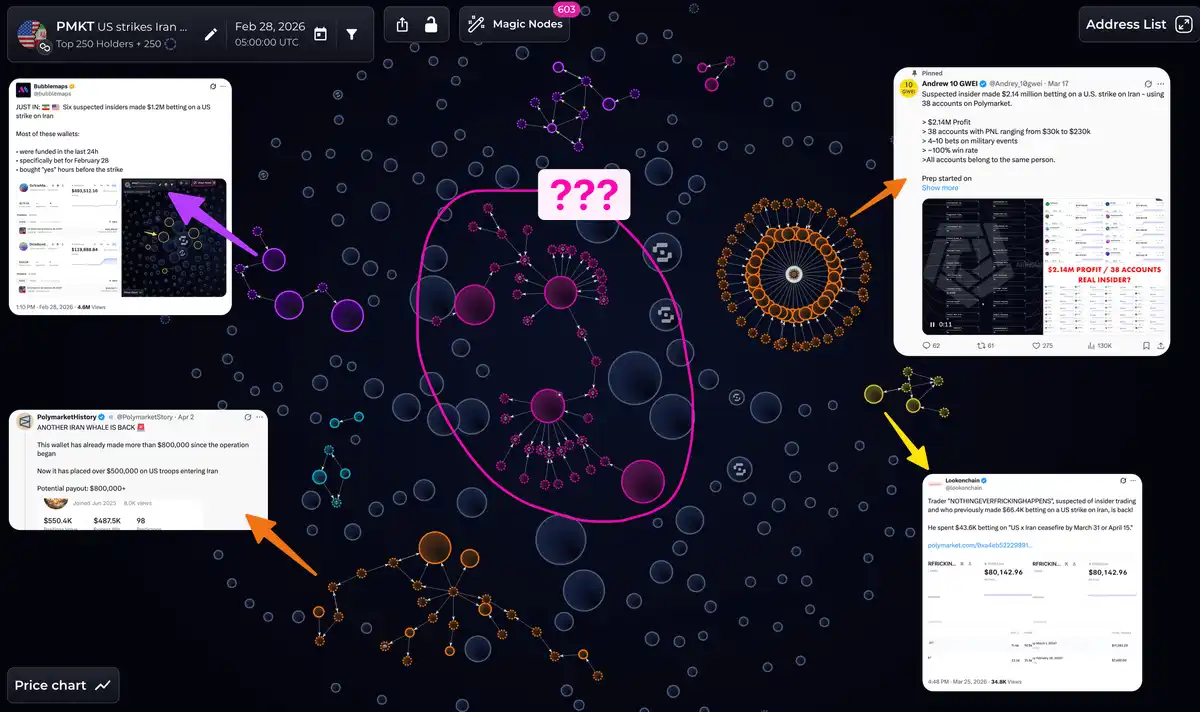
This wasn't simply "good luck." After visualizing the trades in the "Will the US strike Iran for the first time before February 28?" market on Polymarket, Bubblemaps discovered a massive pink cluster previously unmentioned on the X platform.
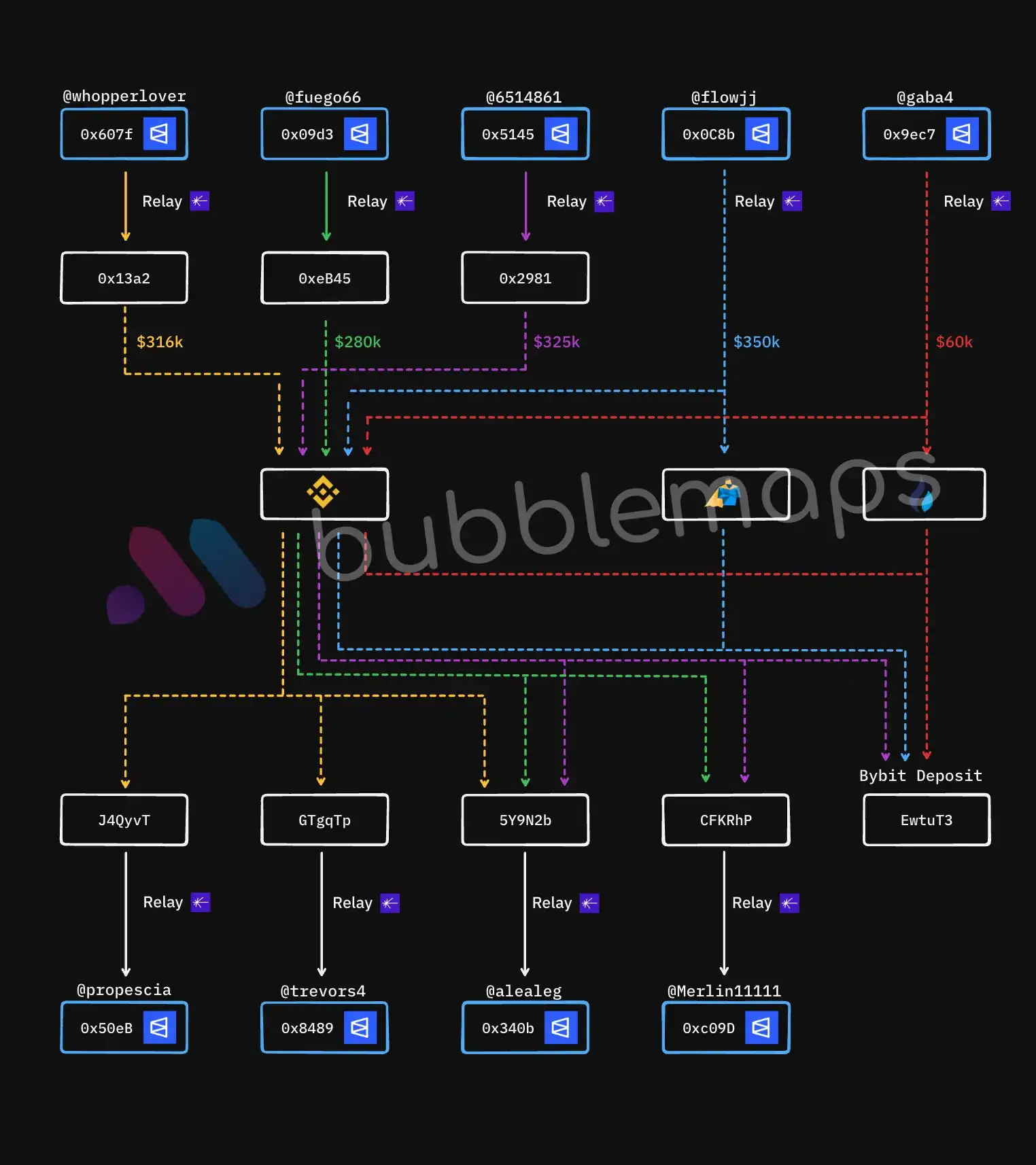
Further investigation linked the initial 4 accounts to another 5 through identical time windows, trade sizes, and fund flow paths. The nine accounts followed highly consistent funding paths: funds were transferred via centralized exchanges into a shared wallet network within an extremely short timeframe, with suspected use of professional services to hide traces.

4 Core Accounts Each Earned $400,000

In the early morning of February 28, 2026, the United States and Israel launched large-scale joint strikes codenamed "Operation Epic Fury" and "Lion's Roar." US-Israeli forces conducted nearly 900 strikes against Iran within 12 hours, targeting nuclear facilities, missile bases, military command centers, and hideouts of senior leaders. Iran's Supreme Leader Ali Khamenei and several of his family members, along with senior commanders of the Revolutionary Guard Corps, were killed in the initial strikes.

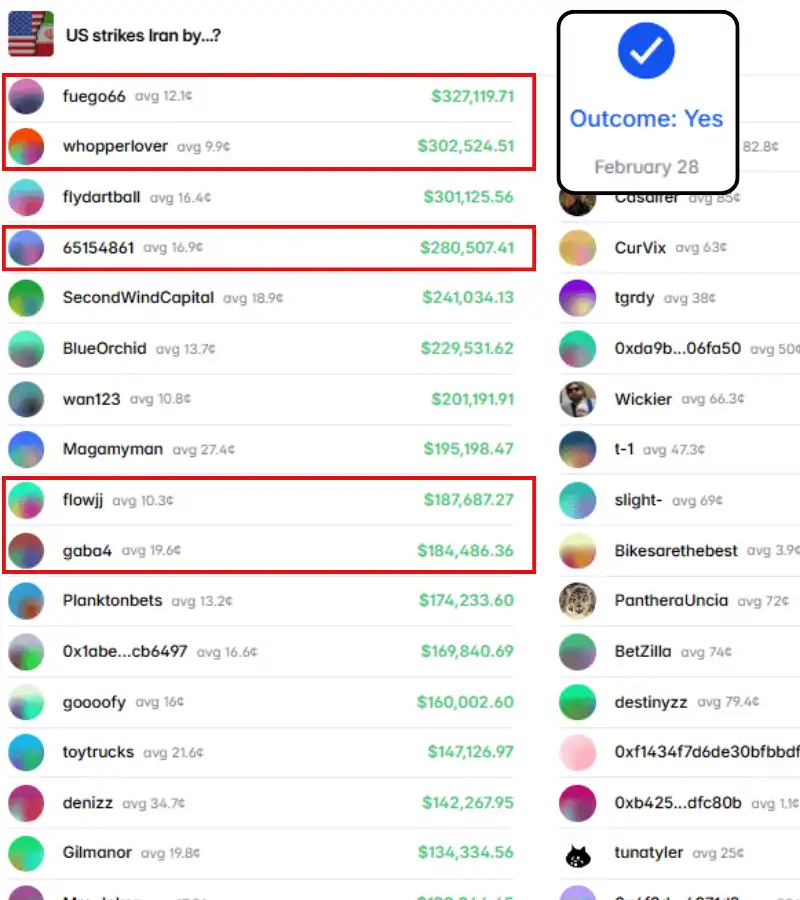
As early as the day of the February 28 strikes, Bubblemaps had publicly flagged six "fresh" accounts. Most of these accounts were created and funded within 24 hours before the strike, accurately betting on "the US will strike Iran before February 28," collectively netting about $1 million (some reports said $1.2 million). At the time, market odds were extremely low, yet these accounts heavily bet on them. Bubblemaps called it "suspected insider trading."

Five months later, the nine-account cluster they discovered was larger and had a higher win rate.
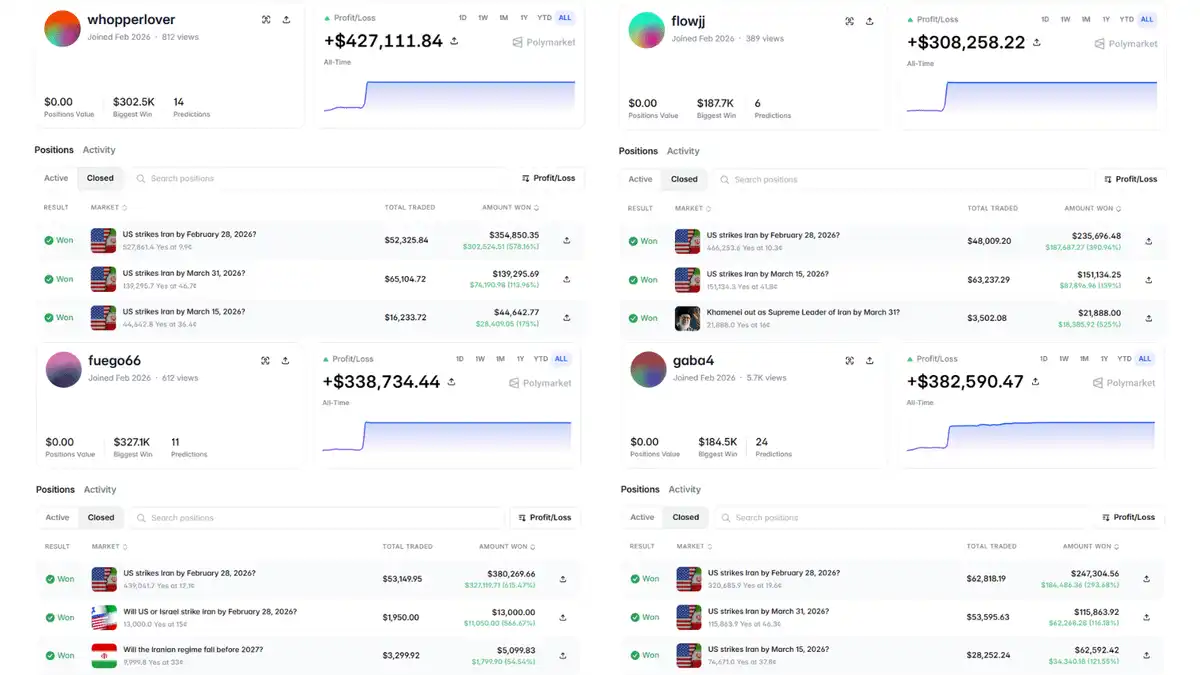
The four core accounts were created a few days before February 28, each earning about $400,000; the subsequent five accounts were linked through fund flows and trade overlaps. The nine accounts placed over 80 bets, almost all on US military actions: the first strike on February 28, the specific timing of Khamenei's elimination, the announcement of a ceasefire agreement, etc. They even placed bets spread across multiple dates to maximize gains, while occasionally placing one or two small losing bets (like on February 20), likely as cover.
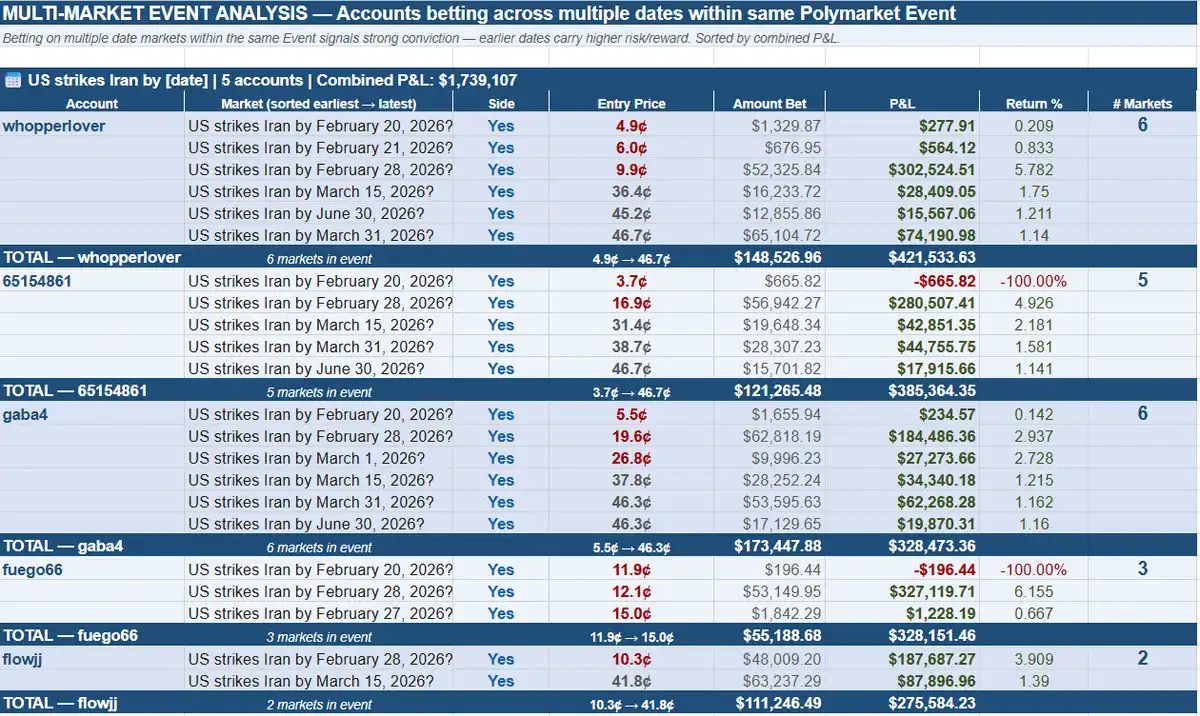
Bubblemaps listed the nine Polymarket wallet addresses (including 0x09d3273fa76282ce09f4f35a87d6f087c05f4e84, etc.), emphasizing that these accounts have long dominated the profit/loss leaderboards. Funds ultimately flowed to a shared wallet network, showing signs of professionalized money laundering or service use.
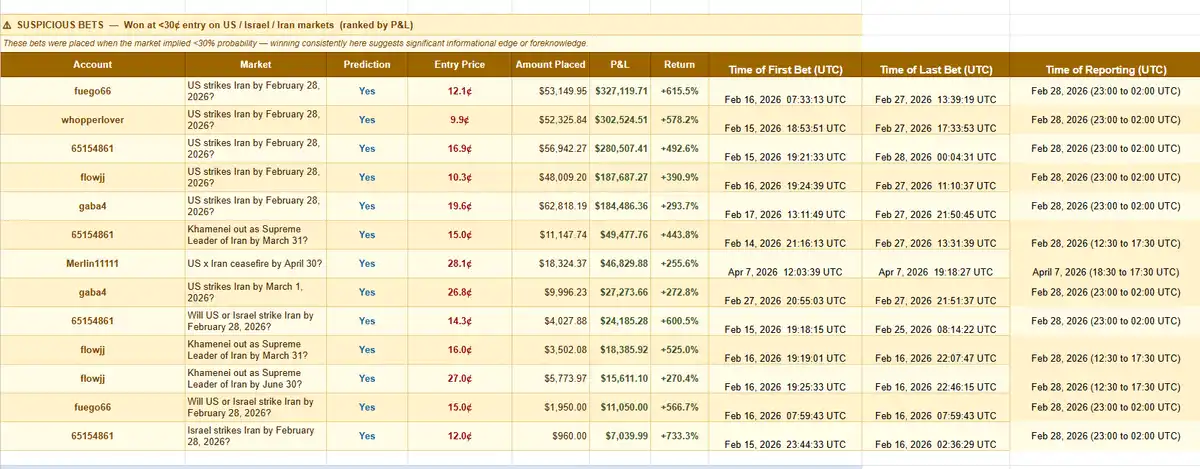
Vaiman stated bluntly: "Luck cannot explain these numbers." Deebs added that potential insider sources are numerous—government officials, military planners, intelligence analysts, even family members of military personnel.
Earlier this year, US Army Staff Sergeant Gannon Ken Van Dyke was charged with using classified intelligence to bet on special operations in Venezuela on Polymarket, investing $34,000 to profit $400,000 before quickly withdrawing funds and attempting to delete the account. Polymarket cooperated closely with law enforcement, ultimately leading to the prosecution. The Van Dyke case is seen as a landmark case for insider trading in prediction markets.

This nine-account cluster's profit is six times that amount, with a higher win rate, and is entirely concentrated on US-Iran military events.
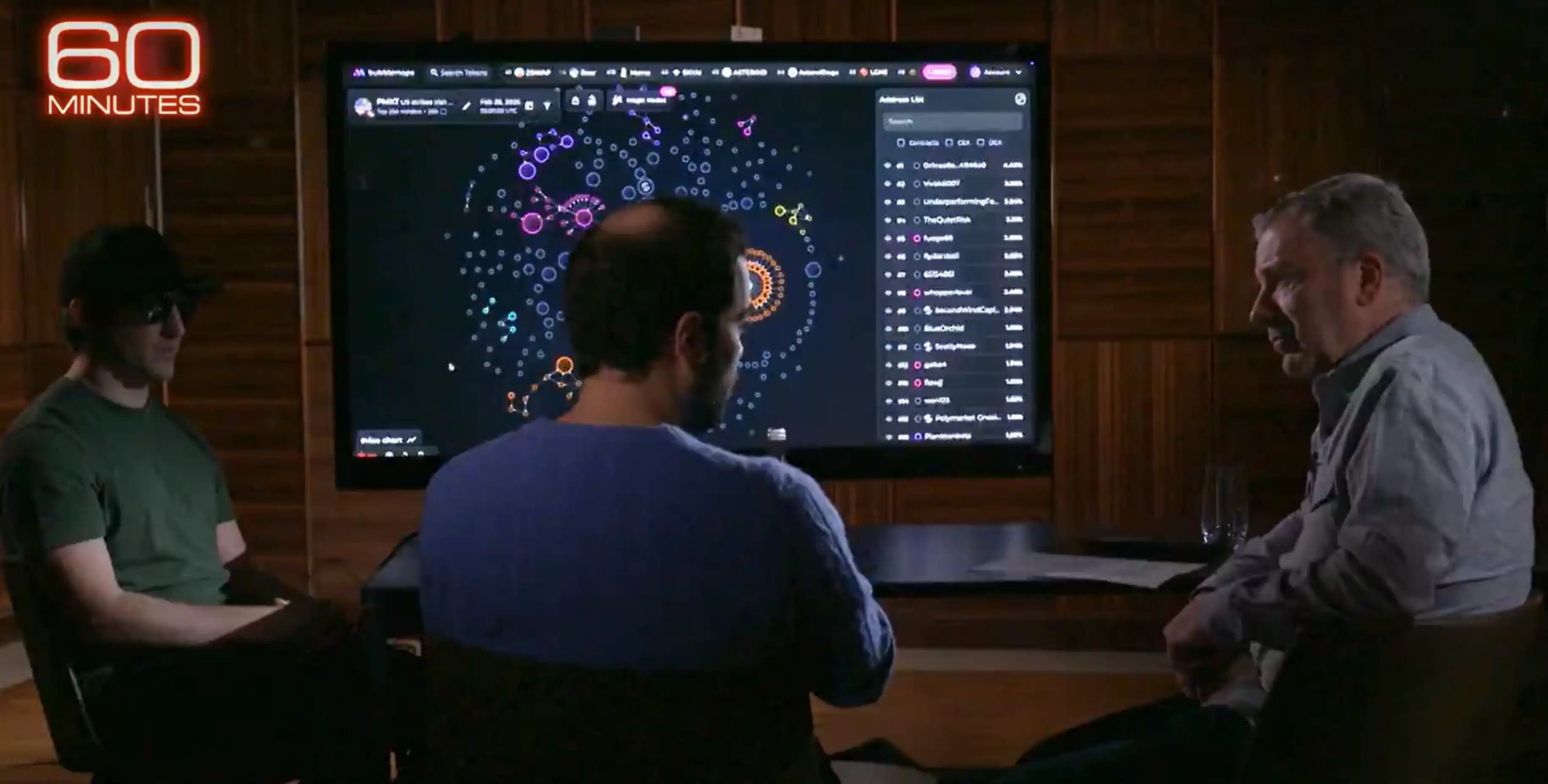
Bubblemaps exclusively shared the investigation with "60 Minutes." The segment aired on the evening of May 17, garnering significant attention. The CBS report noted that Polymarket has established AI monitoring and blockchain forensics systems, reporting suspicious activities to law enforcement authorities once detected, and emphasized that "insider trading is not welcome on the platform."

As of publication, Bubblemaps has not directly linked the nine accounts to any specific entity or government agency, stating only that "the correlation and near-perfect win rate raise serious suspicions."

Fighting Insider Trading vs. Copying Insider Trading

Insider trading makes many market participants feel the game is unfair. Prediction market platforms, including Kalshi and Polymarket, are taking more measures to combat it.

In late March this year, Polymarket updated its market integrity rules for its DeFi platform and its US exchange regulated by the U.S. Commodity Futures Trading Commission (CFTC). The updated rules clarify three core prohibited insider trading behaviors:

  • Trading using stolen confidential information—Participants may not trade any contracts if they possess confidential information about the outcome or likely outcome of an underlying event, and using that information would breach a pre-existing duty of trust or confidence owed to another person or entity.
  • Prohibition on trading using illegal insider tips—Participants may not trade using confidential information provided to them by another person, if the information was provided by someone who owed a pre-existing duty of trust or confidence to another, and the participant knows or has reason to know that the person providing the information themselves would be prohibited from trading on it.
  • Trading by those able to influence the outcome—Participants may not trade any contracts if they have authority or influence sufficient to affect the outcome of the underlying event.

However, rules always have loopholes. Since insider trading cannot be completely eradicated, some ill-intentioned so-called "insider copy-trading projects" have also sparked controversy. These applications compile trading accounts with abnormally high win rates for users, or flag suspiciously timed, abnormally sized trades, helping users copy these trades with one click.

Kreo's selling point is helping users "find insider traders before others." Polycool directly posts a "Polymarket Insider Trading Guide" on its website, stating "This isn't the stock market, betting with non-public information won't land you in jail, the rules for decentralized prediction markets are completely different."

A question then arises: does copying trades from insider trading addresses constitute a violation?

There has been no official response yet.

However, so-called "insider copy-trading platforms" like PolyGUN and Polycule have suffered hacker attacks this year, incurring losses ranging from tens of thousands to hundreds of thousands of dollars.


Preguntas relacionadas

QWhat did Bubblemaps investigators discover about a group of anonymous accounts on Polymarket?

ABubblemaps investigators discovered nine highly correlated anonymous accounts that collectively netted over $2.4 million from prediction markets related to US military actions, with a win rate of 98%. They were primarily focused on US-Iran conflict events in 2026.

QAccording to the article, what characteristics made the trading activity of these nine accounts highly suspicious?

AThe accounts were highly suspicious because they placed bets almost exclusively on US-Iran military events, their timing was unnervingly precise (often days before key actions), they preferred low-odds, long-term options, and they used shared wallet networks and professional services to obscure fund flows.

QWhat is the name of the US soldier mentioned in the article who was charged for insider trading on Polymarket, and what was his profit?

AThe US soldier mentioned is US Army Staff Sergeant Gannon Ken Van Dyke. He was charged for using classified intelligence to bet on a Venezuelan special operations event on Polymarket, investing $34,000 and making a profit of $400,000.

QWhat are the three core types of prohibited insider trading behaviors outlined in Polymarket's updated market integrity rules?

AThe three core prohibited behaviors are: 1) Trading using stolen confidential information. 2) Trading using illegal insider information provided by someone who breached a duty of trust. 3) Trading by individuals who have the authority or influence to affect the outcome of the event.

QWhat controversial practice related to potential insider trading has emerged on prediction market platforms according to the article?

AThe controversial practice is the emergence of 'insider copy-trading' platforms or applications. These services identify accounts with suspiciously high win rates or anomalous trades, allowing users to copy their bets, essentially attempting to profit from potential insider information.

Lecturas Relacionadas

AI Trading Cools, South Korean Stocks Plunge 1.8%, Spot Gold Rises 1%, Bitcoin Dives

A sell-off in AI-related stocks, triggered by Broadcom's disappointing earnings forecast, sent shockwaves through global markets. South Korea's KOSPI led Asia's decline, plunging 1.8% as the risks from concentrated chip stock gains and surging leveraged investments came to the fore. The tech-heavy Nasdaq 100 futures fell 0.5% following Broadcom's 14% after-hours plunge, which signaled a slower-than-expected transition to AI clients. This pullback extended Wall Street's weakness, halting the S&P 500's nine-day rally amid hawkish Fed signals and renewed Middle East tensions. South Korean authorities convened an emergency meeting, pledging "immediate measures" against market volatility and warning of record-high stock margin debt. The adjustment rippled across assets: Bitcoin fell to around $64,000, its lowest since February, while safe-haven gold rose 1% on bargain hunting. Oil prices dipped on Middle East ceasefire news. Market analysts noted the sell-off was driven by profit-taking after massive gains, particularly in chip stocks like Samsung and SK Hynix, which now dominate the KOSPI. Wall Street banks are divided on Korea's outlook, with Goldman Sachs raising its target while Citigroup and others warn of overvaluation and a potential bubble. Bridgewater's Ray Dalio noted that great technological shifts often create bubbles. Meanwhile, Fed officials' hints at potential future rate hikes added to the cautious mood ahead of key U.S. jobs data.

华尔街日报Hace 12 min(s)

AI Trading Cools, South Korean Stocks Plunge 1.8%, Spot Gold Rises 1%, Bitcoin Dives

华尔街日报Hace 12 min(s)

Seeking Alpha's Hot Article: Why Might the U.S. Stock Market Crash in June?

In a recent Seeking Alpha article, financial professor and analyst Damir Tokic argues that the US stock market may be poised for a significant crash in June 2026. The core thesis centers on a "mega-bubble" in equities, particularly within the technology sector, which has driven the S&P 500 to near-record valuations, with a Shiller P/E ratio exceeding 40—a level comparable to the 2000 dot-com bubble. Tokic identifies two primary catalysts for a potential collapse. First, he points to unsustainable market exuberance fueled by what he terms the "Trump Stimulus"—massive AI capital expenditure by tech giants, which he believes is politically driven and cannot last. Second, and more urgently, he highlights the escalating Iran war as a critical threat. The ongoing closure of the Strait of Hormuz has created a severe global energy supply crunch. Strategic petroleum reserves are projected to hit critically low operational levels by June, potentially causing oil prices to spike above $200 per barrel and triggering a severe, supply-driven inflationary shock. This scenario, Tokic warns, would force the Federal Reserve's hand. Despite currently maintaining a dovish bias, the Fed would likely be compelled to officially pivot to a hawkish stance at its June FOMC meeting to combat soaring inflation and bond yields. He contends that such a shift—or even a failure to act, which would destroy Fed credibility—could be the trigger that punctures the market bubble. The resulting downturn, he concludes, could rival the bear markets of 2000 and 2008, advising investors to prepare for a major correction.

marsbitHace 34 min(s)

Seeking Alpha's Hot Article: Why Might the U.S. Stock Market Crash in June?

marsbitHace 34 min(s)

AI PC Battle: Bet on the Toll Booth, Not the Camp

**Title:** The AI PC Battle: Don't Bet on Sides, Bet on the Tollbooth **Summary:** The AI PC competition is moving beyond simple "x86 vs. Arm" narratives. The core investment thesis should focus on identifying which players can sustain margins, cash flow, and pricing power throughout the upgrade cycle, rather than backing a particular architecture. The opportunity is analyzed in three layers: 1. **The Advanced Foundry Tollbooth:** TSMC is positioned to collect "tolls" regardless of which chip designer wins, due to its dominant ~70% share in advanced semiconductor manufacturing, which is essential for high-end AI PC chips. 2. **Compute & Platform Spillover:** AMD represents an offensive in the x86 CPU+GPU space, while NVIDIA leverages its GPU and CUDA software stack dominance. Both benefit from the demand for increased local AI compute. 3. **Architecture Diffusion & Turnaround Plays:** ARM and Intel offer potential for significant upside (elasticity), but investments here require stricter discipline due to higher execution risks and competitive challenges. The industry is transitioning from concept to shipment validation. While short-term forecasts for AI PC adoption have been revised down slightly due to tariffs and procurement delays, the long-term trend towards AI becoming a standard PC feature remains intact. The key driver for upgrade cycles will be whether compelling enterprise applications (e.g., privacy-sensitive computing, low-latency inference) emerge beyond consumer-focused features like meeting summarization. Investment strategy should prioritize companies with platform-level advantages and recurring revenue streams. TSMC offers high certainty as the foundational tollbooth. AMD presents a strong offensive play within the established ecosystem. ARM and Intel are higher-risk, higher-potential-reward turnaround bets. The report cautions against chasing short-term hype and emphasizes a disciplined, long-term approach focused on buying ecosystem strength and cash-flow certainty after market enthusiasm subsides. **Key Risks:** Underwhelming AI PC applications slowing upgrade cycles; slow improvement in Windows on Arm compatibility; macro/tariff impacts on PC demand; potential advanced node supply-demand mismatches affecting TSMC; high overall AI sector valuations making stocks vulnerable to a risk-off shift in markets.

marsbitHace 49 min(s)

AI PC Battle: Bet on the Toll Booth, Not the Camp

marsbitHace 49 min(s)

Ten-Thousand-Word Analysis: From $10 to $290, MRVL Wins the Entire AI Era by 'Not Making GPUs'

Marvell Technology's stock price surged from under $10 in 2016 to a record $290 in June 2026, fueled not by making GPUs, but by dominating AI infrastructure connectivity. This analysis argues the market misvalues MRVL as merely a smaller Broadcom in custom AI chips, overlooking its true, unique position. Marvell's core strength lies in enabling high-speed data flow for AI clusters through three interconnected businesses. First, it holds a commanding ~70% market share in high-speed optical DSPs (essential for data center light modules), a deep-moat business with accelerating growth. Second, its custom AI chip design business serves hyperscalers like AWS, Microsoft, and Google, with a significant revenue pipeline despite lower margins. Third, stable cash flows come from Ethernet switch chips and enterprise storage controllers. Together, they form a full-stack "AI data movement" platform. CEO Matt Murphy's transformative leadership since 2016, involving strategic divestments, key acquisitions (like Inphi for optical DSPs), and securing long-term agreements with major cloud providers, repositioned the company. A pivotal $2 billion strategic investment from NVIDIA in 2026 underscored Marvell's critical role in the AI ecosystem, particularly through collaborations like NVLink Fusion. While Marvell faces risks—including client concentration (losing the Amazon Trainium3 design), lower-margin business mix, competitive threats, insider selling, and complex supply chains—its fundamentals remain strong. The optical interconnect moat is widening with the acquisition of Celestial AI (photonics fabric), and financial metrics show accelerating revenue growth and operating leverage. With a PEG ratio suggesting undervaluation relative to its growth, the thesis is that the market undervalues Marvell's monopolistic position in AI "plumbing" while overemphasizing its competitive custom chip segment. The story transcends investing, symbolizing how in any complex system—from the internet to AI—the value of "connection" ultimately surpasses that of individual "nodes."

marsbitHace 1 hora(s)

Ten-Thousand-Word Analysis: From $10 to $290, MRVL Wins the Entire AI Era by 'Not Making GPUs'

marsbitHace 1 hora(s)

Trading

Spot
Futuros

Artículos destacados

Cómo comprar WAR

¡Bienvenido a HTX.com! Hemos hecho que comprar WAR (WAR) sea simple y conveniente. Sigue nuestra guía paso a paso para iniciar tu viaje de criptos.Paso 1: crea tu cuenta HTXUtiliza tu correo electrónico o número de teléfono para registrarte y obtener una cuenta gratuita en HTX. Experimenta un proceso de registro sin complicaciones y desbloquea todas las funciones.Obtener mi cuentaPaso 2: ve a Comprar cripto y elige tu método de pagoTarjeta de crédito/débito: usa tu Visa o Mastercard para comprar WAR (WAR) al instante.Saldo: utiliza fondos del saldo de tu cuenta HTX para tradear sin problemas.Terceros: hemos agregado métodos de pago populares como Google Pay y Apple Pay para mejorar la comodidad.P2P: tradear directamente con otros usuarios en HTX.Over-the-Counter (OTC): ofrecemos servicios personalizados y tipos de cambio competitivos para los traders.Paso 3: guarda tu WAR (WAR)Después de comprar tu WAR (WAR), guárdalo en tu cuenta HTX. Alternativamente, puedes enviarlo a otro lugar mediante transferencia blockchain o utilizarlo para tradear otras criptomonedas.Paso 4: tradear WAR (WAR)Tradear fácilmente con WAR (WAR) en HTX's mercado spot. Simplemente accede a tu cuenta, selecciona tu par de trading, ejecuta tus trades y monitorea en tiempo real. Ofrecemos una experiencia fácil de usar tanto para principiantes como para traders experimentados.

157 Vistas totalesPublicado en 2024.12.11Actualizado en 2026.06.02

Cómo comprar WAR

Discusiones

Bienvenido a la comunidad de HTX. Aquí puedes mantenerte informado sobre los últimos desarrollos de la plataforma y acceder a análisis profesionales del mercado. A continuación se presentan las opiniones de los usuarios sobre el precio de WAR (WAR).

活动图片