Netherlands To Amend Controversial 36% Tax On Unrealized Crypto, Stock Gains

bitcoinistPublicado a 2026-02-26Actualizado a 2026-02-26

Resumen

Dutch Finance Minister Eelco Heinen has announced that the Netherlands will revise its controversial tax reform bill, which proposed a 36% tax on unrealized gains from crypto, stocks, and other investments. The legislation, known as the Actual Return in Box 3 Act and set to take effect in 2028, has faced strong criticism from lawmakers and investors who argue it is unfair and could drive wealth out of the country. Heinen acknowledged the need for amendments and stated that the government will reexamine the bill with the House of Representatives and the Senate, potentially leading to a complete rewrite if necessary. The current system, which taxes assumed returns, was ruled unsustainable by the Supreme Court, prompting the proposed overhaul.

Dutch financial authorities have revealed that the reform bill to tax unrealized gains on crypto, stocks, and other investments will be revised following criticism from lawmakers and local investors.

Dutch Finance Minister To Revise Tax Overhaul

On Wednesday, the Minister of Finance of the Netherlands, Eelco Heinen, announced that the recently passed bill to tax unrealized gains on crypto and other assets will be reviewed and amended to address multiple concerns brought by the Senate and crypto investors.

“I don’t think the law can go through as it stands,” Heinen told local news outlet RTL Nieuws. “I think something has simply gone wrong here, and the current law needs to be amended.”

The Netherlands plans to overhaul its tax system on January 1, 2028. The proposed system, known as the Actual Return in Box 3 Act, is set to tax investors 36% on the change in value of their crypto and other assets each year, even if these have not been sold.

According to the report, the Dutch finance minister noted that there’s still time to amend the controversial tax overhaul, as it will not be enacted until 2028.

Moreover, he revealed that he has already discussed the bill’s upcoming revision with his state secretary, adding that they are set to examine the legislation and potential amendments with lawmakers.

“We have agreed that we will go back to the drawing board, engage in discussions with the House of Representatives and the Senate, and see how we can amend the law,” he stated.

Heinen also opened the door to a complete rewrite of the crypto tax bill if amendments in certain areas don’t suffice to address the concerns. Nonetheless, he shared that he doesn’t yet know which option will be necessary as they are “just going to have the conversation.”

The Unrealized Crypto, Stock Gains Tax Debate

The new system has been heavily criticized by local investors, who have expressed concerns about being unfairly taxed on their crypto and other assets. Some have argued that the legislation could push wealth out of the country, as crypto investors and other high-net-worth individuals could consider relocating to other jurisdictions with friendlier tax frameworks.

Under the new Box 3 system, the government will calculate tax by comparing the value of an asset at the beginning and end of the year, and the income earned during this period. As a result, both realized and unrealized gains on cryptocurrencies, stocks, bonds, and similar investments will be included.

Only real estate and shares in startups will be exempt from the new system, as they will be taxed when profit is made. Meanwhile, income from these assets will continue to be taxed in the year it is received.

For context, the old Box 3 system taxed investors based on the assumed returns of assets, a practice the Supreme Court ruled unfair and unsustainable after the Dutch state lost several court cases, with every year of delay costing the treasury hundreds of millions, RTL Nieuws detailed.

Since then, lawmakers have been developing the proposed new model that they consider more accurate. However, some reports noted that the government ignored previous concerns and still decided to advance the bill with some adjustments.

Notably, the Dutch House of Representatives passed the legislation two weeks ago, advancing it to the Senate for consideration. RTL Nieuws highlighted that the Dutch Senate, which has yet to discuss the reform plan, also shares similar concerns as investors.
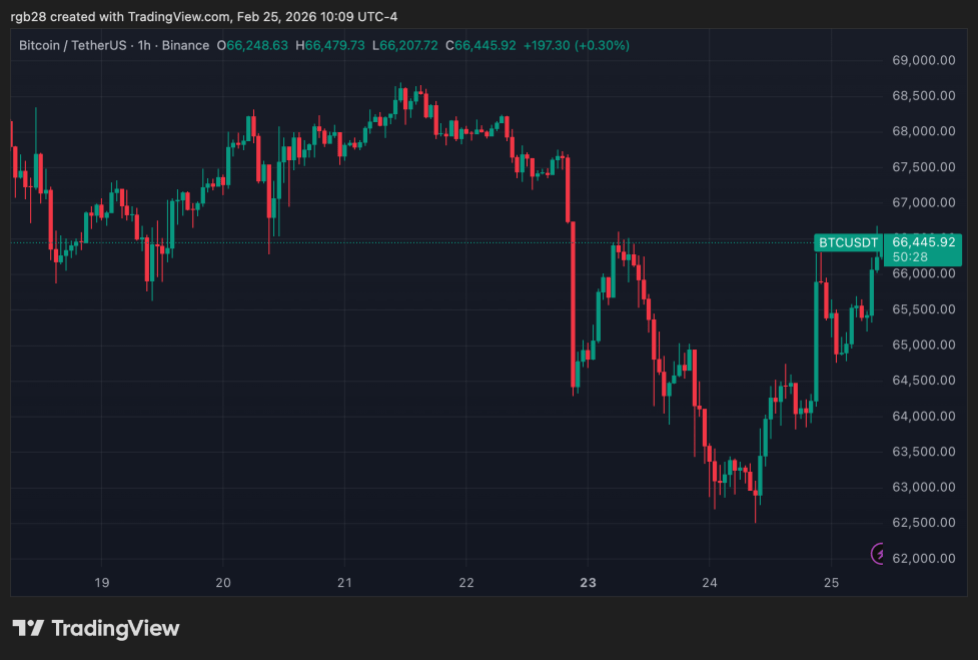
Bitcoin (BTC) trades at $66,445 in the one-week chart. Source: BTCUSDT on TradingView


Preguntas relacionadas

QWhy is the Netherlands planning to amend the controversial tax on unrealized crypto and stock gains?

ADutch Finance Minister Eelco Heinen announced a review and amendment of the tax overhaul due to criticism from lawmakers and local investors, acknowledging that the current law cannot proceed as it stands and something has gone wrong.

QWhat is the proposed tax rate on unrealized gains under the Actual Return in Box 3 Act?

AThe proposed system would impose a 36% tax on the change in value of crypto and other assets each year, even if they have not been sold.

QWhen is the new tax system scheduled to be implemented in the Netherlands?

AThe tax overhaul is planned to take effect on January 1, 2028.

QWhat are the main concerns raised by investors regarding the unrealized gains tax?

AInvestors are concerned about being unfairly taxed on unsold assets, which could lead to wealth leaving the country as high-net-worth individuals might relocate to jurisdictions with more favorable tax frameworks.

QHow did the old Box 3 system differ from the proposed new model?

AThe old Box 3 system taxed investors based on assumed returns of assets, which was ruled unfair by the Supreme Court, while the new model aims to tax actual returns, including both realized and unrealized gains.

Lecturas Relacionadas

SharpLink CEO: How to Understand Ethereum Developers Just Exceeded 1 Million?

SharpLink CEO reflects on the milestone of Ethereum surpassing 1 million historical developers, emphasizing that this figure represents the largest pool of technical talent ever assembled around an open, permissionless blockchain network. While approximately 232,000 developers remain active, the key question for the crypto industry is not which chain is fastest, but where the best builders choose to build long-term. Ethereum's advantage lies in a decade-long accumulation of infrastructure, standards, tools, liquidity, and a cohesive culture, making it the default operating system for programmable finance. This developer base is tackling complex challenges: the Glamsterdam upgrade aims to enhance scalability while preserving core principles; synchronous composability seeks to unify Rollup ecosystems; and significant efforts are underway for post-quantum security. Ethereum's deeper network effects stem from composability and shared standards (like the EVM and Solidity), creating a flywheel of more developers, tools, and liquidity. Three reinforcing strengths cement Ethereum's lead: credible neutrality (secured by ~900k validators), a modular architecture with interconnected Rollups, and a culture that attracts top researchers. The ecosystem is consolidating as the trusted coordination layer for internet-native finance, favored by large institutions valuing security and liquidity. The future of Ethereum is being built by this global community of founders and architects.

链捕手Hace 2 min(s)

SharpLink CEO: How to Understand Ethereum Developers Just Exceeded 1 Million?

链捕手Hace 2 min(s)

A Clod of Chinese Soil Chokes Two Japanese Giants

"Chinese Soil Chokes Japanese Giants" The production of a key electronic specialty gas, tungsten hexafluoride (WF6), vital for manufacturing AI chips, was halted by two leading Japanese producers—Kanto Denka and Central Glass. Their shutdown was not due to a technological failure but a sudden, critical shortage of a raw material they had long taken for granted: ultra-high-purity (6N-grade) tungsten powder, which is almost entirely sourced from China. Following a quiet Chinese export announcement in January 2026, tungsten powder shipments to Japan dropped to zero for months. Despite frantic efforts, Japanese companies found no viable alternative; imported powder was three times more expensive and lacked the required purity. Their existing stockpiles were exhausted by mid-2026. WF6 is essential for depositing tungsten into the microscopic contact holes of High Bandwidth Memory (HBM) chips, which are crucial for advanced processors like those from Nvidia. While Japanese firms had mastered producing ultra-pure WF6 gas, their entire supply chain relied on China's 6N tungsten powder—a dependency now revealed as a fatal vulnerability. China's dominance in this "soil" results from decades of painstaking R&D by companies like Xiamen Tungsten and China Tungsten & Hightech. They overcame immense technical hurdles, such as separating chemically similar molybdenum from tungsten, to achieve mass production of the world's purest tungsten powder. With their primary suppliers gone, Kanto Denka and Central Glass announced a permanent halt to WF6 production starting July 1, 2026. This immediately created a supply crisis for major semiconductor manufacturers like Samsung and SK Hynix, forcing them to urgently seek and certify new Chinese suppliers for WF6 itself. The reversal marks a dramatic shift: China has moved from exporting low-value raw materials to controlling the high-purity foundation of a critical global tech supply chain, upending a long-established industrial hierarchy.

marsbitHace 33 min(s)

A Clod of Chinese Soil Chokes Two Japanese Giants

marsbitHace 33 min(s)

Without Tencent, What's Left for Suiyuan?

The article centers on the crucial question posed in the title: what is Seyond Technology really worth if its dominant customer, Tencent, were to stop purchasing its AI chips? As the last of China's "Four AI Chip Dragons" to secure approval for a public listing, Seyond's IPO filing reveals a profound and controversial dependency. In 2025, 74.9% to over 80% of its revenue came from Tencent. The piece argues that this extreme customer concentration is not merely a vulnerability but a strategic outcome of China's AI industry evolution. It contrasts Seyond's path with its peers (Moore Thread, Biren Technology, and MetaX), noting that while others raced to market with ambitious stories, Seyond focused first on securing and delivering for a major client. Its explosive revenue growth—with Q1 2026 up 1474.85% year-on-year—is driven by concentrated orders from Tencent, which itself faces massive, escalating AI compute demands for products like its Yuanbao and Hunyuan models. The relationship is framed as a deliberate, symbiotic cultivation of a supply chain. As both a major shareholder (20.26%) and primary client, Tencent is actively fostering Seyond to build a controllable, stable alternative to NVIDIA, similar to how global tech giants historically nurtured key suppliers. The high switching costs—involving software stacks and deployed systems—create a deep "ecological moat" for Seyond within Tencent's ecosystem. The analysis positions the AI chip landscape in three tiers: NVIDIA as the global leader, Huawei's Ascend as the state-backed player, and commercial firms like Seyond competing for market orders. Seyond is increasingly seen as "Tencent's compute foundation," with its product roadmap closely aligned with the tech giant's needs. The conclusion is that the industry's metric for success is shifting from fundraising and technical specs to real orders, delivery capability, and ecosystem binding. Seyond's value, therefore, lies not just in its chips but in holding a massive, multi-year procurement order from China's largest internet company—a tangible asset arguably more telling than any technical whitepaper in the current climate. The core insight is that for domestic chips, the ultimate challenge isn't just catching up technologically with NVIDIA, but earning the trust, scenarios, and recurring orders from a major anchor client.

marsbitHace 1 hora(s)

Without Tencent, What's Left for Suiyuan?

marsbitHace 1 hora(s)

Trading

Spot
Futuros
活动图片




