Native Privacy Features: Ethereum's Lifesaver?

marsbitPublicado a 2026-05-29Actualizado a 2026-05-29

Resumen

"The Native Privacy Function: Ethereum's Lifeline?" While Ethereum's ETH price struggles, privacy coins like Zcash (ZEC) are rallying, highlighting growing market demand for financial privacy. Ethereum's developers are now racing to implement native privacy features, seen as critical for its future. Currently, all Ethereum asset balances and transaction histories are fully public, deterring institutional adoption and eroding its core value as a settlement layer. Industry experts warn Ethereum must deliver usable privacy within 12 months or risk falling behind competitors like Solana and Tron, which are already gaining market share and revenue. Data shows a significant decline in holdings among mid-sized and large Ethereum wallets, adding pressure. A broader industry shift towards financial privacy is underway, driven by stablecoin adoption, on-chain applications, and sophisticated AI-powered tracking. Privacy is no longer a niche concern but a mainstream need for both individuals and businesses wanting confidential transactions. Ethereum's co-founder Vitalik Buterin is prioritizing privacy, with a roadmap focusing on three key areas: Account Abstraction (improving wallet programmability and obscuring patterns), FOCIL (to combat transaction censorship), and stealth address mechanisms to break linkability between transactions. Additionally, the Ethereum Foundation's Kohaku toolkit aims to solve pre-chain data leaks at the RPC level. For Ethereum, native privacy is crucial ...

Original author: Oluwapelumi Adejumo

Original compilation: Chopper, Foresight News

TL;DR

  • While the current ETH market is sluggish, privacy coins are defying the trend and strengthening, prompting Ethereum developers to expedite the implementation of native privacy features.
  • Ethereum's on-chain asset balances and transaction records are completely public, which not only deters institutional investors but also undermines its core competitiveness as the industry's default settlement layer.
  • Industry insiders state that Ethereum's privacy features must be launched within 12 months; otherwise, they will remain at the research stage, and user traffic and attention will continue to be captured by competitors.

As market funds gradually shift towards privacy-focused assets, coupled with issues like negative publicity and ambiguous development positioning, Ethereum is struggling to retain investor attention. In response, developers are working at full capacity to equip the world's largest smart contract public blockchain with native privacy capabilities.

Year-to-date, ETH price has fallen approximately 30%, recently trading around $2,000; in contrast, Zcash (ZEC) has achieved double-digit gains, creating a stark divergence in their price movements.

This market contrast has turned privacy protection from a long-term vision of the cypherpunk community into a mandatory product goal that Ethereum must deliver on schedule.

Currently, Ethereum still dominates stablecoin settlement, asset tokenization, decentralized finance (DeFi), and Layer-2 ecosystems. However, the completely public nature of on-chain data poses a major pain point for both retail users and institutions, as asset balances, counterparties, and transaction histories are publicly traceable in real-time.

Tom Dunleavy, Head of Venture at Varys Capital, is highly optimistic about Ethereum's privacy upgrade but emphasizes the need to accelerate progress: "I am extremely bullish on Ethereum's implementation of privacy features, but the entire solution must be launched within 12 months, otherwise it will lose all significance. Ethereum is now in a fierce product race, facing competitors with strong funding, execution capabilities, and industry resources that Ethereum currently lacks. Only by delivering on time can it avoid being left behind."

This warning comes as Ethereum's market position is already under pressure. Data from GSR Research shows that blockchain sector revenue is increasingly flowing to competitors like Solana, Tron, and Hyperliquid; the ETH/Bitcoin price ratio has also fallen to its lowest level since mid-2025.
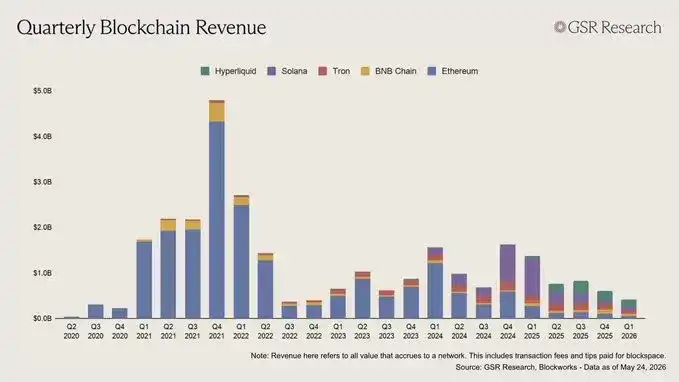
Blockchain Quarterly Revenue, Source: GSR Research

Data from CryptoQuant also reflects the crisis, showing that medium and small Ethereum holders are exiting on a large scale. Over the past three years, wallets holding between 100 and 1,000 ETH have seen their total holdings nearly halve, dropping from a peak of 16.2 million ETH in 2023 to about 8.75 million currently.

Large holders are also reducing their positions. Addresses holding 1,000 to 10,000 ETH, which fueled the 2024 ETH rally, have been gradually decreasing their holdings since late last year.
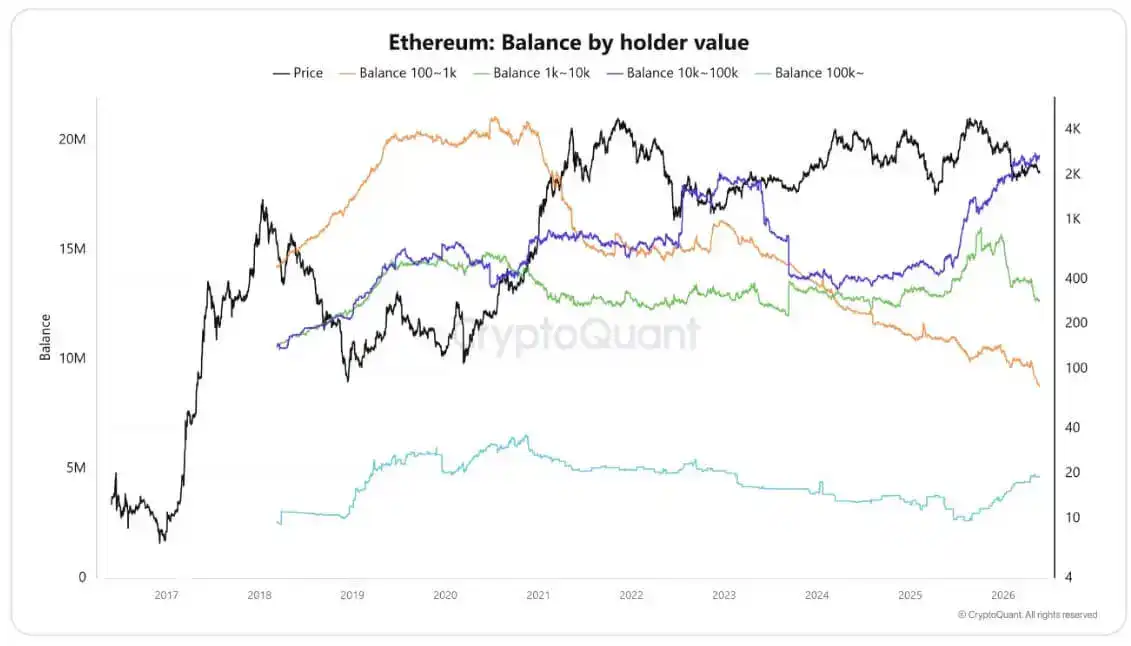
Ethereum Holder Balances

The capital outflow cannot be entirely attributed to the rising demand for privacy, but amidst increasing interest in privacy assets and investors actively seeking catalysts to boost ETH's price, the loss of holdings further intensifies the developmental pressure on Ethereum.

Privacy Has Become the New Main Theme in the Crypto Market

While Ethereum focuses on privacy features, a consensus is forming across the industry: financial privacy will dominate the next major crypto market cycle.

A recent Grayscale Research analysis points out that the digital asset industry is on the verge of a third wave of widespread focus on financial privacy.
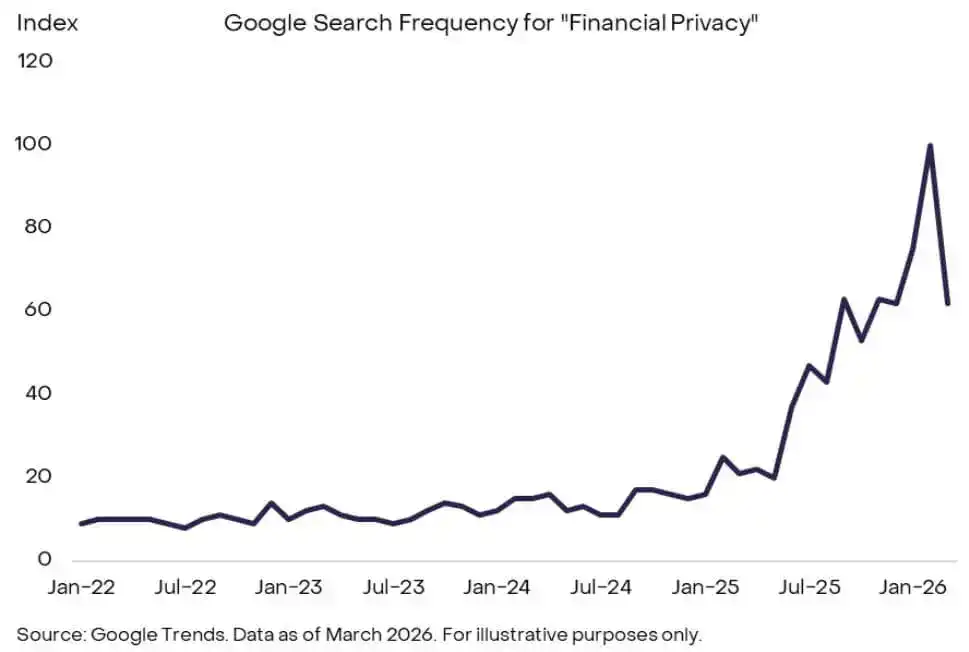
Search Volume for Financial Privacy on Google, Source: Grayscale

This trend is driven by the widespread adoption of stablecoins, the implementation of on-chain applications, and the rapid development of artificial intelligence technology. Grayscale warns that AI tools have given rise to more sophisticated financial tracking methods, while on traditional public blockchains, asset balances, counterparties, and transaction histories are permanently public.

The market's demand for privacy does not come solely from those seeking complete anonymity; it is also a normal desire from the general public and businesses to keep financial information confidential.

Ordinary users do not want their spending records made public; businesses need confidentiality for supplier payments, salary disbursements, and company fund flows; various institutions simply cannot accept having their wallet address structures analyzed in real-time.

However, implementing privacy features also requires weighing commercial trade-offs. Historical experience shows that strong privacy attributes often reduce asset liquidity and create obstacles for exchange listings, regulatory compliance, and wallet integration.

Despite these challenges, Barry Silbert, Chairman of Grayscale Investments, has stated that the era of privacy in the digital asset industry has officially arrived.
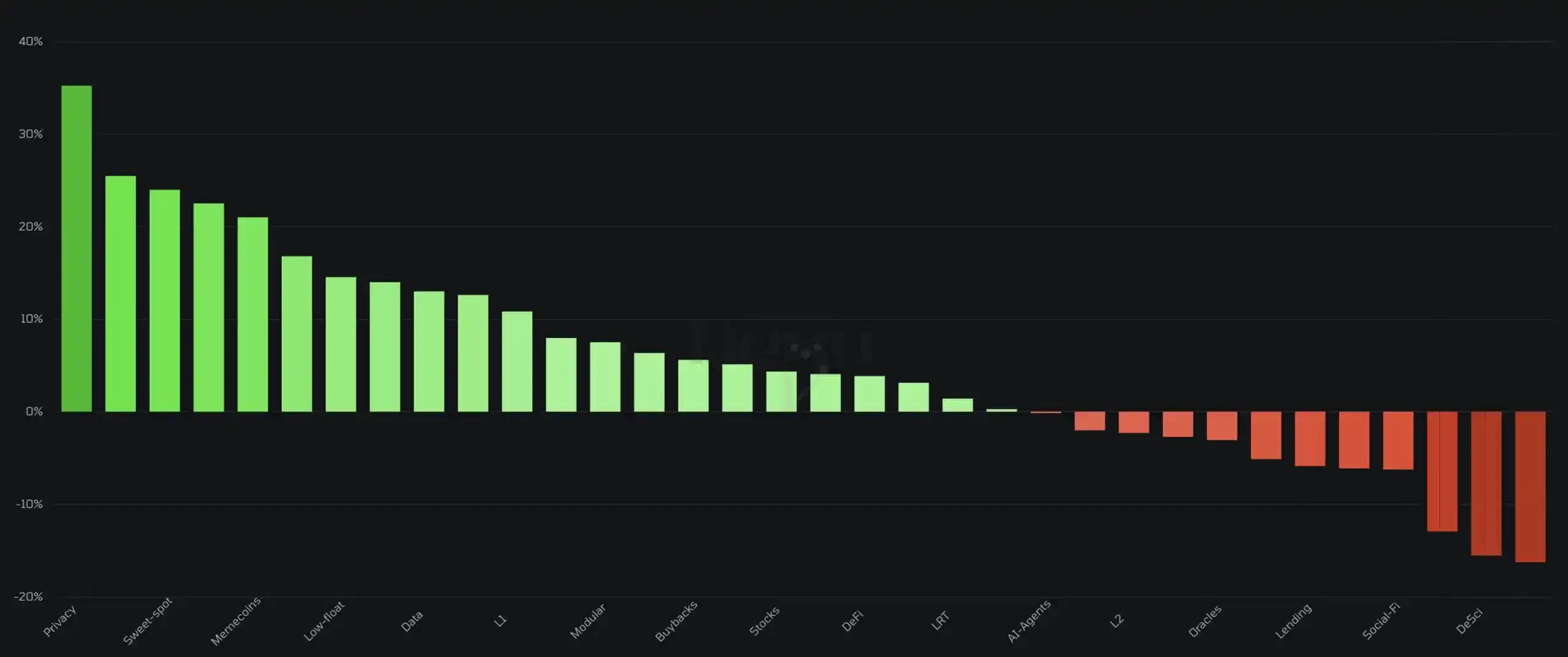
Privacy Coins Begin to Dominate the Crypto Industry

The shift in market focus is vividly reflected in price performance: over the past year, ZEC's market cap has skyrocketed over 900%, nearing $10 billion; Monero (XMR), long troubled by regulatory controversies, has also doubled in price.

Ethereum Co-Founder Advocates for Privacy Upgrade

Recently, Ethereum co-founder Vitalik Buterin has once again placed privacy development at the top of the technical agenda. After years of research and discussion, he is urging developers to accelerate the realization of the privacy vision pursued by cypherpunks.

Ethereum's short-term privacy roadmap primarily focuses on three directions: Account Abstraction and FOCIL, Key Randomization, and Access Layer Privacy Overhaul. The entire set of proposals aims to enhance the censorship resistance of on-chain transactions, sever address correlations, and reduce reliance on trusted third-party infrastructure.

FOCIL, or Forcefully Opened Censorship-Inclusion List, aims to address transaction censorship issues.

Currently, transactions enter a public mempool before being included in a block, allowing block builders and intermediaries to view pending transactions, enabling interception, front-running, and data monitoring. The FOCIL mechanism allows a committee of validators to propose a transaction list, which block builders are forced to include. Blocks that violate this rule are rejected by the network, reducing the risk of privacy-centric transactions being censored at the source.

Account Abstraction addresses another flaw in Ethereum's current design, where most users still rely on externally owned accounts controlled by a single private key. Account Abstraction makes accounts behave more like programmable smart contracts, supporting social recovery, multi-signature authorization, third-party fee payment, and other features.

From a privacy perspective, this feature can optimize wallet behavior patterns, preventing all activities from being exposed through a single account, and also facilitates third-party fee payment.

Key Randomization aims to solve a narrower but crucial metadata leakage problem. Ethereum relies on a nonce to prevent transaction replay; this value increments sequentially, allowing external observers to link seemingly unrelated transactions and trace them back to the same account. The new proposal splits the account counter into multiple independent domains, with different types of transactions using different key randomizations, significantly increasing the difficulty of address tracing.

Additionally, the Ethereum Foundation has launched the Kohaku open-source toolkit, which is the most ambitious part of this privacy upgrade. This project is not solely focused on transaction privacy but also addresses the data leakage issue at the access layer before transactions are submitted to the chain.

Even if transactions themselves are made private, when users query on-chain balances, call contracts, or initiate transactions, their wallets still leak information like IP addresses and wallet identities to the Remote Procedure Call (RPC) node. Kohaku provides wallet developers with privacy and security components that can be directly integrated into existing products. Its features cover private transactions, secure key management, private on-chain queries, and include a reference wallet. The toolkit can also interface with Ethereum's existing privacy protocol Railgun and the still-in-development Privacy Pools. Its goal is to allow users to experience private transactions and private DeFi services without switching their commonly used wallets or using niche tools.

Ethereum researcher soispoke.eth stated that if the aforementioned proposals are implemented simultaneously, Ethereum could achieve native, trustless, censorship-resistant private transactions as early as next year.

Why Privacy Features Are Crucial for Ethereum

Crypto lawyer Gabriel Shapiro believes that the privacy upgrade will help Ethereum compete for the institutional asset tokenization market. Businesses have strong confidentiality needs in scenarios like security tokenization, fund management, and DeFi interactions.

This also touches upon Ethereum's core investment thesis. For a long time, Ethereum's advantage has been its comprehensive ecosystem, covering stablecoins, lending, decentralized exchanges, asset tokenization, Layer-2 networks, and various development infrastructures. However, if all financial interactions remain completely public by default, relying solely on ecosystem breadth will be insufficient to sustain its position.

For institutions, settlement without privacy protection is inherently risky: companies do not want competitors to understand their supply chain dealings; asset managers do not want their trading paths tracked; banks cannot let their clients' tokenized security activities be exposed on a public chain.

Ethereum possesses the underlying infrastructure to serve institutional clients, but the market demands a delivered product, not just theoretical research.

This confirms Dunleavy's 12-month countdown warning. Zcash has long established a clear privacy narrative, and Monero remains a mainstream privacy coin despite regulatory pressure. Meanwhile, competitors like Solana, Tron, and Hyperliquid continue to capture market attention, and Bitcoin still firmly holds institutional capital preference.

Currently, the scale of tokenized assets on Ethereum exceeds $350 billion, and its application ecosystem remains the deepest in the industry, but this leading advantage is not permanently secure.

If Ethereum can launch a mature, usable privacy product within a year, it will further solidify its position as settlement infrastructure for both individuals and institutions. Conversely, if the privacy upgrade remains stuck at the technical planning stage, market funds will continue to flow towards projects that have made privacy their core positioning from the outset.


Preguntas relacionadas

QAccording to the article, why is there an urgent need for Ethereum to implement native privacy features within the next 12 months?

AThere is an urgent need because Ethereum is facing intense competition from other blockchains with strong execution and resources. If privacy features are not delivered within 12 months, the momentum and relevance will shift to competitors who already offer or prioritize privacy, turning Ethereum's efforts into mere technical research without real-world impact.

QWhat are the three main short-term privacy roadmap directions mentioned for Ethereum's development?

AThe three main short-term privacy roadmap directions are: 1) Account abstraction and FOCIL (Enforced Branch Selection Inclusion Lists), 2) Key nonce separation, and 3) Improvements to the access layer for privacy.

QWhat major problem does the FOCIL mechanism aim to solve for Ethereum transactions?

AThe FOCIL mechanism aims to solve the problem of transaction censorship. It allows a committee of validators to propose lists of transactions that block builders must include, preventing them from intercepting, front-running, or monitoring transactions before they are confirmed on-chain.

QHow does the article characterize the current performance of privacy-focused cryptocurrencies like Zcash (ZEC) compared to Ethereum (ETH)?

AThe article notes a stark divergence in performance. While ETH's price has fallen by approximately 30% year-to-date, Zcash (ZEC) has seen double-digit gains, with its market capitalization soaring over 900% in the past year, indicating strong market interest in the privacy asset category.

QWhat is the primary goal of the Ethereum Foundation's Kohaku toolkit, as described in the article?

AThe primary goal of the Kohaku toolkit is to solve access-layer data leakage problems. It provides wallet developers with components to integrate privacy and security features directly into existing products, enabling private transactions, key management, and private on-chain queries without requiring users to switch to niche or specialized wallets.

Lecturas Relacionadas

Another Corporate Bitcoin Treasury Strategy Ends: From High-Profile Entry to Liquidation at a Massive Loss in 11 Months

French semiconductor company Sequans Communications has sold off its bitcoin holdings and terminated its corporate bitcoin treasury strategy less than a year after launching it, sustaining heavy losses. Facing delisting from the New York Stock Exchange in mid-2025 due to low market capitalization, Sequans announced a plan to hold over 3,000 bitcoin as a long-term reserve asset. The strategy was executed with Swan Bitcoin and backed by a $384 million private financing round. At its peak in October 2025, the company held 3,234 bitcoin with an average cost of approximately $116,643 per coin. However, the plan quickly unraveled. With bitcoin's price falling, Sequans sold 970 bitcoin in late 2025 to repay debt, contradicting the core "hold" philosophy of such corporate strategies. The company has now sold more bitcoin to fully repay its convertible notes and announced the termination of its bitcoin reserve strategy. It plans to liquidate its remaining 658 bitcoin. The venture resulted in significant financial damage. The company reported an unrealized loss of $67.4 million on its bitcoin holdings in 2025, contributing to a total net loss of $109.3 million for the year. Sequans' stock (SQNS) has plummeted over 80% since the strategy's launch and is down 77% year-to-date. CEO Georges Karam, who previously championed bitcoin's long-term value, now states the company will refocus entirely on its core IoT semiconductor business. The failed experiment highlights the risks for companies adopting volatile digital assets as treasury reserves.

marsbitHace 18 min(s)

Another Corporate Bitcoin Treasury Strategy Ends: From High-Profile Entry to Liquidation at a Massive Loss in 11 Months

marsbitHace 18 min(s)

BIS Latest Research: The Future of Stablecoins and the Global Monetary Landscape

BIS Working Paper No. 170, released in May 2026, analyzes the impact of stablecoins on the global monetary system. The market has grown exponentially since 2014, with over 300 active stablecoins exceeding $300 billion in market capitalization. It is highly concentrated, dominated by USD-linked stablecoins (98% by market cap, mainly USDT and USDC), which function as new forms of private offshore dollar claims on blockchain. Currently, stablecoin use remains largely within crypto ecosystems for trading and DeFi collateral. Real-economy adoption, such as in cross-border payments, is nascent but growing in emerging markets and developing economies (EMDEs) facing high inflation and volatile currencies, where they facilitate capital flight and "digital dollarization." The paper assesses impacts using the Cohen-Kennen framework. For private-sector functions, stablecoins most directly affect value storage (as a dollar-denominated safe haven in EMDEs) and the medium of exchange (enhancing cross-border payment efficiency, further entrenching dollar use). Impacts on the unit of account and official-sector functions are currently limited but could indirectly constrain monetary policy autonomy and capital controls. The report outlines three potential future scenarios: 1) **Niche adoption**, where stablecoins remain crypto-centric with minimal systemic impact; 2) **Digital dollarization**, a high-risk scenario where USD stablecoins become de facto standards in EMDEs, eroding monetary sovereignty; and 3) **Local currency stablecoin integration**, an ideal but challenging scenario where regulated domestic stablecoins linked to CBDCs enhance efficiency without foreign currency substitution. Key policy recommendations emphasize global coordination: establishing uniform regulatory standards (e.g., for reserves and disclosure), strengthening cross-border supervisory cooperation, enhancing domestic defenses in EMDEs (via macroeconomic stability, improved payment systems, and CBDCs), and combating illicit activities. The paper concludes that stablecoins are a structural force reinforcing dollar dominance in the near term, posing significant risks to EMDEs' financial stability and policy autonomy. Their long-term trajectory depends on regulatory responses, adoption patterns, and the co-evolution with public digital currencies.

marsbitHace 27 min(s)

BIS Latest Research: The Future of Stablecoins and the Global Monetary Landscape

marsbitHace 27 min(s)

BIS Latest Research: Stablecoins and the Future of the Global Monetary Landscape

The Bank for International Settlements (BIS) Working Paper No. 170 analyzes the rise of stablecoins and their impact on the global monetary system. Stablecoins, privately issued digital tokens pegged to fiat currencies, have grown exponentially since 2014, with a market dominated by USD-pegged variants like USDT and USDC. Their core function remains within the crypto ecosystem, though use in cross-border payments and as a store of value in high-inflation emerging markets is increasing. The report identifies stablecoins as a new form of offshore dollar claims, extending dollar liquidity via blockchain. Their stability depends entirely on reserve quality and market arbitrage, lacking traditional banking safeguards. In the short term, stablecoins reinforce the US dollar's dominance, posing risks to monetary sovereignty in emerging market and developing economies (EMDEs) by facilitating "digital dollarization," which can undermine local currency deposits, capital controls, and monetary policy effectiveness. The BIS outlines three potential future scenarios: 1) Niche adoption within crypto (baseline), 2) Widespread "digital dollarization" in EMDEs (high-risk), and 3) Integration of domestic currency stablecoins (ideal but challenging). Effective global regulatory coordination is crucial to manage risks like reserve transparency, cross-border spillovers, and illicit activities. The report concludes that stablecoins represent a structural force reshaping international monetary hierarchies, presenting both opportunities for payment efficiency and significant risks to financial stability and autonomy, necessitating robust policy responses.

链捕手Hace 32 min(s)

BIS Latest Research: Stablecoins and the Future of the Global Monetary Landscape

链捕手Hace 32 min(s)

Solo Company Craze: Some Earn Millions Annually, Others See Incomes Shrink by 90%

The Rise of the "One-Person Company" (OPC): AI Fuels a Solo Entrepreneurship Wave The concept of the "One-Person Company" (OPC)—where an individual leverages AI tools to start and run a business—is gaining significant traction, hailed by some as ushering in a "golden age" for solo entrepreneurship. While success stories abound, the reality is a mixed picture of high earnings and significant struggles. The article profiles several OPC founders across different industries: * A game developer created 6 bullet-chat (danmaku) games in a year using an AI-powered workflow, earning approximately 1 million RMB. AI handled around 70% of art and 99% of coding tasks, slashing development cycles from months to about 15 days per game. * A materials researcher in Japan, using AI for tasks from translation to legal advice, earns roughly triple the salary of a local white-collar worker. * A biotech entrepreneur uses AI Agents to automate 80% of repetitive work like data analysis, doubling their previous income while gaining time freedom. * Conversely, a former tech executive turned cross-border e-commerce founder in Latin America reports a 90% drop in income compared to their previous corporate job, cautioning against blindly following the trend. Key insights from these cases include: AI dramatically lowers barriers to entry and operational costs, but does not guarantee success. It excels at automating repetitive tasks but cannot replace core human skills like creativity, project management, judgment, and client acquisition. Industry experience and existing client/resources remain critical advantages. The model suits self-starters with specific expertise but poses challenges in areas like sales, compliance, and scaling. Ultimately, while AI empowers solo ventures, entrepreneurship's inherent risks and demands persist.

marsbitHace 38 min(s)

Solo Company Craze: Some Earn Millions Annually, Others See Incomes Shrink by 90%

marsbitHace 38 min(s)

Trading

Spot
Futuros

Artículos destacados

Qué es $S$

Entendiendo SPERO: Una Visión General Completa Introducción a SPERO A medida que el panorama de la innovación continúa evolucionando, la aparición de tecnologías web3 y proyectos de criptomonedas juega un papel fundamental en la configuración del futuro digital. Un proyecto que ha atraído la atención en este campo dinámico es SPERO, denotado como SPERO,$$s$. Este artículo tiene como objetivo reunir y presentar información detallada sobre SPERO, para ayudar a entusiastas e inversores a comprender sus fundamentos, objetivos e innovaciones dentro de los dominios web3 y cripto. ¿Qué es SPERO,$$s$? SPERO,$$s$ es un proyecto único dentro del espacio cripto que busca aprovechar los principios de descentralización y tecnología blockchain para crear un ecosistema que promueva la participación, la utilidad y la inclusión financiera. El proyecto está diseñado para facilitar interacciones de igual a igual de nuevas maneras, proporcionando a los usuarios soluciones y servicios financieros innovadores. En su esencia, SPERO,$$s$ tiene como objetivo empoderar a los individuos al proporcionar herramientas y plataformas que mejoren la experiencia del usuario en el espacio de las criptomonedas. Esto incluye habilitar métodos de transacción más flexibles, fomentar iniciativas impulsadas por la comunidad y crear caminos para oportunidades financieras a través de aplicaciones descentralizadas (dApps). La visión subyacente de SPERO,$$s$ gira en torno a la inclusividad, buscando cerrar brechas dentro de las finanzas tradicionales mientras aprovecha los beneficios de la tecnología blockchain. ¿Quién es el Creador de SPERO,$$s$? La identidad del creador de SPERO,$$s$ sigue siendo algo oscura, ya que hay recursos públicos limitados que proporcionan información de fondo detallada sobre su(s) fundador(es). Esta falta de transparencia puede derivarse del compromiso del proyecto con la descentralización, una ética que muchos proyectos web3 comparten, priorizando las contribuciones colectivas sobre el reconocimiento individual. Al centrar las discusiones en torno a la comunidad y sus objetivos colectivos, SPERO,$$s$ encarna la esencia del empoderamiento sin señalar a individuos específicos. Como tal, comprender la ética y la misión de SPERO sigue siendo más importante que identificar a un creador singular. ¿Quiénes son los Inversores de SPERO,$$s$? SPERO,$$s$ cuenta con el apoyo de una diversa gama de inversores que van desde capitalistas de riesgo hasta inversores ángeles dedicados a fomentar la innovación en el sector cripto. El enfoque de estos inversores generalmente se alinea con la misión de SPERO, priorizando proyectos que prometen avances tecnológicos sociales, inclusión financiera y gobernanza descentralizada. Estas fundaciones de inversores suelen estar interesadas en proyectos que no solo ofrecen productos innovadores, sino que también contribuyen positivamente a la comunidad blockchain y sus ecosistemas. El respaldo de estos inversores refuerza a SPERO,$$s$ como un contendiente notable en el dominio de proyectos cripto que evoluciona rápidamente. ¿Cómo Funciona SPERO,$$s$? SPERO,$$s$ emplea un marco multifacético que lo distingue de los proyectos de criptomonedas convencionales. Aquí hay algunas de las características clave que subrayan su singularidad e innovación: Gobernanza Descentralizada: SPERO,$$s$ integra modelos de gobernanza descentralizada, empoderando a los usuarios para participar activamente en los procesos de toma de decisiones sobre el futuro del proyecto. Este enfoque fomenta un sentido de propiedad y responsabilidad entre los miembros de la comunidad. Utilidad del Token: SPERO,$$s$ utiliza su propio token de criptomoneda, diseñado para servir diversas funciones dentro del ecosistema. Estos tokens permiten transacciones, recompensas y la facilitación de servicios ofrecidos en la plataforma, mejorando la participación y la utilidad general. Arquitectura en Capas: La arquitectura técnica de SPERO,$$s$ apoya la modularidad y escalabilidad, permitiendo la integración fluida de características y aplicaciones adicionales a medida que el proyecto evoluciona. Esta adaptabilidad es fundamental para mantener la relevancia en el cambiante paisaje cripto. Participación de la Comunidad: El proyecto enfatiza iniciativas impulsadas por la comunidad, empleando mecanismos que incentivan la colaboración y la retroalimentación. Al nutrir una comunidad sólida, SPERO,$$s$ puede abordar mejor las necesidades de los usuarios y adaptarse a las tendencias del mercado. Enfoque en la Inclusión: Al ofrecer tarifas de transacción bajas e interfaces amigables para el usuario, SPERO,$$s$ busca atraer a una base de usuarios diversa, incluyendo a individuos que anteriormente pueden no haber participado en el espacio cripto. Este compromiso con la inclusión se alinea con su misión general de empoderamiento a través de la accesibilidad. Cronología de SPERO,$$s$ Entender la historia de un proyecto proporciona información crucial sobre su trayectoria de desarrollo y hitos. A continuación se presenta una cronología sugerida que mapea eventos significativos en la evolución de SPERO,$$s$: Fase de Conceptualización e Ideación: Las ideas iniciales que forman la base de SPERO,$$s$ fueron concebidas, alineándose estrechamente con los principios de descentralización y enfoque comunitario dentro de la industria blockchain. Lanzamiento del Whitepaper del Proyecto: Tras la fase conceptual, se lanzó un whitepaper completo que detalla la visión, los objetivos y la infraestructura tecnológica de SPERO,$$s$ para generar interés y retroalimentación de la comunidad. Construcción de Comunidad y Primeras Interacciones: Se realizaron esfuerzos de divulgación activa para construir una comunidad de primeros adoptantes y posibles inversores, facilitando discusiones en torno a los objetivos del proyecto y obteniendo apoyo. Evento de Generación de Tokens: SPERO,$$s$ llevó a cabo un evento de generación de tokens (TGE) para distribuir sus tokens nativos a los primeros seguidores y establecer liquidez inicial dentro del ecosistema. Lanzamiento de la dApp Inicial: La primera aplicación descentralizada (dApp) asociada con SPERO,$$s$ se puso en marcha, permitiendo a los usuarios interactuar con las funcionalidades centrales de la plataforma. Desarrollo Continuo y Alianzas: Actualizaciones y mejoras continuas a las ofertas del proyecto, incluyendo alianzas estratégicas con otros actores en el espacio blockchain, han moldeado a SPERO,$$s$ en un jugador competitivo y en evolución en el mercado cripto. Conclusión SPERO,$$s$ se erige como un testimonio del potencial de web3 y las criptomonedas para revolucionar los sistemas financieros y empoderar a los individuos. Con un compromiso con la gobernanza descentralizada, la participación comunitaria y funcionalidades diseñadas de manera innovadora, allana el camino hacia un paisaje financiero más inclusivo. Como con cualquier inversión en el espacio cripto que evoluciona rápidamente, se anima a los posibles inversores y usuarios a investigar a fondo y participar de manera reflexiva con los desarrollos en curso dentro de SPERO,$$s$. El proyecto muestra el espíritu innovador de la industria cripto, invitando a una mayor exploración de sus innumerables posibilidades. Mientras el viaje de SPERO,$$s$ aún se desarrolla, sus principios fundamentales pueden, de hecho, influir en el futuro de cómo interactuamos con la tecnología, las finanzas y entre nosotros en ecosistemas digitales interconectados.

72 Vistas totalesPublicado en 2024.12.17Actualizado en 2024.12.17

Qué es $S$

Qué es AGENT S

Agent S: El Futuro de la Interacción Autónoma en Web3 Introducción En el paisaje en constante evolución de Web3 y las criptomonedas, las innovaciones están redefiniendo constantemente cómo los individuos interactúan con las plataformas digitales. Uno de estos proyectos pioneros, Agent S, promete revolucionar la interacción humano-computadora a través de su marco agente abierto. Al allanar el camino para interacciones autónomas, Agent S busca simplificar tareas complejas, ofreciendo aplicaciones transformadoras en inteligencia artificial (IA). Esta exploración detallada profundizará en las complejidades del proyecto, sus características únicas y las implicaciones para el dominio de las criptomonedas. ¿Qué es Agent S? Agent S se presenta como un marco agente abierto innovador, diseñado específicamente para abordar tres desafíos fundamentales en la automatización de tareas informáticas: Adquisición de Conocimiento Específico del Dominio: El marco aprende inteligentemente de diversas fuentes de conocimiento externas y experiencias internas. Este enfoque dual le permite construir un rico repositorio de conocimiento específico del dominio, mejorando su rendimiento en la ejecución de tareas. Planificación a Largo Plazo de Tareas: Agent S emplea planificación jerárquica aumentada por la experiencia, un enfoque estratégico que facilita la descomposición y ejecución eficiente de tareas complejas. Esta característica mejora significativamente su capacidad para gestionar múltiples subtareas de manera eficiente y efectiva. Manejo de Interfaces Dinámicas y No Uniformes: El proyecto introduce la Interfaz Agente-Computadora (ACI), una solución innovadora que mejora la interacción entre agentes y usuarios. Utilizando Modelos de Lenguaje Multimodal de Gran Escala (MLLMs), Agent S puede navegar y manipular diversas interfaces gráficas de usuario sin problemas. A través de estas características pioneras, Agent S proporciona un marco robusto que aborda las complejidades involucradas en la automatización de la interacción humana con las máquinas, preparando el terreno para una multitud de aplicaciones en IA y más allá. ¿Quién es el Creador de Agent S? Si bien el concepto de Agent S es fundamentalmente innovador, la información específica sobre su creador sigue siendo elusiva. El creador es actualmente desconocido, lo que resalta ya sea la etapa incipiente del proyecto o la elección estratégica de mantener a los miembros fundadores en el anonimato. Independientemente de la anonimidad, el enfoque sigue siendo en las capacidades y el potencial del marco. ¿Quiénes son los Inversores de Agent S? Dado que Agent S es relativamente nuevo en el ecosistema criptográfico, la información detallada sobre sus inversores y patrocinadores financieros no está documentada explícitamente. La falta de información disponible públicamente sobre las bases de inversión u organizaciones que apoyan el proyecto plantea preguntas sobre su estructura de financiamiento y hoja de ruta de desarrollo. Comprender el respaldo es crucial para evaluar la sostenibilidad del proyecto y su posible impacto en el mercado. ¿Cómo Funciona Agent S? En el núcleo de Agent S se encuentra una tecnología de vanguardia que le permite funcionar de manera efectiva en diversos entornos. Su modelo operativo se basa en varias características clave: Interacción Humano-Computadora Similar a la Humana: El marco ofrece planificación avanzada de IA, esforzándose por hacer que las interacciones con las computadoras sean más intuitivas. Al imitar el comportamiento humano en la ejecución de tareas, promete elevar las experiencias de los usuarios. Memoria Narrativa: Empleada para aprovechar experiencias de alto nivel, Agent S utiliza memoria narrativa para hacer un seguimiento de las historias de tareas, mejorando así sus procesos de toma de decisiones. Memoria Episódica: Esta característica proporciona a los usuarios una guía paso a paso, permitiendo que el marco ofrezca apoyo contextual a medida que se desarrollan las tareas. Soporte para OpenACI: Con la capacidad de ejecutarse localmente, Agent S permite a los usuarios mantener el control sobre sus interacciones y flujos de trabajo, alineándose con la ética descentralizada de Web3. Fácil Integración con APIs Externas: Su versatilidad y compatibilidad con varias plataformas de IA aseguran que Agent S pueda encajar sin problemas en ecosistemas tecnológicos existentes, convirtiéndolo en una opción atractiva para desarrolladores y organizaciones. Estas funcionalidades contribuyen colectivamente a la posición única de Agent S dentro del espacio cripto, ya que automatiza tareas complejas y de múltiples pasos con una intervención humana mínima. A medida que el proyecto evoluciona, sus posibles aplicaciones en Web3 podrían redefinir cómo se desarrollan las interacciones digitales. Cronología de Agent S El desarrollo y los hitos de Agent S pueden encapsularse en una cronología que resalta sus eventos significativos: 27 de septiembre de 2024: El concepto de Agent S fue lanzado en un documento de investigación integral titulado “Un Marco Agente Abierto que Usa Computadoras Como un Humano”, mostrando las bases del proyecto. 10 de octubre de 2024: El documento de investigación fue puesto a disposición del público en arXiv, ofreciendo una exploración profunda del marco y su evaluación de rendimiento basada en el benchmark OSWorld. 12 de octubre de 2024: Se lanzó una presentación en video, proporcionando una visión visual de las capacidades y características de Agent S, involucrando aún más a posibles usuarios e inversores. Estos marcadores en la cronología no solo ilustran el progreso de Agent S, sino que también indican su compromiso con la transparencia y la participación comunitaria. Puntos Clave Sobre Agent S A medida que el marco Agent S continúa evolucionando, varios atributos clave destacan, subrayando su naturaleza innovadora y potencial: Marco Innovador: Diseñado para proporcionar un uso intuitivo de las computadoras similar a la interacción humana, Agent S aporta un enfoque novedoso a la automatización de tareas. Interacción Autónoma: La capacidad de interactuar de manera autónoma con las computadoras a través de GUI significa un salto hacia soluciones informáticas más inteligentes y eficientes. Automatización de Tareas Complejas: Con su metodología robusta, puede automatizar tareas complejas y de múltiples pasos, haciendo que los procesos sean más rápidos y menos propensos a errores. Mejora Continua: Los mecanismos de aprendizaje permiten a Agent S mejorar a partir de experiencias pasadas, mejorando continuamente su rendimiento y eficacia. Versatilidad: Su adaptabilidad en diferentes entornos operativos como OSWorld y WindowsAgentArena asegura que pueda servir a una amplia gama de aplicaciones. A medida que Agent S se posiciona en el paisaje de Web3 y criptomonedas, su potencial para mejorar las capacidades de interacción y automatizar procesos significa un avance significativo en las tecnologías de IA. A través de su marco innovador, Agent S ejemplifica el futuro de las interacciones digitales, prometiendo una experiencia más fluida y eficiente para los usuarios en diversas industrias. Conclusión Agent S representa un audaz avance en la unión de la IA y Web3, con la capacidad de redefinir cómo interactuamos con la tecnología. Aunque aún se encuentra en sus primeras etapas, las posibilidades para su aplicación son vastas y atractivas. A través de su marco integral que aborda desafíos críticos, Agent S busca llevar las interacciones autónomas al primer plano de la experiencia digital. A medida que nos adentramos más en los reinos de las criptomonedas y la descentralización, proyectos como Agent S sin duda desempeñarán un papel crucial en la configuración del futuro de la tecnología y la colaboración humano-computadora.

466 Vistas totalesPublicado en 2025.01.14Actualizado en 2025.01.14

Qué es AGENT S

Cómo comprar S

¡Bienvenido a HTX.com! Hemos hecho que comprar Sonic (S) sea simple y conveniente. Sigue nuestra guía paso a paso para iniciar tu viaje de criptos.Paso 1: crea tu cuenta HTXUtiliza tu correo electrónico o número de teléfono para registrarte y obtener una cuenta gratuita en HTX. Experimenta un proceso de registro sin complicaciones y desbloquea todas las funciones.Obtener mi cuentaPaso 2: ve a Comprar cripto y elige tu método de pagoTarjeta de crédito/débito: usa tu Visa o Mastercard para comprar Sonic (S) al instante.Saldo: utiliza fondos del saldo de tu cuenta HTX para tradear sin problemas.Terceros: hemos agregado métodos de pago populares como Google Pay y Apple Pay para mejorar la comodidad.P2P: tradear directamente con otros usuarios en HTX.Over-the-Counter (OTC): ofrecemos servicios personalizados y tipos de cambio competitivos para los traders.Paso 3: guarda tu Sonic (S)Después de comprar tu Sonic (S), guárdalo en tu cuenta HTX. Alternativamente, puedes enviarlo a otro lugar mediante transferencia blockchain o utilizarlo para tradear otras criptomonedas.Paso 4: tradear Sonic (S)Tradear fácilmente con Sonic (S) en HTX's mercado spot. Simplemente accede a tu cuenta, selecciona tu par de trading, ejecuta tus trades y monitorea en tiempo real. Ofrecemos una experiencia fácil de usar tanto para principiantes como para traders experimentados.

877 Vistas totalesPublicado en 2025.01.15Actualizado en 2025.03.21

Cómo comprar S

Discusiones

Bienvenido a la comunidad de HTX. Aquí puedes mantenerte informado sobre los últimos desarrollos de la plataforma y acceder a análisis profesionales del mercado. A continuación se presentan las opiniones de los usuarios sobre el precio de S (S).

活动图片













