Nasdaq Ventures into Prediction Markets: Wall Street Bets on Tech Index with 'Yes or No'

Odaily星球日报Publicado a 2026-03-03Actualizado a 2026-03-03

Resumen

Nasdaq has filed a proposal with the SEC to launch binary options, or "outcome-related options," on its flagship Nasdaq-100 and Nasdaq-100 Micro indexes. These contracts allow investors to make "yes or no" predictions on whether specific conditions will be met by the index at expiration. Priced between $0.01 and $1.00, the contract value reflects the perceived probability of the outcome—settling at $1 if true and $0 if false. This simplifies trading to a direct bet on event outcomes, rather than price movements. The Nasdaq-100, heavily weighted toward major tech stocks like Apple and Nvidia, is highly sensitive to market sentiment, making it an ideal underlying asset for such products. This move signals traditional exchanges' growing interest in prediction markets. Unlike the Intercontinental Exchange's recent strategic investment in Polymarket, Nasdaq is directly integrating predictive structures into its existing product lineup. If approved, this would mark a significant step in bringing prediction-based trading into the regulated mainstream financial system, blending traditional derivatives with event-driven speculation.

Original | Odaily Planet Daily (@OdailyChina)

Author | Asher (@Asher_ 0210)
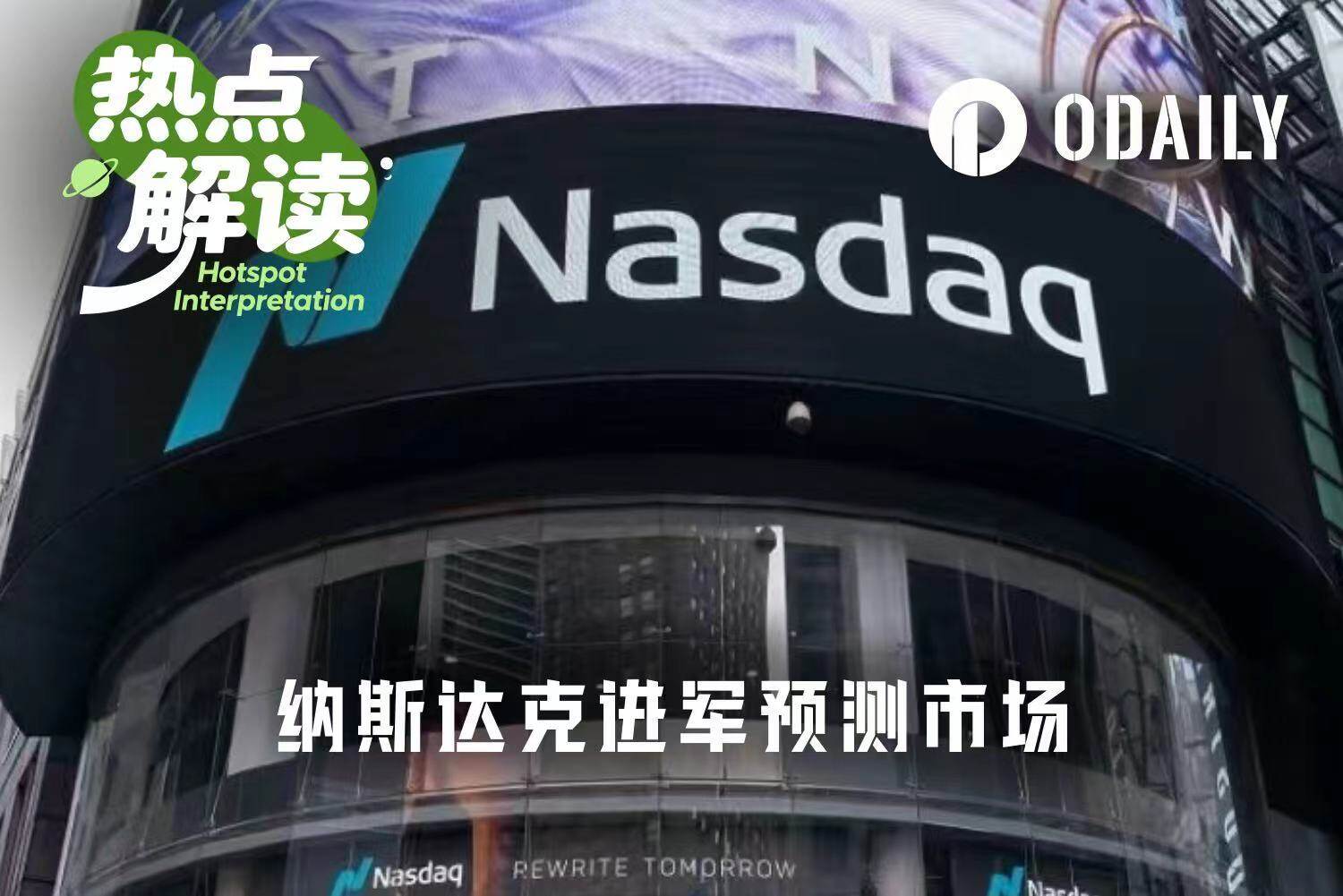
Last night, Nasdaq Inc. submitted a rule change proposal to the U.S. Securities and Exchange Commission (SEC), planning to introduce an options contract that allows investors to make "yes or no" judgments on major stock indices.

According to the document, Nasdaq intends to list "binary options," also known as "outcome-related options," on its flagship products—the Nasdaq 100 Index and the Nasdaq 100 Micro Index. If approved, this would mark Nasdaq's first official foray into products with prediction market attributes.

This move signifies that traditional stock exchange giants are actively entering the rapidly growing prediction market sector.

What Are Binary Options?

The proposed contracts have a pricing range of 1 cent to 1 dollar, with the price itself directly reflecting the market's judgment of the probability of a specific outcome.

For example, if a contract is based on whether "the Nasdaq 100 Index meets a certain condition at a specific time point," then:

  • If the market believes the probability of this outcome is 80%, the price might be close to $0.80;
  • If the condition is met at expiration, the contract settles at $1;
  • If the condition is not met, the contract value becomes zero.

If traditional options are about betting on "how much it will rise or fall," binary options are more concerned with "whether it will happen." There are no complex parameters, no interval calculations—only the outcome itself. This all-or-nothing settlement method makes trading more like making a clear judgment about the future.

Because of this, such products are closer in form to the logic of prediction markets.

Why Choose the Nasdaq 100?

Nasdaq's choice is not an ordinary index but one of the most sentiment-sensitive assets. The Nasdaq 100 has long been regarded as a core indicator of the U.S. technology sector, with concentrated holdings in heavyweight companies like Apple, NVIDIA, Microsoft, Amazon, and Meta. These companies almost always become market focal points each quarter. An earnings report, a regulatory update, or even a policy statement can quickly reflect in the index's movement.

The high concentration of components means that the Nasdaq 100's trends often revolve around a single focus. The market might bet on AI expectations for a period, then shift to interest rate paths or policy changes. During earnings or policy-intensive periods, the index typically reflects market judgments in a relatively short time rather than prolonged back-and-forth fluctuations.

Additionally, the Nasdaq 100 itself has a mature derivatives trading foundation, ample liquidity, and a well-established pricing system. Introducing new structured products on this underlying asset is risk-controllable and more likely to gain market acceptance.

Two Ways Traditional Exchanges Are Entering the Market

Nasdaq is not the first traditional exchange to show interest in prediction markets. In October 2025, Intercontinental Exchange, the parent company of the New York Stock Exchange, announced a strategic investment of approximately $2 billion in Polymarket, acquiring about a 20% stake, with the transaction valuation once reaching around $8 billion.

The NYSE's choice was not to launch its own prediction products but to enter the field through capital participation and data cooperation. Its core intention is to obtain real-time probability data formed by prediction markets and incorporate it into institutional service systems. For the NYSE, prediction markets are more like supplementary sentiment indicators and data assets.

In contrast, Nasdaq's approach is more direct. It chooses to embed binary structures into its core index product line, extending within the existing trading framework. Compared to investing in external prediction market platforms, this method means predictive trading is incorporated into the standardized securities product system, rather than being just an external data source.

The difference in strategies reflects the varying judgments of traditional exchanges when facing new trading structures.

Prediction Markets Are Being Integrated into Traditional Exchange Product Systems

Regardless of whether the SEC ultimately approves this proposal, Nasdaq's submission of the rule change application itself sends a clear signal—predictive trading is no longer just an experiment on crypto platforms or niche markets but is beginning to be integrated into traditional exchange product systems.

For a long time, mainstream derivatives have revolved around price fluctuations, with investors judging the magnitude and timing of rises and falls through different structures. Binary options simplify the question to whether the outcome will occur, shifting the trading focus from magnitude to the conclusion itself.

When the Nasdaq 100 Index is incorporated into such contract structures, the trading logic becomes more direct. The market's focus is no longer on the magnitude of fluctuations but on whether a specific outcome will materialize. The price reflects not just volatility but the consensus on the probability of the outcome.

For Nasdaq, this is an extension of its product line. For prediction market, it is the beginning of its structure being formally accepted by the mainstream system. If this product eventually launches, it could become a bridging attempt between traditional derivatives and event-based trading.


Preguntas relacionadas

QWhat is the new type of option contract that Nasdaq has proposed to the SEC?

ANasdaq has proposed a 'binary option' or 'outcome-related option' contract that allows investors to make 'yes or no' judgments on major stock indices.

QWhich specific indices will the new binary options be based on if approved?

AThe binary options will be based on the Nasdaq 100 Index and the Nasdaq 100 Micro Index.

QHow does the pricing of these binary options reflect market expectations?

AThe price, ranging from 1 cent to 1 dollar, directly reflects the market's judgment of the probability of a specific outcome. For example, a price of $0.80 indicates an 80% probability that the condition will be met.

QWhat is the key difference between traditional options and these new binary options?

ATraditional options focus on 'how much' the price will move, while binary options focus on 'whether' a specific outcome will happen, with a simple all-or-nothing settlement.

QHow does Nasdaq's approach to entering the prediction market differ from that of the New York Stock Exchange's parent company?

ANasdaq is directly integrating binary structures into its core index products, while NYSE's parent, Intercontinental Exchange, made a strategic investment in an external prediction market platform, Polymarket, to gain access to real-time probability data.

Lecturas Relacionadas

The "Impossible Triad" Is Fundamentally a Pseudo-Problem

The article argues that blockchain's fundamental limitation is not the scalability trilemma (decentralization, scalability, security), which has been largely solved, but the lack of **privacy** and, until recently, clear **legitimacy**. Blockchain is described as a slow, expensive, globally shared computer whose core value is censorship resistance and verifiability. While ideal for native digital assets like money (e.g., stablecoins), its default transparency acts as a **tax**, exposing all transactions and enabling MEV extraction, which deters serious institutional capital. Simultaneously, its permissionless nature created regulatory ambiguity. The piece contends that **privacy** is the missing critical feature. It rejects the false choice between total transparency and complete anonymity. Modern cryptography (like zero-knowledge proofs) enables **compliant privacy**: users can prove facts (solvency, KYC status, compliance) without revealing the underlying sensitive data (specific holdings, identities). This preserves auditability for regulators and eliminates the leak of financial information. With recent regulatory progress (e.g., the GENIUS Act) addressing legitimacy, adding default, provably compliant privacy becomes a pure upgrade. It transforms blockchain from a costly, public ledger into a confidential settlement layer, finally bridging the gap to mainstream institutional and individual adoption of on-chain finance.

链捕手Hace 10 hora(s)

The "Impossible Triad" Is Fundamentally a Pseudo-Problem

链捕手Hace 10 hora(s)

Optical Chips: Collective Capacity Expansion

The global optical chip industry is experiencing a massive wave of expansion driven by surging AI data center demand. Major players across the US, Japan, Europe, and China are aggressively investing to ramp up production capacity. In the US, Coherent is expanding its 6-inch Indium Phosphide (InP) semiconductor fab in Texas, supported by CHIPS Act funding and a $2 billion strategic investment from NVIDIA. Lumentum is building a new factory for InP optical devices, and Nokia is scaling its advanced photonic chip packaging and testing capabilities. NVIDIA's investments aim to secure future supply of critical lasers and optical interconnect products for AI infrastructure. Japan's JX Advanced Metals, a leading InP substrate supplier, plans a multi-billion yen investment to increase its capacity 7-10 times, strengthening its grip on the crucial upstream materials market. In Europe, IQE and Tower Semiconductor settled a patent dispute and signed a multi-year InP epitaxial wafer supply agreement, highlighting that next-generation silicon photonics platforms will integrate high-performance InP components. STMicroelectronics and Sivers Semiconductors are also expanding silicon photonics production and partnerships. China is rapidly building out its domestic supply chain. Dongshan Precision's subsidiary, Source Photonics, announced a $12 billion project to expand optical chip and module production. Companies like Sanan Optoelectronics and Yunnan Germanium are scaling up InP chip manufacturing and substrate production, moving towards vertical integration from materials to modules. While debate continues around the exact future architecture—whether CPO (Co-Packaged Optics), NPO, or pluggables will dominate—analysts like Morgan Stanley argue the underlying driver is unchangeable: the explosive growth in bandwidth demand. This will inevitably increase the volume of optical engines, lasers, and related content per GPU, regardless of the final technical path. The competition for "more light" in the AI era has intensified into a global, full-chain capacity race.

marsbitHace 13 hora(s)

Optical Chips: Collective Capacity Expansion

marsbitHace 13 hora(s)

Stablecoins Finally Find Real Yield: An In-Depth Look at On-Chain Reinsurance Re | A Conversation with Re Founder Karan Saroya

Stablecoin Real Yield Found: A Deep Dive into On-Chain Reinsurance with Re's Karan Saroya As stablecoin supply exceeds $170 billion, the search for sustainable, non-speculative yield intensifies. Re, an on-chain reinsurance platform, provides an answer: connecting stablecoin capital to the trillion-dollar traditional reinsurance market. Re operates as a regulated reinsurer, accepting stablecoin deposits as collateral to back US insurance companies. These insurers pay premiums, generating yield that flows back to on-chain depositors. Currently supporting 35 insurers and underwriting $500 million, Re projects scaling to over $1 billion soon. Key insights from a Bankless podcast with founder Karan Saroya and investor Avichal of Electric Capital: 1. **Uncorrelated, Real-World Yield:** Re offers stablecoin holders access to reinsurance returns (targeting 12-14%+), an asset class entirely separate from crypto or equity markets. 2. **Operational Efficiency via Smart Contracts:** Re replaces traditional, labor-intensive capital fundraising with smart contracts, allowing a ~12-person team to compete with industry giants. 3. **Regulatory Leverage:** For every $1 of collateral, regulations allow backing $5-7 in written premiums. This leverage amplifies returns from the underlying risk-free rate. 4. **DeFi Integration:** Depositors receive receipt tokens, which can be used in protocols like Morpho for "looping," potentially pushing yields to 18-20%+. 5. **The "DeFi Mullet" Model:** A compliant front-end (regulated reinsurer) paired with a decentralized back-end (smart contracts, DeFi capital markets). 6. **RE Governance Token:** Modeled on Lloyd's of London, the token governs the central capital pool's allocation, counterparty acceptance, and parameters. 7. **Real Economic Impact:** Capital funds real-world productivity (factories, clinics, businesses) via insurance, moving beyond crypto's internal loops. The discussion highlights a pivotal moment: DeFi's supply-side infrastructure is now met by real demand for productive yield, potentially kickstarting a flywheel where vast on-chain stablecoin capital seeks these real-world returns.

链捕手Hace 14 hora(s)

Stablecoins Finally Find Real Yield: An In-Depth Look at On-Chain Reinsurance Re | A Conversation with Re Founder Karan Saroya

链捕手Hace 14 hora(s)

Trading

Spot
Futuros
活动图片