Narrative Collapse, Trust Reset to Zero: Trove Kicks Off This Year's Crypto Rights Protection Campaign

marsbitPublicado a 2026-01-19Actualizado a 2026-01-19

Resumen

Trove, a Perp DEX platform that claimed to tokenize and trade illiquid collectibles like trading cards and luxury watches, has collapsed amid allegations of fraud and insider manipulation. The project initially built momentum with high-profile partnerships and a $20M+ HYPE token acquisition, leading to a successful $11.5M ICO. However, the team abruptly extended then reversed the ICO timeline, enabling insider betting on prediction markets like Polymarket. Soon after, Trove abandoned its original blockchain, Hyperliquid, and attempted to dump millions in HYPE tokens. Investigations revealed undisclosed payments to influencers, preferential investment terms for insiders, and false public statements. With trust shattered and legal risks under MiCA regulations mounting, Trove’s token is expected to crash at launch, marking a severe breach of trust in the crypto community.

Trove once had a perfect narrative.

As a Perp DEX targeting collectibles and RWA, Trove claimed to be able to transform illiquid "cultural assets," such as Pokémon cards, CSGO skins, and luxury items like high-end watches, into tradable financial assets, providing a hedging venue for collectors.

However, within just ten days, the Trove team staged a farce through a series of astonishing operations. In the process, they emptied the pockets of onlookers.

Bait

At the end of October last year, Trove founder @unwisecap discussed the concept of "Everything Can Be Perped" in several articles and announced that Trove would be built based on HIP-3, building up the community's anticipation.

Over the following month, Trove successively announced collaborations with Kalshi and CARDS (Collector_Crypt), receiving official Twitter replies as "endorsements" from these well-known project teams (P.S. As of the time of writing, Kalshi had already completed the "cutting off," deleting their reply under Trove's official tweet).

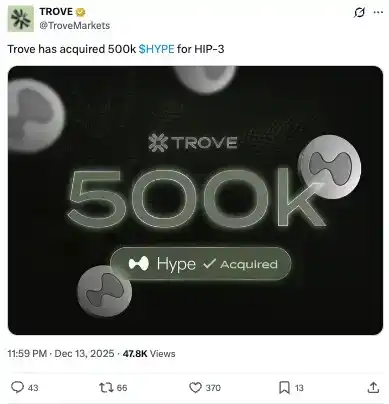
In mid-December, Trove announced that it had spent over $20 million to acquire 500,000 HYPE tokens to meet the integration requirements of HIP-3. Shortly after, the testnet points program was launched, and the trading volume on the platform exceeded $1 million within two weeks. Everything seemed to be progressing as expected. Until...
A Textbook Case of Insider Trading

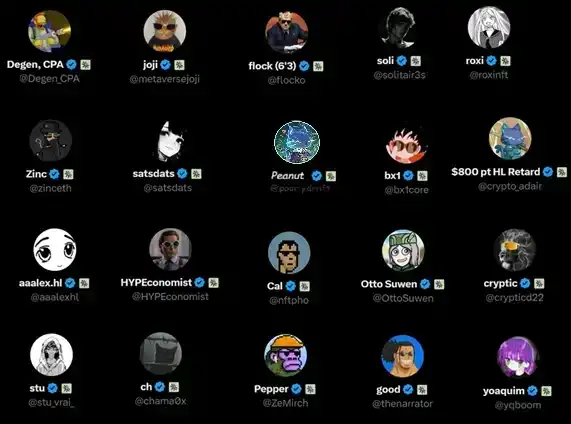
On January 6th, Trove suddenly announced an ICO with a $20 million FDV. The public sale adopted an "oversubscription" model, offering priority allocation rights to points holders. Accompanied by concentrated promotions from a group of KOLs sporting Trove badges, Trove successfully raised $11.5 million, oversubscribed by 4.6 times.
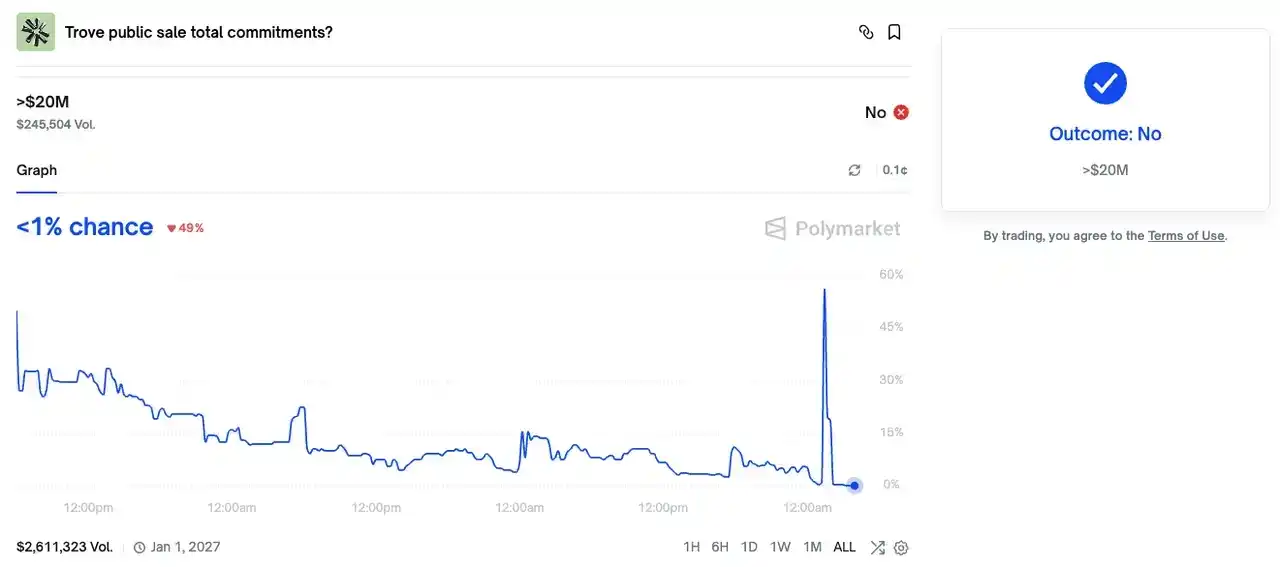
At this point, with less than two hours left until the ICO deadline, the probability of the "Trove ICO total fundraising amount greater than $20 million" prediction market on Polymarket had approached zero.

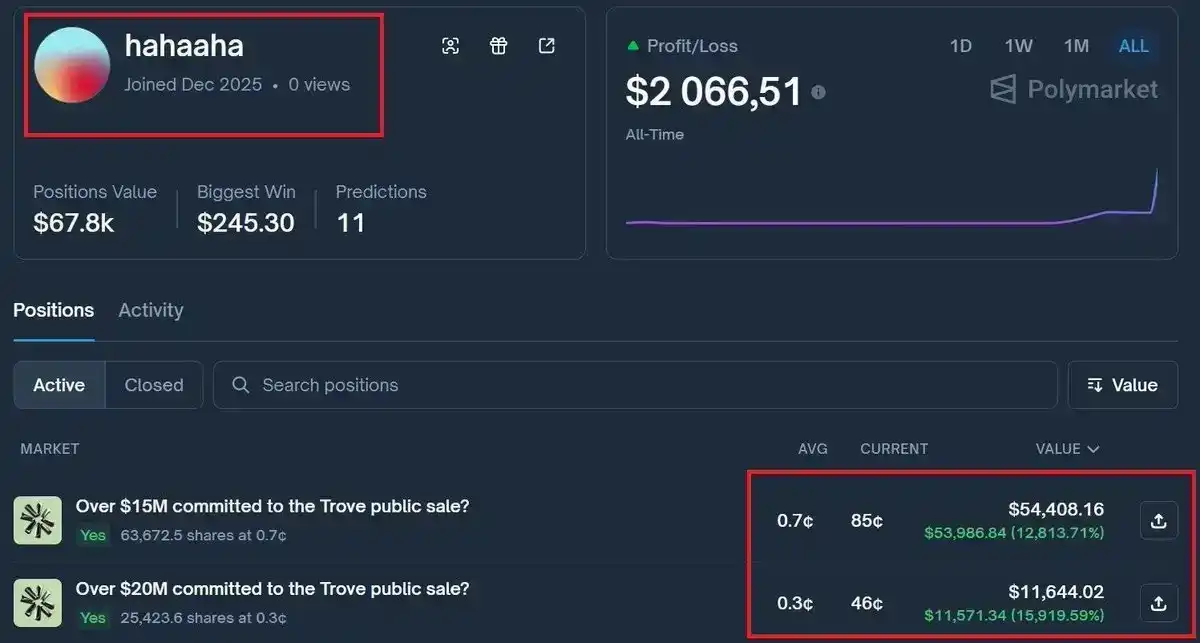
The real show began shortly after. The team suddenly broke the rules, announcing an extension of the ICO by five days to ensure fair allocation. The "YES" option on Polymarket instantly skyrocketed from the bottom to nearly 60%. Insider funds were clearly a step ahead; on-chain data showed that specific wallets placed precise bets before the announcement was made and quickly exited after the price surge.
Perhaps deeming the liquidity of the prediction market insufficient to satisfy their appetite, and amidst a wave of community skepticism, the Trove team seized the opportunity to stage a dramatic "crying wolf" scenario: they announced the withdrawal of the extension decision, ending the ICO as originally planned.

Following this announcement, the corresponding market directly zeroed out and settled. Polymarket data indicated that related wallets had placed precise bets before the news was released and continued to profit from the subsequent reversal.
The Great Retreat

On January 17th, Trove suddenly announced it was abandoning Hyperliquid and would instead issue its token on Solana. For a project that had been fundraising under the banner of the Hyperliquid ecosystem, this was nothing short of pulling the rug out from under everyone.

Simultaneously, on-chain detective MLM caught the Trove team using a timed sell function, attempting to sell half of their HYPE tokens within 40 minutes.

Choosing to sell tens of millions worth of tokens in 40 minutes on a weekend, during the lowest trading volume, showed the Trove team was truly desperate.
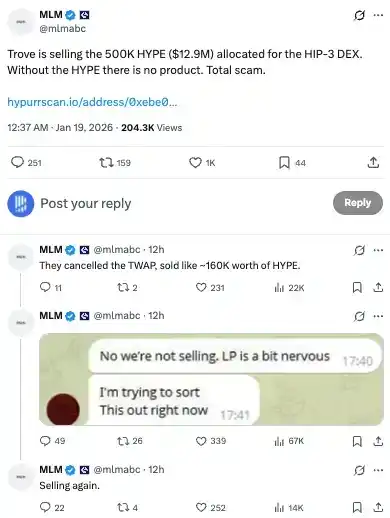
Faced with质疑 (queries/doubt), the explanation provided by the Trove team seemed feeble: "The backers got nervous and decided to exit." However, on-chain transaction records showed these sell-offs were conducted simultaneously while the team was publicly denying "we are selling tokens."

This inconsistency between words and actions彻底击穿了 (completely shattered) the community's trust底线 (bottom line). As trust collapsed, more shady details were uncovered.

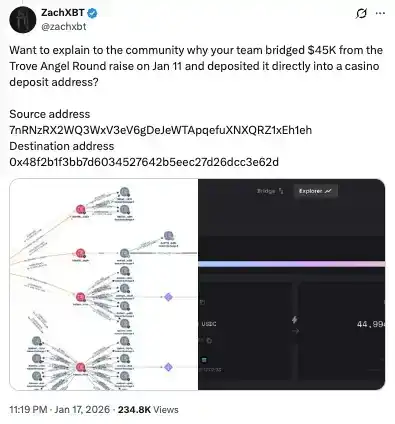
Renowned on-chain detective ZachXBT disclosed that the Trove team paid @TJRTrades a hefty marketing fee of $45,000, directly depositing it into the KOL's online gambling site top-up address.
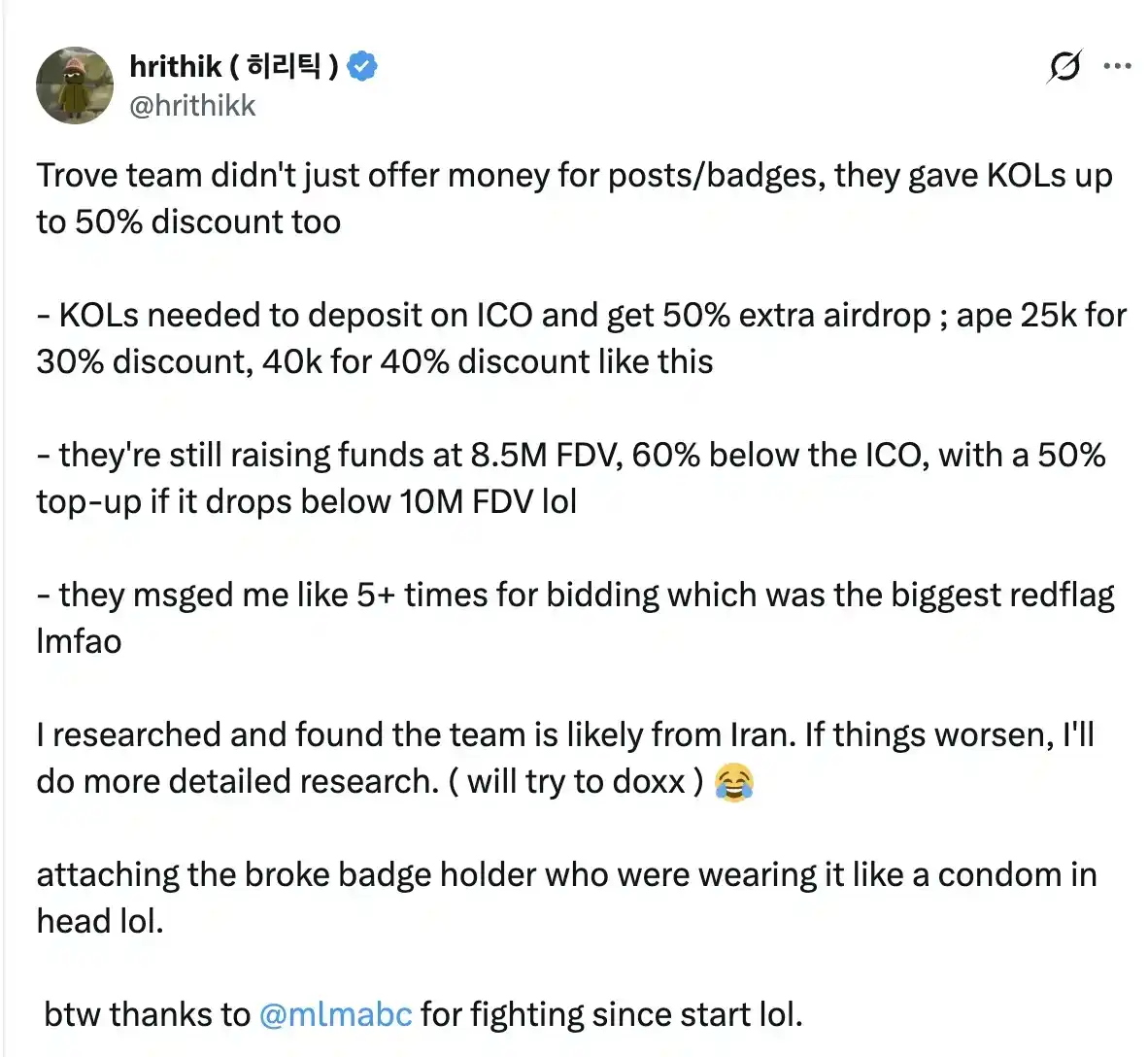
KOL @hrithikk stated that the Trove team not only provided KOLs with substantial marketing fees but also privately offered ICO allocations at valuations as low as $8.5 million, a discount of up to 60%, accompanied by huge airdrop rewards. Trove is still selling shares at low prices and has contacted him over 5 times asking if he would invest in Trove.
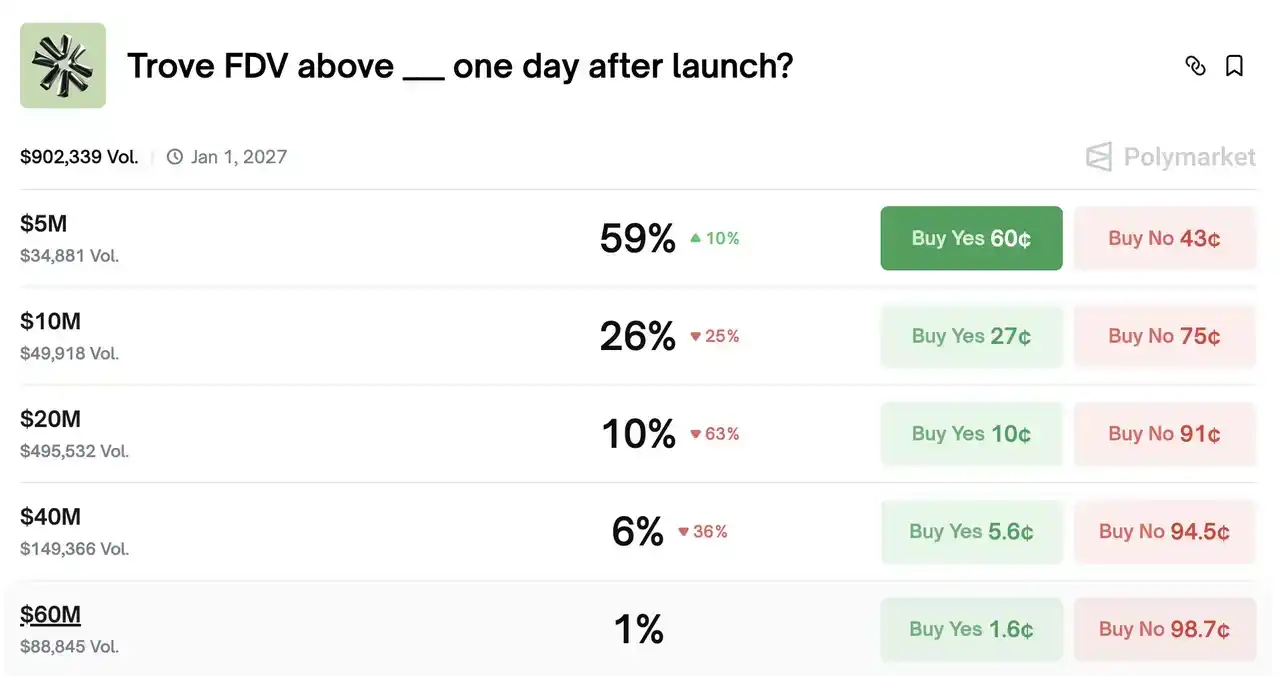
Trove's TGE is scheduled for January 20th at 1:00 AM Beijing Time. The prediction market on Polymarket shows, based on the pre-sale valuation, a 90% probability that the TROVE token will fall below its issuance price.
The good news is that this farce might not end with a simple "Soft Rug." Trove had previously claimed on its official website to comply with EU MiCA regulations. Now, facing accusations of false advertising and potential fraud, angry investors have every reason to initiate civil lawsuits based on MiCA provisions.

The bad news is, as revealed in chat screenshots by a KOL, team members appear to be from Iran.

The Hyperliquid ecosystem is known for its strong community cohesion, but this atmosphere of abundant trust also provides fertile ground for scammers to thrive.


Preguntas relacionadas

QWhat was Trove's original value proposition and narrative before its controversial actions?

ATrove was a Perp DEX for collectibles and RWA that claimed to convert illiquid 'cultural assets' like Pokémon cards, CSGO skins, and luxury watches into tradable financial assets, providing a hedging venue for collectors.

QWhat key event on January 6th marked the beginning of Trove's 'insider trading textbook' scandal?

AOn January 6th, Trove announced an ICO with a $20 million FDV using an 'oversubscription' model, but then suddenly extended the ICO by 5 days after it was nearly complete, allowing insiders to profit on prediction markets like Polymarket with prior knowledge.

QWhat action did Trove take on January 17th that completely shattered community trust and was described as 'pulling the rug from the cauldron'?

AOn January 17th, Trove abruptly announced it was abandoning the Hyperliquid blockchain to issue its token on Solana instead, despite having fundraised under the Hyperliquid ecosystem, and was caught attempting to dump its HYPE tokens in a short time frame.

QAccording to on-chain detectives, what evidence exposed Trove's unethical practices regarding influencer marketing and private allocations?

AZachXBT revealed Trove paid a KOL $45,000 for marketing to a gambling site deposit address, and KOL @hrithikk disclosed that the team offered private ICO allocations at a 60% discount ($8.5M valuation vs. public $20M) with massive airdrop bonuses.

QWhat potential legal repercussions does Trove face according to the article, and what complicating factor was mentioned?

AInvestors could file civil lawsuits under EU's MiCA regulations for false advertising and potential fraud, but a complicating factor is that team members are allegedly from Iran, which may hinder legal action.

Lecturas Relacionadas

Stuck Polymarket: The Real Test After Riding the Traffic Boom Has Arrived

Polymarket, a leading prediction market platform, is facing significant technical challenges as its growth outpaces its current infrastructure on Polygon. Users are experiencing laggy transactions, unresponsive orders, and delayed confirmations, severely impacting the trading experience. In response, DeFi Engineering VP Josh Stevens outlined a comprehensive engineering overhaul. The plan includes reducing on-chain data delays, fixing order cancellation issues, rebuilding the central limit order book (CLOB), improving website performance, and developing a unified SDK and API. A major revelation was the ongoing "chain migration," indicating a potential move away from Polygon. The core issue is that Polymarket has evolved from a simple prediction market into a high-frequency trading platform, making Polygon's limitations—such as block space, gas fees, and block time—a ceiling for further growth. The migration is not just a simple chain switch but a fundamental rebuild of its trading system to support more complex products like perpetual contracts (Perps). This announcement has sparked competition among chains like Solana, Sui, and Algorand, all vying to host Polymarket. For Polygon, losing this key application, which contributes significantly to its gas fee revenue, would be a major setback. The real test for Polymarket is no longer attracting users but proving it can provide a stable, reliable trading environment that retains them.

Odaily星球日报Hace 1 min(s)

Stuck Polymarket: The Real Test After Riding the Traffic Boom Has Arrived

Odaily星球日报Hace 1 min(s)

Lowering Expectations for BTC's Next Bull Market

The author, Alex Xu, explains his decision to significantly reduce his Bitcoin holdings (from full to ~30% of his portfolio) during the current bull cycle, citing a lowered long-term outlook for BTC's price appreciation in the next cycle. He outlines six key reasons for this reduced expectation: 1. **Diminished Growth Drivers:** The narrative of exponential user adoption has largely played out with institutional ETF adoption. The next major growth phase—adoption by sovereign national reserves or central banks—seems unlikely in the near future. 2. **Personal Opportunity Cost:** More attractive investment opportunities have emerged in other assets, such as undervalued companies. 3. **Industry-Wide Contraction:** The broader crypto industry is struggling, with most Web3 business models (SocialFi, GameFi, DePIN) failing. This overall萧条 (depression) reduces the fundamental demand and consensus for Bitcoin. 4. **Strain on Major Buyer:** MicroStrategy, a major corporate buyer of BTC, faces rising financing expenses for its debt, which could slow its purchasing rate and create significant marginal pressure on the market. 5. **Increased Competition from Gold:** The emergence of "tokenized gold" has closed the functional gap (portability, divisibility) between physical gold and Bitcoin, offering a strong competitor in the non-sovereign store-of-value space. 6. **Security Budget Concerns:** The block reward halving continues to exacerbate the long-standing issue of funding Bitcoin's network security, with new fee source explorations like Ordinals and L2s largely failing. The author's decision to hold a significant (though reduced) position reflects a cautious, not bearish, outlook. He remains open to increasing his exposure if the fundamental reasons for his skepticism change or if new positive catalysts emerge.

marsbitHace 39 min(s)

Lowering Expectations for BTC's Next Bull Market

marsbitHace 39 min(s)

Can Iran 'Control' the Strait of Hormuz?

Iran has announced a comprehensive plan to assert control over the strategic Strait of Hormuz, a critical global oil shipping chokepoint. The proposed measures include requiring all vessels to obtain Iranian permission for passage, imposing fees for security, environmental protection, and navigation management—preferably paid in Iranian rials—and absolutely banning Israeli ships. Vessels from countries deemed hostile by Iran’s top security bodies may also be barred. Analysts suggest Iran’s motives are multifaceted: increasing pressure on the U.S. and Israel by leveraging control over oil transit to influence global prices and inflation; creating a new revenue stream, potentially exceeding $7.7 billion annually, to counter Western sanctions and support postwar reconstruction; and using transit permissions as bargaining chips in future negotiations, notably with the U.S. However, the plan faces significant practical and diplomatic challenges. Enforcing comprehensive interception and fee collection in the busy waterway, patrolled by international military forces, would be difficult. The U.S. has already countering with a blockade of Iranian ports and threats to intercept any ship paying fees, potentially strangling Iran’s oil exports and fee revenue. Broad international opposition, led by European and Gulf states, and legal controversies further complicate implementation. The proposal may ultimately serve more as a negotiating tactic than a feasible policy, with its execution remaining highly uncertain.

marsbitHace 1 hora(s)

Can Iran 'Control' the Strait of Hormuz?

marsbitHace 1 hora(s)

Trading

Spot
Futuros
活动图片




