Narrative Collapse, Trust Reset to Zero: Trove Kicks Off This Year's Crypto Rights Protection Campaign

marsbitPublicado a 2026-01-19Actualizado a 2026-01-19

Resumen

Trove, a Perp DEX platform that claimed to tokenize and trade illiquid collectibles like trading cards and luxury watches, has collapsed amid allegations of fraud and insider manipulation. The project initially built momentum with high-profile partnerships and a $20M+ HYPE token acquisition, leading to a successful $11.5M ICO. However, the team abruptly extended then reversed the ICO timeline, enabling insider betting on prediction markets like Polymarket. Soon after, Trove abandoned its original blockchain, Hyperliquid, and attempted to dump millions in HYPE tokens. Investigations revealed undisclosed payments to influencers, preferential investment terms for insiders, and false public statements. With trust shattered and legal risks under MiCA regulations mounting, Trove’s token is expected to crash at launch, marking a severe breach of trust in the crypto community.

Trove once had a perfect narrative.

As a Perp DEX targeting collectibles and RWA, Trove claimed to be able to transform illiquid "cultural assets," such as Pokémon cards, CSGO skins, and luxury items like high-end watches, into tradable financial assets, providing a hedging venue for collectors.

However, within just ten days, the Trove team staged a farce through a series of astonishing operations. In the process, they emptied the pockets of onlookers.

Bait

At the end of October last year, Trove founder @unwisecap discussed the concept of "Everything Can Be Perped" in several articles and announced that Trove would be built based on HIP-3, building up the community's anticipation.

Over the following month, Trove successively announced collaborations with Kalshi and CARDS (Collector_Crypt), receiving official Twitter replies as "endorsements" from these well-known project teams (P.S. As of the time of writing, Kalshi had already completed the "cutting off," deleting their reply under Trove's official tweet).

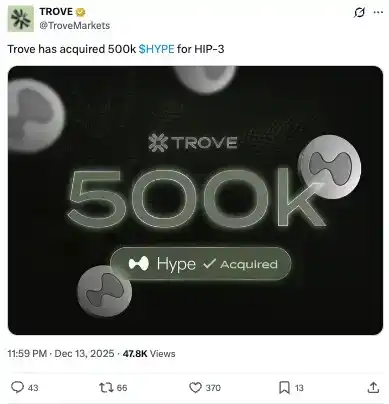
In mid-December, Trove announced that it had spent over $20 million to acquire 500,000 HYPE tokens to meet the integration requirements of HIP-3. Shortly after, the testnet points program was launched, and the trading volume on the platform exceeded $1 million within two weeks. Everything seemed to be progressing as expected. Until...
A Textbook Case of Insider Trading

On January 6th, Trove suddenly announced an ICO with a $20 million FDV. The public sale adopted an "oversubscription" model, offering priority allocation rights to points holders. Accompanied by concentrated promotions from a group of KOLs sporting Trove badges, Trove successfully raised $11.5 million, oversubscribed by 4.6 times.

At this point, with less than two hours left until the ICO deadline, the probability of the "Trove ICO total fundraising amount greater than $20 million" prediction market on Polymarket had approached zero.

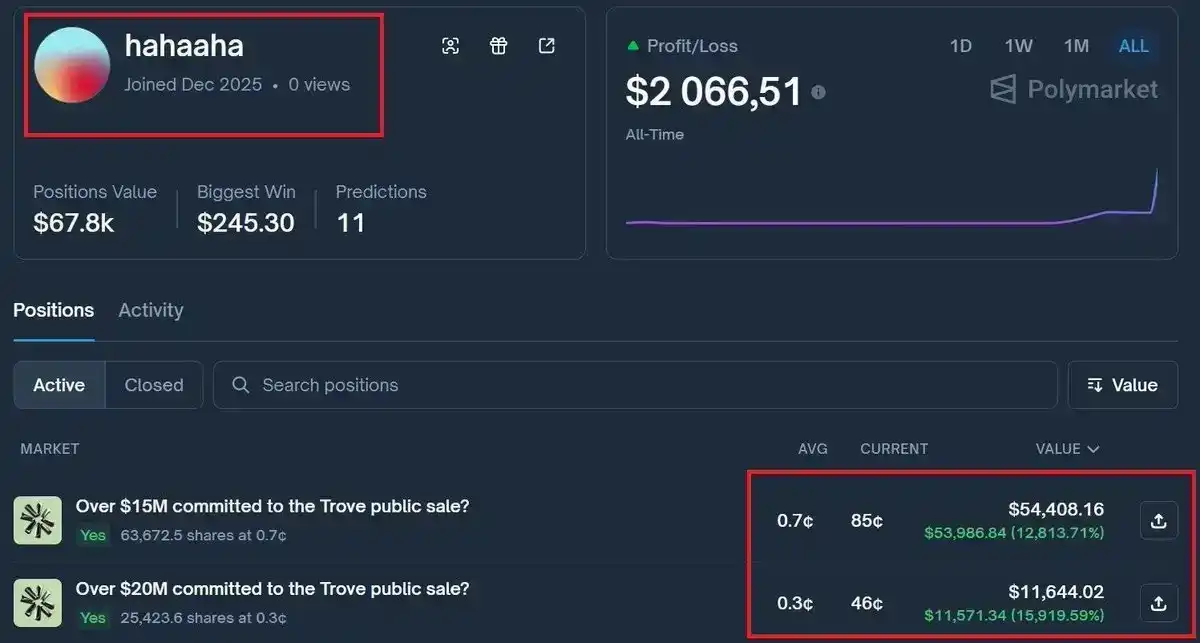
The real show began shortly after. The team suddenly broke the rules, announcing an extension of the ICO by five days to ensure fair allocation. The "YES" option on Polymarket instantly skyrocketed from the bottom to nearly 60%. Insider funds were clearly a step ahead; on-chain data showed that specific wallets placed precise bets before the announcement was made and quickly exited after the price surge.
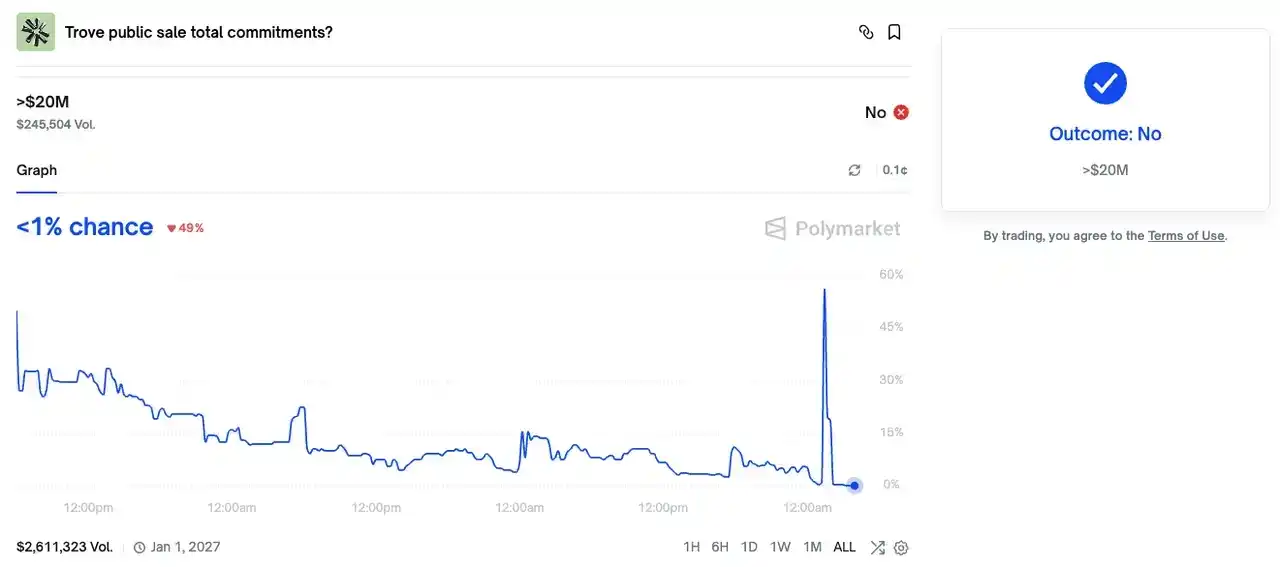
Perhaps deeming the liquidity of the prediction market insufficient to satisfy their appetite, and amidst a wave of community skepticism, the Trove team seized the opportunity to stage a dramatic "crying wolf" scenario: they announced the withdrawal of the extension decision, ending the ICO as originally planned.

Following this announcement, the corresponding market directly zeroed out and settled. Polymarket data indicated that related wallets had placed precise bets before the news was released and continued to profit from the subsequent reversal.
The Great Retreat

On January 17th, Trove suddenly announced it was abandoning Hyperliquid and would instead issue its token on Solana. For a project that had been fundraising under the banner of the Hyperliquid ecosystem, this was nothing short of pulling the rug out from under everyone.

Simultaneously, on-chain detective MLM caught the Trove team using a timed sell function, attempting to sell half of their HYPE tokens within 40 minutes.

Choosing to sell tens of millions worth of tokens in 40 minutes on a weekend, during the lowest trading volume, showed the Trove team was truly desperate.
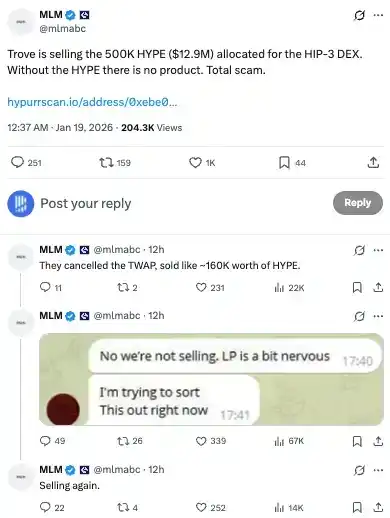
Faced with质疑 (queries/doubt), the explanation provided by the Trove team seemed feeble: "The backers got nervous and decided to exit." However, on-chain transaction records showed these sell-offs were conducted simultaneously while the team was publicly denying "we are selling tokens."

This inconsistency between words and actions彻底击穿了 (completely shattered) the community's trust底线 (bottom line). As trust collapsed, more shady details were uncovered.

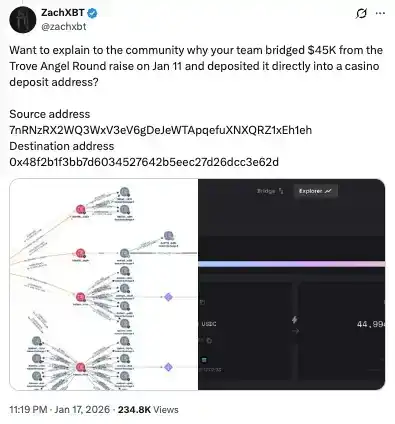
Renowned on-chain detective ZachXBT disclosed that the Trove team paid @TJRTrades a hefty marketing fee of $45,000, directly depositing it into the KOL's online gambling site top-up address.
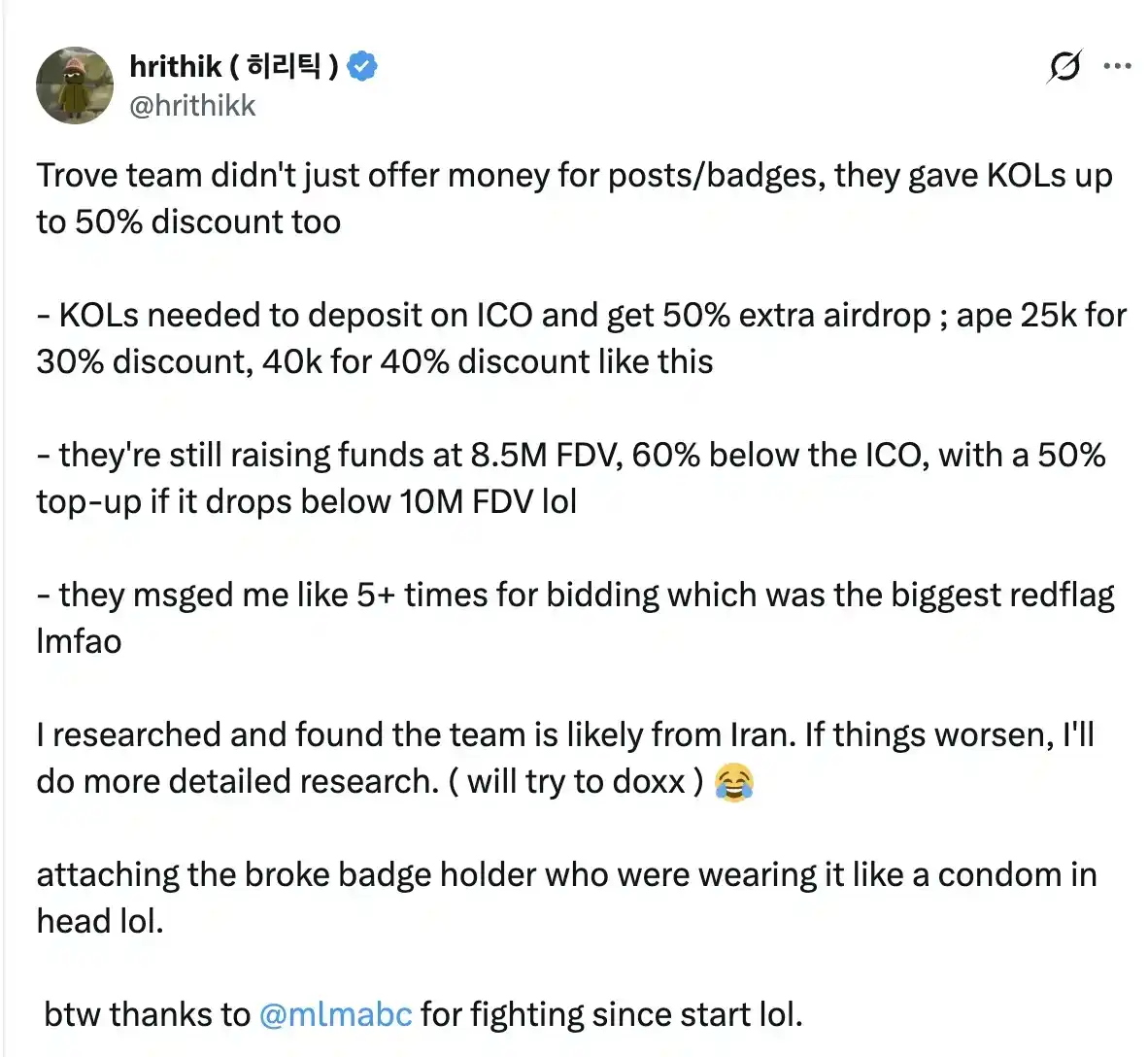
KOL @hrithikk stated that the Trove team not only provided KOLs with substantial marketing fees but also privately offered ICO allocations at valuations as low as $8.5 million, a discount of up to 60%, accompanied by huge airdrop rewards. Trove is still selling shares at low prices and has contacted him over 5 times asking if he would invest in Trove.
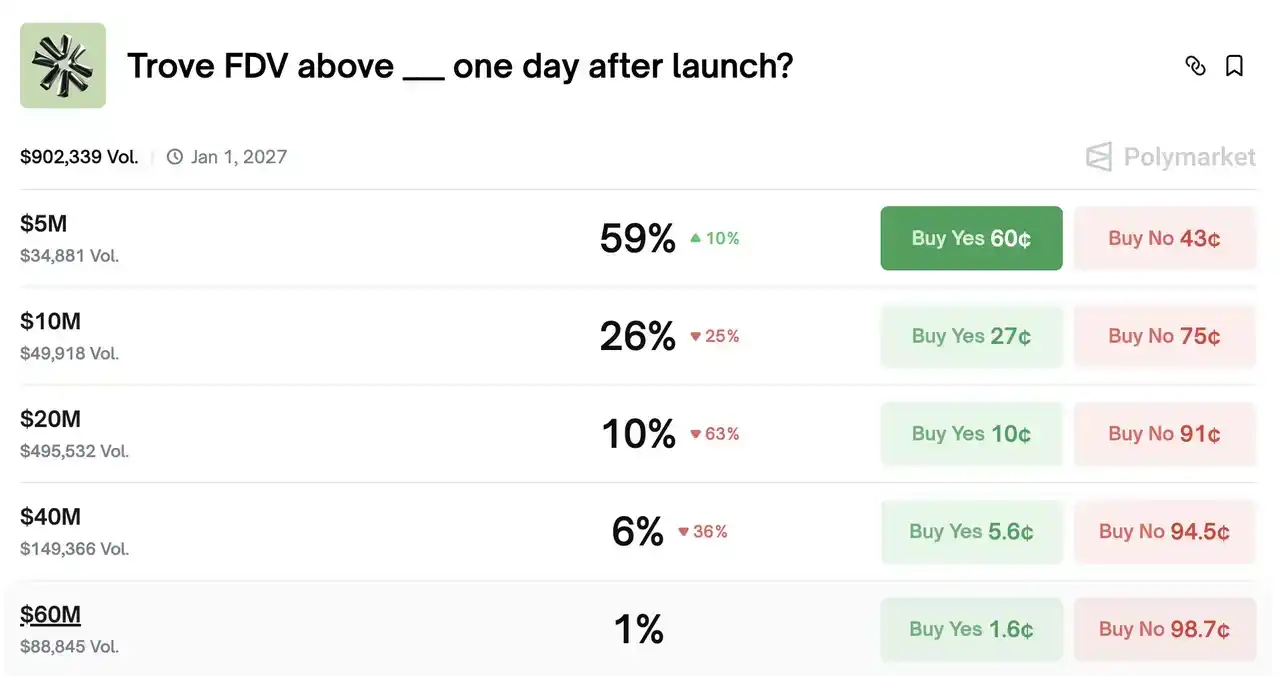
Trove's TGE is scheduled for January 20th at 1:00 AM Beijing Time. The prediction market on Polymarket shows, based on the pre-sale valuation, a 90% probability that the TROVE token will fall below its issuance price.
The good news is that this farce might not end with a simple "Soft Rug." Trove had previously claimed on its official website to comply with EU MiCA regulations. Now, facing accusations of false advertising and potential fraud, angry investors have every reason to initiate civil lawsuits based on MiCA provisions.

The bad news is, as revealed in chat screenshots by a KOL, team members appear to be from Iran.

The Hyperliquid ecosystem is known for its strong community cohesion, but this atmosphere of abundant trust also provides fertile ground for scammers to thrive.


Preguntas relacionadas

QWhat was Trove's original value proposition and narrative before its controversial actions?

ATrove was a Perp DEX for collectibles and RWA that claimed to convert illiquid 'cultural assets' like Pokémon cards, CSGO skins, and luxury watches into tradable financial assets, providing a hedging venue for collectors.

QWhat key event on January 6th marked the beginning of Trove's 'insider trading textbook' scandal?

AOn January 6th, Trove announced an ICO with a $20 million FDV using an 'oversubscription' model, but then suddenly extended the ICO by 5 days after it was nearly complete, allowing insiders to profit on prediction markets like Polymarket with prior knowledge.

QWhat action did Trove take on January 17th that completely shattered community trust and was described as 'pulling the rug from the cauldron'?

AOn January 17th, Trove abruptly announced it was abandoning the Hyperliquid blockchain to issue its token on Solana instead, despite having fundraised under the Hyperliquid ecosystem, and was caught attempting to dump its HYPE tokens in a short time frame.

QAccording to on-chain detectives, what evidence exposed Trove's unethical practices regarding influencer marketing and private allocations?

AZachXBT revealed Trove paid a KOL $45,000 for marketing to a gambling site deposit address, and KOL @hrithikk disclosed that the team offered private ICO allocations at a 60% discount ($8.5M valuation vs. public $20M) with massive airdrop bonuses.

QWhat potential legal repercussions does Trove face according to the article, and what complicating factor was mentioned?

AInvestors could file civil lawsuits under EU's MiCA regulations for false advertising and potential fraud, but a complicating factor is that team members are allegedly from Iran, which may hinder legal action.

Lecturas Relacionadas

Must-Watch Events Next Week|CLARITY Act Could Face Senate Vote; SpaceX, Circle to Report Earnings (8.3-8.9)

**Summary: Key Events and Developments to Watch (August 3-9)** The upcoming week is marked by significant financial disclosures, key legislative deadlines, and notable product updates. **Major Financial Events:** Several companies are scheduled to release their Q2 2026 earnings. American Bitcoin (ABTC) will report on August 3, followed by SpaceX and Hut 8 Mining Corp. on August 4, and Circle on August 5. Notably, a significant portion of SpaceX shares (up to 12% of total shares) will be unlocked on August 6 following their earnings release. **Key Legislative Deadline:** The U.S. Senate faces an August 7 deadline to secure 60 votes for the CLARITY Act, a bipartisan bill aiming to establish a federal regulatory framework for cryptocurrencies. The Senate may hold a full vote on the bill during the week. **Economic Data:** The U.S. July Non-Farm Payrolls report will be released on August 7, providing crucial labor market data. **Technology & Product Updates:** * **Shutdowns:** DeFi portfolio tracker Zapper and wallet app Ctrl Wallet will cease operations on August 3. * **Upgrades:** LayerZero will deprecate its v1 relayers on August 3. XRP Ledger's new version 3.3.0, featuring five new functions, is expected next week. * **AI:** Elon Musk announced that the advanced Grok 4.6 AI model is set for release around August 7. * **Bitcoin:** The BIP-110 forced signaling for a potential Bitcoin network change is scheduled to begin around August 8. **Other Notable Events:** Chinese robotics firm Unitree Tech has set its preliminary price inquiry for its IPO for August 5. South Korean exchange Upbit will delist AQT and AERGO tokens on August 3.

marsbitHace 49 min(s)

Must-Watch Events Next Week|CLARITY Act Could Face Senate Vote; SpaceX, Circle to Report Earnings (8.3-8.9)

marsbitHace 49 min(s)

Stocks Are Plummeting More Sharply Than Cryptocurrencies. Where Has the Money Gone?

Stock Markets Plunge Deeper Than Cryptocurrencies: Where Did the Money Go? In late July, Seoul's Kospi index triggered circuit breakers for two consecutive days, plummeting over 40% from its June high. The collapse was led by heavyweight stocks like SK Hynix, whose record profits still disappointed investors, and devastating leveraged ETFs, with one major product losing over 83% of its value. This signaled a global, forced deleveraging targeting the most crowded trades. Interestingly, while stocks exhibited extreme volatility akin to crypto markets, Bitcoin rose nearly 15% in July after a prior steep drop. Analysis shows the money fleeing equities did not flow into Bitcoin. Instead, Bitcoin had already absorbed its sell-off in May-June, when U.S. spot Bitcoin ETFs saw historic outflows. The true safe-haven beneficiary was gold, whose price rose over 20% year-on-year, highlighting a decoupling between Bitcoin and gold as "digital gold." The sell-off was a targeted unwinding of leveraged positions in tech and semiconductors, accelerated by broker-dealer risk management and shifts in the AI narrative, including new competition from Chinese memory chipmakers. The retreat path was clear: from high-valuation tech stocks to cash and U.S. Treasuries, then to gold. For Bitcoin to attract sustained institutional inflows, conditions like eased global liquidity pressure, a "soft-landing" Fed rate cut, and U.S. regulatory clarity via legislation like the stalled CLARITY Act are needed. Currently, Bitcoin is not a safe haven but an already-cleared asset. Its low correlation with tech stocks, however, makes it a potential diversification play for institutional portfolios once the storm passes. The money isn't here yet, but the positioning is underway.

marsbitHace 49 min(s)

Stocks Are Plummeting More Sharply Than Cryptocurrencies. Where Has the Money Gone?

marsbitHace 49 min(s)

In Conversation with Ray Dalio: We Are Currently in an AI Bubble, with 1% of My Portfolio in Bitcoin

Ray Dalio, founder of Bridgewater Associates, warns in an interview that the current AI boom shows classic bubble characteristics, which could lead to significant economic downturns as seen in past cycles like 1929 or 2000. He explains that speculative enthusiasm, fueled by debt and overvaluation, often precedes a crash when rising rates or taxation force asset sales, causing widespread losses and recession. Dalio also outlines his "Big Cycle" theory, describing an approximate 80-year pattern where widening wealth gaps, massive government deficits, and shifting geopolitical power (like China's rise) create internal conflict and global instability. He emphasizes that we are in a late-cycle, transitional phase where traditional powers like the US and UK face decline. For personal wealth protection, Dalio advises diversification beyond cash into assets like stocks, bonds, real estate, and particularly gold, which he prefers over Bitcoin. While he holds about 1% of his portfolio in Bitcoin as a non-printable hard asset, he views gold as more secure from technological or governmental threats. Regarding AI's impact, Dalio believes it will disproportionately benefit capital owners, worsening inequality by replacing both physical and cognitive labor. He suggests that human intuition and emotional intelligence, combined with AI, will be key for future workers. On taxation, Dalio argues that wealth taxes are impractical and risk triggering asset sell-offs, reducing productive investment. He points to the UK as a cautionary example of debt, low productivity, and political strife. Geopolitically, Dalio foresees a more regionalized world, with the US showing weakness in prolonged conflicts like with Iran, akin to past imperial declines. The ideal outcome, he suggests, is coexisting powerful blocs (e.g., Americas, China-Asia Pacific) without major war.

marsbitHace 4 hora(s)

In Conversation with Ray Dalio: We Are Currently in an AI Bubble, with 1% of My Portfolio in Bitcoin

marsbitHace 4 hora(s)

Daily 7.2 Trillion KRW: Foreign Capital's Record Net Buying on Friday! Wall Street Says Headwinds for Korean Stock Fund Flows Have Subsided

South Korean stock market sees a dramatic shift in fund flows. On July 31, foreign investors made a record net purchase of approximately KRW 7.2 trillion in KOSPI stocks, marking a fundamental reversal from the persistent large-scale net outflows seen in previous months. This contributed to a significant narrowing of foreign net selling in July to KRW 9.8 trillion, down sharply from KRW 48.4 trillion in June and KRW 44.5 trillion in May. Simultaneously, domestic institutional pressure eased. South Korean pension funds and asset managers turned to a net buying position in July, purchasing KRW 1.0 trillion worth of KOSPI shares, contrasting with net sales in May and June. Market volatility is expected to be dampened by new financial regulations. Effective July 31, the Financial Services Commission tightened access for retail investors to single-stock leveraged ETFs by raising the minimum cash deposit requirement. Trading volumes for these products subsequently dropped to about 50% of their monthly average. Citigroup Research maintains its year-end KOSPI target of 10,000 points. The firm cites several supportive factors: the substantial easing of headwinds from capital outflows, a robust fundamental outlook for the semiconductor sector, historically low market valuations, strong economic fundamentals, and the potential for policy support from financial authorities if needed.

marsbitHace 4 hora(s)

Daily 7.2 Trillion KRW: Foreign Capital's Record Net Buying on Friday! Wall Street Says Headwinds for Korean Stock Fund Flows Have Subsided

marsbitHace 4 hora(s)

Trading

Spot
活动图片




