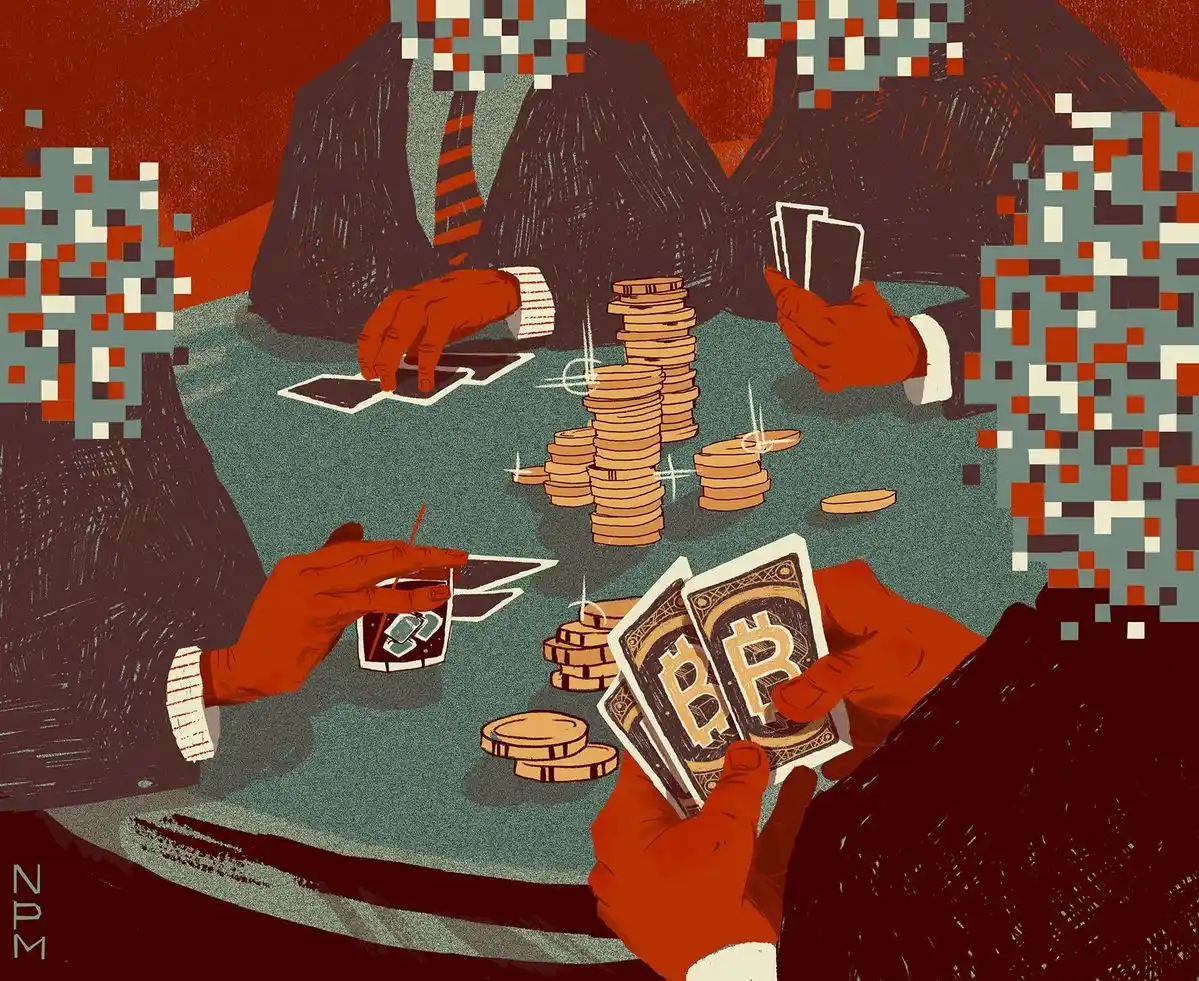
Mysticism Takes Over Crypto: When Candlestick Charts Give Way to Bazi and Feng Shui

比推Publicado a 2025-12-25Actualizado a 2025-12-25

Resumen

In the crypto world, traditional technical analysis is increasingly being overshadowed by metaphysical practices like astrology and feng shui. The author describes encountering well-known crypto figures—KOLs, traders, and VCs—praying at temples for wealth, highlighting a cultural shift where beliefs in destiny and supernatural forces are becoming mainstream. Some investors and funds now prioritize checking founders' facial fortunes or project name compatibility over conventional due diligence. Anecdotes include a listed company CEO who reportedly earned hundreds of millions by following feng shui advice, while others suffered losses after ignoring such guidance. The trend is framed not as mere superstition but as a psychological response to extreme market volatility and uncertainty. In an environment where tweets from influencers or politicians can trigger 50% price swings, metaphysical practices serve as emotional anchors—much like ocean-faring cultures relying on divine protection during unpredictable voyages. Ultimately, when rationality reaches its limits, belief fills the void.

Author: Xiaobing, Deep Tide TechFlow

Original Title: Satoshi Nakamoto Would Have to Kowtow to the God of Wealth


Every year on the fifth day of the Lunar New Year, Xiaobing wakes up early to go to the Number One Temple of Wealth at Beigao Peak in Hangzhou.

I thought I would be jostling with aunties and uncles, but when I arrived, the scene was filled with familiar faces amidst the swirling incense smoke.

On the left was a well-known爆料KOL, on the right was someone involved in community schemes, and a few tech elites who usually preach "decentralization" were devoutly kowtowing with loud thuds. In that moment, algorithmic consensus and Federal Reserve movements were no match for the three sticks of incense in their hands.

Over the past two years, mysticism has become the "prominent study" in the crypto world. If you're still looking at candlestick charts, you're a classical rookie. The real veterans are now reading Bazi (Eight Characters).

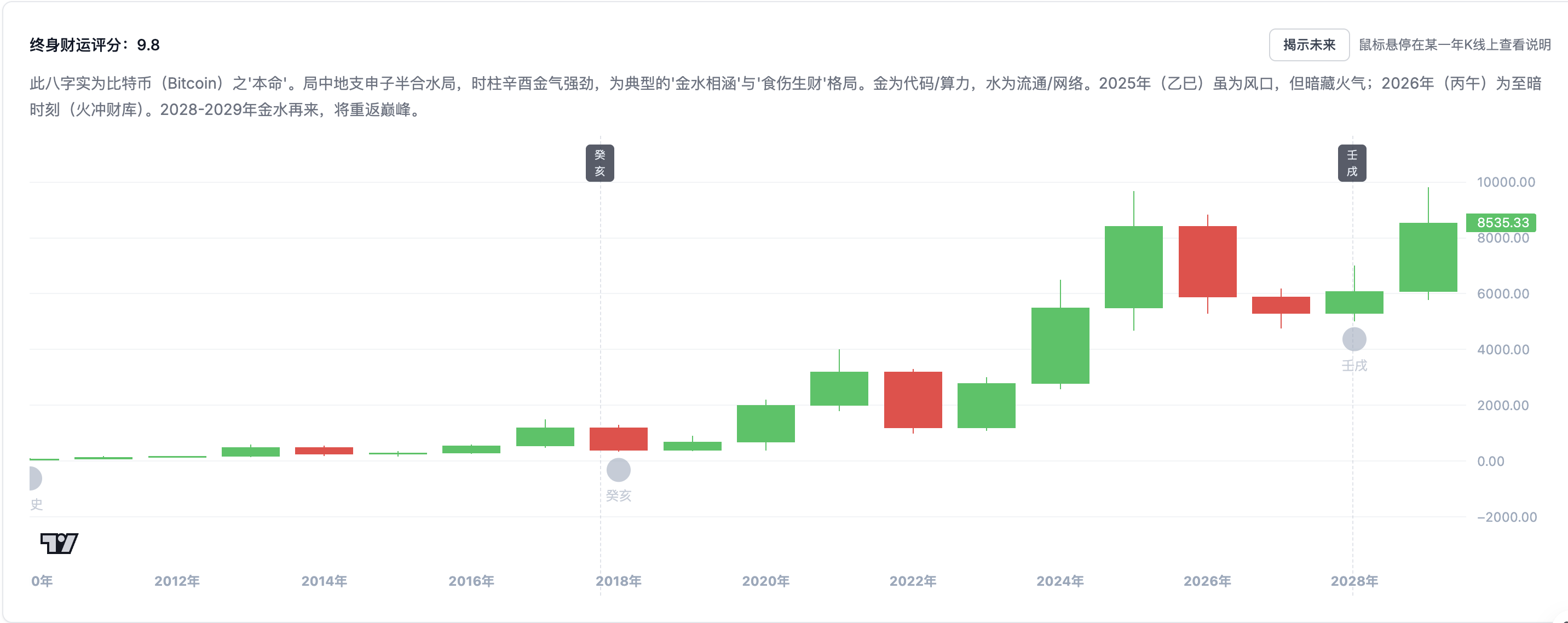
A crypto trader familiar with various macroeconomic indicators eventually turned to mysticism, recently calculating BTC's Bazi—and the outlook is grim: fire clashes with the wealth repository, making 2026 (Bing Wu Year) Bitcoin's darkest hour. I quickly checked my wallet; luckily, it was already empty.
Remember, Alen, a partner at crypto VC y2z Ventures, once stated bluntly that one of their fund's core competencies was "reading faces." In the past, due diligence (DD) involved code audits and business models. Now, it's different: first, check if the founder has a "wealth-losing face," then see if the project's name clashes with Feng Shui.

During a recent trip to Shenzhen, I noticed that traders and KOLs' standard setup isn't data terminals; they all have a "Feng Shui consultant" behind them.

Don't laugh—this approach really works in crypto. Xiaobing knows a boss of a Hong Kong-listed company who is a devout believer in Feng Shui, donating real money to temples—possibly more than the company's R&D budget.

And the result? Feng Shui brought help from noble patrons. Starting in 2023, he bought Bitcoin, earning hundreds of millions of dollars by hoarding it. Later, he caught the wave of the DAT (Crypto Treasury Reserve) narrative, and the company's stock price doubled... Although everyone knows this is "survivorship bias," you can't argue with the fact that he really made a fortune.

There are counterexamples too. A爆料KOL with a frog avatar also had a Feng Shui consultant who advised him not to make moves recently. He couldn't resist and played with contracts, resulting in a neat and tidy liquidation.

About this phenomenon, it's not entirely superstition.

Our traditional land-based civilization emphasizes farming—"sow one grain in spring, reap ten thousand in autumn"—focusing on certainty. But what does maritime civilization face? Storms and unknown waters.

Why do people in the southeastern coastal areas worship Mazu? Not because of ignorance, but because on the vast ocean, besides experience and technology, you need something else.

The crypto world is essentially a modern version of the "Age of Exploration." It faces bottomless seas and sudden storms. This is human nature: the greater the randomness and volatility, the more we seek supernatural spiritual anchors.

When candlestick charts fail, and a single tweet from Musk, Trump, or CZ can sway the market, Feng Shui becomes the last psychological defense. This isn't ignorance; it's an instinctive stress response to massive wealth fluctuations.

After all, when your assets can swing 50% in a day, you need to believe in something to sleep at night. As for whether the God of Wealth understands blockchain, does it really matter?


Twitter:https://twitter.com/BitpushNewsCN

Bitpush TG Discussion Group:https://t.me/BitPushCommunity

Bitpush TG Subscription: https://t.me/bitpush

Original Link:https://www.bitpush.news/articles/7598323

Preguntas relacionadas

QWhat is the main theme of the article '玄学接管币圈:当K线图让位于八字与风水'?

AThe article discusses how metaphysical practices like astrology, fortune-telling, and feng shui are becoming increasingly influential in the cryptocurrency circle, replacing traditional methods like analyzing K-line charts for investment guidance.

QAccording to the article, what did the crypto VC y2z Ventures partner claim as one of their core competencies?

AAlen, a partner at y2z Ventures, stated that one of their fund's core competencies is 'reading facial features' (面相) to evaluate founders and projects, rather than relying solely on technical or business due diligence.

QWhy does the article compare the cryptocurrency market to the 'Age of Exploration'?

AThe article compares the crypto market to the Age of Exploration because both involve navigating high uncertainty and volatility, similar to sailors facing unpredictable storms at sea, leading people to seek supernatural or spiritual anchors for psychological comfort.

QWhat example does the article provide to show the effectiveness of feng shui in crypto investments?

AThe article cites a Hong Kong-listed company老板 who heavily donated to temples and followed feng shui practices, which allegedly helped him earn hundreds of millions by buying Bitcoin in 2023 and benefiting from market trends, though it acknowledges this could be survivorship bias.

QHow does the article explain the shift from traditional analysis to玄学in crypto trading?

AThe article attributes the shift to the extreme randomness and influence of factors like tweets from figures such as Elon Musk or Donald Trump, which make traditional charts unreliable, leading traders to adopt玄学as a psychological defense mechanism against high volatility.

Lecturas Relacionadas

Gate Research Institute: The 'Wall Street-ization' Wave of Crypto Financial Products – Competition or Integration?

The article titled "Gate Research Institute: Are Crypto Financial Products Sparking a 'Wall Street' Wave—Competition or Convergence?" explores the evolving relationship between the crypto ecosystem and traditional finance (TradFi). The piece begins by reflecting on Bitcoin's original 2009 vision of decentralization, disintermediation, and moving away from banks. It then contrasts this with the 2024 landscape, where key crypto assets like Bitcoin are increasingly held through Wall Street products like ETFs issued by giants like BlackRock. The article questions whether this signifies that TradFi is systematically taking over the rights to issue, price, custody, and distribute crypto financial assets. The core argument is that this is not a zero-sum takeover but rather a bidirectional convergence where each side addresses the other's weaknesses. Crypto offers 24/7 global markets, programmable settlement, and open access but lacks compliant channels, institutional-grade custody, deep fiat liquidity, and mainstream distribution. TradFi possesses these but is constrained by legacy systems, limited operating hours, and slow settlement. Two primary convergence paths are highlighted: * **Path A (CEX to TradFi):** Exemplified by Gate, which has progressed from offering tokenized stocks and CFDs to providing direct, real stock trading (US, Hong Kong, South Korea) within its platform, using USDT. * **Path B (TradFi to Crypto):** Exemplified by Robinhood, which has integrated crypto trading, acquired exchanges like Bitstamp, and is moving traditional assets like stocks onto the blockchain via tokenization and its own Layer 2. Both paths are ultimately competing to become the next-generation, unified financial account—a "super account" where users can seamlessly trade cryptocurrencies, stocks, ETFs, RWA (Real World Assets), and tokenized treasury products in one interface. The growth of RWA and tokenized treasuries (e.g., BlackRock's BUIDL) is presented as the asset-layer fusion, providing stable, yield-bearing assets on-chain and acting as a bridge between the two worlds. In conclusion, the "Wall Street-ization" of crypto is framed as a mutual transformation. Decentralized ideals persist in the protocol layer, while at the application layer, a more efficient, global, and accessible unified capital market is emerging from this convergence. The future competition lies not between crypto exchanges and stockbrokers, but between platforms vying to offer the most comprehensive asset coverage, liquidity, and user experience within a single account.

marsbitHace 2 min(s)

Gate Research Institute: The 'Wall Street-ization' Wave of Crypto Financial Products – Competition or Integration?

marsbitHace 2 min(s)

Claude's Major New Feature: Screen Recording + Voice, Distilling Your Skills into AI Tasks in One Click

Claude has introduced a major new feature called "Record a Skill," available for Pro, Max, and Team users. This function, found in the Claude desktop app's CoWork menu, allows users to create reusable AI skills simply by recording their screen and providing voice narration while performing a task. Claude then automatically analyzes the recording and generates a functional Skill. A hands-on test confirmed the feature works seamlessly. Users start recording via the Skills manager, perform their workflow while verbally explaining the steps and logic, and avoid including sensitive information. After recording, Claude processes the content and creates the Skill, which can be saved and later invoked with a slash command (/). This eliminates the need for manual adjustments or writing complex instruction files. The innovation goes beyond mere efficiency. Previously, creating a Skill required writing a detailed SKILL.md file in Markdown—a significant barrier for non-technical users. "Record a Skill" bypasses this by directly capturing both actions and the implicit reasoning shared in the narration. This lowers the barrier to knowledge transfer and automation, addressing a core challenge in corporate knowledge management: the difficulty of getting experts to write and maintain documentation. However, the feature also highlights a shift in the nature of work. A case study from March 2026 showed a freelancer whose five-year client relationship was effectively replaced by a hand-coded Claude Skill automating their content workflow. With the even lower barrier of screen recording, the ability to distill personal expertise into automatable skills accelerates this trend. The "moat" for work is moving from simply knowing how to do a task to mastering tasks that are difficult or impossible to automate.

marsbitHace 7 min(s)

Claude's Major New Feature: Screen Recording + Voice, Distilling Your Skills into AI Tasks in One Click

marsbitHace 7 min(s)

Feeding AI "Noise" Can Also Boost Scores, This Work Enables Positive Transfer with Noise

Feeding "Noise" to AI Can Improve Performance: A Method Enables Positive Transfer from Noise This work, Semi-Supervised Noise Adaptation (SSNA), introduces a Noise Adaptation Framework (NAF) that challenges traditional transfer learning. Instead of requiring a labeled source domain of real data (e.g., images, text), NAF uses randomly generated Gaussian noise as the source. For a target task with C classes, it constructs C noise clusters by sampling from Gaussian distributions. Although this synthetic noise contains no semantic meaning, NAF trains it to form a discriminative class structure in a shared representation space—clustering same-class noise and separating different classes. The key is aligning this learned structure from the noise domain to the real, sparsely labeled target domain. A small number of target labels are still essential to establish the correspondence between noise clusters and actual classes. The training objective combines: 1) supervised loss on the few labeled target samples, 2) classification loss for the noise to build its structure, and 3) a distribution alignment loss (using Negative Domain Similarity) to minimize the gap between the noise and target domains in the shared space. Experiments show significant gains in few-label settings. With just 4 labels per class, NAF with a ResNet-18 backbone improves accuracy over a standard supervised baseline (ERM) by +12.35% on CIFAR-10, +7.61% on CIFAR-100, +4.38% on DTD-47, and +2.74% on Caltech-101. It also benefits fine-grained datasets and scales to ImageNet-1K (with 100 labels/class) and text classification (AG News). NAF can be integrated into existing semi-supervised methods like FixMatch for further gains. Ablation studies confirm the transferred benefit comes from the discriminative structure of the noise, not randomness itself. Collapsing all noise into a single point causes negative transfer, while increasing separation between noise cluster centers improves performance. The amount of noise per class is less critical once a basic structure forms. In conclusion, this work demonstrates that for positive transfer, the semantic content of source data may not be necessary. What can be effectively transferred is the *organizational structure* of categories within a representation space. This offers a promising alternative for scenarios where real source data is unavailable due to privacy, copyright, or procurement constraints.

marsbitHace 8 min(s)

Feeding AI "Noise" Can Also Boost Scores, This Work Enables Positive Transfer with Noise

marsbitHace 8 min(s)

Trading

Spot
活动图片