MrBeast, the Most Generous KOL, Sets His Sights on Teenagers' Digital Wallets

marsbitPublicado a 2026-02-10Actualizado a 2026-02-10

Resumen

MrBeast, the renowned YouTube creator with over 466 million subscribers, has expanded into fintech through his company Beast Industries by acquiring Step, a mobile banking app designed for teenagers. Step offers FDIC-insured banking services via Evolve Bank & Trust, including savings accounts and Visa cards. This move follows a $200 million equity investment from Ethereum treasury firm BitMine in January 2026, with plans to integrate DeFi into future financial services. Previously, MrBeast faced allegations of profiting over $10 million through alleged pump-and-dump schemes involving low-market-cap cryptocurrencies like SUPER and PMON, where he promoted tokens before selling them during price surges. Despite these controversies, MrBeast aims to create financial educational content and provide youth with financial tools he lacked. His company has also filed a trademark for "MrBeast Financial," indicating intentions to offer crypto trading and payment processing services.

Original Author: ChandlerZ, Foresight News

On February 9, Beast Industries, owned by renowned YouTube creator MrBeast, announced its acquisition of Step, a mobile banking app for teenagers, marking its entry into the fintech sector. This move follows the company's recent announcement of a $200 million equity investment from Ethereum treasury firm BitMine, representing its first concrete action since the funding round.

Step is an all-in-one financial management application designed to help young people begin their financial journey through a digital banking platform. The company has long offered a range of services tailored for teenagers and young adults, including savings accounts, credit-building Visa cards that function like debit cards, and cash advances. Step itself is not a bank but provides banking services through a partnership with Evolve Bank & Trust, a member of the FDIC.

Neither company disclosed the terms of the transaction. In 2022, Step reported raising $500 million in equity and debt financing from institutional investors such as General Catalyst, companies like Stripe, and individual investors including TikTok influencer Charli D'Amelio.

Expanding Beyond YouTube

MrBeast, whose real name is Jimmy Donaldson, has evolved from a single creator into the core of a commercial organization spanning content, consumer goods, and offline experiences. Public data shows he has over 466 million YouTube subscribers, with his main channel and multi-language matrix covering an extensive audience, placing his communication efficiency and user mobilization capabilities at the top of global internet platforms.

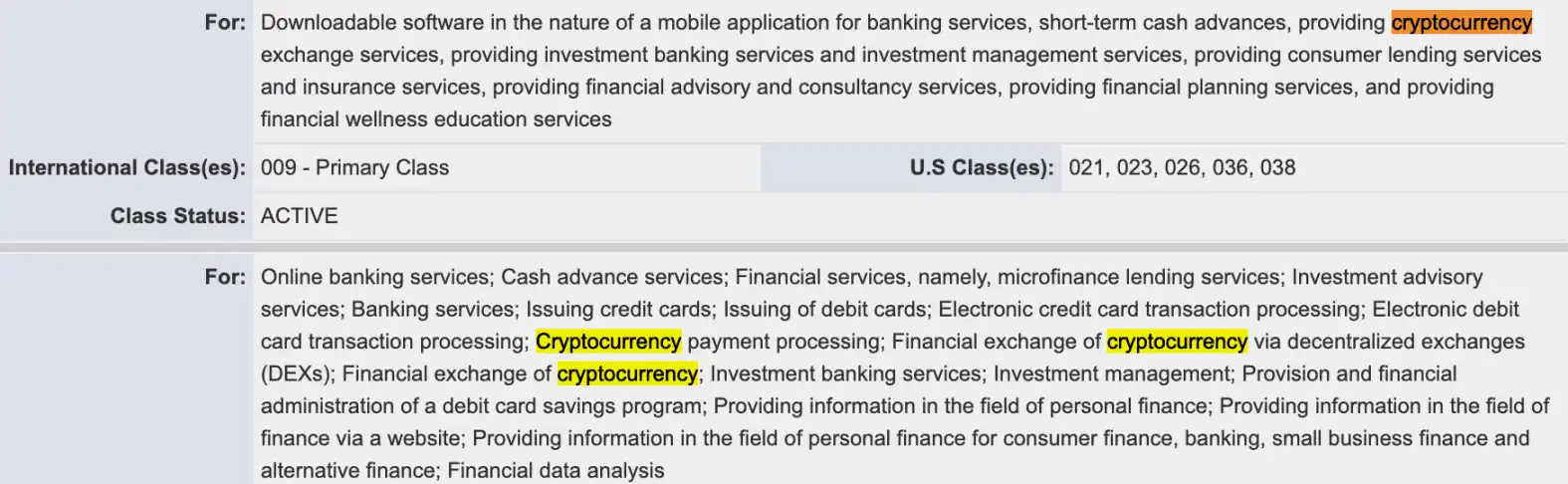
The influencer began planning his entry into the fintech sector several months ago. In October 2025, Beast Holdings, LLC filed a trademark application for "MrBeast Financial" with the U.S. Patent and Trademark Office. The company plans to offer cryptocurrency trading services, crypto payment processing, and crypto trading via DEXs, among other services.

Although a trademark application only represents a预设的业务边界 and does not directly equate to product launch, with regulatory approvals and business implementation still requiring time, it nonetheless marks the first time MrBeast's intentions in finance and crypto have been formally documented.
Going back a month earlier, in January 2026, Ethereum treasury company BitMine announced a $200 million equity investment in Beast Industries, with the transaction expected to be completed around January 19, 2026. Beast Industries CEO Jeff Housenbold stated that future collaborations would explore introducing DeFi into their financial services platform. The two parties plan to explore integrating DeFi into the upcoming financial services platform. Beast Industries is an entertainment and consumer goods company founded by renowned YouTube creator MrBeast.

MrBeast has frequently discussed his personal financial situation, viewing the acquisition of Step as an opportunity to "provide millions of young people with the financial foundation I never had." As the company prepares to enter the financial industry, MrBeast expressed his desire to create videos about finance, such as "educating people on how to invest and showing them what a Roth IRA is."

Previously Accused of Profiting Over $10 Million Through Crypto Pump-and-Dump Schemes

This is not MrBeast's first foray into the crypto space. On October 11, 2024, on-chain detective SomaXBT publicly released a chain investigation. The investigation alleged that MrBeast participated in several Initial DEX Offerings (IDOs) and token promotion activities, profiting significantly from代言后 token price surges.

The projects involved included SuperFarm (SUPER), Polychain Monsters (PMON), SPLYT (SHOPX), and others. Some tokens experienced price drops of over 90% after MrBeast sold his holdings.
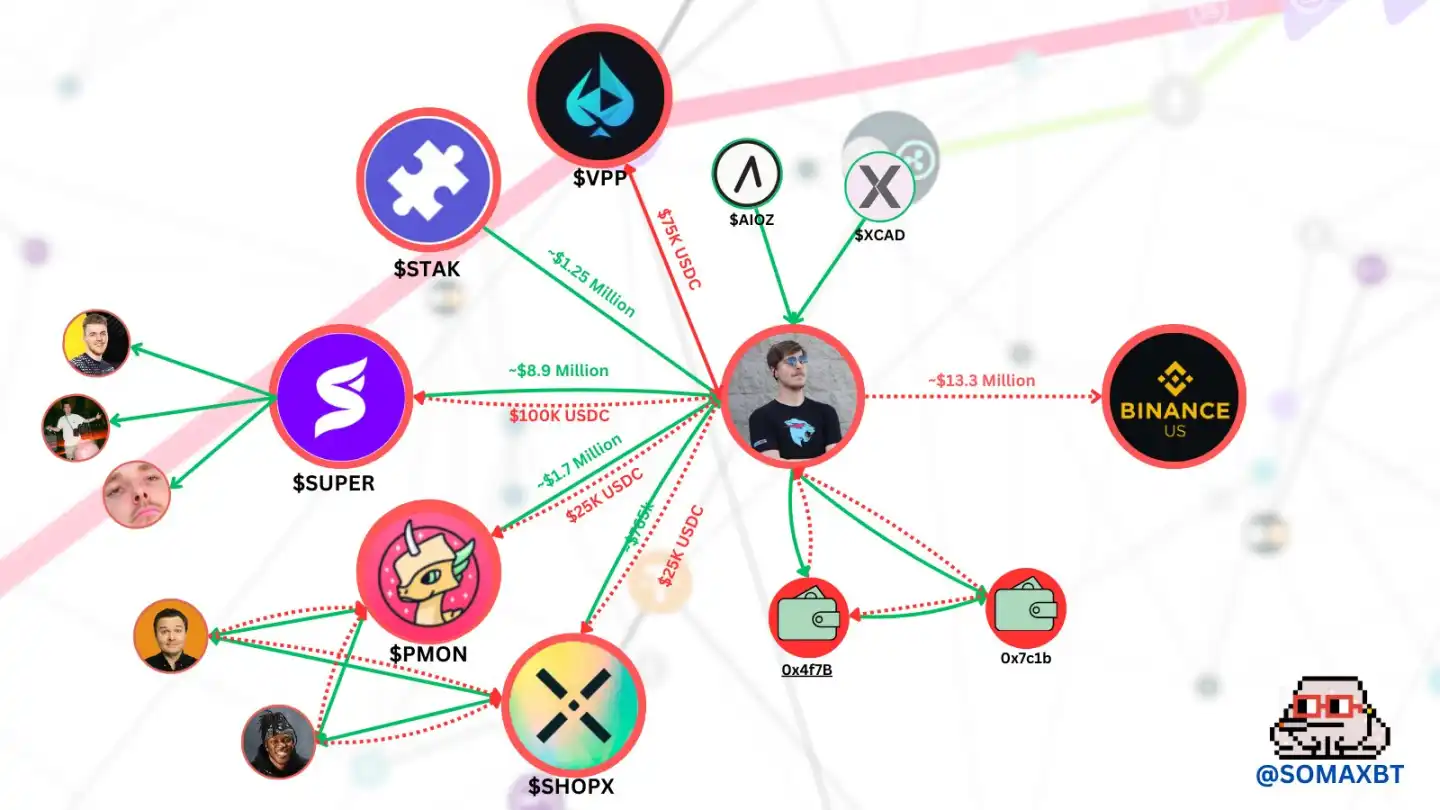
SomaXBT detailed multiple cases. Using the SUPER token, a project backed by Elliot Trades, as an example:

According to SomaXBT, MrBeast invested $100,000 in the project and received 1 million SUPER tokens in return. After his investment, the token price surged. MrBeast transferred his SUPER tokens to an alternate wallet on March 30, 2021, where they were sold through a series of transactions totaling 1,900 ETH (approximately $3.7 million at the time). MrBeast received additional SUPER tokens based on a vesting contract, which he later sold for $5.5 million, bringing his total revenue from the project to approximately $9 million.

SomaXBT's investigation also highlighted MrBeast's involvement with Polychain Monsters (PMON), another low-market-cap token project. In this case, MrBeast invested $25,000 and received 25,000 PMON tokens. On March 31, 2021, his wallet transferred these tokens to another wallet, where they were sold through a series of transactions, netting a profit of 685 ETH (approximately $1.3 million).

The investigation also discussed projects like SHOPX, STAK, and VPP under the same pattern, alleging that after MrBeast completed the accused sell-offs, these tokens experienced significant price corrections, with some falling over 90% from their peaks. It characterized this as a "pump-and-dump" scheme, emphasizing that influencer promotions combined with low-liquidity tokens amplify volatility and transfer risk to retail investors.
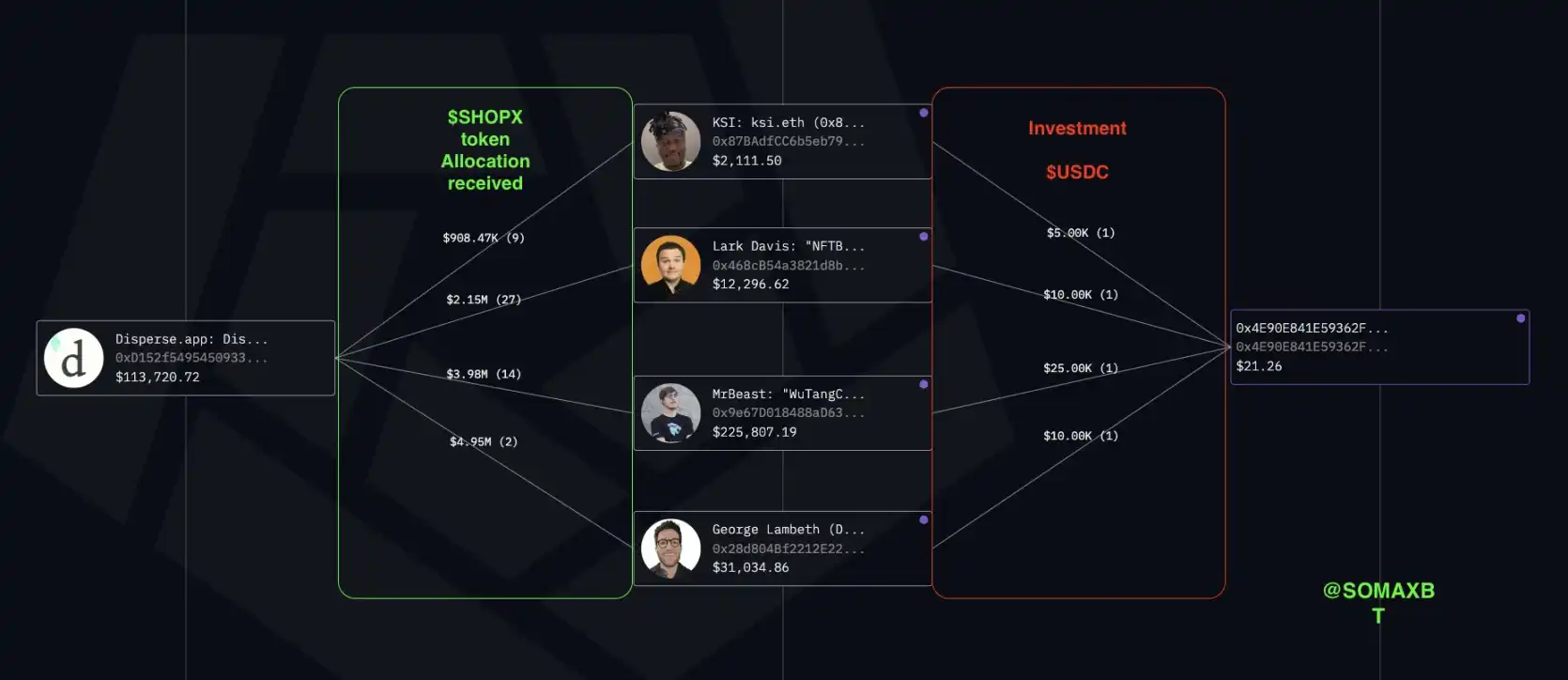
Additionally, in September 2025, MrBeast accumulated 705,821 ASTER tokens, worth approximately $1.28 million at the time.

In summary, Beast Industries has made a key move in establishing its financial entry point. Crypto-related capabilities are still in the planning and exploration stages, and historical on-chain controversies may continue to affect the trust threshold for its financial and crypto businesses.


Preguntas relacionadas

QWhat is the main business move announced by MrBeast's Beast Industries on February 9th?

ABeast Industries announced it has acquired Step, a mobile banking app for teenagers, marking its entry into the fintech sector.

QWhat specific financial services does the Step app provide to its young audience?

AStep provides a suite of services including savings accounts, a credit-building card that functions like a debit card, and cash advances. It offers these banking services through a partnership with the FDIC-insured Evolve Bank & Trust.

QWhat was the significant investment that preceded the acquisition of Step, and which company made it?

APrior to the acquisition, Beast Industries received a $200 million equity investment from BitMine, an Ethereum treasury company.

QAccording to the on-chain investigation by SomaXBT, what controversial practice was MrBeast accused of in the crypto space?

AMrBeast was accused of participating in 'pump and dump' schemes, where he promoted low-market-cap tokens and sold his allocated tokens after their prices surged, allegedly profiting over $10 million and leaving retail investors with significant losses.

QWhat future financial content does MrBeast express an interest in creating for his audience?

AMrBeast expressed an interest in creating videos that educate people on how to invest and explain financial concepts like a Roth IRA.

Lecturas Relacionadas

Misjudged A-Shares: Resilience, Expectations, and Confidence

China's A-share market recently faced selling pressure, especially in tech sectors, initially triggered by a global tech sell-off that began in South Korea. However, the article argues this is a case of "mistaken injury" and highlights the market's underlying resilience. This resilience stems from three main pillars: **1) Tech Sector Fundamentals:** Unlike Korea's market dominated by a few memory chip stocks, China's tech sector is diversified across computing, communications, electronics, and semiconductors, supported by dual narratives of global AI supply chains and domestic substitution. Core areas like optical modules and fiber optics continue to show strong earnings growth. **2) "National Team" Support:** State-backed institutions and large corporations have made significant market purchases and announced buybacks, providing liquidity and signaling confidence. This is seen as a stabilizing policy signal, often associated with market bottoms. **3) Broader Market Pillars:** Other major sectors are showing endogenous recovery momentum. Consumer stocks benefit from stabilizing CPI and signs of sector recovery (e.g., liquor price hikes). Cyclical sectors like aluminum have high earnings, potential price increases due to tight supply, and low valuations. The financial sector offers stable dividends and low valuations. The conclusion is that the sell-off was driven by external contagion, not a collapse in fundamentals. With strong policy support and recovering momentum across key sectors, the A-share market possesses the toughness to regain stability.

marsbitHace 29 min(s)

Misjudged A-Shares: Resilience, Expectations, and Confidence

marsbitHace 29 min(s)

The Clarity Act's Journey Through Congress: The Thorny Path of Bipartisan Compromise in the U.S.

The U.S. Congress is struggling to advance the crypto market structure bill known as the Clarity Act, with bipartisan compromise proving difficult. Key hurdles include unresolved disputes over "yield" products and, more critically, the inclusion of strong ethics provisions for elected officials—a non-negotiable demand for many Democrats. While a compromise on yield was reached in May, securing only limited Democratic support in committee, the separate Senate Agriculture Committee version later passed with no Democratic votes due to the ethics impasse. As Republicans push for a full Senate vote in July, demands for ethics rules have expanded, and other contentious issues like developer protections and concerns from law enforcement and large banks further complicate negotiations. Despite consensus on the need for legislation, the path forward is unclear. Recent discussions between senators and White House officials aim to find acceptable ethics language. Some lawmakers question whether a compromise text can garner enough bipartisan support, with one Democrat stating the current proposal lacks the strong ethics provisions required for their vote. Potential short-term goals for the crypto community include symbolic Senate action before the August recess, a longer-term aim for passage by 2026, or establishing a detailed framework that addresses ethics and other compromises. The process remains arduous, relying on the traditional, vote-by-vote effort to build bipartisan support.

marsbitHace 48 min(s)

The Clarity Act's Journey Through Congress: The Thorny Path of Bipartisan Compromise in the U.S.

marsbitHace 48 min(s)

Are Kalshi and Polymarket Founders at Odds? This Business Rivalry Is More Brutal Than You Think

"The Rivalry Between Kalshi and Polymarket Founders Turns Bitter and Litigious" The intense feud between Tarek Mansour, CEO of Kalshi, and Shayne Coplan, founder of Polymarket, has escalated far beyond typical business competition into personal animosity and regulatory battles. Both lead billion-dollar prediction market platforms, but their approaches differ sharply. Kalshi positions itself as the compliant operator, securing U.S. regulatory approval before launching. In contrast, Polymarket initially operated offshore, allowing U.S. users to access its platform via VPN, which drew regulatory scrutiny. The conflict reached a peak in November 2024 when FBI agents raided Coplan's New York apartment. While Coplan publicly blamed political motives, his team privately suspected Kalshi was involved. According to sources, Kalshi's lawyers had previously reported Polymarket's operations to federal prosecutors, highlighting its accessibility to U.S. users despite a ban. This incident fueled mutual accusations and underhanded tactics, including social media smear campaigns and attempts to sabotage each other's major business deals. Their rivalry also played out in Washington, influencing regulatory debates. Kalshi actively lobbied against Polymarket's practices, framing them as illegal and unethical. Polymarket, after facing a CFTC fine and investigation, later acquired a licensed U.S. firm to launch a domestic app, regaining a foothold. Despite the hostility, both companies have seen massive growth, with combined trading volumes soaring. However, increased regulatory scrutiny, particularly around insider trading on Polymarket's platform, continues to pose challenges. The founders' deep-seated mutual disdain ensures their battle for market dominance remains as much a personal vendetta as a commercial one.

marsbitHace 57 min(s)

Are Kalshi and Polymarket Founders at Odds? This Business Rivalry Is More Brutal Than You Think

marsbitHace 57 min(s)

Trading

Spot
活动图片




