MoveBit Research Release | Belobog: A Move Fuzzing Framework for Real-World Attacks

marsbitPublicado a 2025-12-16Actualizado a 2025-12-16

Resumen

MoveBit introduces Belobog, a novel fuzzing framework designed specifically for Move smart contracts to address security challenges beyond syntax and type errors. Unlike traditional fuzzing methods that struggle with Move’s strong type system and resource semantics, Belobog leverages type-guided input generation and mutation. It constructs a type graph to produce semantically valid and executable transaction calls, significantly improving the efficiency and depth of state exploration. The framework integrates concolic execution (combining concrete and symbolic execution) to penetrate complex constraints and branch conditions, enabling deeper coverage of potential vulnerabilities. Evaluated on 109 real-world Move contracts, Belobog detected 100% of Critical and 79% of Major vulnerabilities confirmed by manual audits. It also demonstrated the ability to reproduce full exploit paths without prior knowledge of vulnerabilities. Designed to be developer-friendly, Belobog will be released as open-source to encourage community adoption and extension. The work is currently under peer review for PLDI’26. Preprint: https://arxiv.org/abs/2512.02918

Move, as a language that Web3 developers cannot afford to ignore, is particularly "hardcore" in its strong type system and resource semantics, especially regarding asset ownership, illegal transfers, and data races. Ecosystems like Sui and Aptos place increasingly important assets and core protocols on Move precisely because of its core language features, which enable the creation of more secure and lower-risk smart contracts.

However, the reality we've observed through long-term auditing and offensive/defensive practices is that a significant portion of thorny issues often do not occur in obvious places like "syntax errors" or "type mismatches," but rather at more complex, real-world levels—cross-module interactions, permission assumptions, state machine boundaries, and those call sequences that seem reasonable step-by-step but can be exploited when combined. Precisely because of this, even though the Move language has more robust security paradigms, there have still been significant attack incidents within its ecosystem. Clearly, security research for Move needs to go further.

We identified a core problem: the lack of an effective fuzzing tool for the Move language. Because Move has stronger constraints, traditional smart contract fuzzing faces a tricky pain point in the Move context: generating transaction sequences that are both "type-correct" and "semantically reachable" is very complex. If the input isn't precise enough, the call cannot be completed; if the call cannot be made, it fails to cover deep branches and reach critical states, making it easier to miss the paths that can truly trigger vulnerabilities.

Based on this long-standing pain point, we collaborated with a university research team to jointly complete and publish our research findings:

《Belobog: Move Language Fuzzing Framework For Real-World Smart Contracts》

arXiv:2512.02918 (Preprint)

Paper Link:https://arxiv.org/abs/2512.02918

This paper is currently published on arXiv as a preprint, its significance is to allow the community to see research progress faster and receive feedback. We are submitting this work to PLDI’26 and awaiting the peer review process. After the submission result is confirmed and peer review is completed, we will also share relevant updates promptly.
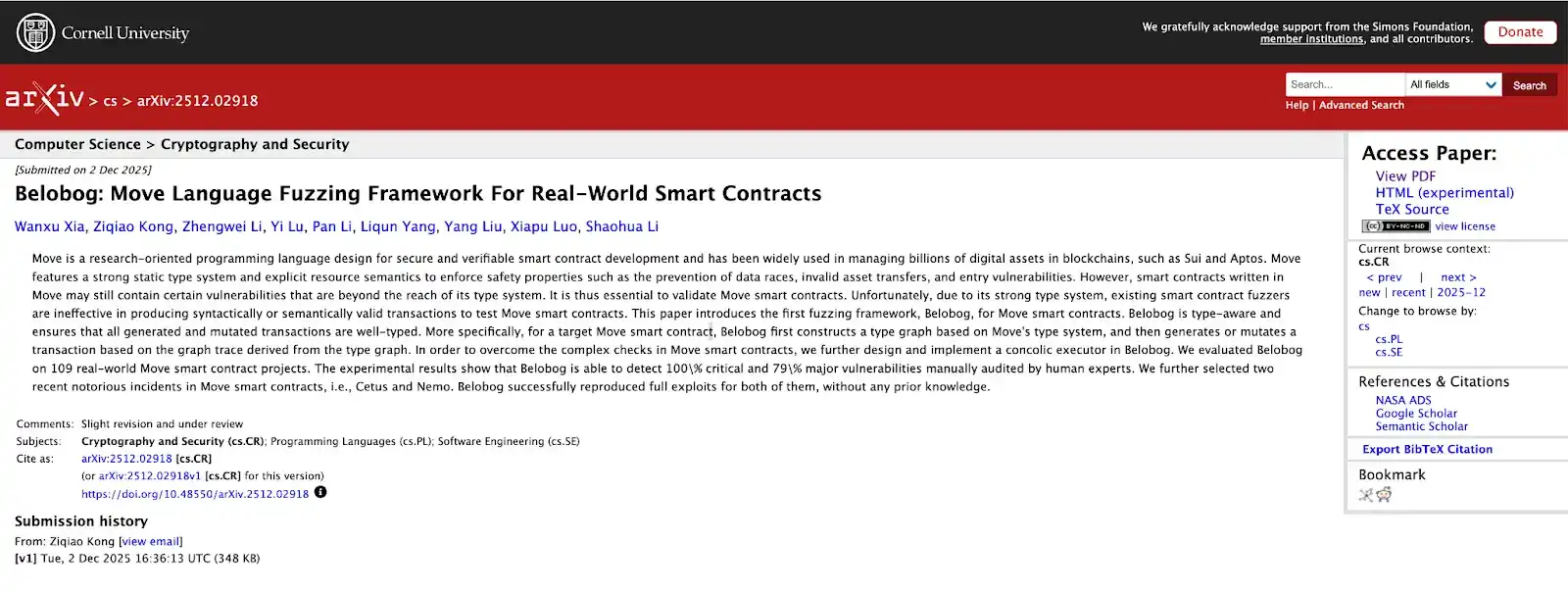
Making Fuzzing Truly "Run Into" Move: From Random Trial and Error to Type-Guided Exploration

Belobog's core idea is straightforward: since Move's type system is its fundamental constraint, fuzzing should use types as a guide, not an obstacle.

Traditional approaches often rely on random generation and mutation, but on Move, this quickly produces a large number of invalid samples: type mismatches, unreachable resources, parameters that cannot be correctly constructed, call chains with blocking points—what you end up with is not test coverage, but a pile of "failures at the starting line."

Belobog's method is more like giving the Fuzzer a "map." It starts from Move's type system, constructs a type graph based on type semantics for the target contract, and then uses this graph to generate or mutate transaction sequences. In other words, it doesn't blindly stitch calls together but constructs more reasonable, more executable, and更容易深入状态空间的调用组合 (easier to深入 state space call combinations) along type relationships.

For security research, the benefit this change brings is not a "fancier algorithm," but a very simple yet crucial gain:
Higher proportion of valid samples, higher exploration efficiency, and a better chance of reaching the deep paths where real vulnerabilities often appear.

Facing Complex Constraints: Belobog Introduces Concolic Execution to "Push Open the Door"

In real Move contracts, critical logic is often surrounded by layers of checks, assertions, and constraints. If you only rely on traditional mutation, you easily keep bumping at the door: the conditions are never met, the branches are never entered, the state is never reached.

To solve this problem, Belobog further designed and implemented concolic execution (a hybrid of concrete execution + symbolic reasoning). Simply put:

It maintains concrete execution that "can run," while on the other hand, it uses symbolic reasoning to more directionally approximate those branch conditions, thereby more effectively penetrating complex checks and advancing coverage depth.

This is particularly important for the Move ecosystem because the "sense of security" in Move contracts is often built on multiple layers of constraints, and the real problems often hide in the gaps after these constraints intersect. What Belobog wants to do is push testing near these gaps.

Aligning with the Real World: Not Just Running Demos, But Approaching Real Attack Paths

We don't want this kind of work to stop at "being able to run demos." Belobog's evaluation directly targets real projects and real vulnerability findings. According to the experimental results in the paper: Belobog was evaluated on 109 real-world Move smart contract projects. The experimental results show that Belobog was able to detect 100% of the Critical vulnerabilities and 79% of the Major vulnerabilities confirmed by manual security expert audits.

More notably: Without relying on prior vulnerability knowledge, Belobog was able to reproduce full exploits in real on-chain incidents. The value of this capability lies in the fact that it更接近我们在现实攻防里面对的情况 (closer to the situations we face in real-world offense/defense): attackers succeed not through "single-point function errors" but through complete paths and state evolution.

What This Work Aims to Express is Not Just "Making a Tool"

This paper is worth reading not only because it proposes a new framework, but because it represents a more pragmatic direction: abstracting frontline security experience into reusable methods and落地 (grounding) it with verifiable engineering implementations.

We believe the significance of Belobog lies not in being "yet another Fuzzer," but in making Fuzzing on Move closer to reality—able to run in, go deep, and align more closely with real attack paths. Belobog is not a closed tool designed for a few security experts, but a developer-friendly framework: it strives to lower the barrier to entry, allowing developers to continuously integrate security testing into their familiar development workflow, rather than making Fuzzing a one-time, after-the-fact task.

We will also release Belobog as open source, hoping it becomes infrastructure that the community can collectively use, extend, and evolve, rather than remaining an experimental project at the "tool level."

Paper (Preprint):https://arxiv.org/abs/2512.02918
(This work is also currently submitted to PLDI’26, awaiting peer review.)

About MoveBit

MoveBit (Mobi Security), a sub-brand under BitsLab, is a blockchain security company focused on the Move ecosystem, aiming to make the Move ecosystem the most secure Web3 ecosystem by pioneering the use of formal verification. MoveBit has successively cooperated with many well-known global projects and provided partners with comprehensive security audit services. The MoveBit team consists of security experts from academia and industry leaders with 10 years of security experience, having published security research results at top international security academic conferences such as NDSS and CCS. Moreover, they are early contributors to the Move ecosystem, working with Move developers to establish standards for secure Move applications.


Criptos en tendencia

Preguntas relacionadas

QWhat is the main challenge that traditional fuzzing tools face when applied to Move smart contracts?

ATraditional fuzzing tools struggle with generating transaction sequences that are both 'type-correct' and 'semantically reachable' in Move. Due to Move's strong type system and resource semantics, random generation and mutation produce a high volume of invalid samples, such as type mismatches, unreachable resources, and incorrectly constructed parameters. This results in many calls failing immediately, preventing deep branch coverage and making it difficult to reach critical states where real vulnerabilities often lie.

QHow does Belobog's approach differ from traditional fuzzing methods for smart contracts?

ABelobog uses Move's type system as a guide rather than an obstacle. It constructs a type graph based on the semantic relationships within the target contract and uses this graph to generate or mutate transaction sequences. This approach ensures that calls are constructed along type relationships, making them more reasonable, executable, and capable of penetrating deeper into the state space, unlike traditional methods that rely on blind, random splicing of calls.

QWhat technique does Belobog employ to handle complex constraints and branch conditions in Move contracts?

ABelobog employs concolic execution (a hybrid of concrete execution and symbolic reasoning). It maintains concrete execution to keep the program running' while using symbolic derivation to directionally approach branch conditions. This allows it to more effectively penetrate complex checks, such as assertions and constraints, and advance coverage depth, which is crucial for uncovering vulnerabilities hidden behind layered security checks in Move contracts.

QWhat were the key results of Belobog's evaluation on real-world Move smart contracts?

AIn an evaluation on 109 real-world Move smart contract projects, Belobog was able to detect 100% of the Critical vulnerabilities and 79% of the Major vulnerabilities that were confirmed by manual security audits. Notably, without relying on prior vulnerability knowledge, Belobog could also replicate full attack exploits (full exploits) from real on-chain incidents, demonstrating its ability to uncover complex attack paths that involve state evolution and multiple steps.

QHow does the Belobog team plan to release the framework, and what is its intended impact on the community?

AThe Belobog team plans to release the framework as open source. The goal is to make it a developer-friendly infrastructure that the community can collectively use, extend, and evolve, rather than keeping it as an experimental tool. By lowering the barrier to entry, it aims to integrate security testing seamlessly into developers' familiar workflows, promoting continuous security assessment rather than one-off, post-development audits.

Lecturas Relacionadas

AI is Killing 'Poor People's Entertainment'

AI Is Eliminating 'Entertainment for the Poor' This article discusses the rising cost of video gaming, arguing that AI is making digital entertainment increasingly expensive. It follows the example of a frugal gamer who, accustomed to waiting for discounts and buying second-hand games, now faces a new reality. Video game consoles like the PS5 Pro and Switch 2 are increasing in price post-launch, breaking the traditional pattern of降价 over time. Game prices are also rising, with major titles like GTA 6 launching at $80. Furthermore, the industry is moving towards eliminating physical media, exemplified by Sony's plan to stop PS disc production by 2028. This shift blocks the二手 market, a key cost-saving avenue for players. Even Valve's anticipated affordable Steam Machine launched with a high price and disappointing specs. Manufacturers cite inflation, supply chain issues, and rising development costs, but a core driver is the AI boom. AI data centers now consume semiconductor and memory resources once prioritized for consumer electronics like game consoles. This competition from a more profitable sector drives up hardware costs. Additionally, developing modern AAA games with massive teams over many years is astronomically expensive, pushing publishers towards digital-only distribution and subscription models to secure recurring revenue. The article suggests this trend extends beyond gaming. Video streaming, music platforms, cloud storage, and AI tools are increasingly locked behind complex subscription tiers. While AI promises future benefits, it is currently making digital entertainment and services more costly. The era of progressively cheaper, accessible online entertainment is ending, forcing consumers to pay more upfront for future technological promises.

marsbitHace 7 min(s)

AI is Killing 'Poor People's Entertainment'

marsbitHace 7 min(s)

The Demise of the Trillion-HKD ETF Myth: SK Hynix Plummets, Hong Kong Switches from 'Double Leverage' to 'Flexible Leverage', South Korea Restricts Leveraged ETF Investments

South Korea's AI-driven bull market has taken a sharp downturn, severely impacting SK Hynix's stock and prompting regulatory tightening in both Hong Kong and South Korea on single-stock leveraged products. The CSOP SK Hynix Daily Leveraged (2x) ETF, once the world's largest single-stock leveraged ETF with over HKD 130 billion in assets, saw its value plummet by over 80% as SK Hynix shares fell nearly 46% from their June peak, erasing more than HKD 100 billion. In response, Hong Kong's Securities and Futures Commission (SFC) revised its regulatory framework. Starting August 3rd, fixed 2x leverage for single-stock leveraged and inverse products will shift to a dynamic "flexible leverage" mechanism, where daily leverage can vary up to a maximum of 2x. This aims to balance market development with investor protection but has sparked debate about changes to the products' core features and potential reduced appeal for risk-seeking investors. Simultaneously, South Korean authorities announced plans to further restrict single-stock leveraged ETFs following two consecutive days of market circuit breakers. Proposed measures include capping individual investors' allocations to such products at 20% of their total financial investment assets, increasing trading costs, and enhancing suitability requirements. The Finance Minister publicly apologized, acknowledging insufficient initial risk assessment. Analysts note that while the long-term fundamentals for South Korean semiconductor firms like SK Hynix remain solid, short-term market volatility is heightened due to concentrated leveraged bets and shifting global risk sentiment. The regulatory moves in both markets signal a clear shift from encouraging innovation towards prioritizing risk control, reminding investors of the amplified risks inherent in leveraged products.

marsbitHace 13 min(s)

The Demise of the Trillion-HKD ETF Myth: SK Hynix Plummets, Hong Kong Switches from 'Double Leverage' to 'Flexible Leverage', South Korea Restricts Leveraged ETF Investments

marsbitHace 13 min(s)

After the Privatization of the Internet, Silicon Valley Begins Privatizing Human Civilization

"The Privatization of Human Civilization" The article critiques how AI companies like Anthropic are systematically acquiring and digitizing millions of books—sometimes by destroying physical copies—to build proprietary training datasets for models like Claude. While a lawsuit resulted in a settlement, the author argues the deeper issue transcends copyright: it is about the privatization and centralized control of human knowledge and civilization. This process coincides with a powerful Silicon Valley ideology, exemplified by Marc Andreessen's "Techno-Optimist Manifesto" and movements like e/acc (Effective Accelerationism). This worldview frames technological growth and speed as inherently moral, portraying caution, regulation, and public dissent as obstacles to progress. It often envisions intelligence itself, rather than human well-being, as the ultimate goal, potentially sidelining present human concerns. Figures like Peter Thiel and Curtis Yarvin express skepticism towards democratic processes as too slow, suggesting more centralized, founder-led governance is efficient. This logic extends to AI, where a small team within a company defines the model's "constitution"—its rules, values, and definitions of truth and safety—effectively governing how millions understand the world. Thus, the scanned books symbolize a new form of control. Knowledge isn't erased but is ingested into private, opaque systems. The original, decentralized, and contestable nature of books and public knowledge is replaced by a curated, company-controlled output. The public's access to their own cultural heritage becomes mediated by corporate AI, which remembers civilization only in the form its creators dictate. This is not book-burning but a subtler, potentially more complete privatization of human memory and understanding.

marsbitHace 22 min(s)

After the Privatization of the Internet, Silicon Valley Begins Privatizing Human Civilization

marsbitHace 22 min(s)

Trading

Spot

Artículos destacados

Cómo comprar O

¡Bienvenido a HTX.com! Hemos hecho que comprar O1 exchange (O) sea simple y conveniente. Sigue nuestra guía paso a paso para iniciar tu viaje de criptos.Paso 1: crea tu cuenta HTXUtiliza tu correo electrónico o número de teléfono para registrarte y obtener una cuenta gratuita en HTX. Experimenta un proceso de registro sin complicaciones y desbloquea todas las funciones.Obtener mi cuentaPaso 2: ve a Comprar cripto y elige tu método de pagoTarjeta de crédito/débito: usa tu Visa o Mastercard para comprar O1 exchange (O) al instante.Saldo: utiliza fondos del saldo de tu cuenta HTX para tradear sin problemas.Terceros: hemos agregado métodos de pago populares como Google Pay y Apple Pay para mejorar la comodidad.P2P: tradear directamente con otros usuarios en HTX.Over-the-Counter (OTC): ofrecemos servicios personalizados y tipos de cambio competitivos para los traders.Paso 3: guarda tu O1 exchange (O)Después de comprar tu O1 exchange (O), guárdalo en tu cuenta HTX. Alternativamente, puedes enviarlo a otro lugar mediante transferencia blockchain o utilizarlo para tradear otras criptomonedas.Paso 4: tradear O1 exchange (O)Tradear fácilmente con O1 exchange (O) en HTX's mercado spot. Simplemente accede a tu cuenta, selecciona tu par de trading, ejecuta tus trades y monitorea en tiempo real. Ofrecemos una experiencia fácil de usar tanto para principiantes como para traders experimentados.

262 Vistas totalesPublicado en 2026.06.19Actualizado en 2026.06.29

Cómo comprar O

Cómo comprar PROS

¡Bienvenido a HTX.com! Hemos hecho que comprar Pharos (PROS) sea simple y conveniente. Sigue nuestra guía paso a paso para iniciar tu viaje de criptos.Paso 1: crea tu cuenta HTXUtiliza tu correo electrónico o número de teléfono para registrarte y obtener una cuenta gratuita en HTX. Experimenta un proceso de registro sin complicaciones y desbloquea todas las funciones.Obtener mi cuentaPaso 2: ve a Comprar cripto y elige tu método de pagoTarjeta de crédito/débito: usa tu Visa o Mastercard para comprar Pharos (PROS) al instante.Saldo: utiliza fondos del saldo de tu cuenta HTX para tradear sin problemas.Terceros: hemos agregado métodos de pago populares como Google Pay y Apple Pay para mejorar la comodidad.P2P: tradear directamente con otros usuarios en HTX.Over-the-Counter (OTC): ofrecemos servicios personalizados y tipos de cambio competitivos para los traders.Paso 3: guarda tu Pharos (PROS)Después de comprar tu Pharos (PROS), guárdalo en tu cuenta HTX. Alternativamente, puedes enviarlo a otro lugar mediante transferencia blockchain o utilizarlo para tradear otras criptomonedas.Paso 4: tradear Pharos (PROS)Tradear fácilmente con Pharos (PROS) en HTX's mercado spot. Simplemente accede a tu cuenta, selecciona tu par de trading, ejecuta tus trades y monitorea en tiempo real. Ofrecemos una experiencia fácil de usar tanto para principiantes como para traders experimentados.

275 Vistas totalesPublicado en 2026.06.22Actualizado en 2026.06.29

Cómo comprar PROS

Qué es VERONA

I. Introducción al Proyecto VERONA es una blockchain construida para todos, en todas partes a través de la abstracción de cadenas. Utilizando su capa de Abstracción Generalizada, VERONA se distingue por integrar funcionalidades complejas de blockchain, como cuentas, firmas e interoperabilidad, directamente a nivel de protocolo. Este enfoque permite interactuar con aplicaciones de blockchain sin necesidad de entender las tecnologías subyacentes.1) Información Básica Nombre: VERONA (VERONA)III. Enlaces Relacionados Enlace al sitio web oficial: https://xion.burnt.com/ Libro Blanco: https://xion.burnt.com/whitepaper.pdf Exploradores: https://explorer.burnt.com/ Redes Sociales: https://x.com/burnt_xion Nota: La introducción del proyecto proviene de los materiales publicados o proporcionados por el equipo oficial del proyecto, que es solo para referencia y no constituye asesoramiento de inversión. HTX no se hace responsable de ninguna pérdida directa o indirecta resultante.

362 Vistas totalesPublicado en 2026.06.22Actualizado en 2026.06.22

Qué es VERONA

Discusiones

Bienvenido a la comunidad de HTX. Aquí puedes mantenerte informado sobre los últimos desarrollos de la plataforma y acceder a análisis profesionales del mercado. A continuación se presentan las opiniones de los usuarios sobre el precio de A (A).

活动图片