Morningstar Valuates SpaceX at Only $780B, Less Than Half of IPO Target, 'Largest IPO Ever' Overpriced?

marsbitPublicado a 2026-06-03Actualizado a 2026-06-03

Resumen

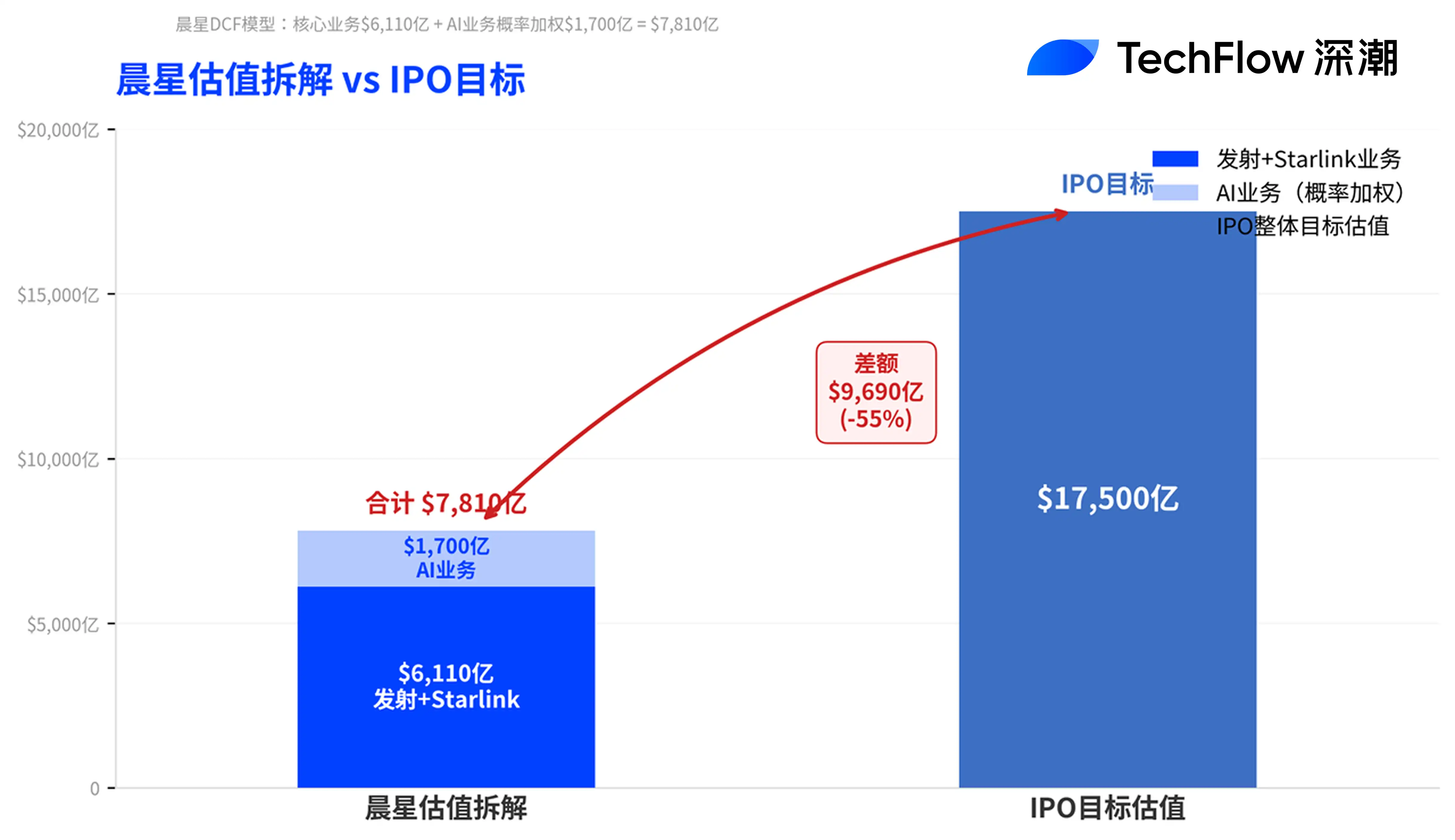
Morningstar values SpaceX at $780 billion ahead of its IPO, far below the company's $1.75 trillion target. The research firm's DCF model values the core launch and Starlink businesses at $611 billion and assigns only a $170 billion probability-weighted valuation to the AI segment (including xAI). Analyst Nicolas Owens calls the company "severely overvalued," citing a near-100x price-to-sales ratio based on 2025 revenue. Despite the bearish long-term view, Morningstar acknowledges short-term price support from low float and potential rapid inclusion in the Nasdaq 100. The IPO is set for June 12, featuring an unusual tiered lock-up expiration that could create selling pressure over time.

Author: Claude, Deep Tide TechFlow

Deep Tide Guide:SpaceX's roadshow kicks off this week, but Morningstar has already poured cold water. The research firm values it at a fair value of $780 billion using a DCF model, only 45% of SpaceX's target valuation of $1.75 trillion, with the analyst bluntly stating "the company is severely overvalued." Morningstar values the core launch and Starlink businesses at $611 billion, with xAI-related AI business receiving only a $170 billion probability-weighted valuation. However, Morningstar also admits that with extremely low float and the Nasdaq 100's rapid inclusion mechanism, SpaceX's stock price may still rise in the short term.

SpaceX is about to welcome what could be the largest IPO ever, and one of Wall Street's most well-known independent research firms just threw a bucket of cold water on it.

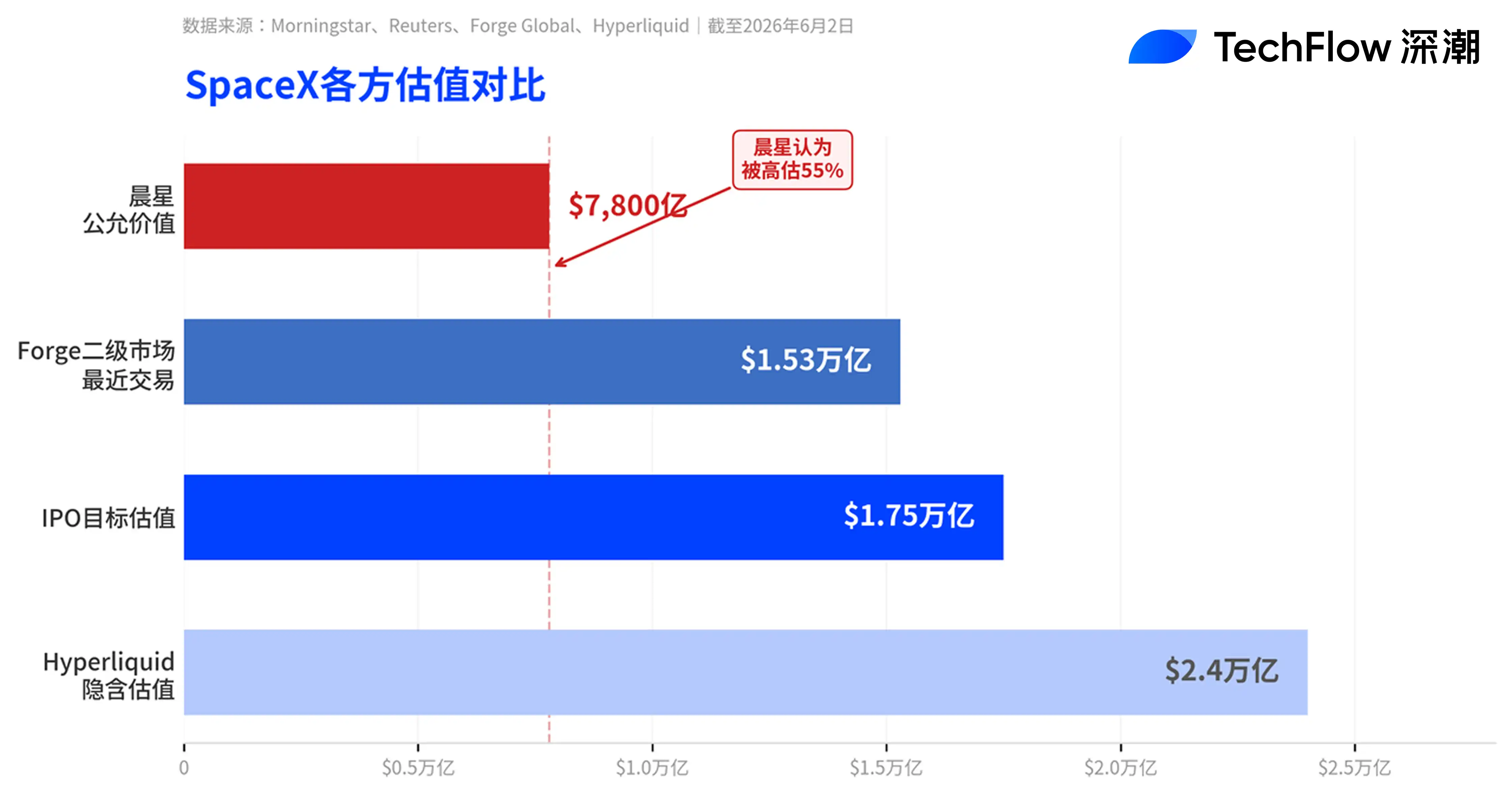
According to a Reuters report on June 2, Morningstar, just before SpaceX's planned roadshow launch this week, initiated research coverage on the company for the first time, providing a fair value estimate of $780 billion. This is nearly a 50% discount to SpaceX's most recent secondary market valuation of $1.53 trillion on the Forge Global platform and only about 45% of its $1.75 trillion IPO target valuation.

Morningstar equity analyst Nicolas Owens's judgment was unequivocal: "We believe the company is severely overvalued, and investors will have the opportunity to buy at a more attractive price after the IPO."
Where Does $780B Come From: Launch+Starlink Worth $611B, AI Worth Only $170B

Morningstar's valuation breakdown reveals the core of the disagreement.

Owens's DCF model values SpaceX's core launch business and Starlink satellite broadband business together at approximately $611 billion in enterprise value, with an additional probability-weighted valuation of about $170 billion for the AI business (including xAI and social media platform X). Morningstar gives SpaceX a "Narrow Moat" rating, citing its cost advantage in reusable rockets and Starlink's scale effects, but believes the recently acquired AI business drags down the overall rating.

Regarding the AI business specifically, Morningstar modeled three scenarios: the most optimistic "moonshot" scenario values it at $1.3 trillion but is assigned only a 7% probability; the most pessimistic "unviable" scenario would destroy over $81 billion in value and is assigned a 43% probability. Owens wrote: "We do not regard Grok as one of today's leading AI labs." He also warned that the future prospects of SpaceX's AI business rely on unproven technologies like orbital data centers.

Starlink's fundamentals are relatively solid. According to S-1 filing disclosures, Starlink's 2025 revenue grew 50% year-over-year to $11.3 billion, with operating profit exceeding $4.4 billion. The user base has surpassed 10 million, making it SpaceX's only profitable business segment currently. Yet, even with that, based on the $1.75 trillion valuation, SpaceX's estimated total 2025 revenue of around $18.7 billion implies a price-to-sales ratio nearing 100.

Musk's Retort from Afar: 'You shall see'

Faced with valuation doubts, Musk chose to respond with Tesla's history. He posted on platform X early Tuesday: "Tesla's IPO market cap was only 0.1% of its current value." When a user pressed him on how to defend a valuation with over 50x price-to-sales, Musk replied with just three words: "You shall see."

But the validity of the analogy is questionable. According to Yahoo Finance, Tesla's current market cap is about $1.3 trillion, with a price-to-sales ratio of about 15.7x and a P/E nearing 400. Even by Tesla's already expensive valuation standards, SpaceX seeking a higher market cap with significantly lower revenue presents a much higher pricing hurdle.

NYU Stern professor Scott Galloway's podcast co-host Ed Elson used sharper language. As cited by Motley Fool, he described SpaceX's IPO filing documents in an article as "non-serious, empty, full of illusions, bordering on dishonest."

Staged Unlock + Nasdaq Rapid Inclusion: Short-term Rise Followed by Potential Decline

Despite its bearish valuation, Morningstar also acknowledged that SpaceX's stock price may still rise in the short term after the IPO. The logic is threefold: extremely low initial float (only about 3% of shares publicly offered), robust investor demand for AI infrastructure plays, and the Nasdaq 100 index's fast-track inclusion mechanism.

According to CNBC, new Nasdaq rules introduced on May 1 allow mega-cap new listings to be included in the Nasdaq 100 index after just 15 trading days post-IPO, a condition SpaceX fully meets based on its expected valuation. Upon inclusion, all passive funds tracking the index will be forced to buy, creating a wave of short-term index inclusion buying pressure.
However, mid-term selling pressure is also a concern. SpaceX has adopted an unconventional staged lock-up release structure: after the company releases its first quarterly report post-IPO (covering April to June), insiders can sell up to 20% of their locked shares; if the stock price has risen over 30% from the IPO price by then, an additional 10% can be unlocked. Subsequently, at days 70, 90, 105, 120, and 135, an additional 7% unlocks each time. After the Q3 earnings release, another 28% unlocks, with the remainder fully unlocked 180 days after the IPO. Musk himself is subject to a 366-day lock-up.

According to the S-1/A filing, SpaceX has also reserved up to 5% of IPO shares for designated employees and executives, and these holders are not subject to standard lock-up restrictions. Motley Fool analysis suggests investors need not rush to buy on the first IPO day; waiting until all unlock provisions expire and index inclusion is complete might be wiser.

$20B Bridge Loan and Governance Risks

Morningstar also flagged two structural risks.

First, debt accumulated by SpaceX in recent years is mainly related to AI infrastructure investments, with $20 billion in the form of a bridge loan maturing 15 months after the IPO, posing refinancing risk. Morningstar expects the company to raise $50-$80 billion through the IPO, with part of the proceeds used to repay this loan.

Second is corporate governance issues. Musk holds about 85% of voting rights through a dual-class share structure. Additionally, the $250 billion acquisition of xAI earlier this year was not an arm's-length transaction. This related-party deal boosted SpaceX's valuation from around $1.5 trillion to the IPO target level, but the AI business itself has not yet proven its economic viability.

SpaceX plans to launch its roadshow during the week of June 8, price on June 11, and list on Nasdaq under the ticker SPCX on June 12. This will be the largest IPO in history and could also be one with the most significant bullish-bearish divergence in recent years.


Lecturas Relacionadas

Xiaohongshu's Second Great Voyage, This Time Sailing Towards AI

Xiaohongshu's Second Voyage: Navigating Towards AI Since ChatGPT's emergence, Xiaohongshu's founder Mao Wenchao has been acutely aware of AI's potential threat, recognizing that the life advice people seek from chatbots overlaps directly with his platform's core business. Founded in 2013 as a PDF shopping guide for Chinese tourists, Xiaohongshu evolved into a massive community where millions share authentic, personal experiences—from product reviews to travel tips. This vast repository of "I've tried this" human judgment became its most valuable asset. However, the rise of AI, which delivers instant answers, challenges the very need for users to sift through numerous personal notes. Fearing its treasure trove of lived experience could become mere training data for others, Xiaohongshu is proactively adapting. In 2026, it established a dedicated AI division (Dots), launched RED Skill to turn user experiences into usable AI tools, and acquired the AI search product "Diandian." Its investments now extend to AI firms like MiniMax and hardware startups, moving upstream to address needs before they even become search queries. The platform's commercialization strategy is also evolving. With a newly acquired payment license and tools like the AIPS model to track consumer decision journeys, Xiaohongshu aims to seamlessly integrate recommendations with transactions, embedding commerce within AI-generated answers. Yet, a critical tension remains. While building smarter machines to organize and leverage its human experiences, Xiaohongshu must prevent AI from drowning out the authentic, flawed, and trustworthy "I've tried this" voices that built its community. Its core challenge is to harness AI's power without letting the map—the machine's perfect, synthesized answer—replace the territory of genuine human experience. This balance between technological advancement and preserving human trust defines its current journey and its future.

marsbitHace 4 min(s)

Xiaohongshu's Second Great Voyage, This Time Sailing Towards AI

marsbitHace 4 min(s)

SharpLink CEO: How to Understand Ethereum Developers Just Exceeded 1 Million?

SharpLink CEO reflects on the milestone of Ethereum surpassing 1 million historical developers, emphasizing that this figure represents the largest pool of technical talent ever assembled around an open, permissionless blockchain network. While approximately 232,000 developers remain active, the key question for the crypto industry is not which chain is fastest, but where the best builders choose to build long-term. Ethereum's advantage lies in a decade-long accumulation of infrastructure, standards, tools, liquidity, and a cohesive culture, making it the default operating system for programmable finance. This developer base is tackling complex challenges: the Glamsterdam upgrade aims to enhance scalability while preserving core principles; synchronous composability seeks to unify Rollup ecosystems; and significant efforts are underway for post-quantum security. Ethereum's deeper network effects stem from composability and shared standards (like the EVM and Solidity), creating a flywheel of more developers, tools, and liquidity. Three reinforcing strengths cement Ethereum's lead: credible neutrality (secured by ~900k validators), a modular architecture with interconnected Rollups, and a culture that attracts top researchers. The ecosystem is consolidating as the trusted coordination layer for internet-native finance, favored by large institutions valuing security and liquidity. The future of Ethereum is being built by this global community of founders and architects.

链捕手Hace 19 min(s)

SharpLink CEO: How to Understand Ethereum Developers Just Exceeded 1 Million?

链捕手Hace 19 min(s)

A Clod of Chinese Soil Chokes Two Japanese Giants

"Chinese Soil Chokes Japanese Giants" The production of a key electronic specialty gas, tungsten hexafluoride (WF6), vital for manufacturing AI chips, was halted by two leading Japanese producers—Kanto Denka and Central Glass. Their shutdown was not due to a technological failure but a sudden, critical shortage of a raw material they had long taken for granted: ultra-high-purity (6N-grade) tungsten powder, which is almost entirely sourced from China. Following a quiet Chinese export announcement in January 2026, tungsten powder shipments to Japan dropped to zero for months. Despite frantic efforts, Japanese companies found no viable alternative; imported powder was three times more expensive and lacked the required purity. Their existing stockpiles were exhausted by mid-2026. WF6 is essential for depositing tungsten into the microscopic contact holes of High Bandwidth Memory (HBM) chips, which are crucial for advanced processors like those from Nvidia. While Japanese firms had mastered producing ultra-pure WF6 gas, their entire supply chain relied on China's 6N tungsten powder—a dependency now revealed as a fatal vulnerability. China's dominance in this "soil" results from decades of painstaking R&D by companies like Xiamen Tungsten and China Tungsten & Hightech. They overcame immense technical hurdles, such as separating chemically similar molybdenum from tungsten, to achieve mass production of the world's purest tungsten powder. With their primary suppliers gone, Kanto Denka and Central Glass announced a permanent halt to WF6 production starting July 1, 2026. This immediately created a supply crisis for major semiconductor manufacturers like Samsung and SK Hynix, forcing them to urgently seek and certify new Chinese suppliers for WF6 itself. The reversal marks a dramatic shift: China has moved from exporting low-value raw materials to controlling the high-purity foundation of a critical global tech supply chain, upending a long-established industrial hierarchy.

marsbitHace 50 min(s)

A Clod of Chinese Soil Chokes Two Japanese Giants

marsbitHace 50 min(s)

Trading

Spot
Futuros

Artículos destacados

Cómo comprar T

¡Bienvenido a HTX.com! Hemos hecho que comprar Threshold Network Token (T) sea simple y conveniente. Sigue nuestra guía paso a paso para iniciar tu viaje de criptos.Paso 1: crea tu cuenta HTXUtiliza tu correo electrónico o número de teléfono para registrarte y obtener una cuenta gratuita en HTX. Experimenta un proceso de registro sin complicaciones y desbloquea todas las funciones.Obtener mi cuentaPaso 2: ve a Comprar cripto y elige tu método de pagoTarjeta de crédito/débito: usa tu Visa o Mastercard para comprar Threshold Network Token (T) al instante.Saldo: utiliza fondos del saldo de tu cuenta HTX para tradear sin problemas.Terceros: hemos agregado métodos de pago populares como Google Pay y Apple Pay para mejorar la comodidad.P2P: tradear directamente con otros usuarios en HTX.Over-the-Counter (OTC): ofrecemos servicios personalizados y tipos de cambio competitivos para los traders.Paso 3: guarda tu Threshold Network Token (T)Después de comprar tu Threshold Network Token (T), guárdalo en tu cuenta HTX. Alternativamente, puedes enviarlo a otro lugar mediante transferencia blockchain o utilizarlo para tradear otras criptomonedas.Paso 4: tradear Threshold Network Token (T)Tradear fácilmente con Threshold Network Token (T) en HTX's mercado spot. Simplemente accede a tu cuenta, selecciona tu par de trading, ejecuta tus trades y monitorea en tiempo real. Ofrecemos una experiencia fácil de usar tanto para principiantes como para traders experimentados.

614 Vistas totalesPublicado en 2024.12.10Actualizado en 2026.06.02

Cómo comprar T

Discusiones

Bienvenido a la comunidad de HTX. Aquí puedes mantenerte informado sobre los últimos desarrollos de la plataforma y acceder a análisis profesionales del mercado. A continuación se presentan las opiniones de los usuarios sobre el precio de T (T).

活动图片