Morning Post | Hyperliquid Launches Off-chain Event Prediction Market Contract; Strategy Completes $1.5 Billion Debt Buyback; Kelp DAO Announces rsETH Fully Restored

链捕手Publicado a 2026-05-27Actualizado a 2026-05-27

Resumen

Crypto Market Digest (May 27, 2026) Ondo Finance's founder Nathan Allman has passed away, with President Ian De Bode taking over as CEO. In regulatory news, Hong Kong authorities concluded a consultation on virtual asset service provider licensing, aiming to align rules with traditional finance. Kelp DAO announced its rsETH token has fully recovered five weeks after a $293 million hack by Lazarus Group, though the incident caused significant damage to DeFi lending protocols like Aave. Key industry developments include Hyperliquid launching off-chain event prediction market contracts, and the CME introducing futures for Avalanche and Sui. A report highlights the rise of AI Agent payments, with over $73 million settled on-chain in a year, predominantly using USDC. Meanwhile, blockchain detective ZachXBT exposed market manipulation involving several BSC tokens. In investment news, a firm referred to as "Strategy" completed a $1.5 billion debt buyback. Political contributions from the crypto sector for the 2026 U.S. elections have surpassed $500 million, heavily favoring Republican candidates. BitMEX founder Arthur Hayes revealed Zcash is his second-largest holding, citing the growing necessity for monetary privacy. The digest concludes with trending memecoins on Ethereum, Solana, and Base networks, and highlights in-depth articles covering the impending SpaceX IPO, Polymarket's regulatory challenges, and an analysis of the on-chain treasury landscape.

Compiled by: ChainCatcher


Key Information:

  • Ondo Finance founder Nathan Allman passed away unexpectedly, with President Ian De Bode taking over as CEO.
  • Hyperliquid announced the launch of off-chain event prediction market contracts.
  • Kelp DAO announced that rsETH has been fully restored after five weeks of repairs, following a $293 million hack.
  • Strategy completed a $1.5 billion debt buyback, with BTC yielding 13.3% year-to-date.
  • CME launched Avalanche and Sui futures contracts.
  • Report: AI Agents have completed over $73 million in on-chain payments, with USDC becoming the default settlement asset.

What important events happened in the past 24 hours?

Strategy completed a $1.5 billion debt buyback, with BTC yielding 13.3% year-to-date.

Hong Kong's Financial Services and Treasury Bureau and SFC release consultation conclusion on virtual asset regulatory regime.

ChainCatcher news, according to a Jinshi report, the Hong Kong Financial Services and Treasury Bureau and the Securities and Futures Commission published a consultation conclusion on the regulatory regime for virtual asset advice and management services. The proposed licensing regime for virtual asset advice and management received broad market support during the consultation period.

The new licensing regime will follow the principle of "same business, same risks, same rules," aligning its scope with the relevant regulated activities under the Securities and Futures Ordinance. This new series of regimes will enhance participation in Hong Kong's digital asset market and help build a robust and secure ecosystem.

Report: AI Agents have completed over $73 million in on-chain payments, with USDC becoming the default settlement asset.

ChainCatcher news, a report titled "Who Pays the Agent?" released by crypto market maker Keyrock, in collaboration with Coinbase, Tempo, and Virtuals Protocol, states that AI Agents are rapidly becoming key participants in the on-chain economy. Data shows that between May 2025 and April 2026, AI Agents have cumulatively completed approximately 176 million on-chain transactions, with a total settlement amount exceeding $73 million. The report notes that the average single payment amount for AI Agents is only $0.31 to $0.48, indicating the formation of a machine-native micropayment economy. About 76% of transaction amounts are below the $0.30 fixed fee threshold of Visa, showing that traditional card and bank payment systems are increasingly ill-suited for AI's high-frequency, small-amount, autonomous payment demands.

Data shows that 98.6% of AI Agent payments are settled using USDC. As of Q1 2026, over 104,000 AI Agents have completed registration. The report states that on the Base network, the cost of a USDC transfer is about $0.0001, accounting for only about 0.03% of a $0.31 transaction amount, demonstrating significant cost advantages over traditional payment systems. The report believes that stablecoins are gradually becoming the "default monetary infrastructure" for economic activities between AIs and machines. However, Keyrock also warns that the current high dependency of the AI payment ecosystem on USDC poses centralization risks, meaning this emerging AI payment system relies heavily on the regulatory and infrastructure stability of a single stablecoin issuer.

Furthermore, several tech and payment companies have begun building AI Agent payment infrastructure, including Coinbase's x402 protocol, Stripe and Tempo's Machine Payments Protocol (MPP), Google's AP2 delegated payment system, and Visa's extended tokenized payment credential services. The report also points out that current regulatory frameworks, including Europe's MiCA regulation, the US GENIUS Act, and the EU AI Act, still lack comprehensive regulatory standards for AI autonomous financial transactions and inter-machine payments.

ZachXBT: Same entity linked to multiple BSC token manipulations, ESPORTS plunges 93% in a day.

ChainCatcher news, on-chain detective ZachXBT posted on a personal channel stating that a certain entity previously received ESPORTS, RIVER, and LIGHT tokens via Sablier vesting contracts and is directly linked to three multisig wallet signers of the LAB multisig. These BSC tokens have all experienced market manipulation incidents on centralized exchanges.

ZachXBT had previously flagged anomalies with LAB and RIVER, and now the ESPORTS token has experienced a flash crash, plummeting 93% briefly. The CEX deposit addresses linked to this entity and the LAB signer addresses have been publicly disclosed.

Crypto industry invests over $500 million in 2026 US elections, with Republicans receiving far more funding than Democrats.

ChainCatcher news, according to a Cointelegraph report, crypto-related political action committees (PACs) and industry executives have invested over $500 million in the 2026 US elections.

Data from Follow the Crypto shows that crypto industry companies and related individuals have contributed over $320 million, while crypto-related PACs still hold more than $245 million in cash; Republican-related candidates/committees received approximately $127 million in support, significantly higher than the approximately $11.5 million for Democrats.

Arthur Hayes: Monetary privacy will be "very necessary," therefore holds Zcash as second-largest position.

ChainCatcher news, Arthur Hayes stated that as large tech companies, governments, and AI expand their surveillance scope, monetary privacy will "become very necessary" in the future.

Arthur Hayes said this is why he holds the privacy coin Zcash (ZEC) as his second-largest personal asset position.

Kelp DAO announces rsETH fully restored after five weeks of repairs, following $293 million hack.

ChainCatcher news, Kelp DAO announced on Monday that rsETH has been fully restored after five weeks of repairs following the April 18 attack by North Korea's Lazarus Group, which resulted in a $293 million loss. Kelp DAO stated that the final batch of 20,373.7 rsETH has been sent to the LayerZero smart contract responsible for cross-chain transfers, officially concluding the operational phase of the rsETH recovery plan.

Multiple crypto protocols contributed funds to support the restoration of rsETH through the DeFi United initiative. The first batch of 25,000 rsETH was transferred on May 13, with withdrawals reopening the following day; currently, minting, redemption, and reward operations are all functioning normally. The attack caused a chain reaction in the DeFi lending market, with the attacker using a large amount of stolen rsETH as collateral on Aave to borrow WETH, resulting in $190 million in bad debt for Aave and causing its TVL to drop from $26.4 billion to below $14 billion, where it remains, fluctuating between $13.9 billion and $15.1 billion without recovery. There were 25 crypto hack incidents in April, with total losses of $630 million.

Meme Popularity Ranking

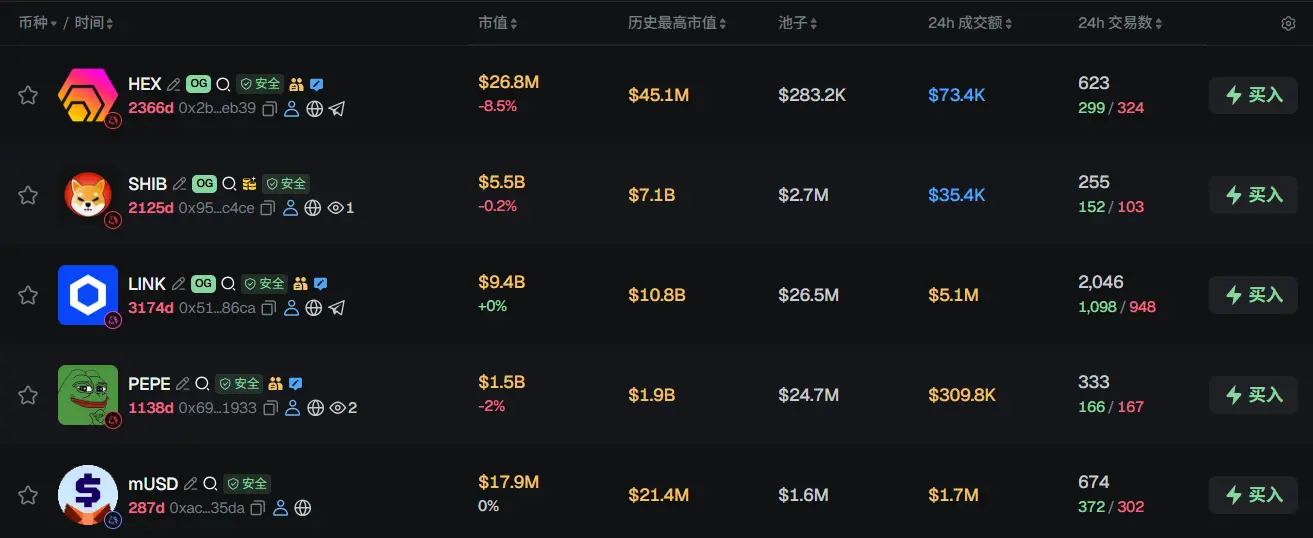
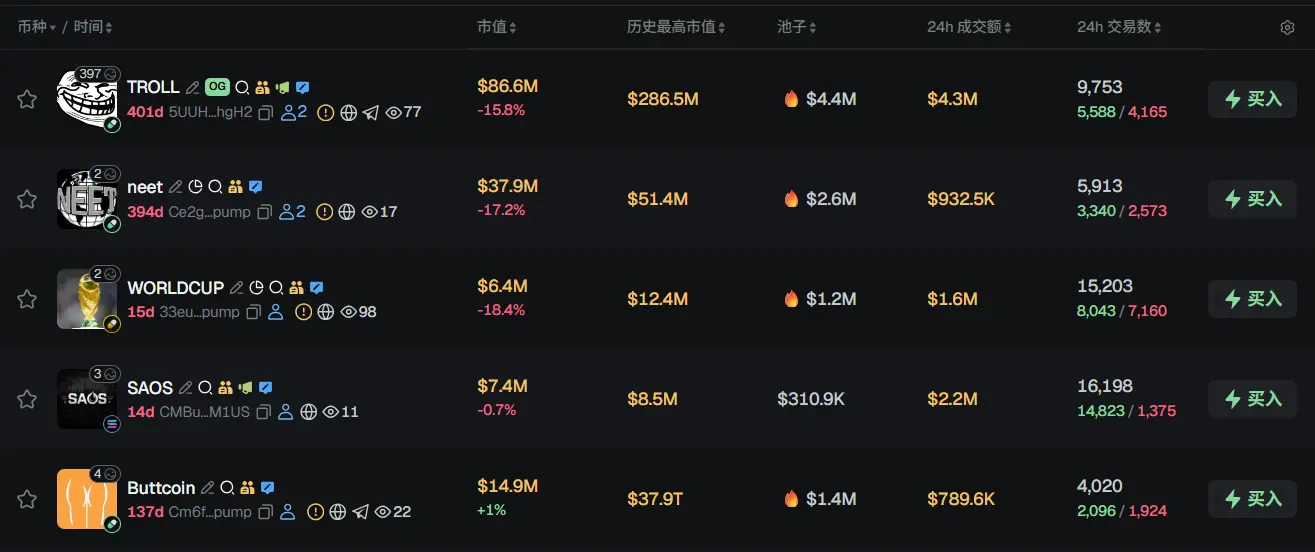
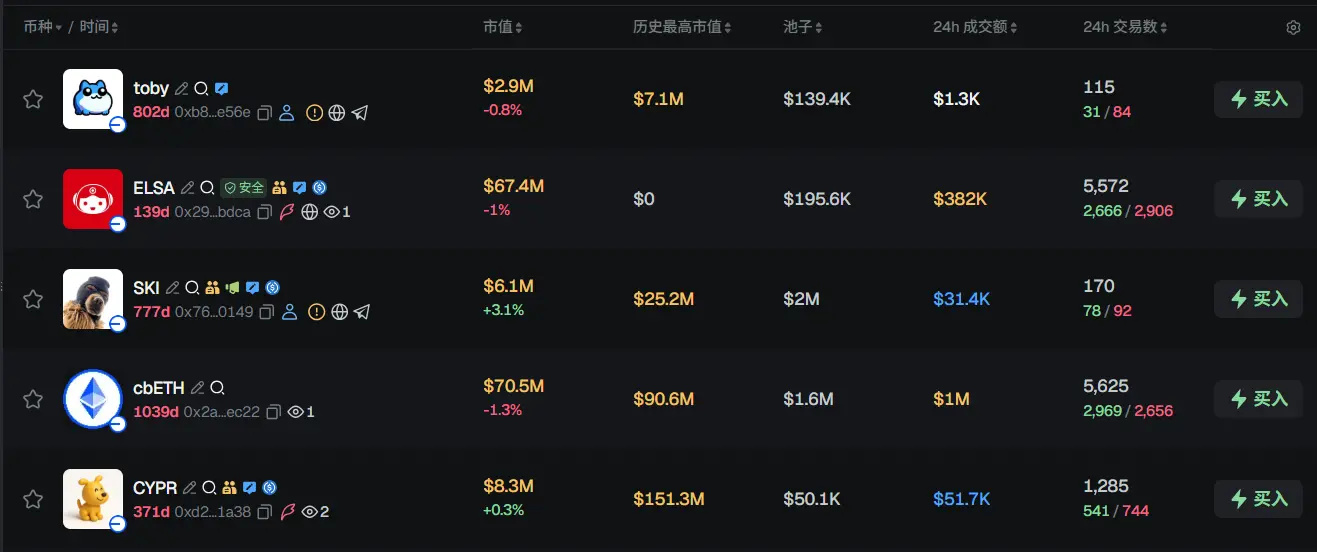
According to data from the meme token tracking and analysis platform GMGN, as of 09:00 on May 27,

The top five popular ETH-based tokens in the past 24h are: HEX, SHIB, LINK, PEPE, mUSD
The top five popular Solana-based tokens in the past 24h are: TROLL, neet, WORLDCUP, SAOS, Buttcoin
The top five popular Base-based tokens in the past 24h are: toby, ELSA, SKI, cbETH, CYPR
Which noteworthy articles are worth reading from the past 24 hours?

Those Betting on Musk in the Inner Circle Are Reaping "Historic-Level Returns"

The largest initial public offering (IPO) in global history has entered the countdown phase. Elon Musk's SpaceX is expected to price its IPO on June 12 and begin trading the next day.

Investors are eyeing a valuation of around $2 trillion. At that level, Musk himself would directly become the world's first trillionaire. But the real drama of this deal is that the wealth won't flow only to Musk. With the disclosure of the prospectus, the value of the holdings of a group of long-time loyal lieutenants and early allies who have remained in Musk's shadow has surfaced for the first time.

Their "loyalty" and patience are being rewarded with one of the most substantial payouts in history.

Easy to Conquer, Hard to Rule: Polymarket Must Humble Itself Everywhere to Plant Its Flag Globally

Last week, the prediction market went dark in India. Users connecting to polymarket.com only saw an "This site can't be reached" error message. India's Ministry of Electronics and Information Technology (MeitY) had issued a blocking order, requiring domestic internet service providers to cut off access, on the grounds that India had classified the platform as "online money gambling," a category that is completely prohibited.

Moreover, on the same day, Bloomberg cited informed sources revealing that Polymarket has appointed a local representative in Japan and is preparing to lobby for the "legalization of prediction markets," aiming to obtain Japanese government approval before 2030.

This simultaneous advance and retreat accurately describes Polymarket's situation: while the prediction market continues to grow in scale, regulatory hurdles in various countries are making progress difficult.

Deconstructing On-Chain Vaults in 10,000 Words: Eight Tracks, Who Is Rising and Who Is Declining?

This section of the report provides a quantitative analysis of the vault landscape to offer a comprehensive picture of the field and its evolution. We analyze the ecosystem by category, tracking TVL shifts across different vaults and curators.

We dissect the concentration of curators and provide an outlook on major capital flows, placing the structural shifts defining this year's vault landscape into specific context.

Vaults should not be viewed as a single, all-encompassing market but should be assessed based on their different implementations, each with distinct parameters, risk vectors, and responses to stress tests. Aggregate data only provides a partial picture; a more nuanced analytical perspective is urgently needed.

Before beginning the analysis, it's important to define the term "vault" as the foundation of our methodology.

Preguntas relacionadas

QWhat major incident occurred to Kelp DAO, and what is the current status of rsETH?

AKelp DAO suffered a $293 million hack by the Lazarus Group in mid-April 2026. After five weeks of restoration efforts, the protocol has announced that its liquid restaking token, rsETH, is now fully restored. The final batch of over 20,000 rsETH tokens has been transferred to the LayerZero smart contract for cross-chain operations, marking the completion of the recovery plan's operational phase. Minting, redeeming, and reward operations have all returned to normal.

QAccording to the report mentioned, what are the key findings about AI Agent payments on-chain?

AA report titled 'Who Pays the Agent?' by Keyrock, Coinbase, Tempo, and Virtuals Protocol found that AI Agents are rapidly becoming significant participants in the on-chain economy. From May 2025 to April 2026, AI Agents completed approximately 176 million on-chain transactions, with a total settlement value exceeding $73 million. The average transaction amount is very small, between $0.31 and $0.48, indicating a nascent machine-native micro-payment economy. Notably, 98.6% of these payments are settled using USDC, making it the default settlement asset. The report warns of centralization risks due to this heavy reliance on a single stablecoin.

QWhat significant regulatory development was announced in Hong Kong regarding virtual assets?

AThe Hong Kong Financial Services and the Treasury Bureau (FSTB) and the Securities and Futures Commission (SFC) jointly published a consultation conclusion on a new regulatory regime for virtual asset advisory and management services. The proposed licensing regime received broad market support during the consultation. It will follow the principle of 'same business, same risks, same rules,' aligning its scope with regulated activities under the existing Securities and Futures Ordinance. The new framework aims to enhance participation in Hong Kong's digital asset market and help build a robust and secure ecosystem.

QWhy did Arthur Hayes state that monetary privacy will be 'very necessary,' and what action did he take as a result?

AArthur Hayes argued that as large tech companies, governments, and AI expand their surveillance capabilities, monetary privacy will become 'very necessary' in the future. Citing this belief in the growing importance of financial privacy, he disclosed that he holds the privacy-focused cryptocurrency Zcash (ZEC) as his second-largest personal investment.

QWhat issue did ZachXBT identify regarding several BSC tokens, and which token experienced a sharp price drop?

AOn-chain investigator ZachXBT identified market manipulation involving several Binance Smart Chain (BSC) tokens—ESPORTS, RIVER, and LIGHT. He linked these tokens to a single entity that received them via a Sablier vesting contract, which was directly connected to three multisig signers of the LAB project's multisig wallet. ZachXBT had previously flagged anomalies with LAB and RIVER. Following his disclosure, the ESPORTS token experienced a flash crash, plummeting 93% in a short period.

Lecturas Relacionadas

A Trillion-Dollar Frenzy for Memory Sellers, Halved Profits for Memory Buyers

Summary: A stark divide has emerged in the tech industry. While memory chipmaker Micron's stock soared 19% in a single day, pushing its market cap over $1 trillion, smartphone manufacturer Xiaomi reported a 43% plunge in adjusted net profit. The core driver is a severe supply crunch in memory chips, particularly for AI applications. Wall Street analysts, led by UBS and its unprecedented 204% target price hike for Micron, argue that long-term agreements (LTAs) from AI cloud giants are fundamentally ending the sector's notorious boom-and-bust cycles, justifying a re-rating from cyclical to infrastructure-like valuations. However, the "storage" market is now fragmented into three tiers. The first, AI-grade memory like HBM and server DDR5, faces extreme shortages and soaring prices driven by massive cloud capex. The second, mobile memory for smartphones, is also seeing sharp price hikes as manufacturers like Xiaomi are forced to pay more for remaining capacity, severely squeezing their margins. The third, PC retail channels, shows price declines due to existing inventory. The article questions the sustainability of the "supercycle" narrative. It highlights that Micron's revenue surge is driven almost entirely by price increases, not shipment volumes, making it vulnerable to a potential demand slowdown. While LTAs may dampen volatility, history suggests they are often tested during downturns. The current peak earnings, used to justify high valuations, represent a classic cyclical top. The piece concludes with a note of caution: when the entire Street chants "this time is different," it's wise to remember past bubbles, even as it acknowledges AI demand may indeed be structural.

marsbitHace 30 min(s)

A Trillion-Dollar Frenzy for Memory Sellers, Halved Profits for Memory Buyers

marsbitHace 30 min(s)

This New Generation of US Stock Trading Gods No Longer Read Financial Reports

The new generation of "stock gods" in the 2026 US AI bull market are not analyzing traditional financial reports. Instead of focusing on giants like NVIDIA, figures like the 22-year-old Leopold Aschenbrenner (who reportedly turned $200M into $14B) and influencers like Serenity on platforms like Reddit's WallStreetBets, X, and Substack are gaining fame and returns by targeting obscure, low-cap "micro-cap" stocks. Their strategy, dubbed "supply chain sniping," involves identifying critical, often monopolistic, bottlenecks in the AI hardware supply chain—such as specific materials or components essential for giants like Google and NVIDIA—that are missed by mainstream Wall Street analysts. Serenity's call on AXTI, a $700M company supplying indium phosphide substrates crucial for photonics and optical interconnects, saw the stock soar from ~$12 to nearly $150. Similarly, accounts like KawzInvests and PhotonCap focus on thematic, supply-chain-driven research in areas like AI infrastructure, optics, and cloud services for SMEs, bypassing traditional valuation metrics. This shift represents a cultural move away from Warren Buffett-style value investing based on deep financial statement analysis. The new approach thrives on low liquidity, early narratives, and strong community propagation on social media, similar to meme stocks or crypto. However, this "attention economy" strategy carries risks: it depends on sustained information gaps, the underlying companies' ability to deliver fundamental results, and the potential for crowded, volatile exits as narratives shift. The trend also shows crypto traders applying their narrative-sensing skills to US micro-caps, marking a significant evolution in trading culture.

marsbitHace 33 min(s)

This New Generation of US Stock Trading Gods No Longer Read Financial Reports

marsbitHace 33 min(s)

Trillion-Dollar Euphoria for Memory Sellers, Halved Profits for Memory Buyers

Title: The Trillion-Dollar Memory Seller's Carnival vs. The Buyer's Halved Profits On May 26, a stark contrast unfolded. While memory chipmaker Micron's market cap surged past $1 trillion, smartphone maker Xiaomi reported plummeting profits. Xiaomi's Q1 2026 profits fell 43% year-on-year. Executive Lu Weibing cited memory prices quadrupling from last year, adding roughly $210 to a phone's cost. To survive, Xiaomi is cutting entry-level models, sacrificing volume. Micron's stock, however, skyrocketed over 19% in a day, capping an 8x gain in a year. Major banks like UBS and JPMorgan issued bullish reports, raising price targets drastically. Their core thesis: Long-Term Agreements (LTAs) with AI cloud giants (Microsoft, Google, etc.) are eliminating the memory industry's notorious boom-bust cycle. By locking in fixed-price, multi-year contracts for AI-grade memory (HBM, server DDR5), these deals promise stable, utility-like earnings, justifying a higher valuation (20-30x P/E vs. the historical 8-15x). The article reveals a three-tiered memory market in 2026: 1) **AI Storage (HBM/DDR5/Enterprise SSD)**: Extreme shortage, soaring prices, LTAs. This is Micron's story. 2) **Mobile/Embedded Memory**: Also facing sharp price hikes as AI production crowds out capacity, severely pressuring phone makers like Xiaomi. 3) **PC Retail**: Some spot prices are falling due to channel inventory liquidation, creating a divergence from contract markets. The author questions if LTAs truly end the cycle. It hinges on sustained, hyper-growth AI demand. Micron's current profits are at a cycle peak, driven mostly by price hikes, not volume. If AI capital expenditure growth slows, the massive industry capacity expansion (e.g., Micron's $250B+ CapEx plan) could lead to a glut. Historically, using peak-cycle earnings for valuation is a classic trap. While the AI-driven structural shift might be real, the unanimous Wall Street euphoria warrants caution, echoing past bubbles like Cisco's in 2000. The memory seller's trillion-dollar狂欢 (carnival) continues, but the cycle's shadow remains.

链捕手Hace 39 min(s)

Trillion-Dollar Euphoria for Memory Sellers, Halved Profits for Memory Buyers

链捕手Hace 39 min(s)

Trading

Spot
Futuros

Artículos destacados

Cómo comprar ONDO

¡Bienvenido a HTX.com! Hemos hecho que comprar OndoFinance (ONDO) sea simple y conveniente. Sigue nuestra guía paso a paso para iniciar tu viaje de criptos.Paso 1: crea tu cuenta HTXUtiliza tu correo electrónico o número de teléfono para registrarte y obtener una cuenta gratuita en HTX. Experimenta un proceso de registro sin complicaciones y desbloquea todas las funciones.Obtener mi cuentaPaso 2: ve a Comprar cripto y elige tu método de pagoTarjeta de crédito/débito: usa tu Visa o Mastercard para comprar OndoFinance (ONDO) al instante.Saldo: utiliza fondos del saldo de tu cuenta HTX para tradear sin problemas.Terceros: hemos agregado métodos de pago populares como Google Pay y Apple Pay para mejorar la comodidad.P2P: tradear directamente con otros usuarios en HTX.Over-the-Counter (OTC): ofrecemos servicios personalizados y tipos de cambio competitivos para los traders.Paso 3: guarda tu OndoFinance (ONDO)Después de comprar tu OndoFinance (ONDO), guárdalo en tu cuenta HTX. Alternativamente, puedes enviarlo a otro lugar mediante transferencia blockchain o utilizarlo para tradear otras criptomonedas.Paso 4: tradear OndoFinance (ONDO)Tradear fácilmente con OndoFinance (ONDO) en HTX's mercado spot. Simplemente accede a tu cuenta, selecciona tu par de trading, ejecuta tus trades y monitorea en tiempo real. Ofrecemos una experiencia fácil de usar tanto para principiantes como para traders experimentados.

243 Vistas totalesPublicado en 2024.12.12Actualizado en 2025.03.21

Cómo comprar ONDO

Discusiones

Bienvenido a la comunidad de HTX. Aquí puedes mantenerte informado sobre los últimos desarrollos de la plataforma y acceder a análisis profesionales del mercado. A continuación se presentan las opiniones de los usuarios sobre el precio de ONDO (ONDO).

活动图片