Morning Brief | Deloitte Acquires Crypto Infrastructure Firm Blocknative; Stablecoin Firm Checker Raises $8M; a16z Likely Becomes Largest External Holder of HYPE

链捕手Publicado a 2026-05-21Actualizado a 2026-05-21

Resumen

ChainCatcher Daily Update - May 21st Major headlines include Deloitte's acquisition of crypto infrastructure firm Blocknative, signaling further traditional finance adoption. In funding news, stablecoin infrastructure company Checker secured $8 million, while decentralized derivatives platform Variational raised $50 million in a Series A round led by Dragonfly Capital. Significant corporate moves saw Tether acquire SoftBank's entire stake in Twenty One Capital (XXI), and Mastercard pivot its strategy by investing in BVNK for stablecoin payments after abandoning Zerohash. VC giant Andreessen Horowitz (a16z) is reported to be a major external holder of HYPE, with positions exceeding $356 million. On the institutional front, MicroStrategy's CEO noted that 13 of its top 15 institutional shareholders increased their $MSTR holdings in Q1 2026, with aggregate positions growing 27%. Meanwhile, the parent company of the NYSE, ICE, announced plans to launch a futures market for AI computing power ("hashrate"). The report also features a "Meme Hot List" ranking trending tokens on Ethereum, Solana, and Base networks, and highlights several key articles. These include an analysis of renowned investor Duan Yongping's first crypto investment in Circle, concerns over talent drain and institutional selling pressure at the Ethereum Foundation, the growing business of crypto asset recovery, and an examination of the trillion-dollar potential and remaining hurdles for the tokenized asset mar...

Compiled by: ChainCatcher


Key Updates:

  • Stablecoin infrastructure firm Checker completes $8M financing round with participation from Galaxy Ventures and others
  • Deloitte acquires crypto infrastructure company Blocknative via M&A
  • Mastercard abandons investment in Zerohash, shifts focus to BVNK for stablecoin payment infrastructure
  • a16z likely becomes HYPE's largest external holder, accumulating over $356M
  • Tether acquires all SoftBank-held shares in Twenty One Capital (XXI)
  • Decentralized derivatives platform Variational completes $50M Series A led by Dragonfly Capital
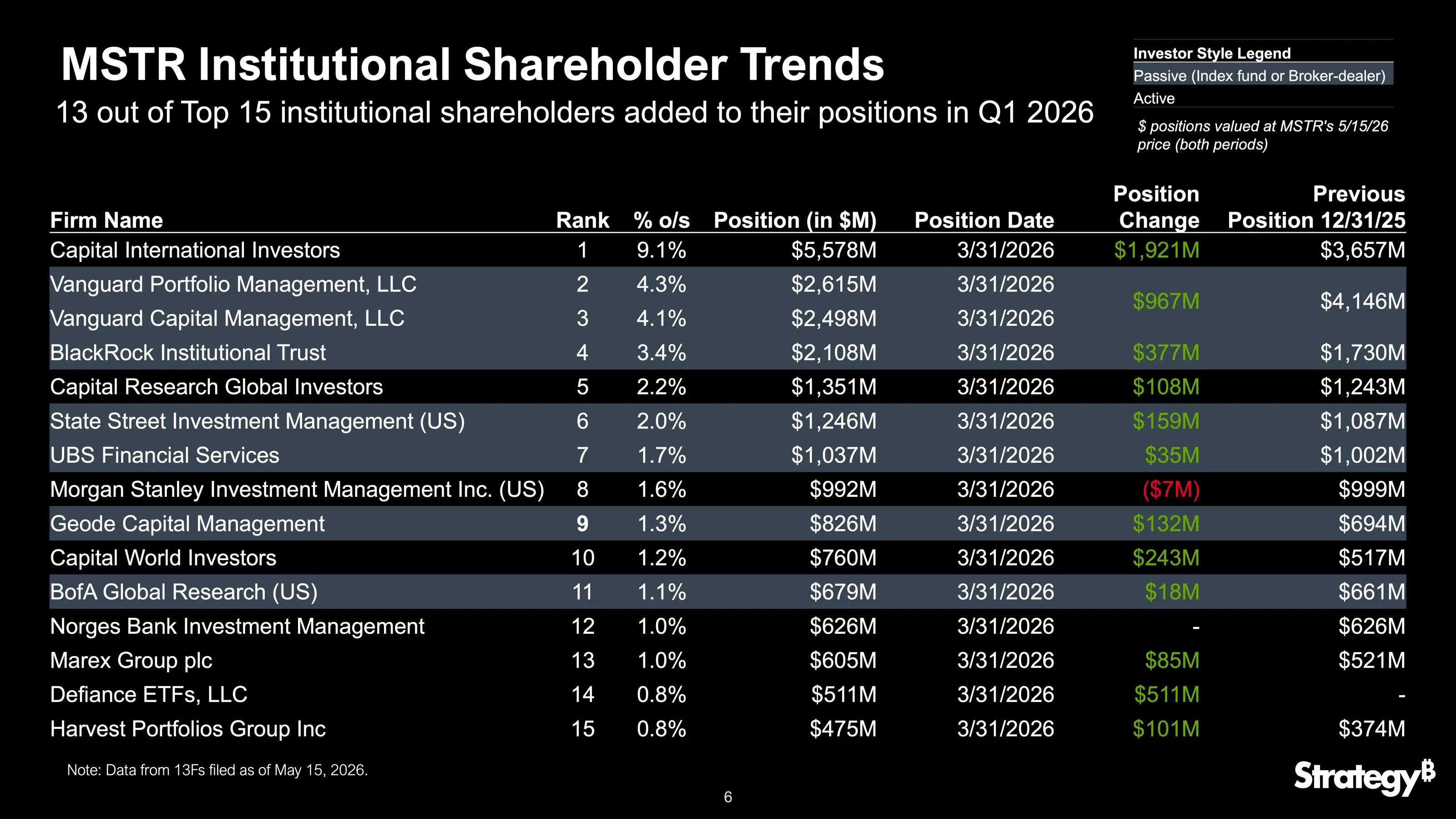
  • Strategy CEO: Among Q1 top 15 institutional shareholders, 13 increased MSTR holdings, total stake up 27%

What happened in the last 24 hours?

Strategy CEO: Among Q1 top 15 institutional shareholders, 13 increased MSTR holdings, total stake up 27%

ChainCatcher news: Strategy CEO Phong Le stated that in Q1 2026, 13 of Strategy's top 15 institutional shareholders increased their holdings of $MSTR, with their total stake growing by 27%.
Decentralized derivatives platform Variational completes $50M Series A led by Dragonfly Capital

ChainCatcher news, according to Fortune: Decentralized derivatives trading platform Variational announced the completion of a $50 million Series A funding round, led by Dragonfly Capital, with participation from Bain Capital Crypto and Coinbase Ventures.

Headquartered in the Cayman Islands, the company is committed to building an on-chain derivatives protocol for institutions and traditional financial traders. By aggregating liquidity from traditional finance and crypto markets, it aims to provide instantly tradable on-chain markets for real-world assets like oil and commodities. Its core product, the Omni platform, adopts a zero-fee model and incorporates liquidity pool mechanisms to enhance market depth and execution efficiency.

Variational stated that its goal is not to directly compete with centralized exchanges, but rather to connect multiple liquidity sources—including traditional financial market makers and mainstream crypto trading platforms—through a "brokerage" model to solve the "cold start" liquidity problem in on-chain markets.

NYSE parent ICE plans to launch compute futures market

ChainCatcher news, according to Bloomberg: Intercontinental Exchange (ICE), parent company of the New York Stock Exchange, announced plans to launch futures contracts based on "computing power," tracking changes in the cost of GPU and other compute resources supporting the AI industry. The product still requires regulatory approval.

Reportedly, ICE will partner with financial infrastructure company Ornn to develop a derivatives pricing system based on its GPU cost index, which will underpin the compute futures contracts.

Tether acquires all SoftBank-held shares in Twenty One Capital (XXI)

ChainCatcher news, according to an official announcement: Tether International announced the acquisition of all SoftBank-held shares in Twenty One Capital (XXI), becoming a larger controlling shareholder. Following the transaction, SoftBank-appointed board members of XXI have stepped down from the board as per the shareholder agreement.

Tether stated that this move reflects its long-term strategic commitment and confidence in XXI's Bitcoin-centric approach to building a listed company from the ground up. The announcement noted that SoftBank's early involvement provided XXI with significant institutional backing and governance experience, helping the company complete its initial phase layout. Tether will build upon this foundation to propel XXI into its next development stage.

Fintech company Mercury completes $200M financing led by TCV

ChainCatcher news, according to CNBC: Fintech company Mercury announced the completion of a new $200 million financing round, led by TCV, with participation from Sequoia Capital, Andreessen Horowitz (a16z), Coatue Management, and other institutions.

Mercury primarily provides banking services to startups. It currently serves over 300,000 clients and generates approximately $650 million in annualized revenue. The company noted that the recent AI startup boom has significantly driven demand for new company registrations and account openings, becoming a key growth driver.

Simultaneously, Mercury also announced receiving conditional approval from the U.S. Office of the Comptroller of the Currency (OCC) and plans to apply for a federal banking charter to expand lending and payment network (like Zelle) access capabilities, reducing dependence on partner banks. The company's founder stated that the future goal remains an independent listing rather than being acquired.

Goldman Sachs to serve as lead underwriter for SpaceX IPO

a16z likely becomes HYPE's largest external holder, accumulating over $356M

ChainCatcher news, according to on-chain analyst Ai姨 (@ai_9684xtpa) monitoring: a16z (@a16zcrypto) may have become the sixth-largest entity holding HYPE, and likely the largest external holder by scale, assuming the top five positions are occupied by entities within Hype's own ecosystem.

Data shows that a16z initiated a significant accumulation mode in August 2025, amassing a total of 9.18 million HYPE (approx. $356 million) at an average withdrawal price of $38.77. After deducting portions transferred to exchanges and market makers, approximately 8.844 million HYPE remain, distributed across dozens of addresses.

In just the past 11 hours, a16z accumulated an additional 206,000 HYPE (approx. $9.95 million). Since April 16, it has accumulated 2.35 million HYPE (approx. $102 million), and since the start of 2026, it has accumulated 4.92 million HYPE (approx. $183 million). Based on current prices, its unrealized profit per token has reached $79.29 million.

Coinbase, Kraken, and Gemini urge Senate to remove crypto token listing restriction clause

Deloitte acquires crypto infrastructure company Blocknative

ChainCatcher news: Deloitte announced on Tuesday that it has acquired crypto infrastructure company Blocknative primarily through a talent-focused acquisition. According to the announcement, the Blocknative team will in the future "focus on driving Web3 innovation within Deloitte's client ecosystem." Currently, Blocknative's website displays a notice stating the company "is winding down operations." Its Blocknative API and Gas Network services will also be gradually shut down, with operations expected to continue until June 19.

Founded in 2018, Blocknative is a blockchain infrastructure company specializing in real-time mempool monitoring, Gas fee prediction, and transaction management. It provides APIs and related tools for optimizing on-chain transactions; its Gas Network is a decentralized oracle network for providing real-time Gas fee data. This move comes amid a wave of consolidation within the broader crypto ecosystem, alongside increased crypto exposure from traditional firms like Deloitte. Deloitte now provides accounting, auditing, and other enterprise services to crypto companies.

Meme Trending List

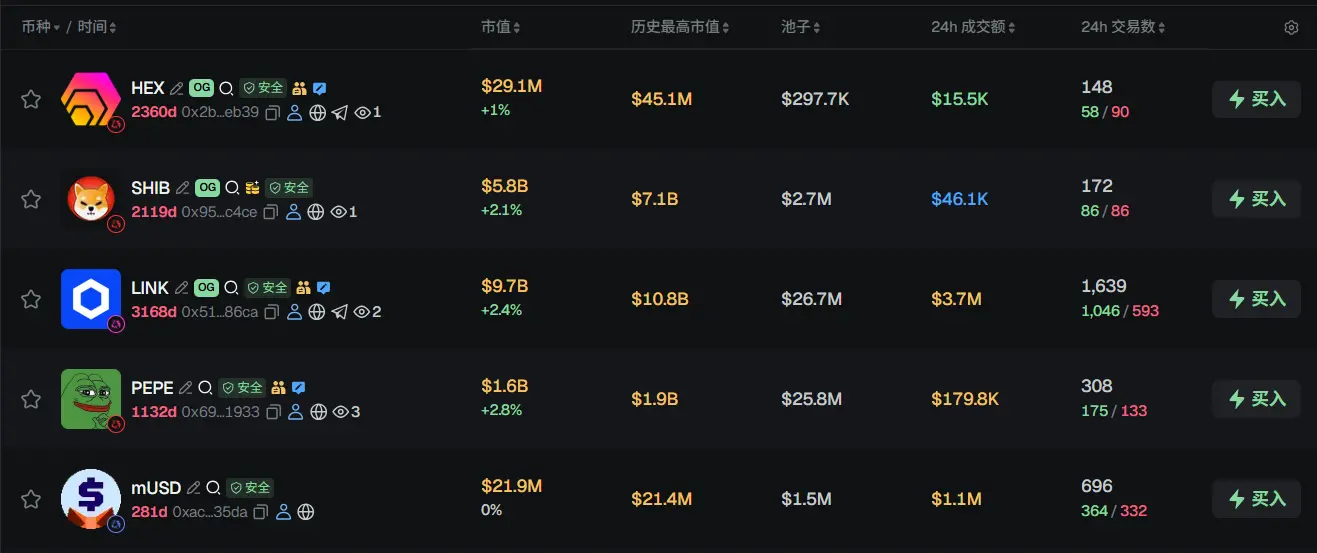
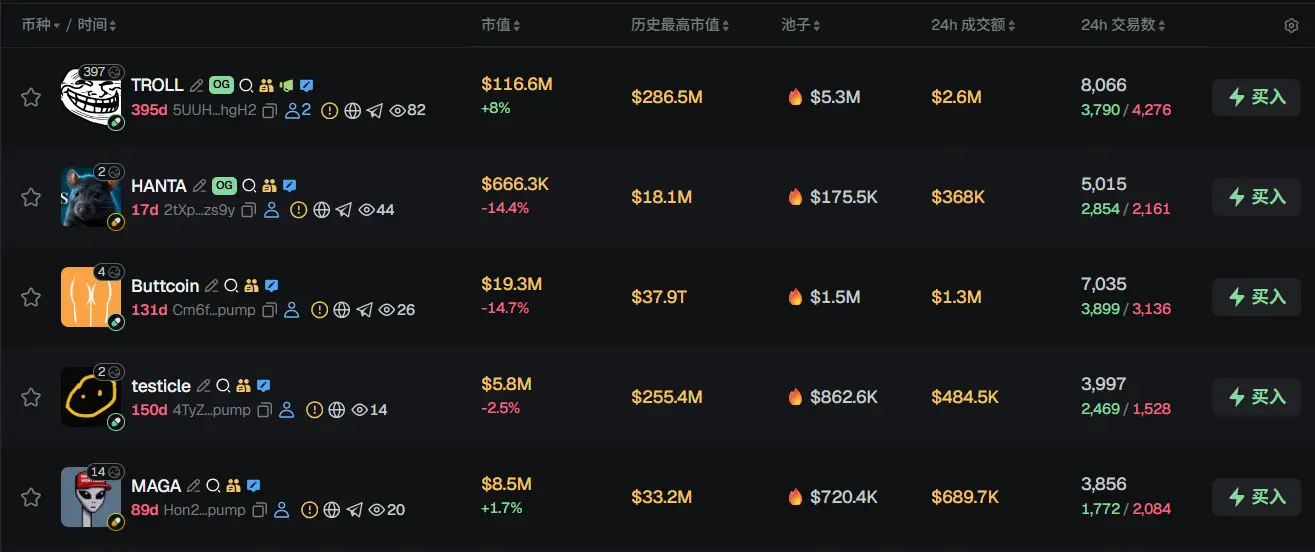
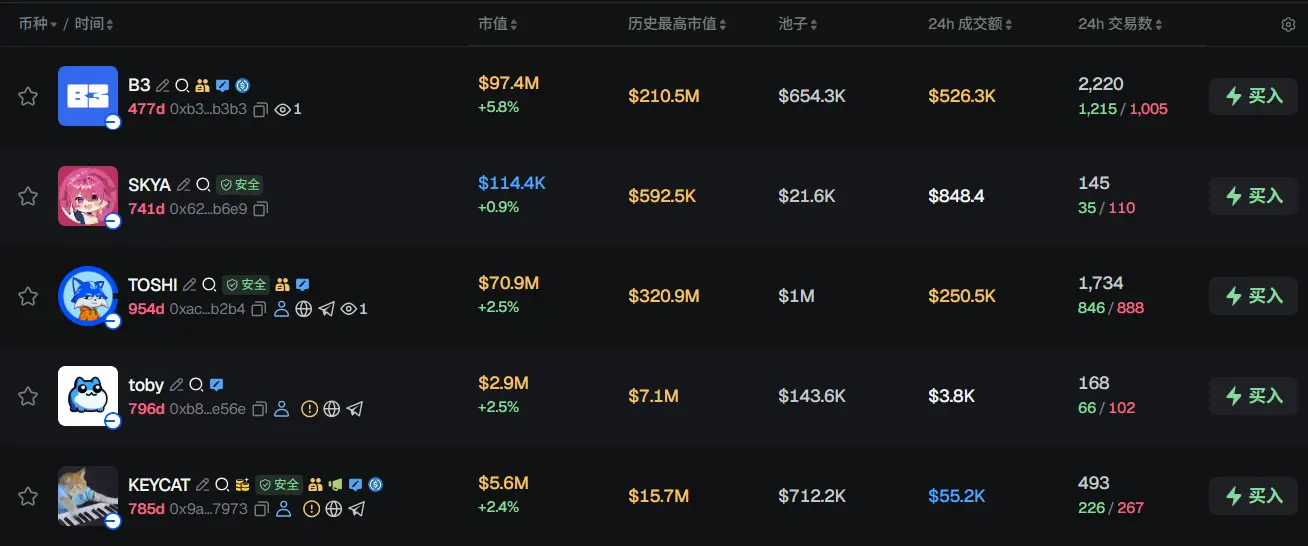
According to data from the Meme token tracking and analytics platform GMGN as of 09:00 May 21:

Top 5 trending tokens on ETH in the past 24h: HEX, SHIB, LINK, PEPE, mUSD
Top 5 trending tokens on Solana in the past 24h: TROLL, HANTA, Buttcoin, testicle, MAGA
Top 5 trending tokens on Base in the past 24h: B3, SKYA, TOSHI, toby, KEYCAT
What are the must-read articles from the past 24 hours?

Duan Yongping's First Crypto Company Investment: Why Circle?

Renowned investor Duan Yongping, hailed as the "Chinese Buffett," recently saw his family wealth management firm, H&H International Investment LLC, file its Q1 2026 13F holdings report with the U.S. SEC as of March 31.

According to the report, the total market value of Duan's investment portfolio surged from $17.49 billion last quarter to $20.004 billion. Besides continuing heavy positions in Apple (AAPL), Berkshire Hathaway (BRK.B), and Nvidia (NVDA), a new addition has drawn the attention of both the crypto industry and value investors: stablecoin giant Circle (NYSE: CRCL).

Harvard and Other Institutions Sell Off, Six Core Talents Depart in a Month: What's Happening with Ethereum?

Recently, the Ethereum Foundation has once again suffered a personnel shock, as core researchers Carl Beek and Julian Ma officially announced their departures.

This year, at least 7 core members or senior contributors have left one after another—from co-executive directors to protocol researchers, from upgrade coordinators to cryptography experts—sparking significant community concern over the foundation's stability and execution capabilities.

Simultaneously, institutional holdings data is emerging. Goldman Sachs reduced its BlackRock ETHA position by about 70%, Harvard University's endowment fund completely sold off its previously acquired roughly $87 million worth of Ethereum ETF holdings, and South Korea's seventh-largest pension relief company recorded an approximately $32.73 million loss from investing in an Ethereum leveraged ETF.

Additionally, the Ethereum Foundation recently unstaked 21,271 ETH from Lido and has repeatedly sold ETH on-chain for treasury rebalancing.

Core internal teams are leaving, large external capital is exiting, and the foundation itself is divesting. Ethereum is being 'voted with their feet' by different types of participants simultaneously.

Crypto Asset Recovery: A Lucrative, Quietly Profitable Business

Today in Hangzhou, I had a long conversation with a friend who specializes in crypto asset recovery.

They've handled quite a few cases over the past year, with individual project amounts typically starting at $1 million USD, some even higher. Before our chat, my understanding of this type of business was also quite superficial, assuming that so-called "crypto asset recovery" mainly involved more dramatic scenarios like theft, fraud, hacking attacks, and on-chain tracking. After our conversation, I discovered that what actually happens on a large scale are more mundane, specific, and often more frustrating issues for the parties involved.

The Tokenized Market Will Reach Trillion-Dollar Scale, But Four Major Hurdles Remain

We are at the dawn of a new financial era. Tokenization is no longer a niche experiment but rapidly evolving into a significant field, with institutions racing to lead one of the largest emerging asset classes, and capital allocators seeking more substantial returns here.

The question today is no longer whether trillions of dollars will move on-chain, but who will lead this process. This article explores the conditions needed to achieve this and the opportunities for operators and entrepreneurs building platforms to custody and trade trillions of dollars in assets.

Tokenized finance has already reached a considerable scale. Stablecoin circulation alone exceeds $300 billion, while the total market value of other tokenized financial assets (including money market funds, private credit, equities, commodities, etc.) surpasses $30 billion. Many of the world's largest asset managers, including BlackRock, Fidelity, and Franklin Templeton, have cumulatively onboarded billions of dollars in real-world assets onto the blockchain.


Preguntas relacionadas

QAccording to the article, which company was acquired by Deloitte through an acquisition focused on talent?

AAccording to the article, Deloitte has acquired the crypto infrastructure company Blocknative through a talent-focused acquisition.

QHow much funding did the stablecoin infrastructure company Checker complete?

AThe stablecoin infrastructure company Checker completed an $8 million funding round.

QWho is reported to have become the largest external institutional holder of HYPE?

AAndreessen Horowitz (a16z) is reported to have potentially become the largest external institutional holder of HYPE, with an accumulated position exceeding $356 million.

QWhat are the top five hottest meme tokens on the Ethereum network in the past 24 hours, as listed in the article?

AAccording to the article, the top five hottest meme tokens on the Ethereum network in the past 24 hours are: HEX, SHIB, LINK, PEPE, and mUSD.

QWhat new market does the NYSE's parent company ICE plan to launch according to the news?

AAccording to the article, the New York Stock Exchange's parent company, Intercontinental Exchange (ICE), plans to launch a futures market for 'computational power' or hashrate.

Lecturas Relacionadas

U.S. Government Bans Foreign Nationals from Using Fable 5, Anthropic Issues Rebuttal

U.S. Government Bans Foreign Access to Fable 5, Anthropic Issues Rebuttal On June 12th, the U.S. government ordered AI company Anthropic to immediately suspend all foreign access—including foreign nationals within the U.S. and Anthropic's own foreign employees—to its newly released Fable 5 and Mythos 5 AI models, citing national security concerns. This forced Anthropic to temporarily disable access to both models for all users globally, as it cannot technically differentiate user nationality at scale. The models, released just three days prior, represent Anthropic's highest public capability tier. Fable 5 is the first publicly available model from the advanced "Mythos" family, while Mythos 5 is a less-restricted version for approved cybersecurity and critical infrastructure partners. The government's directive was reportedly triggered by claims from another company that it could "jailbreak" Mythos 5, raising alarm within the Trump administration. Anthropic, in a detailed public statement, strongly challenged this rationale. The company argues the demonstrated "jailbreak" is a narrow, non-generalized technique that merely involves identifying minor, known software vulnerabilities—a capability common to other publicly available models like OpenAI's GPT-5.5 and routinely used by cybersecurity defenders. Anthropic stated it has complied with the order but disagrees with the government's standard, warning that applying it industry-wide would halt all new frontier model deployments. The company criticized the lack of a transparent, fact-based legal process and expressed confidence the situation stems from a misunderstanding. It is working to restore access and will release more technical details within 24 hours. Other Anthropic models remain unaffected.

链捕手Hace 18 min(s)

U.S. Government Bans Foreign Nationals from Using Fable 5, Anthropic Issues Rebuttal

链捕手Hace 18 min(s)

The Revelation from the Raydium Theft Incident: New DeFi Vulnerabilities Lurking in Forgotten Old Contracts

**Raydium Exploit Reveals DeFi's Hidden Risk: Forgotten "Zombie" Contracts** A recent attack on Raydium's deprecated V3 AMM pools resulted in a loss of approximately $1.34 million. The hacker exploited pools that were no longer supported by Raydium's current UI or SDK but remained fully functional and accessible on-chain. This incident highlights a critical, often overlooked category of risk in DeFi: inactive or legacy smart contracts that projects fail to properly decommission. Since March 2025, there have been at least 8 publicly reported attacks targeting such abandoned contracts, with total losses around $10.8 million. Including older pools and deprecated features, the count rises to 10 incidents with roughly $22.5 million in losses. These "zombie contracts" represent a lifecycle management failure rather than a code vulnerability, yet they are typically misclassified under general "code bug" categories in security reports, masking the true scale of the problem. The root cause is that projects often merely document a contract as "deprecated" without taking essential technical steps to secure it: withdrawing remaining assets, disabling external call functions, and implementing ongoing monitoring. These forgotten, under-monitored components become prime targets for attackers. To address this, the industry needs to recognize "zombie contracts" as a distinct risk category and establish standardized decommissioning protocols. Essential steps should include: 1) a formal retirement announcement, 2) removal of all front-end integrations, 3) withdrawal of locked assets, 4) disabling key contract functions, 5) ongoing security monitoring, 6) clear user communication, and 7) a post-mortem analysis. The value of a DeFi project lies not only in its current TVL but also in the security of its historical codebase, which has now become a new attack surface.

Foresight NewsHace 2 hora(s)

The Revelation from the Raydium Theft Incident: New DeFi Vulnerabilities Lurking in Forgotten Old Contracts

Foresight NewsHace 2 hora(s)

Robots Begin to 'Consume Data': The Hidden Production Chain from Indian Data Factories to Billion-Dollar Humanoid Robots

Robots have started to 'consume data,' driving the formation of a new industrial supply chain focused on producing training data for embodied AI. Unlike large language models, which are trained on vast internet text corpora, embodied AI models face a 'data desert' in the physical world. This has created a massive demand for first-person perspective video data (Ego Data), captured by workers wearing cameras in places like Indian garment factories. Companies like Neocambrian AI are establishing 'data factories' where workers perform standardized tasks (e.g., sorting clothes, kitchen organization) to generate thousands of hours of video. Research, such as NVIDIA's EgoScale, demonstrates that scaling this human demonstration data predictably improves robot performance, particularly for dexterous manipulation. This has validated a training path combining large-scale human data for pre-training with smaller amounts of robot-specific data for fine-tuning. The value of different data types varies significantly, forming a 'data pyramid.' The base consists of low-cost, large-scale internet and Ego Data. Higher layers include more expensive motion-capture data (e.g., from data gloves), simulation/synthetic data, and the most costly and scarce layer: real robot teleoperation data. This demand has spawned a layered ecosystem of data suppliers: low-cost data factories, motion capture and alignment specialists, robot-native teleoperation service providers, simulation data companies, and platforms aiming for data standardization. Robot companies themselves are adopting a 'layered procurement' strategy: outsourcing generic Ego Data while building in-house capabilities for robot-specific adaptation data and the critical deployment/failure data generated in real-world applications. The industry is shifting focus from hardware and basic mobility to the data pipelines required for general-purpose capability. While parallels exist to data labeling companies like Scale AI in the LLM boom, the physical complexity of robot data—involving action success ambiguity and sim-to-real gaps—requires more integrated solutions for data collection, annotation, and a continuous feedback loop. The race is on to build the data engines that will teach robots to operate reliably in the unstructured real world.

marsbitHace 4 hora(s)

Robots Begin to 'Consume Data': The Hidden Production Chain from Indian Data Factories to Billion-Dollar Humanoid Robots

marsbitHace 4 hora(s)

Trading

Spot
Futuros

Artículos destacados

Cómo comprar HYPE

¡Bienvenido a HTX.com! Hemos hecho que comprar Hyperliquid (HYPE) sea simple y conveniente. Sigue nuestra guía paso a paso para iniciar tu viaje de criptos.Paso 1: crea tu cuenta HTXUtiliza tu correo electrónico o número de teléfono para registrarte y obtener una cuenta gratuita en HTX. Experimenta un proceso de registro sin complicaciones y desbloquea todas las funciones.Obtener mi cuentaPaso 2: ve a Comprar cripto y elige tu método de pagoTarjeta de crédito/débito: usa tu Visa o Mastercard para comprar Hyperliquid (HYPE) al instante.Saldo: utiliza fondos del saldo de tu cuenta HTX para tradear sin problemas.Terceros: hemos agregado métodos de pago populares como Google Pay y Apple Pay para mejorar la comodidad.P2P: tradear directamente con otros usuarios en HTX.Over-the-Counter (OTC): ofrecemos servicios personalizados y tipos de cambio competitivos para los traders.Paso 3: guarda tu Hyperliquid (HYPE)Después de comprar tu Hyperliquid (HYPE), guárdalo en tu cuenta HTX. Alternativamente, puedes enviarlo a otro lugar mediante transferencia blockchain o utilizarlo para tradear otras criptomonedas.Paso 4: tradear Hyperliquid (HYPE)Tradear fácilmente con Hyperliquid (HYPE) en HTX's mercado spot. Simplemente accede a tu cuenta, selecciona tu par de trading, ejecuta tus trades y monitorea en tiempo real. Ofrecemos una experiencia fácil de usar tanto para principiantes como para traders experimentados.

205 Vistas totalesPublicado en 2024.12.11Actualizado en 2026.06.02

Cómo comprar HYPE

Discusiones

Bienvenido a la comunidad de HTX. Aquí puedes mantenerte informado sobre los últimos desarrollos de la plataforma y acceder a análisis profesionales del mercado. A continuación se presentan las opiniones de los usuarios sobre el precio de HYPE (HYPE).

活动图片