On September 7th, domestic GPU company Moore Threads hit the 20% limit down in early trading on the STAR Market. This marks the first time the company has experienced a 20% limit down since its listing on the STAR Market in December 2025.
As of the midday close, the company's stock price stood at 415.48 yuan, down 103.87 yuan or 20.00% from the previous trading day. Its total market capitalization fell below the 200 billion yuan mark, settling at approximately 195.3 billion yuan.
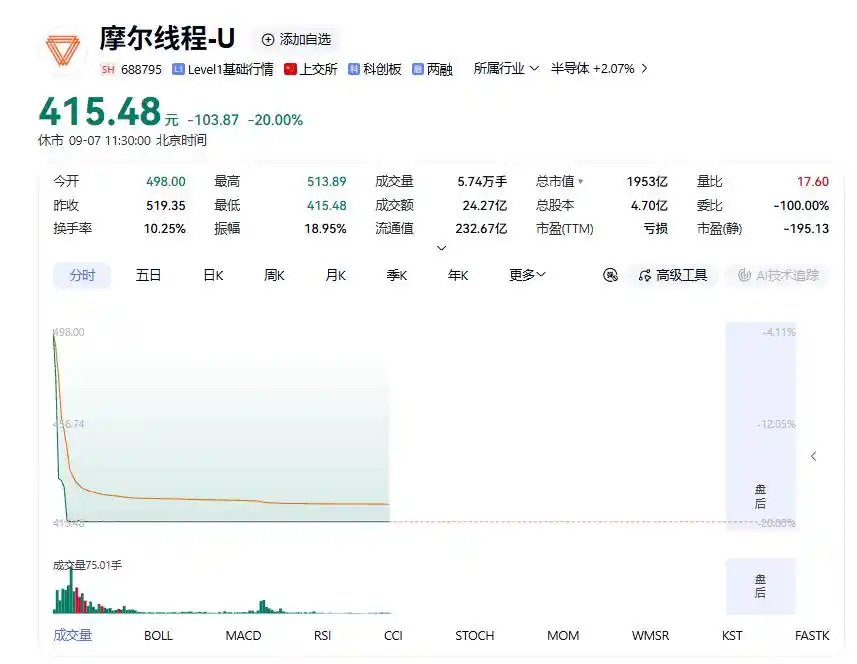
The direct trigger for this sharp stock price movement was the large-scale lifting of sales restrictions on shares. According to the company's previous announcement, on September 7th, a total of 25.7745 million shares of IPO offline placement shares became tradable upon the lifting of their sales restrictions. These shares account for 5.48% of the company's total share capital and were subject to a lock-up period of 9 months from the listing date. Based on the closing price of 519.35 yuan per share on September 4th, the market value corresponding to this batch of shares is approximately 13.386 billion yuan.
Prior to this lifting, Moore Threads had only 30.2255 million shares in public circulation. After the restriction lift, the number of publicly traded shares will increase to 56 million, nearly doubling the public float. For STAR Market stocks, which are often newly listed and have a relatively small public float, such a concentrated release of a large volume of tradable shares created significant selling pressure in the secondary market in the short term, serving as the core driver behind the stock price hitting the limit down.
From a broader market perspective, according to Wind data, a total of 16 listed companies had restricted shares becoming tradable on September 7th, with a combined volume of 521 million shares and a corresponding market value of approximately 27.785 billion yuan. Moore Threads' lifted shares were among the largest in terms of value on that day.
In response to the limit-down incident, Moore Threads quickly issued an official statement.
The company's securities affairs representative stated in an interview with the media that the day marked the lifting of restrictions on a large volume of shares from the offline placement during the IPO, which is a normal post-listing capital market event. The shares becoming tradable mainly belong to mutual fund institutions and offline investors who participated in the IPO subscription. The representative also emphasized that the company's current production and operations are normal, with no significant changes in its fundamentals. The company called on investors to rationally view the stock price fluctuations caused by the lifting and make rational investment decisions.
Other company personnel also told the media that this lifting of restrictions represents the normal expiration of the lock-up period for IPO shares, and the market does not need to overinterpret it.
From an operational perspective, the company's latest interim report data supports the assessment of stable fundamentals.
In the first half of 2026, Moore Threads achieved operating revenue of 1.736 billion yuan, a significant year-on-year increase of 147.42%, with revenue scale already surpassing the full-year 2025 level. Gross profit reached 989 million yuan, up 103.78% year-on-year, indicating synchronized improvement in profitability. On the profit front, the company's net profit attributable to shareholders and net profit attributable to shareholders after deducting non-recurring items narrowed by 95.73% and 52.37% year-on-year, respectively, showing significant reduction in losses and continuous improvement in profitability.
As a core player in the domestic GPU sector, Moore Threads continues to advance its product line layout in areas such as desktop graphics cards and data center GPUs. The industry logic of import substitution remains a long-term focus for the market.
It is worth noting that this lifting of restrictions is not the largest one for Moore Threads post-listing.
According to the IPO prospectus schedule, on December 7th, 2026, the company will face an even larger wave of lifted restrictions, with 185.9064 million restricted shares becoming tradable, accounting for 39.55% of the total share capital, leading to a more substantial expansion of the public float.
Some market analysts point out that short-term stock price volatility caused by the lifting of share restrictions is a normal market phenomenon. The medium- to long-term trend of a stock ultimately depends on the company's fundamentals and industry growth logic. Future developments in domestic GPU technology iteration and commercialization progress will be the core variables affecting the company's valuation.
Source: Galaxy Business Observation
This article is from "ZAKER Finance"