Money Has Gone to Bonds and IPOs, Leaving Only HYPE Rising in Crypto

marsbitPublicado a 2026-05-19Actualizado a 2026-05-19

Resumen

The article "Where Has All the Money Gone? Bonds and IPOs Are Soaring, While Crypto Only Sees HYPE Rising" analyzes the recent underperformance of major cryptocurrencies like Bitcoin and Ethereum compared to traditional financial markets. It identifies three primary factors diverting capital away from crypto: First, surging bond yields, with the 30-year U.S. Treasury hitting a near 20-year high of 5.12%, are attracting capital seeking safe, predictable returns. This is evidenced by Bitcoin spot ETFs experiencing a significant $10.39 billion net outflow in mid-May. Second, a massive $4 trillion IPO pipeline, highlighted by SpaceX's upcoming listing, is absorbing risk capital that might otherwise flow into crypto. Platforms like Hyperliquid are even channeling on-chain crypto liquidity into pre-IPO trading for traditional stocks. Third, uncertainty surrounds new Federal Reserve Chair Warsh's ability to deliver expected interest rate cuts this year due to conflicting political pressures and stubborn inflation expectations, potentially eliminating a hoped-for source of new market liquidity. Consequently, while traditional equities and bonds rally, the crypto market's post-leverage crash recovery is stalled. The notable exception is assets like Hyperliquid (HYPE), which is rising due to its role in facilitating traditional asset trading, underscoring a market divergence where only crypto projects with novel, cross-market narratives are gaining. The article concludes that Bitcoin...

Where has all the money gone?

The S&P 500 hit new all-time highs last week, and the Nasdaq completed a nearly seven-week winning streak. The 30-year US Treasury yield surged to 5.12%, the highest since 2007. SpaceX's Pre-IPO contracts on Hyperliquid saw $40 million in turnover on the first day.

Money is pouring in everywhere—except into crypto. BTC, which had just climbed above $82,000 on May 14th, has since tumbled below $77,000 in recent days. ETH fared no better, dropping nearly 10% over the week from the $2,300 range down to $2,110. Solana completely erased its recent gains, falling from a high near $100 back to $84. It seems nothing in the major crypto space is holding strong, except for HYPE.

Why is crypto, as a risk asset, falling behind alone?

30-Year Bond Yields Hit Nearly 20-Year High

The bond market is once again becoming the gravitational center for global capital.

The yield on the 30-year US Treasury bond has reached its highest level since June 2007, rising from 4.63% at the end of February to 5.12%. Meanwhile, the 10-year yield touched 4.6%, and the two-year yield climbed to 4.08%.
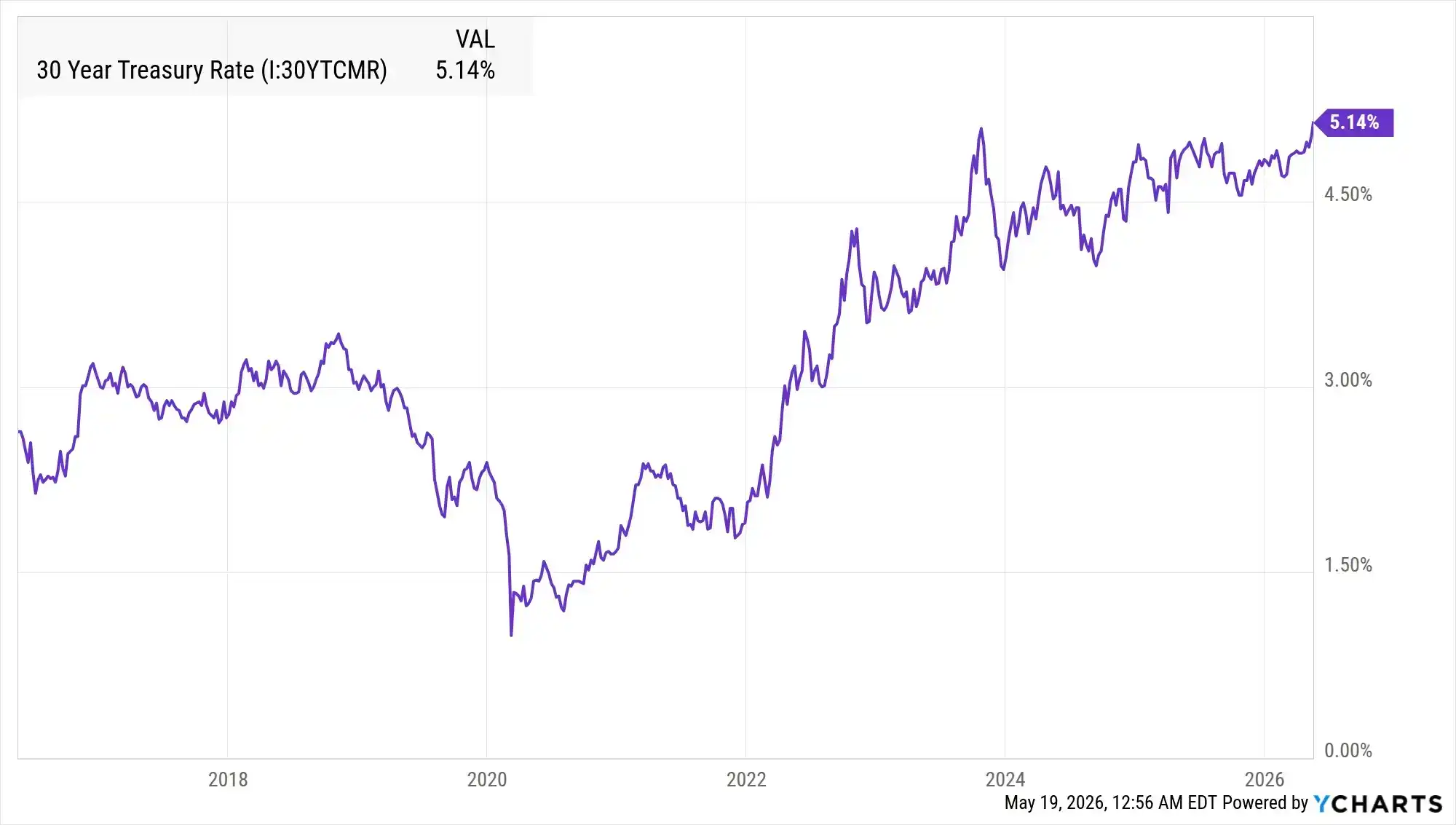
It's not just the United States. In a report on Sunday, May 17th, Apollo Global Management chief economist Torsten Slok stated that the yields on government bonds with maturities of 10 years or longer across G7 nations have collectively reached their highest levels since 2004, all approaching 5%.

Government fiscal deficits are expanding worldwide, necessitating more borrowing and bond issuance. The US fiscal deficit remains around 6% of GDP. Rising borrowing costs make it harder for governments to spend their way out of crises, precisely at a time when many countries face crises due to war.

In a report on May 18th, Deutsche Bank's Jim Reid noted that bond issues are likely to be on the agenda for the two-day G7 finance ministers' meeting opening that day in Paris. However, the structural problems in the bond market cannot be solved by any single ministerial meeting.

At a time of heightened geopolitical tension, global capital favors assets with more certain returns.

The outflow data from Bitcoin ETFs also corroborates this point.
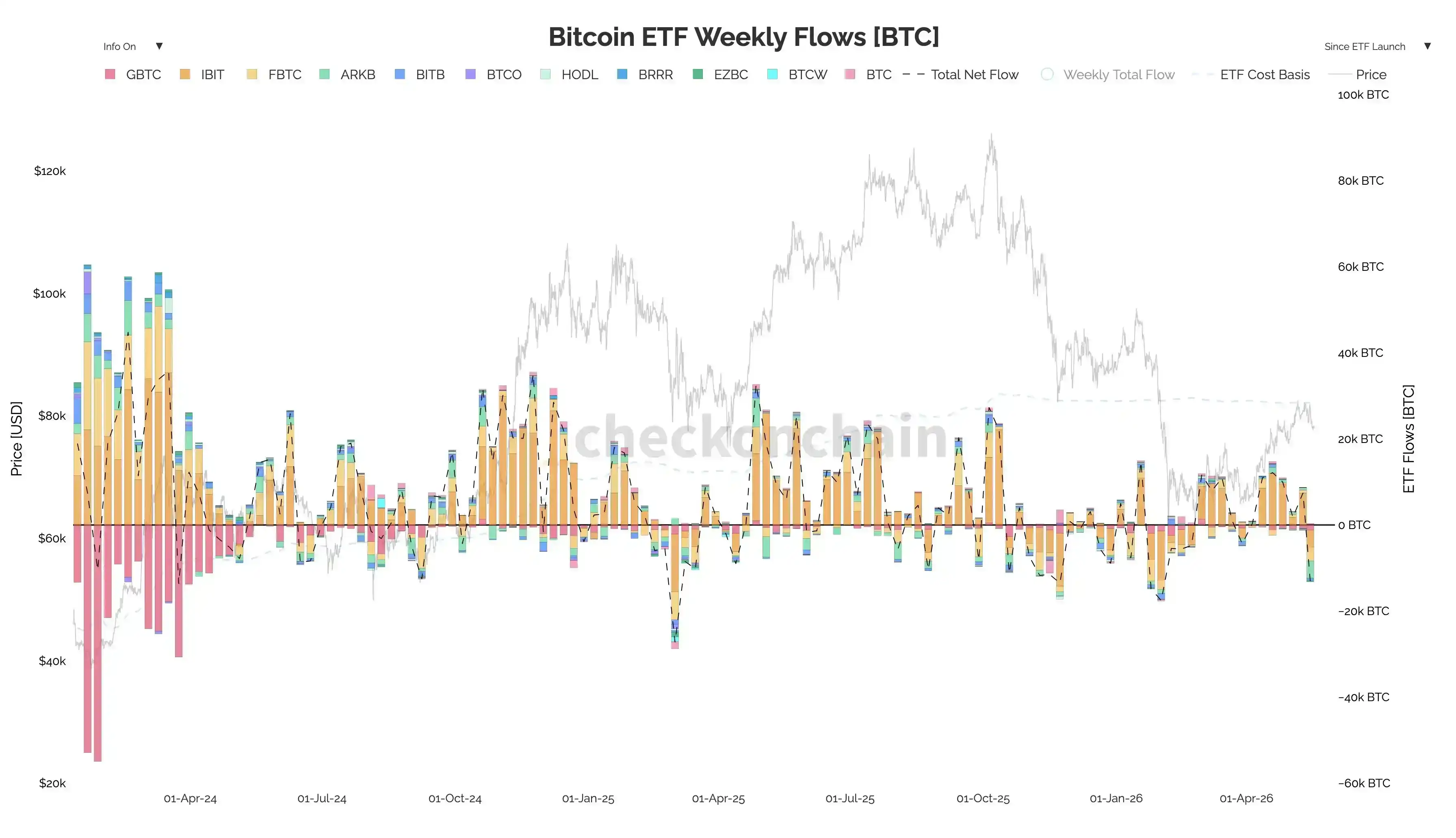
According to SoSoValue data, Bitcoin spot ETFs saw a net outflow of $1.039 billion for the week of May 11th to May 15th, ending six consecutive weeks of net inflows. This was also the largest weekly outflow since the end of January.

Drilling down to specific products, ARKB had a weekly net outflow of $324 million, and IBIT saw a net outflow of $317 million, with both leading products bleeding simultaneously. The intraday data paints an even sharper picture. There was a net outflow of $233 million on May 12th, a single-day withdrawal of $635 million on May 13th, and on Friday, May 15th, the 11 Bitcoin ETFs collectively experienced another outflow of $290 million. This indicates institutional funds are exiting in an orderly fashion.

Comparing with data from previous weeks highlights the force of this reversal. The week of April 17th saw nearly $1 billion in net inflows, the week of April 24th had $824 million in net inflows, and the week of May 8th still recorded $623 million in net inflows. The funding situation reversed from "sustained inflows" to "a $1 billion weekly outflow" within a single week.

Concurrently, Ethereum ETFs also saw a net outflow of $255 million, marking five consecutive days of negative outflows. The funding landscape for the entire crypto ETF asset class collectively turned downward in mid-May.

As the bond market's attractiveness grows, crypto's relative appeal naturally diminishes passively.

$4 Trillion in IPOs: How Can Crypto Compete?

Bonds are siphoning off funds with little risk appetite. IPOs are capturing risk capital, which constitutes the most direct liquidity drain for crypto.

There are $4 trillion worth of IPOs queued up for 2026, waiting to compete for capital. This is a figure substantial enough to reshape the map of global capital allocation.

SpaceX has become the next concentrated market focus. In this environment, Pre-IPO and new listing strategies offer an attraction that bonds cannot provide—non-linear wealth effects.

Meanwhile, the AI narrative remains the dominant theme of 2026. In a report on May 15th, Evercore analysts pointed out that US economic data shows demand remains strong, especially with a surge in AI-related capital expenditures. The flip side of this AI capital spending boom is the life-changing wealth effects created by AI leaders in the secondary market.

The return efficiency of names like Nvidia and Cerebras makes any crypto narrative seem less appealing by comparison.

More glaringly, even on-chain activity is helping traditional markets pull in money.

On the night SpaceX debuted on Trade.xyz, the Pre-IPO contracts on Hyperliquid saw $40 million in turnover on the first day. The HIP-3 platform is using perpetuals to facilitate price discovery for traditional stocks. Hyperliquid itself rose 10% to $45 for the week, becoming the only major crypto asset to buck the downtrend. Related reading: The Biggest Winner of the SpaceX IPO Might Be Trade.xyz.

In the short term, this is not exactly good news for crypto-native assets.

On-chain liquidity is being directed to price discovery for traditional stock targets like SpaceX, rather than flowing back to Bitcoin, ETH, or Solana. Even Hyperliquid's gains are not fundamentally driven by crypto narratives, but rather by the dividends of traditional asset narratives.

Warsh Takes Over, But Rate Cuts May Be Off the Table

While the bond and IPO markets are draining liquidity from the crypto space, looking at the Federal Reserve, the anticipated new liquidity injection might not materialize either.

Powell's term ended on May 15th. Warsh was confirmed by the Senate as the new Federal Reserve Chair last week and is currently awaiting formal appointment committee approval from the President and completion of asset clearance to comply with ethics regulations.

And even before officially taking the oath, Warsh already faces some tough problems.

Trump nominated Warsh partly because he hoped Warsh would be more cooperative than Powell with the White House's cost-cutting agenda. Treasury Secretary Bessent has consistently included lowering the government's borrowing costs as a core part of the White House's cost-cutting promises over the past few months. He laid it out clearly in his speech at the New York Fed last autumn: lowering government borrowing costs means lower corporate borrowing costs, lower mortgage rates, lower car loan payments—improving affordability for all Americans.

But as mentioned earlier, today's reality is that the bond market has pushed five-year inflation expectations to 2.7%, the highest since 2023. Yardeni Research directly pointed out in a report on May 17th that a two-year Treasury yield of 4.08% is the market using price to signal to the Fed that the current target range of 3.50%-3.75% is set too low.

By Warsh's own logic, he should continue raising rates, or at least not cut them. But the White House, especially Trump himself, has made its political desire for rate cuts almost public.

On the other hand, those who heard Warsh's pre-confirmation hearing remarks know he spent considerable time discussing AI. He believes AI will boost productivity, suppress inflation, and thus supports rate cuts. The problem is, short-term data shows no signs of this happening.

The view of José Torres, a senior economist at Interactive Brokers, already represents a large segment of opinion. In a report on May 15th, he wrote the assessment that, due to lack of progress in geopolitical conflicts, the market has abandoned bets on room for further rate hikes.

If Warsh chooses to succumb to Trump's political pressure and forces a rate cut, the bond market will respond with even higher long-end yields, making all duration-sensitive assets even more uncomfortable. If Warsh chooses a hawkish stance, then rate cut expectations for this year are directly off the table, and the market's bets on liquidity easing all need to be repriced.

This means the bets placed over the past few months on Warsh cutting rates upon taking office may be completely overturned.

HYPE Leads Crypto Gains

After October 10th, the recovery period following the crypto market's deleveraging should have been fueled by the return of new capital.

With $4 trillion in IPOs queued for 2026 and AI names continuing to generate wealth effects, the appeal of altcoin trades is being persistently diluted in this environment. Even Bitcoin, the most institutionally-favored crypto asset, is beginning to cede ground to traditional markets. The $1 billion weekly outflow from ETFs is the most direct evidence.

High bond yields, Bitcoin ETF outflows. The recovery period is being drawn out indefinitely, and crypto consistently fails to catch up with the overall upward pace of risk assets.

However, it's worth noting that some differentiation trends are already emerging within the broader crypto market.
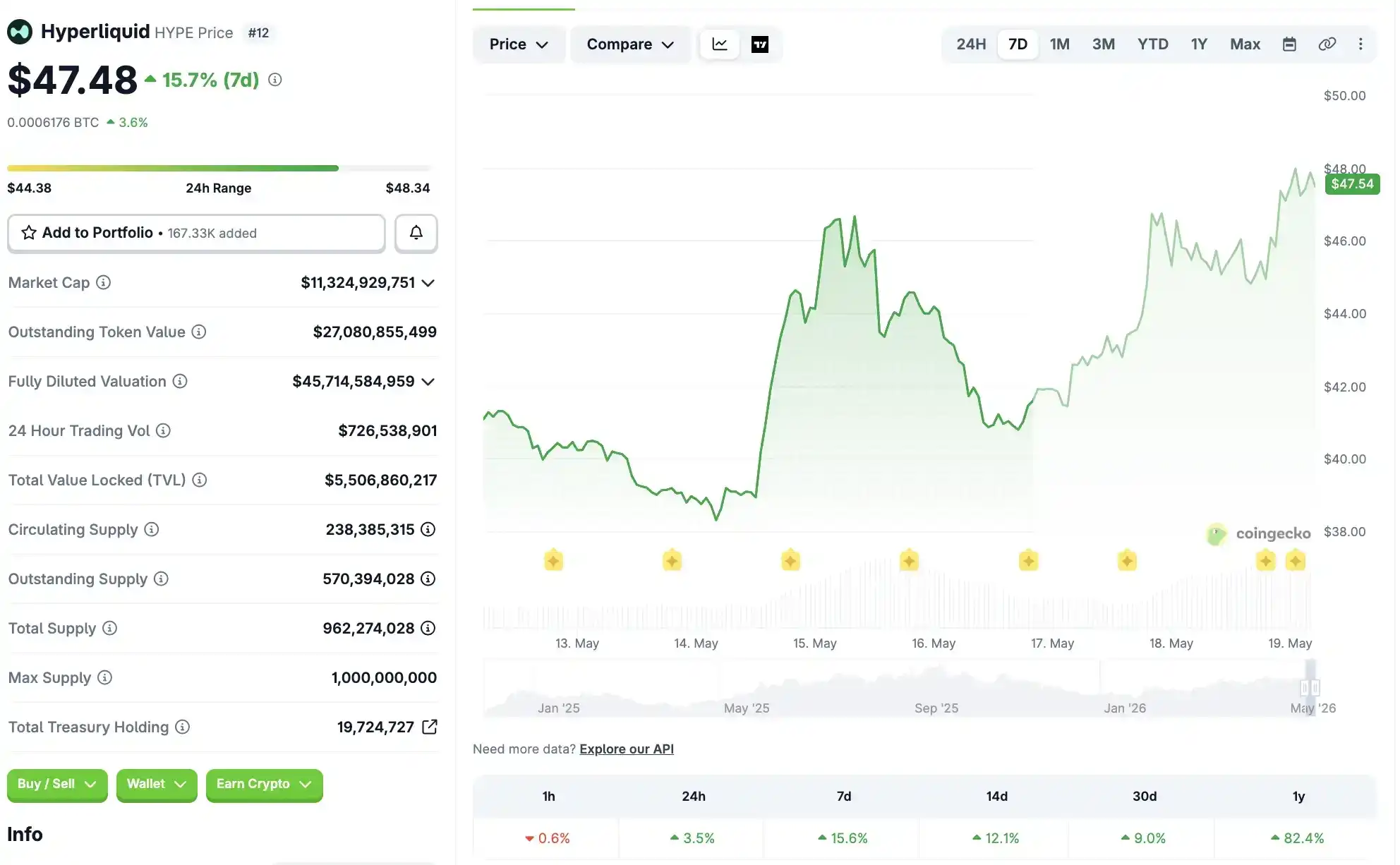
Hyperliquid rose 15% weekly to $48, with a year-to-date gain of 69%, precisely riding on the Pre-IPO price discovery narrative enabled by HIP-3. Assets that can tell new stories and capture entry points into traditional markets are still rising, while assets relying purely on beta are being compressed in pricing. Even Bitcoin has to take a back seat.

Zooming out to view the broader financial market reveals three forces simultaneously draining liquidity from the crypto space over the past few weeks. The bond market is pulling risk-averse money back with 5% yields, IPOs are capturing incremental risk budgets with a $4 trillion queue, and the new Fed Chair Warsh, upon taking office, may be unable to deliver on this year's rate cut expectations.

However, there are still potential catalysts for Bitcoin's next phase.

The upside catalyst is the enactment of the CLARITY Act in August. This is the biggest policy tailwind window for crypto this year, and increased regulatory certainty could directly release some pent-up institutional demand.

The downside risk is that before this catalyst materializes, we may need to retest the $70,000 level. If the current $77,000 level fails to hold, the next effective support is likely around $70,000.


Preguntas relacionadas

QWhat is the main point of the article regarding the current state of the crypto market?

AThe main point is that capital is being diverted away from the crypto market towards traditional assets. Specifically, it highlights that money is flowing into high-yield bonds (like the 30-year US Treasury) and into traditional IPOs (with a $4 trillion pipeline), leaving the crypto market behind and causing major assets like Bitcoin and Ethereum to decline. The only crypto asset seeing gains is HYPE, which benefits from a narrative tied to traditional finance.

QAccording to the article, what are the three forces currently draining liquidity from the cryptocurrency circle?

AThe three forces draining liquidity from the crypto market are: 1) The bond market, offering high yields (e.g., 5.12% for 30-year US Treasuries), pulling away risk-averse capital. 2) The traditional IPO market, with a $4 trillion pipeline of upcoming listings, competing for and absorbing risk capital. 3) The uncertainty around the Federal Reserve's future interest rate policy under the new Chairman Warsh, which threatens the expected liquidity injection from potential rate cuts.

QWhat does the article say about the performance of Bitcoin ETFs and what does this indicate?

AThe article states that Bitcoin spot ETFs experienced a net outflow of $1.039 billion for the week of May 11-15. This ended six consecutive weeks of inflows and was the largest weekly outflow since late January. It indicates that institutional money is making an organized retreat from the crypto market, likely due to the increased attractiveness of yields in traditional bonds.

QHow does the article describe the situation with the new Federal Reserve Chairman, Kevin Warsh?

AThe article describes a dilemma for the new Fed Chairman, Kevin Warsh. On one hand, there is significant political pressure from the Trump administration for him to cut interest rates to lower government borrowing costs. On the other hand, the bond market's high yields signal that inflation expectations are elevated, suggesting that current rates might be too low and that a rate hike or hold would be more appropriate. The article suggests his earlier dovish stance based on AI productivity gains may be challenged by short-term data, and markets may have to revise their expectations for rate cuts in 2026.

QWhat is one potential upcoming positive catalyst for Bitcoin mentioned in the article, and what is a key downside risk?

AOne potential positive catalyst for Bitcoin is the August enactment of the 'CLARITY Act', which is described as the biggest policy tailwind for crypto this year, as it would provide greater regulatory clarity and potentially unlock institutional demand. A key downside risk mentioned is that Bitcoin may need to retest the $70,000 support level if it fails to hold above $77,000 before that catalyst materializes.

Lecturas Relacionadas

Musk Posted a Recruitment Ad for SpaceX, and After Reading the Comments Section, I Understood

On May 20th, SpaceX filed for a landmark IPO with a $1.75 trillion valuation. Shortly after, Elon Musk posted a recruitment call on X, seeking "world-class engineers and physicists" for SpaceX. The application process was starkly simple: email with three bullet points proving "exceptional ability," with real, complex projects as a plus. Musk promised to review qualifying emails himself. The post garnered millions of views and thousands of replies, revealing a spectrum of responses. Most comments, including a highly-upvoted humorous one listing absurd "skills," merely listed credentials or experiences in a conventional, non-differentiating way. This highlighted a key insight: a traditional resume listing degrees and skills often fails to demonstrate true exceptionalism. Effective self-presentation requires "performance efficiency." A standout reply came from an OpenAI engineering lead, who simply stated "codex." This demonstrated that for those who have built significant, recognized products, the product itself becomes the ultimate resume. The article argues that in the AI era, any tangible, shareable output—a tool, research, or online project—serves as a living, self-evident credential more powerful than a list of attributes. However, a twist emerged when applicants found the provided email address non-functional, leading to speculation that the post might also serve as an IPO publicity stunt, projecting an image of aggressive talent acquisition to investors. Ultimately, the episode served as a microcosm: some participate through performance, others through proof of work, while some question the reality of the stage itself. It underscores the enduring challenge of defining and demonstrating value in an age of abundant, yet often superficial, content.

marsbitHace 7 min(s)

Musk Posted a Recruitment Ad for SpaceX, and After Reading the Comments Section, I Understood

marsbitHace 7 min(s)

Cutting Off OpenAI, Anthropic Acquires the Tool Provider Used by a Quarter of Global Developers

Anthropic has acquired Stainless, a developer tool company that automatically generated official SDKs (Software Development Kits) for AI giants including OpenAI, Anthropic, Meta, and Cloudflare. The deal, reportedly valued at around $300 million, marks a strategic shift for Anthropic as it builds its "AI agent" infrastructure. Stainless acted as a "translator," converting complex API specifications into ready-to-use code libraries for developers. Its tools indirectly reached about a quarter of professional software developers globally. Following the acquisition, Stainless will shut down its public products and its team will join Anthropic to focus on internal platform development, notably for the Claude Platform. Existing SDKs remain with their respective client companies but will no longer receive updates from Stainless. This move is part of Anthropic's broader 18-month strategy to assemble a complete "agent stack." The stack consists of the Claude model at its core, the newly acquired Stainless for standardized API interfaces, and the Model Context Protocol (MCP), an open standard for connecting agents to external tools and data. This contrasts with OpenAI's focus on model generations and consumer-scale compute. Anthropic believes an agent's ultimate utility depends on its ability to connect to external systems. By internalizing the SDK layer and promoting MCP as a connection standard, Anthropic aims to lock in long-term ecosystem advantages and create path dependency, moving beyond the transient lead provided by any single model generation.

marsbitHace 9 min(s)

Cutting Off OpenAI, Anthropic Acquires the Tool Provider Used by a Quarter of Global Developers

marsbitHace 9 min(s)

Bankless Founder Sells Off ETH, Collective Collapse of Ethereum Faith

Ethereum faces a "crisis of faith" as David Hoffman, co-founder of the prominent pro-Ethereum media outlet Bankless, announces he has sold all his ETH. This move, coupled with reports of major layoffs at Bankless, signals a potential retreat of Ethereum's staunchest supporters. Hoffman and co-founder Ryan Sean Adams confirm Bankless is entering a "second era," with Adams stepping back and Hoffman exploring new frontiers. Hoffman sharply criticizes the Ethereum Foundation, stating that ETH's poor price performance cannot be separated from its leadership. He has a history of public dissatisfaction, citing the Foundation's failure to drive market growth and its "endless manifestos." His frustration coincides with ETH/BTC hitting multi-month lows and a significant exodus of senior researchers and executives from the Ethereum Foundation, partly attributed to controversial "loyalty oaths." The article contrasts Ethereum's current predicament—with its Layer-2 narrative discredited and ecosystem stagnant—against what should have been a highlight year in 2026 amid tokenization trends. While a previous surge to near $5,000 was driven by corporate buybacks (DAT热潮), ETH has since fallen over 50%. The core question remains: with fading faith and intense competition, what is Ethereum's next solution? Hoffman's divestment symbolizes a growing disconnect between the community and the ecosystem's direction.

Odaily星球日报Hace 32 min(s)

Bankless Founder Sells Off ETH, Collective Collapse of Ethereum Faith

Odaily星球日报Hace 32 min(s)

a16z Invests Heavily with $356 Million in HYPE, Surpassing Paradigm to Become the Largest External Holder

On May 21st, HYPE surged past $59, reaching a new high since September 2025, with a market cap nearing $150 billion. Analysts attribute the rally to a short squeeze and significant ETF inflows. The launch of two U.S. spot ETFs for Hyperliquid has driven substantial capital, with their inflows at times surpassing those of Bitcoin and Ethereum ETFs. Major institutions are actively accumulating HYPE. Venture firm a16z has become the largest external holder with a $356 million position, surpassing Paradigm. Other firms like Goldman Sachs, Grayscale, and Galaxy Digital have also made large purchases, with Goldman reportedly selling portions of its XRP, ETH, and BTC holdings to buy HYPE. Bitwise CIO Matt Hougan calls HYPE one of the most "mispriced" assets, arguing its valuation should reflect Hyperliquid's broader platform beyond just a perpetual DEX token. The protocol generates substantial real revenue, using 97% of fees to buy back and burn HYPE. Its expansion into RWA commodities and prediction markets has driven user growth and transaction volume, now commanding about 70% of the on-chain perpetual DEX market. However, this rapid growth faces challenges. Traditional exchanges CME and ICE are pressuring the CFTC to regulate Hyperliquid, citing concerns over its impact on global commodity benchmarks. Concurrently, some major market makers have withdrawn significant liquidity from the platform. With HYPE up over 125% year-to-date, operational risks are rising. Large holders are reportedly hedging with sizable short positions. The regulatory outlook from the CFTC remains a key uncertainty, adding another layer to the ongoing battle over the future of on-chain finance.

链捕手Hace 33 min(s)

a16z Invests Heavily with $356 Million in HYPE, Surpassing Paradigm to Become the Largest External Holder

链捕手Hace 33 min(s)

Trading

Spot
Futuros

Artículos destacados

Qué es $S$

Entendiendo SPERO: Una Visión General Completa Introducción a SPERO A medida que el panorama de la innovación continúa evolucionando, la aparición de tecnologías web3 y proyectos de criptomonedas juega un papel fundamental en la configuración del futuro digital. Un proyecto que ha atraído la atención en este campo dinámico es SPERO, denotado como SPERO,$$s$. Este artículo tiene como objetivo reunir y presentar información detallada sobre SPERO, para ayudar a entusiastas e inversores a comprender sus fundamentos, objetivos e innovaciones dentro de los dominios web3 y cripto. ¿Qué es SPERO,$$s$? SPERO,$$s$ es un proyecto único dentro del espacio cripto que busca aprovechar los principios de descentralización y tecnología blockchain para crear un ecosistema que promueva la participación, la utilidad y la inclusión financiera. El proyecto está diseñado para facilitar interacciones de igual a igual de nuevas maneras, proporcionando a los usuarios soluciones y servicios financieros innovadores. En su esencia, SPERO,$$s$ tiene como objetivo empoderar a los individuos al proporcionar herramientas y plataformas que mejoren la experiencia del usuario en el espacio de las criptomonedas. Esto incluye habilitar métodos de transacción más flexibles, fomentar iniciativas impulsadas por la comunidad y crear caminos para oportunidades financieras a través de aplicaciones descentralizadas (dApps). La visión subyacente de SPERO,$$s$ gira en torno a la inclusividad, buscando cerrar brechas dentro de las finanzas tradicionales mientras aprovecha los beneficios de la tecnología blockchain. ¿Quién es el Creador de SPERO,$$s$? La identidad del creador de SPERO,$$s$ sigue siendo algo oscura, ya que hay recursos públicos limitados que proporcionan información de fondo detallada sobre su(s) fundador(es). Esta falta de transparencia puede derivarse del compromiso del proyecto con la descentralización, una ética que muchos proyectos web3 comparten, priorizando las contribuciones colectivas sobre el reconocimiento individual. Al centrar las discusiones en torno a la comunidad y sus objetivos colectivos, SPERO,$$s$ encarna la esencia del empoderamiento sin señalar a individuos específicos. Como tal, comprender la ética y la misión de SPERO sigue siendo más importante que identificar a un creador singular. ¿Quiénes son los Inversores de SPERO,$$s$? SPERO,$$s$ cuenta con el apoyo de una diversa gama de inversores que van desde capitalistas de riesgo hasta inversores ángeles dedicados a fomentar la innovación en el sector cripto. El enfoque de estos inversores generalmente se alinea con la misión de SPERO, priorizando proyectos que prometen avances tecnológicos sociales, inclusión financiera y gobernanza descentralizada. Estas fundaciones de inversores suelen estar interesadas en proyectos que no solo ofrecen productos innovadores, sino que también contribuyen positivamente a la comunidad blockchain y sus ecosistemas. El respaldo de estos inversores refuerza a SPERO,$$s$ como un contendiente notable en el dominio de proyectos cripto que evoluciona rápidamente. ¿Cómo Funciona SPERO,$$s$? SPERO,$$s$ emplea un marco multifacético que lo distingue de los proyectos de criptomonedas convencionales. Aquí hay algunas de las características clave que subrayan su singularidad e innovación: Gobernanza Descentralizada: SPERO,$$s$ integra modelos de gobernanza descentralizada, empoderando a los usuarios para participar activamente en los procesos de toma de decisiones sobre el futuro del proyecto. Este enfoque fomenta un sentido de propiedad y responsabilidad entre los miembros de la comunidad. Utilidad del Token: SPERO,$$s$ utiliza su propio token de criptomoneda, diseñado para servir diversas funciones dentro del ecosistema. Estos tokens permiten transacciones, recompensas y la facilitación de servicios ofrecidos en la plataforma, mejorando la participación y la utilidad general. Arquitectura en Capas: La arquitectura técnica de SPERO,$$s$ apoya la modularidad y escalabilidad, permitiendo la integración fluida de características y aplicaciones adicionales a medida que el proyecto evoluciona. Esta adaptabilidad es fundamental para mantener la relevancia en el cambiante paisaje cripto. Participación de la Comunidad: El proyecto enfatiza iniciativas impulsadas por la comunidad, empleando mecanismos que incentivan la colaboración y la retroalimentación. Al nutrir una comunidad sólida, SPERO,$$s$ puede abordar mejor las necesidades de los usuarios y adaptarse a las tendencias del mercado. Enfoque en la Inclusión: Al ofrecer tarifas de transacción bajas e interfaces amigables para el usuario, SPERO,$$s$ busca atraer a una base de usuarios diversa, incluyendo a individuos que anteriormente pueden no haber participado en el espacio cripto. Este compromiso con la inclusión se alinea con su misión general de empoderamiento a través de la accesibilidad. Cronología de SPERO,$$s$ Entender la historia de un proyecto proporciona información crucial sobre su trayectoria de desarrollo y hitos. A continuación se presenta una cronología sugerida que mapea eventos significativos en la evolución de SPERO,$$s$: Fase de Conceptualización e Ideación: Las ideas iniciales que forman la base de SPERO,$$s$ fueron concebidas, alineándose estrechamente con los principios de descentralización y enfoque comunitario dentro de la industria blockchain. Lanzamiento del Whitepaper del Proyecto: Tras la fase conceptual, se lanzó un whitepaper completo que detalla la visión, los objetivos y la infraestructura tecnológica de SPERO,$$s$ para generar interés y retroalimentación de la comunidad. Construcción de Comunidad y Primeras Interacciones: Se realizaron esfuerzos de divulgación activa para construir una comunidad de primeros adoptantes y posibles inversores, facilitando discusiones en torno a los objetivos del proyecto y obteniendo apoyo. Evento de Generación de Tokens: SPERO,$$s$ llevó a cabo un evento de generación de tokens (TGE) para distribuir sus tokens nativos a los primeros seguidores y establecer liquidez inicial dentro del ecosistema. Lanzamiento de la dApp Inicial: La primera aplicación descentralizada (dApp) asociada con SPERO,$$s$ se puso en marcha, permitiendo a los usuarios interactuar con las funcionalidades centrales de la plataforma. Desarrollo Continuo y Alianzas: Actualizaciones y mejoras continuas a las ofertas del proyecto, incluyendo alianzas estratégicas con otros actores en el espacio blockchain, han moldeado a SPERO,$$s$ en un jugador competitivo y en evolución en el mercado cripto. Conclusión SPERO,$$s$ se erige como un testimonio del potencial de web3 y las criptomonedas para revolucionar los sistemas financieros y empoderar a los individuos. Con un compromiso con la gobernanza descentralizada, la participación comunitaria y funcionalidades diseñadas de manera innovadora, allana el camino hacia un paisaje financiero más inclusivo. Como con cualquier inversión en el espacio cripto que evoluciona rápidamente, se anima a los posibles inversores y usuarios a investigar a fondo y participar de manera reflexiva con los desarrollos en curso dentro de SPERO,$$s$. El proyecto muestra el espíritu innovador de la industria cripto, invitando a una mayor exploración de sus innumerables posibilidades. Mientras el viaje de SPERO,$$s$ aún se desarrolla, sus principios fundamentales pueden, de hecho, influir en el futuro de cómo interactuamos con la tecnología, las finanzas y entre nosotros en ecosistemas digitales interconectados.

72 Vistas totalesPublicado en 2024.12.17Actualizado en 2024.12.17

Qué es $S$

Qué es AGENT S

Agent S: El Futuro de la Interacción Autónoma en Web3 Introducción En el paisaje en constante evolución de Web3 y las criptomonedas, las innovaciones están redefiniendo constantemente cómo los individuos interactúan con las plataformas digitales. Uno de estos proyectos pioneros, Agent S, promete revolucionar la interacción humano-computadora a través de su marco agente abierto. Al allanar el camino para interacciones autónomas, Agent S busca simplificar tareas complejas, ofreciendo aplicaciones transformadoras en inteligencia artificial (IA). Esta exploración detallada profundizará en las complejidades del proyecto, sus características únicas y las implicaciones para el dominio de las criptomonedas. ¿Qué es Agent S? Agent S se presenta como un marco agente abierto innovador, diseñado específicamente para abordar tres desafíos fundamentales en la automatización de tareas informáticas: Adquisición de Conocimiento Específico del Dominio: El marco aprende inteligentemente de diversas fuentes de conocimiento externas y experiencias internas. Este enfoque dual le permite construir un rico repositorio de conocimiento específico del dominio, mejorando su rendimiento en la ejecución de tareas. Planificación a Largo Plazo de Tareas: Agent S emplea planificación jerárquica aumentada por la experiencia, un enfoque estratégico que facilita la descomposición y ejecución eficiente de tareas complejas. Esta característica mejora significativamente su capacidad para gestionar múltiples subtareas de manera eficiente y efectiva. Manejo de Interfaces Dinámicas y No Uniformes: El proyecto introduce la Interfaz Agente-Computadora (ACI), una solución innovadora que mejora la interacción entre agentes y usuarios. Utilizando Modelos de Lenguaje Multimodal de Gran Escala (MLLMs), Agent S puede navegar y manipular diversas interfaces gráficas de usuario sin problemas. A través de estas características pioneras, Agent S proporciona un marco robusto que aborda las complejidades involucradas en la automatización de la interacción humana con las máquinas, preparando el terreno para una multitud de aplicaciones en IA y más allá. ¿Quién es el Creador de Agent S? Si bien el concepto de Agent S es fundamentalmente innovador, la información específica sobre su creador sigue siendo elusiva. El creador es actualmente desconocido, lo que resalta ya sea la etapa incipiente del proyecto o la elección estratégica de mantener a los miembros fundadores en el anonimato. Independientemente de la anonimidad, el enfoque sigue siendo en las capacidades y el potencial del marco. ¿Quiénes son los Inversores de Agent S? Dado que Agent S es relativamente nuevo en el ecosistema criptográfico, la información detallada sobre sus inversores y patrocinadores financieros no está documentada explícitamente. La falta de información disponible públicamente sobre las bases de inversión u organizaciones que apoyan el proyecto plantea preguntas sobre su estructura de financiamiento y hoja de ruta de desarrollo. Comprender el respaldo es crucial para evaluar la sostenibilidad del proyecto y su posible impacto en el mercado. ¿Cómo Funciona Agent S? En el núcleo de Agent S se encuentra una tecnología de vanguardia que le permite funcionar de manera efectiva en diversos entornos. Su modelo operativo se basa en varias características clave: Interacción Humano-Computadora Similar a la Humana: El marco ofrece planificación avanzada de IA, esforzándose por hacer que las interacciones con las computadoras sean más intuitivas. Al imitar el comportamiento humano en la ejecución de tareas, promete elevar las experiencias de los usuarios. Memoria Narrativa: Empleada para aprovechar experiencias de alto nivel, Agent S utiliza memoria narrativa para hacer un seguimiento de las historias de tareas, mejorando así sus procesos de toma de decisiones. Memoria Episódica: Esta característica proporciona a los usuarios una guía paso a paso, permitiendo que el marco ofrezca apoyo contextual a medida que se desarrollan las tareas. Soporte para OpenACI: Con la capacidad de ejecutarse localmente, Agent S permite a los usuarios mantener el control sobre sus interacciones y flujos de trabajo, alineándose con la ética descentralizada de Web3. Fácil Integración con APIs Externas: Su versatilidad y compatibilidad con varias plataformas de IA aseguran que Agent S pueda encajar sin problemas en ecosistemas tecnológicos existentes, convirtiéndolo en una opción atractiva para desarrolladores y organizaciones. Estas funcionalidades contribuyen colectivamente a la posición única de Agent S dentro del espacio cripto, ya que automatiza tareas complejas y de múltiples pasos con una intervención humana mínima. A medida que el proyecto evoluciona, sus posibles aplicaciones en Web3 podrían redefinir cómo se desarrollan las interacciones digitales. Cronología de Agent S El desarrollo y los hitos de Agent S pueden encapsularse en una cronología que resalta sus eventos significativos: 27 de septiembre de 2024: El concepto de Agent S fue lanzado en un documento de investigación integral titulado “Un Marco Agente Abierto que Usa Computadoras Como un Humano”, mostrando las bases del proyecto. 10 de octubre de 2024: El documento de investigación fue puesto a disposición del público en arXiv, ofreciendo una exploración profunda del marco y su evaluación de rendimiento basada en el benchmark OSWorld. 12 de octubre de 2024: Se lanzó una presentación en video, proporcionando una visión visual de las capacidades y características de Agent S, involucrando aún más a posibles usuarios e inversores. Estos marcadores en la cronología no solo ilustran el progreso de Agent S, sino que también indican su compromiso con la transparencia y la participación comunitaria. Puntos Clave Sobre Agent S A medida que el marco Agent S continúa evolucionando, varios atributos clave destacan, subrayando su naturaleza innovadora y potencial: Marco Innovador: Diseñado para proporcionar un uso intuitivo de las computadoras similar a la interacción humana, Agent S aporta un enfoque novedoso a la automatización de tareas. Interacción Autónoma: La capacidad de interactuar de manera autónoma con las computadoras a través de GUI significa un salto hacia soluciones informáticas más inteligentes y eficientes. Automatización de Tareas Complejas: Con su metodología robusta, puede automatizar tareas complejas y de múltiples pasos, haciendo que los procesos sean más rápidos y menos propensos a errores. Mejora Continua: Los mecanismos de aprendizaje permiten a Agent S mejorar a partir de experiencias pasadas, mejorando continuamente su rendimiento y eficacia. Versatilidad: Su adaptabilidad en diferentes entornos operativos como OSWorld y WindowsAgentArena asegura que pueda servir a una amplia gama de aplicaciones. A medida que Agent S se posiciona en el paisaje de Web3 y criptomonedas, su potencial para mejorar las capacidades de interacción y automatizar procesos significa un avance significativo en las tecnologías de IA. A través de su marco innovador, Agent S ejemplifica el futuro de las interacciones digitales, prometiendo una experiencia más fluida y eficiente para los usuarios en diversas industrias. Conclusión Agent S representa un audaz avance en la unión de la IA y Web3, con la capacidad de redefinir cómo interactuamos con la tecnología. Aunque aún se encuentra en sus primeras etapas, las posibilidades para su aplicación son vastas y atractivas. A través de su marco integral que aborda desafíos críticos, Agent S busca llevar las interacciones autónomas al primer plano de la experiencia digital. A medida que nos adentramos más en los reinos de las criptomonedas y la descentralización, proyectos como Agent S sin duda desempeñarán un papel crucial en la configuración del futuro de la tecnología y la colaboración humano-computadora.

449 Vistas totalesPublicado en 2025.01.14Actualizado en 2025.01.14

Qué es AGENT S

Cómo comprar S

¡Bienvenido a HTX.com! Hemos hecho que comprar Sonic (S) sea simple y conveniente. Sigue nuestra guía paso a paso para iniciar tu viaje de criptos.Paso 1: crea tu cuenta HTXUtiliza tu correo electrónico o número de teléfono para registrarte y obtener una cuenta gratuita en HTX. Experimenta un proceso de registro sin complicaciones y desbloquea todas las funciones.Obtener mi cuentaPaso 2: ve a Comprar cripto y elige tu método de pagoTarjeta de crédito/débito: usa tu Visa o Mastercard para comprar Sonic (S) al instante.Saldo: utiliza fondos del saldo de tu cuenta HTX para tradear sin problemas.Terceros: hemos agregado métodos de pago populares como Google Pay y Apple Pay para mejorar la comodidad.P2P: tradear directamente con otros usuarios en HTX.Over-the-Counter (OTC): ofrecemos servicios personalizados y tipos de cambio competitivos para los traders.Paso 3: guarda tu Sonic (S)Después de comprar tu Sonic (S), guárdalo en tu cuenta HTX. Alternativamente, puedes enviarlo a otro lugar mediante transferencia blockchain o utilizarlo para tradear otras criptomonedas.Paso 4: tradear Sonic (S)Tradear fácilmente con Sonic (S) en HTX's mercado spot. Simplemente accede a tu cuenta, selecciona tu par de trading, ejecuta tus trades y monitorea en tiempo real. Ofrecemos una experiencia fácil de usar tanto para principiantes como para traders experimentados.

868 Vistas totalesPublicado en 2025.01.15Actualizado en 2025.03.21

Cómo comprar S

Discusiones

Bienvenido a la comunidad de HTX. Aquí puedes mantenerte informado sobre los últimos desarrollos de la plataforma y acceder a análisis profesionales del mercado. A continuación se presentan las opiniones de los usuarios sobre el precio de S (S).

活动图片













