Mexico Launches Electricity Theft Case Against Owners of 300 Confiscated Mining Rigs

cryptonews.ruPublished on 2026-09-10Last updated on 2026-09-10

Abstract

Mexican authorities have seized 300 cryptocurrency mining machines in a remote area of Tlalola, Puebla, and have initiated legal proceedings against their owners for electricity theft. The equipment, consisting of GPU-based rigs, was discovered illegally tapping power directly from the federal Nuevo Necaxa hydroelectric dam complex. State Security Minister Francisco Sánchez indicated the noise and isolated location of the operation raised suspicions. The site, believed to be part of a larger network exploiting hydroelectric infrastructure in the Sierra Norte region, was dismantled in a joint operation involving federal prosecutors, the navy, and state police. Authorities are now investigating the financing of the equipment and whether the mined cryptocurrency was used for money laundering. This follows similar crackdowns on illegal mining operations in Puebla and the neighboring state of Tlaxcala in 2025. The case highlights the global issue of electricity theft linked to crypto mining, with recent major losses reported in Malaysia and seizures in Thailand.

Federal prosecutors in Mexico, the Navy, and the state police of Puebla seized 300 cryptocurrency mining machines at a remote site in Tlaola, which were siphoning electricity directly from a federal hydropower complex, the state's Ministry of Security reported.

Noise and Isolation Gave Away the Mining Operation

The site is located in the Sierra Norte, the rugged northern highlands of Puebla, in a municipality with a population of about 20,000. Staff members, who had transformers, medium-voltage terminals, and working satellite internet antennas, were also taken away.

The seized devices were graphics processing units (GPUs), ruling out Bitcoin mining and indicating the mining of cryptocurrencies that are still mined with graphics cards. The targeted cryptocurrency of the operation has not been confirmed by authorities yet.

In a September 6 post on X, the State Security Secretariat stated that the site was secured jointly by the federal attorney general's office, the Navy, and forces from the state of Puebla.

The site housed "electrical infrastructure, satellite internet, and specialized equipment" for creating digital assets.

"Mining consumes an enormous amount of energy and generates a lot of noise, so operators look for isolated and very remote places. That's exactly what alerted us," State Security Minister Francisco Sanchez told journalists.

Sanchez added that the tip came from the site's proximity to the Nuevo Necaxa dam, where investigators were looking into reports of illegal mining, and that "there was a very large connection to the electrical grid there."
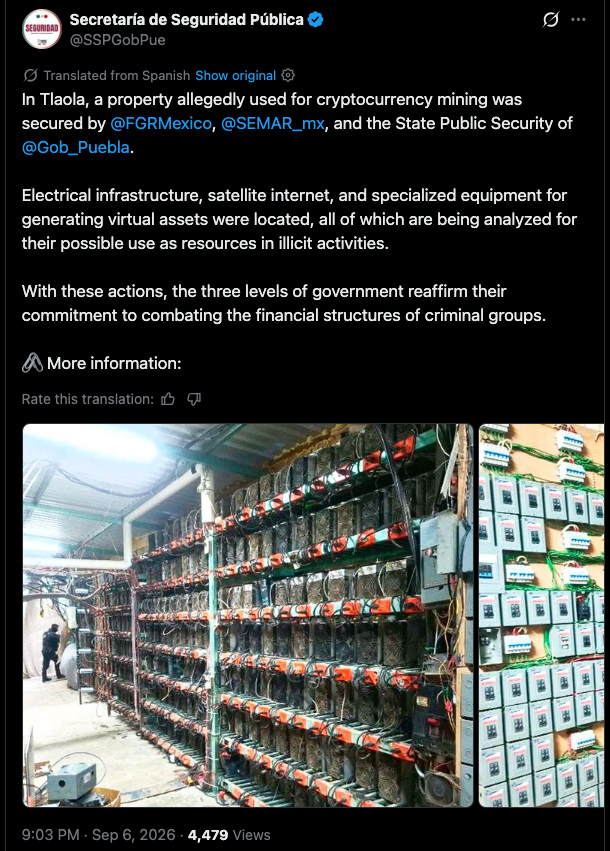
Photos from a September 6, 2026, publication by the Ministry of State Security showing confiscated mining rig racks and electrical equipment at the Tlaola site.

Expert Teams Investigate Illegal Cryptocurrency Money Laundering Network Activities

Sanchez described the Tlaola site as one node in a broader network that is leveraging the hydropower infrastructure of the Sierra Norte for its purposes. He said similar activity is being observed in neighboring states, and the search has already spread to nearby municipalities.

Forensic accountants are trying to establish who paid for the equipment, and the state government is investigating whether the coins mined at the site were used to launder proceeds from criminal activity.

In 2025, Mexican authorities shut down three more mining operations in Puebla and neighboring Tlaxcala.

As reported by Cryptopolitan, in Malaysia, the national energy company Tenaga Nasional is said to have lost over $1.1 billion from 2020 to August 2025 due to electricity theft related to mining.

In June, Thai authorities seized 315 Bitcoin mining machines in five northeastern provinces, estimating damages from tampered meters and unpaid bills to be around $1.2 million.

end-content

Related Questions

QWhat was seized by Mexican authorities in the Tlaola raid, and what was its main purpose?

AMexican authorities seized 300 cryptocurrency mining machines (specifically GPU-based, indicating mining of non-Bitcoin cryptocurrencies) alongside electrical transformers, medium-voltage terminals, and satellite internet antennas. The main purpose of the equipment was to create digital assets (mine cryptocurrency).

QAccording to the State Security Minister, what key factor led authorities to discover the illegal mining operation?

AAccording to State Security Minister Francisco Sanchez, the operation was discovered because mining consumes a huge amount of energy and generates a lot of noise, leading operators to seek isolated and remote locations. The unusual activity and isolation of the site alerted the authorities.

QHow was electricity being supplied to the illegal mining farm, and why is this significant?

AThe mining farm was directly intercepting and stealing electricity from the federal Nuevo Necaxa hydroelectric complex. This is significant because electricity theft on this scale represents a major financial loss for the state and is a common issue with large-scale illegal mining operations.

QWhat broader criminal activity are state forensic accountants investigating in connection with the Tlaola site?

AState forensic accountants are investigating whether the cryptocurrency mined at the Tlaola site was used for money laundering proceeds from criminal activities.

QAccording to the article, what is one international example of significant losses due to electricity theft for crypto mining?

AThe article cites Malaysia, where the national energy company Tenaga Nasional reportedly lost over $1.1 billion between 2020 and August 2025 due to electricity theft linked to crypto mining.

Related Reads

Changelly to give away 200 hardware wallets and offer up to 57% off this Black Friday

Changelly has launched its Black Friday sale, offering up to 57% off selected hardware wallets from Marketplace partners including Ledger, Trezor, SafePal, Tangem, ELLIPAL, CoolWallet, Digital Shield, NGRAVE and DCENT. The campaign runs from November 16 to November 30, 2026, and Changelly will also give away 200 hardware wallets to 100 winners, with two wallets per winner—one to keep and one to gift to a friend. Users can take a free 30-second quiz that asks about their crypto habits and recommends a suitable hardware wallet, with results linking directly to partner offers in the Changelly Marketplace. To enter the giveaway, participants must complete the quiz and submit their email address on the results page before November 30 at 10:00 UTC. No purchase, crypto swap, social media share or referral is required, though eligibility restrictions apply. Changelly will randomly select 100 winners from eligible entries and notify them by email within seven days after the campaign ends. Winners will have five days to respond, and each participant can win only once. Prize models are selected by Changelly and may differ from those recommended in the quiz. Wallet partners handle checkout and shipping for discounted purchases. Changelly is an instant crypto exchange platform serving over 12 million users worldwide. Founded in 2015, it offers crypto-to-crypto and fiat-to-crypto exchanges for 1,200+ coins across 200 blockchains, with 24/7 live customer support and 840+ partners through its exchange and fiat on-/off-ramp APIs.

cointelegraph2h ago

Changelly to give away 200 hardware wallets and offer up to 57% off this Black Friday

cointelegraph2h ago

Xsolla ZK Introduces a Gas Token Designed to Let Digital Items Move Between Games and Players

Xsolla ZK, Inc. has introduced Xsolla Gas (XLA), the native token of Xsolla ZK, an Ethereum Layer 2 ZK rollup network for games. XLA is designed to pay network fees when players transfer or share eligible digital items on the network. Players who prefer not to set up a separate wallet can buy XLA-NT, a non-transferable gas credit usable only for network fees on Xsolla ZK, through Xsolla Gas Station using familiar payment methods. XLA is also available on crypto exchanges including Kraken, LBank, and Biconomy in supported markets. The initiative addresses a key limitation: most digital items today live on a single game's backend and cannot be transferred to friends or used in other games, and they become inaccessible if a game shuts down. Blockchain-backed items stay with players, but transferring them typically requires a separate wallet and the right token. Xsolla ZK aims to lower these barriers. Players use Xsolla Backpack, an inventory for owned digital items; items issued in transferable form are designed to remain available even if the issuing game shuts down, and players can give them to others. Players sign in with their usual account, without needing a seed phrase or separate wallet setup. Chris Hewish, President of Xsolla (USA), said players should be able to share and gift digital items they own anytime, anywhere, with anyone they know, and that developers gain a new way to monetize games while players gain items that are theirs to keep. Developers and partners can also use XLA to pay network fees for their item activity. More than 1,500 game teams use Xsolla's tools, and Xsolla Backpack and Xsolla Gas Station are available without additional development for teams using compatible Xsolla products, integrating with existing player and payment flows. XLA is an ERC-20 token on Ethereum mainnet with a total supply of 1 billion and becomes the base token of Xsolla ZK through the canonical bridge.

TheNewsCrypto3h ago

Xsolla ZK Introduces a Gas Token Designed to Let Digital Items Move Between Games and Players

TheNewsCrypto3h ago

Trading

Spot
活动图片