Meme Wrapped Contracts: Is alt.fun Real Innovation or a Pseudo-Need?

marsbitPublicado a 2026-05-18Actualizado a 2026-05-18

Resumen

A new platform called alt.fun on Hyperliquid has gained attention by merging meme coin creation with leveraged futures trading. Unlike typical meme platforms like Pump.fun, alt.fun requires creators to select an underlying asset (like HYPE or S&P 500) and a leverage level (2x, 3x, or 5x) to take a long or short position. The issued meme token is directly linked to a corresponding leveraged token (LT) on BounceTech, which represents that perpetual contract position. This means the token's price is driven by both the standard bonding curve (community buying/selling) and the performance of its leveraged underlying asset, allowing value to increase even without new purchases. The platform's "graduation" to a DEX pool requires a市值 of $9,000, achievable through market demand or underlying asset growth. While this mechanism can amplify gains in trending markets, it also introduces significant risks from asset volatility, leverage decay during rebalancing, and potential liquidation during sharp price moves. Despite early traction—with its top token ALT reaching an $8.8M market cap—alt.fun faces challenges. Its limited selection of 14 underlying assets constrains variety, leading to tokens with identical financial profiles. More fundamentally, critics argue it misunderstands the meme coin ethos: its tokens are primarily financial instruments tied to asset performance, lacking the community-driven narratives and cultural appeal essential for sustaining meme coin value. The article co...

Original | Odaily Planet Daily (@OdailyChina)

Author | Golem (@web3_golem)
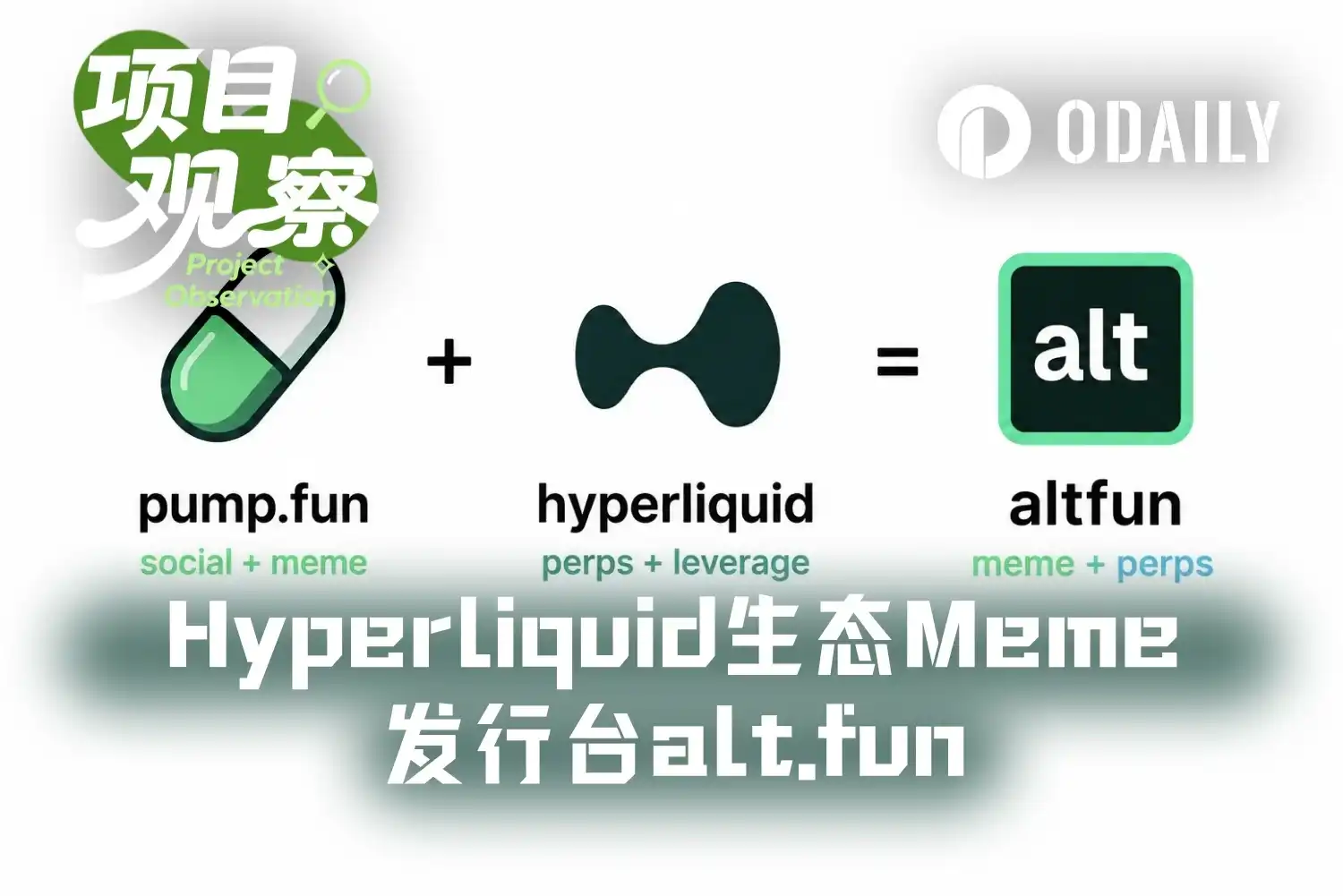
Last week, a new Meme issuance platform named alt.fun in the Hyperliquid ecosystem garnered significant attention from Meme players. Within just one week of launch, its leading token ALT reached a peak market cap of $8.8 million, with the current price having retraced, maintaining a market cap around $6.7 million.

The novelty of alt.fun can be understood as a combination of Pump.fun and Hyperliquid, where users can simultaneously experience the dual thrill of playing with Memes and opening contracts.

Introduction to the alt.fun Platform Mechanism

Specifically, each Meme token issued on alt.fun has a corresponding contract position matched on Hyperliquid at its core.

Similar to Pump.fun, any user can issue a Meme coin with one click on HyperEVM through the alt.fun platform. The token price is still influenced by a bonding curve. The total supply of the created Meme coin is 1 billion tokens, and when 75% of the tokens are sold, the token successfully "graduates" and is migrated to a HyperSwap V2 liquidity pool.

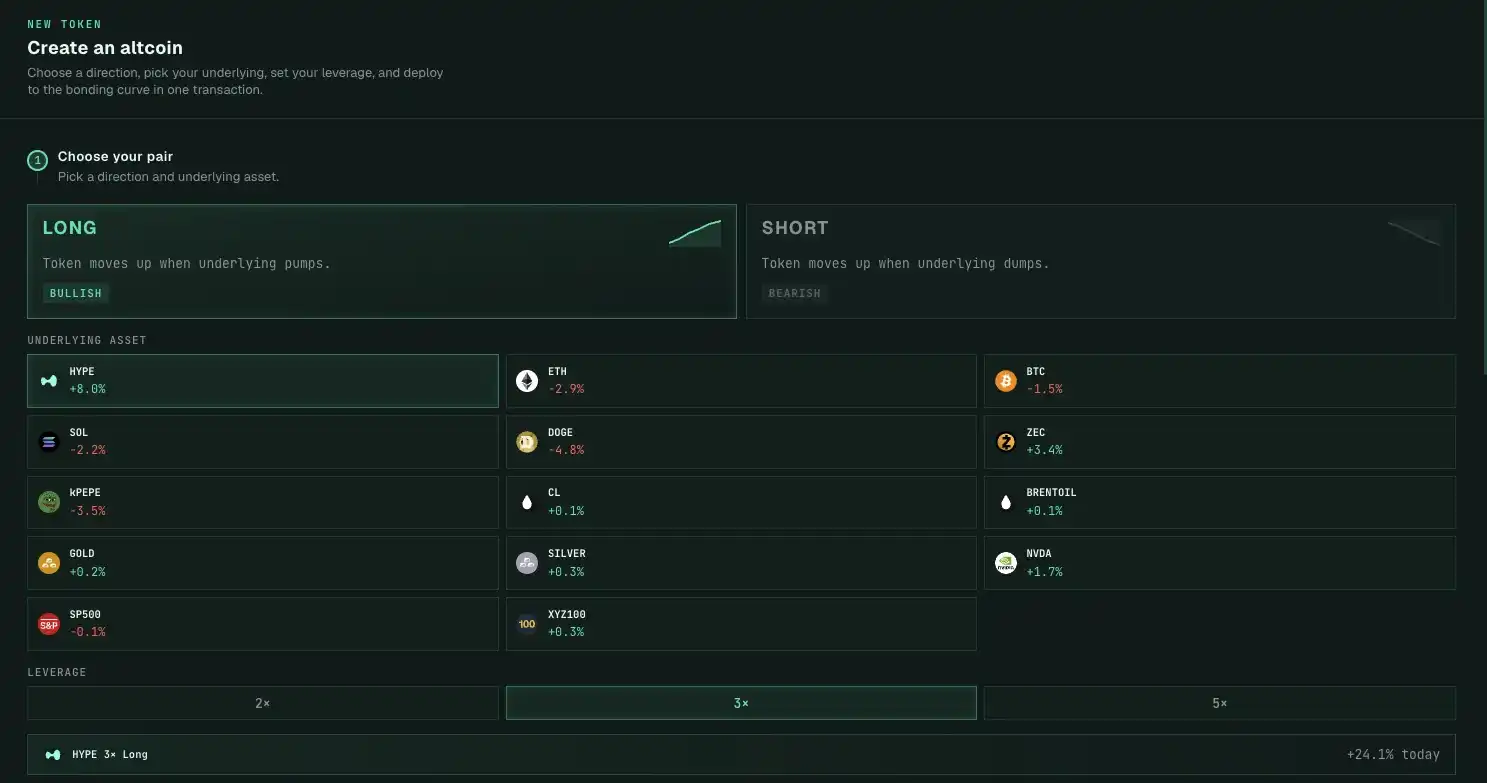
The difference from Pump.fun is that when creating a token on alt.fun, users also need to select an underlying asset and choose a limited leverage multiple (2x/3x/5x) to go short/long. At the same moment of token creation, the platform mints a corresponding amount of leveraged tokens (LT) on BounceTech(Odaily note: a permissionless leveraged token platform on Hyperliquid) and sends them to the user. This leveraged token corresponds to establishing a perpetual contract position on Hyperliquid. For example, if a user chooses to create a token based on a 3x long position on HYPE, what they receive is essentially a leveraged token that tracks the gains of a 3x long HYPE position.

As shown in the figure below, currently on alt.fun, users can choose from 14 types of underlying assets when creating a token. Similarly, when players buy Meme coins on this platform, the platform also mints corresponding leveraged tokens on BounceTech. If a player sells, this process is reversed—the leveraged token is redeemed, and the user receives the corresponding USDC.
This model of packaging and then selling leveraged tokens as underlying assets is similar to the securitization of specific risk exposures like futures and options in traditional finance, such as 3x inverse Nasdaq ETFs or 5x inverse crude oil products. In this process, the alt.fun platform acts like an asset management company, managing the long-term positions behind the leveraged tokens for users.

The price of such financial products primarily follows the net asset value. However, since the token price issued by the alt.fun platform is also simultaneously influenced by the bonding curve mechanism of Meme coins, the graduation mode and price drivers of tokens on this platform are not singular either.

Dual Graduation Modes and Price Drivers

This means that the price of tokens on the alt.fun platform is influenced by two factors: one is market sentiment driven by buying and selling, and the other is the performance of the underlying asset. So now you might understand what alt.fun's slogan "Your token pumps even when nobody's buying" means.

For instance, if a user creates a token based on a 3x long HYPE position with an initial investment of $20 (the platform's minimum buy-in size), and subsequently HYPE rises by 10%, then even if no one buys the token, the user's holding value increases by 30% to $26.

Based on this dual driver of price, the token graduation mode on the alt.fun platform is not limited to one method either. Specifically, its token graduation condition is reaching a market cap of $9,000, which essentially calculates the value of the leveraged token. Besides achieving graduation through buying tokens, if the token itself reaches a market cap of $9,000 due to the rise of its underlying asset, it can also graduate successfully. Therefore, whether a token reaches the graduation threshold is often a combined result of the two pricing mechanisms.

Of course, ideally, a rise in the underlying asset drives up the leveraged token, and combined with the emotional catalysis of the Meme market, the token might soar step by step. But once the underlying asset falls, the value of the leveraged token continuously shrinks, the market might panic-sell, and the token price could potentially crash instantly.

Thus, while alt.fun's mechanism can effectively leverage amplification effects, this only works in a one-sided market trend and requires users to accurately time the trend. If encountering volatile conditions in the underlying asset, users also have to bear leverage decay losses. This is because when the underlying asset price fluctuates, the platform needs to perform "rebalancing" to manage positions to avoid liquidation. This means that even if the underlying asset drops and then recovers, the leveraged token will suffer depreciation due to forced position reduction during the decline.

Moreover, in the case of wick or flash crash events, the platform might fail to react in time, potentially leading the leveraged token value to zero.

Meme or not Meme

Currently, the alt.fun platform has a total of 41 graduated tokens, with only two having a market cap exceeding one million: ALT (based on 5x long HYPE) and STONKS (based on 5x long S&P 500). The total number of users is around over 1,000. Although alt.fun is still in its early stages, we can also discern its current development bottlenecks from this.

First, the platform has too few underlying assets. Based on the current 14 types of underlying assets, there can be at most 84 different combinations of leveraged tokens. alt.fun has already seen leveraged tokens with the same leverage multiple shorting/longing the same underlying asset. For example, the current highest token ALT is based on 5x long HYPE, while another token with the ticker ATH is also based on 5x long HYPE. Apart from the token name and creation time, there is no difference between the two. If so, why wouldn't investors buy the lower market cap ATH?

Although alt.fun may support more underlying assets in the future, its core pain point is its inability to coalesce Meme coin community consensus.

The fundamental reason investors choose to buy leveraged tokens on the alt.fun platform instead of opening leverage directly on Hyperliquid themselves is essentially to gain greater price leverage. Moreover, because the platform manages position rebalancing in the backend for users, individual users can be "hands-off landlords," not having to worry about individual liquidation risks.

But this is also the problem. Investors buying an alt.fun token are essentially still basing their decision on future price expectations for its underlying asset, rather than on narratives, market games, or attention—these "meaningless things" are precisely what support the core value of a Meme. A Meme's ability to rise or gain market recognition is often not due to any practical value backing or financial design behind it; more importantly, it's the community propagation attribute.

As a Meme player, it's difficult for me to develop a love for a leveraged token similar to the affection for a particular Meme's community culture. If one truly has conviction in the underlying asset of a leveraged token, it might be better to issue one's own leveraged token rather than buy an existing one and bear unnecessary premiums.

Therefore, while the mechanism of the alt.fun platform appears novel, in my eyes, it's merely a mechanical innovation. If alt.fun pivots towards developing as a DeFi platform in the future, there might still be opportunities. But if it insists on forcefully entering the Meme issuance platform track, it is destined to be a flash in the pan.


Preguntas relacionadas

QWhat is the core innovation of the alt.fun platform as described in the article?

AThe core innovation is combining a Meme token launchpad (similar to Pump.fun) with leveraged perpetual contracts on Hyperliquid. Each Meme token created on alt.fun has an underlying leveraged token position on Hyperliquid, allowing token value to be influenced by both market buying/selling and the performance of the chosen leveraged asset.

QAccording to the article, what is one major drawback or criticism of the alt.fun model?

AA major drawback is its perceived inability to build genuine Meme community consensus. The token's value is fundamentally tied to the performance of a leveraged financial product rather than narrative, culture, or community hype, which are considered the true drivers of Meme value. It risks being a 'mechanical innovation' lacking the social dynamics essential for Meme success.

QHow can a token on alt.fun 'graduate' or be considered successful besides being bought by others?

AA token can graduate if its market capitalization (calculated as the value of the underlying leveraged tokens) reaches $9,000. This can happen not only through direct purchases but also if the value of the underlying leveraged position increases significantly due to favorable price movement of the base asset (e.g., HYPE or S&P 500).

QWhat role does the BounceTech platform play in the alt.fun ecosystem?

ABounceTech is the permissionless leveraged token platform on Hyperliquid. When a user creates or buys a Meme token on alt.fun, the platform mints a corresponding leveraged token (LT) on BounceTech and sends it to the user. This LT represents a perpetual contract position on Hyperliquid. Selling the Meme token reverses the process, redeeming the LT for USDC.

QWhat potential risks does an investor face when holding a token from alt.fun?

AInvestors face several risks: 1) Exposure to the high volatility and potential liquidation of the underlying leveraged position. 2) Leverage decay during volatile or sideways markets due to mandatory 'rebalancing' of the position, which can erode value. 3) The risk of the leveraged token's value going to zero during extreme market events like a flash crash. 4) The premium paid for the Meme token layer on top of the leveraged token's intrinsic value.

Lecturas Relacionadas

U.S. Government Bans Foreign Nationals from Using Fable 5, Anthropic Issues Rebuttal

U.S. Government Bans Foreign Access to Fable 5, Anthropic Issues Rebuttal On June 12th, the U.S. government ordered AI company Anthropic to immediately suspend all foreign access—including foreign nationals within the U.S. and Anthropic's own foreign employees—to its newly released Fable 5 and Mythos 5 AI models, citing national security concerns. This forced Anthropic to temporarily disable access to both models for all users globally, as it cannot technically differentiate user nationality at scale. The models, released just three days prior, represent Anthropic's highest public capability tier. Fable 5 is the first publicly available model from the advanced "Mythos" family, while Mythos 5 is a less-restricted version for approved cybersecurity and critical infrastructure partners. The government's directive was reportedly triggered by claims from another company that it could "jailbreak" Mythos 5, raising alarm within the Trump administration. Anthropic, in a detailed public statement, strongly challenged this rationale. The company argues the demonstrated "jailbreak" is a narrow, non-generalized technique that merely involves identifying minor, known software vulnerabilities—a capability common to other publicly available models like OpenAI's GPT-5.5 and routinely used by cybersecurity defenders. Anthropic stated it has complied with the order but disagrees with the government's standard, warning that applying it industry-wide would halt all new frontier model deployments. The company criticized the lack of a transparent, fact-based legal process and expressed confidence the situation stems from a misunderstanding. It is working to restore access and will release more technical details within 24 hours. Other Anthropic models remain unaffected.

链捕手Hace 14 min(s)

U.S. Government Bans Foreign Nationals from Using Fable 5, Anthropic Issues Rebuttal

链捕手Hace 14 min(s)

The Revelation from the Raydium Theft Incident: New DeFi Vulnerabilities Lurking in Forgotten Old Contracts

**Raydium Exploit Reveals DeFi's Hidden Risk: Forgotten "Zombie" Contracts** A recent attack on Raydium's deprecated V3 AMM pools resulted in a loss of approximately $1.34 million. The hacker exploited pools that were no longer supported by Raydium's current UI or SDK but remained fully functional and accessible on-chain. This incident highlights a critical, often overlooked category of risk in DeFi: inactive or legacy smart contracts that projects fail to properly decommission. Since March 2025, there have been at least 8 publicly reported attacks targeting such abandoned contracts, with total losses around $10.8 million. Including older pools and deprecated features, the count rises to 10 incidents with roughly $22.5 million in losses. These "zombie contracts" represent a lifecycle management failure rather than a code vulnerability, yet they are typically misclassified under general "code bug" categories in security reports, masking the true scale of the problem. The root cause is that projects often merely document a contract as "deprecated" without taking essential technical steps to secure it: withdrawing remaining assets, disabling external call functions, and implementing ongoing monitoring. These forgotten, under-monitored components become prime targets for attackers. To address this, the industry needs to recognize "zombie contracts" as a distinct risk category and establish standardized decommissioning protocols. Essential steps should include: 1) a formal retirement announcement, 2) removal of all front-end integrations, 3) withdrawal of locked assets, 4) disabling key contract functions, 5) ongoing security monitoring, 6) clear user communication, and 7) a post-mortem analysis. The value of a DeFi project lies not only in its current TVL but also in the security of its historical codebase, which has now become a new attack surface.

Foresight NewsHace 2 hora(s)

The Revelation from the Raydium Theft Incident: New DeFi Vulnerabilities Lurking in Forgotten Old Contracts

Foresight NewsHace 2 hora(s)

Robots Begin to 'Consume Data': The Hidden Production Chain from Indian Data Factories to Billion-Dollar Humanoid Robots

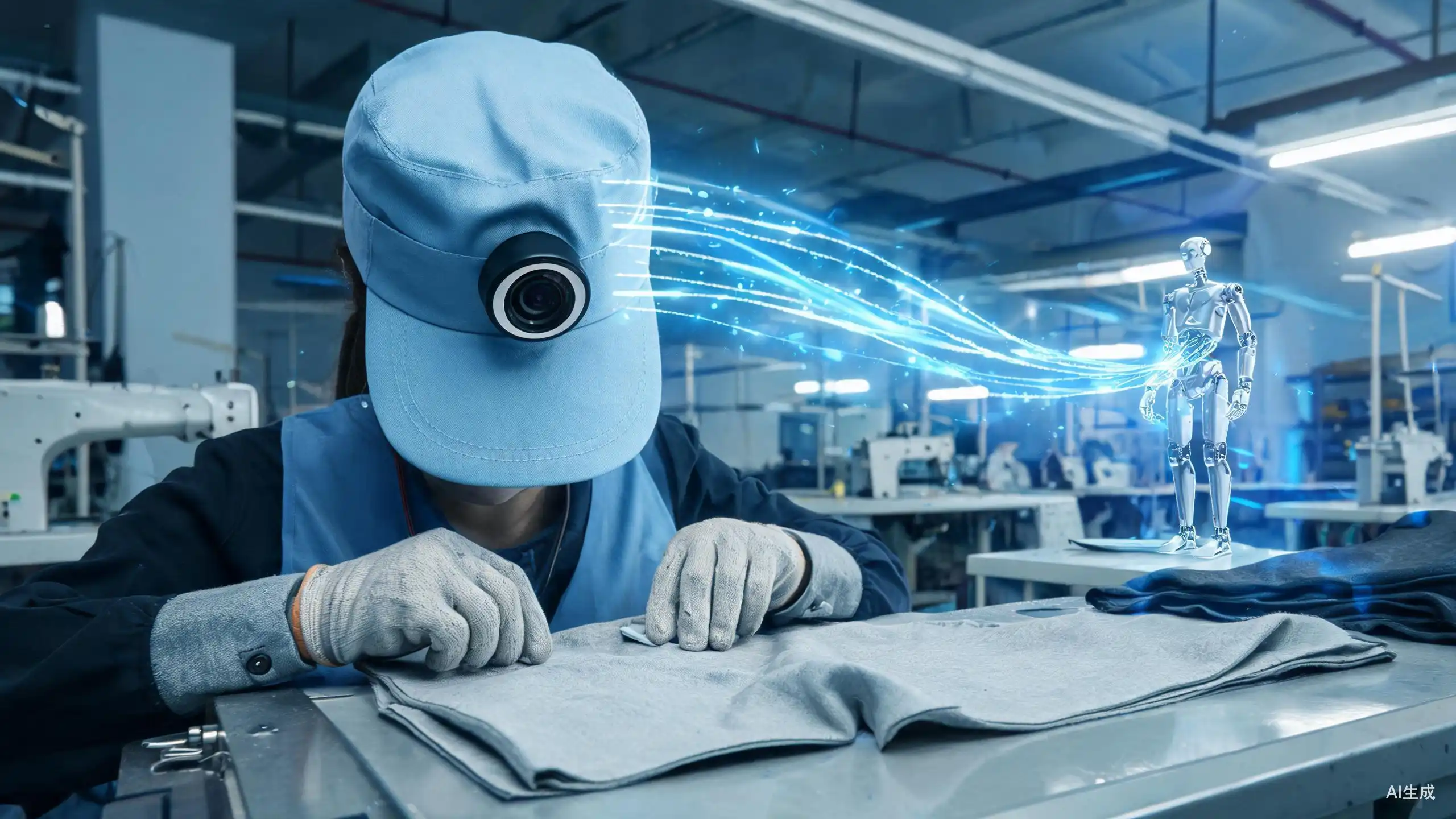
Robots have started to 'consume data,' driving the formation of a new industrial supply chain focused on producing training data for embodied AI. Unlike large language models, which are trained on vast internet text corpora, embodied AI models face a 'data desert' in the physical world. This has created a massive demand for first-person perspective video data (Ego Data), captured by workers wearing cameras in places like Indian garment factories. Companies like Neocambrian AI are establishing 'data factories' where workers perform standardized tasks (e.g., sorting clothes, kitchen organization) to generate thousands of hours of video. Research, such as NVIDIA's EgoScale, demonstrates that scaling this human demonstration data predictably improves robot performance, particularly for dexterous manipulation. This has validated a training path combining large-scale human data for pre-training with smaller amounts of robot-specific data for fine-tuning. The value of different data types varies significantly, forming a 'data pyramid.' The base consists of low-cost, large-scale internet and Ego Data. Higher layers include more expensive motion-capture data (e.g., from data gloves), simulation/synthetic data, and the most costly and scarce layer: real robot teleoperation data. This demand has spawned a layered ecosystem of data suppliers: low-cost data factories, motion capture and alignment specialists, robot-native teleoperation service providers, simulation data companies, and platforms aiming for data standardization. Robot companies themselves are adopting a 'layered procurement' strategy: outsourcing generic Ego Data while building in-house capabilities for robot-specific adaptation data and the critical deployment/failure data generated in real-world applications. The industry is shifting focus from hardware and basic mobility to the data pipelines required for general-purpose capability. While parallels exist to data labeling companies like Scale AI in the LLM boom, the physical complexity of robot data—involving action success ambiguity and sim-to-real gaps—requires more integrated solutions for data collection, annotation, and a continuous feedback loop. The race is on to build the data engines that will teach robots to operate reliably in the unstructured real world.

marsbitHace 4 hora(s)

Robots Begin to 'Consume Data': The Hidden Production Chain from Indian Data Factories to Billion-Dollar Humanoid Robots

marsbitHace 4 hora(s)

Trading

Spot
Futuros

Artículos destacados

Qué es MEME 2.0

Memecoin 2.0: El Ascenso de $MEME 2.0 en el Mundo de las Criptomonedas Introducción En el panorama siempre cambiante de las criptomonedas, ha surgido un nuevo contendiente. Memecoin 2.0, simbolizada como $MEME 2.0, lleva el concepto de las monedas meme a un emocionante nuevo nivel. Como un subproducto del Memecoin original, este proyecto ha capturado la atención de la comunidad cripto al cambiar el enfoque de los incentivos financieros típicos a una experiencia comprometida y entretenida. Operando en la blockchain de Ethereum, Memecoin 2.0 redefine audazmente la participación de la comunidad en la esfera cripto. ¿Qué es Memecoin 2.0, $MEME 2.0? En su núcleo, Memecoin 2.0 es un proyecto de criptomoneda que prioriza el espíritu comunitario y la diversión asociada con la cultura meme. A diferencia de las criptomonedas convencionales, que se concentran en casos de uso prácticos y beneficios tangibles, Memecoin 2.0 se distingue al abrazar el lado más liviano de la moneda digital. El proyecto existe sin promesas de utilidad, un mapa estructurado o retornos financieros, enfocándose en cambio en fomentar una comunidad vibrante centrada en memes y en el disfrute compartido. Al hacerlo, aprovecha la creciente tendencia de la cultura meme en el espacio en línea, convirtiéndose en un jugador único en el mundo de los activos digitales. Creador de Memecoin 2.0, $MEME 2.0 A pesar de la extensa investigación sobre los orígenes de Memecoin 2.0, la identidad explícita de su creador sigue siendo desconocida. Esta anonimidad no es inusual en la comunidad cripto, donde muchos proyectos son liderados por individuos o grupos que prefieren permanecer en las sombras. La falta de información disponible públicamente sobre el creador podría verse como un movimiento estratégico, poniendo el foco en la participación comunitaria en lugar de la notoriedad individual dentro del espacio. Inversores de Memecoin 2.0, $MEME 2.0 La información sobre los inversores o el respaldo financiero de Memecoin 2.0 es escasa. Esta ausencia de detalles puede sugerir que el proyecto es autofinanciado o que su enfoque en la comunidad en lugar de las estructuras de inversión tradicionales ha atraído a un tipo diferente de apoyo. Dado que el mundo de las monedas meme generalmente involucra una participación más de base en lugar de inversión institucional, este enfoque está alineado con la ética de los proyectos impulsados por la comunidad. ¿Cómo Funciona Memecoin 2.0, $MEME 2.0? Memecoin 2.0 opera completamente en la blockchain de Ethereum, capitalizando sus robustas características de seguridad y escalabilidad. Al aprovechar las fortalezas de Ethereum, Memecoin 2.0 puede ofrecer un entorno seguro para las interacciones de los usuarios, asegurando que las transacciones sean tanto eficientes como rentables. Uno de los atributos únicos de Memecoin 2.0 radica en su estructura impulsada por la comunidad. El valor y la popularidad del token $MEME 2.0 derivan de la participación activa de sus usuarios, en vez de de una utilidad inherente. Este diseño refuerza el enfoque del proyecto en el aspecto de entretenimiento de las criptomonedas, lo que implica que la risa y la participación comunitaria son las verdaderas monedas que impulsan su éxito. Además, el proyecto encaja dentro del ecosistema más amplio de las monedas meme, donde el valor de cada moneda meme oscila basado en la cultura, tendencias y la participación de la comunidad, en lugar de principios económicos tradicionales. Cronología de Memecoin 2.0, $MEME 2.0 Para entender mejor la evolución y los hitos de Memecoin 2.0, aquí hay una cronología que destaca eventos significativos en su historia: 2024: Se reconoce la creación de Memecoin 2.0 como una ramificación del Memecoin original, estableciéndose dentro del contexto próspero de las monedas meme mientras opera en la blockchain de Ethereum. 13 de julio de 2024: Memecoin 2.0 se posiciona oficialmente como una moneda meme centrada en la comunidad en la red de Ethereum, enfatizando su enfoque centrado en el entretenimiento que invita a los usuarios a participar y crecer. Puntos Clave Sobre Memecoin 2.0, $MEME 2.0 Varios rasgos críticos definen a Memecoin 2.0: Enfoque Centrado en la Comunidad: La misión principal de Memecoin 2.0 es crear una experiencia comunitaria divertida y atractiva, capitalizando en el disfrute colectivo derivado de la cultura memética. Construido sobre Ethereum: Operar en la blockchain de Ethereum proporciona al proyecto una infraestructura esencial que garantiza seguridad y escalabilidad. Falta de Utilidad o Hoja de Ruta: En un notable desvío de las criptomonedas tradicionales, Memecoin 2.0 no promete características utilitarias ni retornos financieros, reafirmando su compromiso con la participación comunitaria y el compromiso social. Enfoque en la Cultura Memética: Al abrazar los aspectos humorísticos y culturales del fenómeno meme, Memecoin 2.0 proporciona una plataforma para que los usuarios interactúen con cripto tanto fuera de línea como en línea. Contexto Adicional: La Importancia de las Monedas Meme Las monedas meme han surgido como una clase distinta de criptomonedas, a menudo impulsadas por el humor y un enfoque desenfadado para el comercio. Estas monedas generalmente carecen de una utilidad significativa o hojas de ruta de desarrollo, atrayendo a los usuarios con la promesa de diversión, interacción comunitaria y relevancia cultural. En el panorama del ecosistema cripto más amplio, las monedas meme reviven la importancia de la participación comunitaria, revirtiendo enfoques únicamente motivados por el lucro. Proyectos como Memecoin 2.0 inauguran una era donde el entretenimiento puede armonizar con las aspiraciones financieras, convirtiendo la blockchain en un parque de diversiones para la creatividad y la interacción social. Conclusión Memecoin 2.0, o $MEME 2.0, encarna una nueva ola de criptomonedas que prioriza la participación comunitaria sobre estructuras financieras rígidas. Con un enfoque en el humor y la interacción social, capitaliza sobre la fascinación que rodea la cultura meme. Al operar en la blockchain de Ethereum, Memecoin 2.0 aprovecha las capacidades de la tecnología mientras se mantiene firme en su compromiso con el valor de entretenimiento de la moneda digital. A medida que el espacio alrededor de las criptomonedas continúa evolucionando, Memecoin 2.0 sirve como un testimonio de la noción de que el futuro de los activos digitales podría depender, en gran medida, de experiencias compartidas, risas y sólidas conexiones comunitarias. En el mundo impredecible de las criptomonedas, quizás la alegría pueda ser tan valiosa como la ganancia financiera tradicional.

95 Vistas totalesPublicado en 2024.04.04Actualizado en 2024.12.03

Qué es MEME 2.0

Cómo comprar MEME

¡Bienvenido a HTX.com! Hemos hecho que comprar Memeland (MEME) sea simple y conveniente. Sigue nuestra guía paso a paso para iniciar tu viaje de criptos.Paso 1: crea tu cuenta HTXUtiliza tu correo electrónico o número de teléfono para registrarte y obtener una cuenta gratuita en HTX. Experimenta un proceso de registro sin complicaciones y desbloquea todas las funciones.Obtener mi cuentaPaso 2: ve a Comprar cripto y elige tu método de pagoTarjeta de crédito/débito: usa tu Visa o Mastercard para comprar Memeland (MEME) al instante.Saldo: utiliza fondos del saldo de tu cuenta HTX para tradear sin problemas.Terceros: hemos agregado métodos de pago populares como Google Pay y Apple Pay para mejorar la comodidad.P2P: tradear directamente con otros usuarios en HTX.Over-the-Counter (OTC): ofrecemos servicios personalizados y tipos de cambio competitivos para los traders.Paso 3: guarda tu Memeland (MEME)Después de comprar tu Memeland (MEME), guárdalo en tu cuenta HTX. Alternativamente, puedes enviarlo a otro lugar mediante transferencia blockchain o utilizarlo para tradear otras criptomonedas.Paso 4: tradear Memeland (MEME)Tradear fácilmente con Memeland (MEME) en HTX's mercado spot. Simplemente accede a tu cuenta, selecciona tu par de trading, ejecuta tus trades y monitorea en tiempo real. Ofrecemos una experiencia fácil de usar tanto para principiantes como para traders experimentados.

216 Vistas totalesPublicado en 2024.12.12Actualizado en 2026.06.02

Cómo comprar MEME

Discusiones

Bienvenido a la comunidad de HTX. Aquí puedes mantenerte informado sobre los últimos desarrollos de la plataforma y acceder a análisis profesionales del mercado. A continuación se presentan las opiniones de los usuarios sobre el precio de MEME (MEME).

活动图片