McKinsey x Artemis Joint Report: Only 1% of Stablecoin's $35 Trillion Transaction Volume is Real Payments, C-Side Usage Negligible

marsbitPublicado a 2026-03-18Actualizado a 2026-03-18

Resumen

McKinsey and Artemis's joint report reveals that out of $35 trillion in annual stablecoin transaction volume, only about 1% ($390 billion) represents genuine payments. The majority (58%) of these real payments are B2B transactions—such as cross-border settlements and corporate treasury operations—which grew 733% year-over-year. Consumer usage, including retail payments and card spending, remains negligible. The report identifies five structural reasons for this institutional dominance: 1) Greater financial efficiency incentives for businesses; 2) Programmable payments suit B2B workflows, not consumer use cases; 3) Regulatory frameworks favor institutional adoption; 4) Closed-loop B2B systems avoid network effects needed for retail; 5) Corporations prioritize internal benefits over expanding to retail networks. While B2B stablecoin adoption continues accelerating, consumer usage faces significant friction and may remain secondary. The analysis suggests stablecoins may evolve primarily as an institutional settlement layer rather than a mainstream retail payment tool.

Author: Stablecoin Insider / McKinsey×Artemis

Compiled by: Deep Tide TechFlow

Deep Tide Introduction: The McKinsey and Artemis joint report did something rare in the industry: breaking down the stablecoin transaction volume data. The conclusion: of the approximately $35 trillion in annual on-chain transaction volume, only about $390 billion (about 1%) represents real payment behavior, of which 58% is business-to-business financial operations, with an annual growth of 733%. Consumer-side stablecoin usage is almost negligible, and this is no accident—the article summarizes five structural reasons explaining why the gap between institutions and individuals is not just a temporary disparity.

Full text as follows:

The stablecoin industry has a headline problem.

On one hand, raw on-chain data shows tens of trillions of dollars flowing on-chain annually, a figure that fuels endless comparisons with Visa and Mastercard, and predictions of SWIFT's imminent replacement.

On the other hand, a landmark report released in February 2026 by McKinsey & Company and Artemis Analytics stripped all this away and asked a more direct question: how much of it is real payments?

The answer is about 1%.

Of the approximately $35 trillion in annualized stablecoin transaction volume, only about $390 billion represents genuine end-user payments, such as supplier invoices, cross-border remittances, payroll disbursements, and card swipes. The rest is trading activity, internal fund shuffling, arbitrage behavior, and automated smart contract loops.
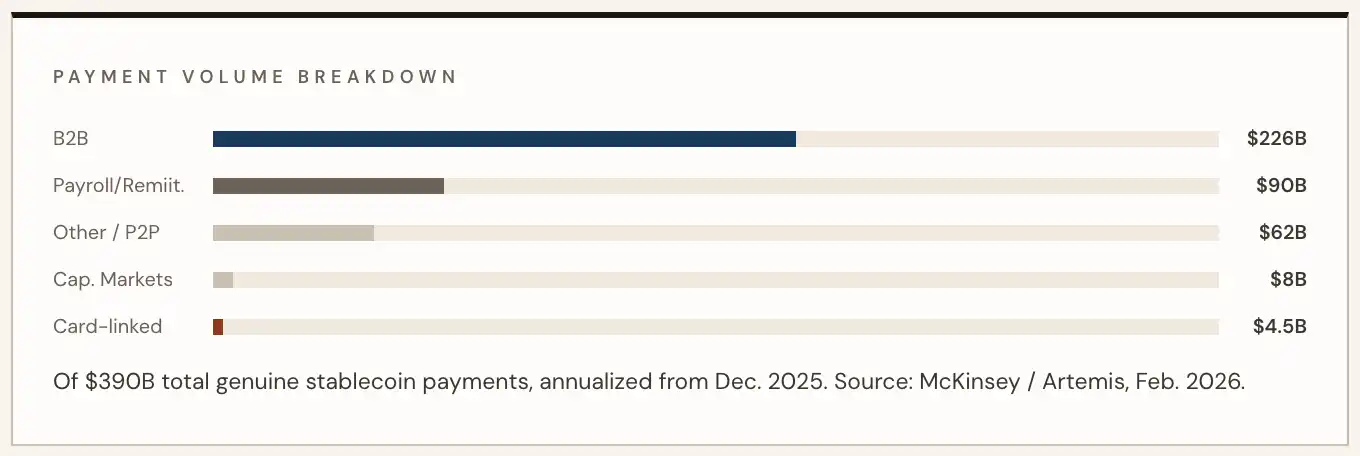
The report concludes that the inflated headline numbers should be "the starting point for analysis, not a proxy for measuring payment adoption."

But within this real $390 billion baseline, there is a story worth examining closely, and it almost entirely revolves around corporate finance, not consumer wallets.

B2B Dominates: What the Data Actually Shows

According to the McKinsey/Artemis analysis (benchmarked to activity data from December 2025), business-to-business transactions account for $226 billion of all real stablecoin payment volume, about 58%.

This figure represents a 733% year-on-year increase, primarily driven by supply chain payments, cross-border supplier settlements, and financial liquidity management. Asia leads in geographic activity, but adoption is also accelerating in Latin America and Europe.

The remainder of the real payment space is distributed among payroll and remittances ($90 billion), capital market settlements ($8 billion), and linked card spending ($4.5 billion).

According to McKinsey, card spending associated with stablecoins grew an astonishing 673% year-on-year, but in absolute terms, it remains only a small fraction of B2B flow.
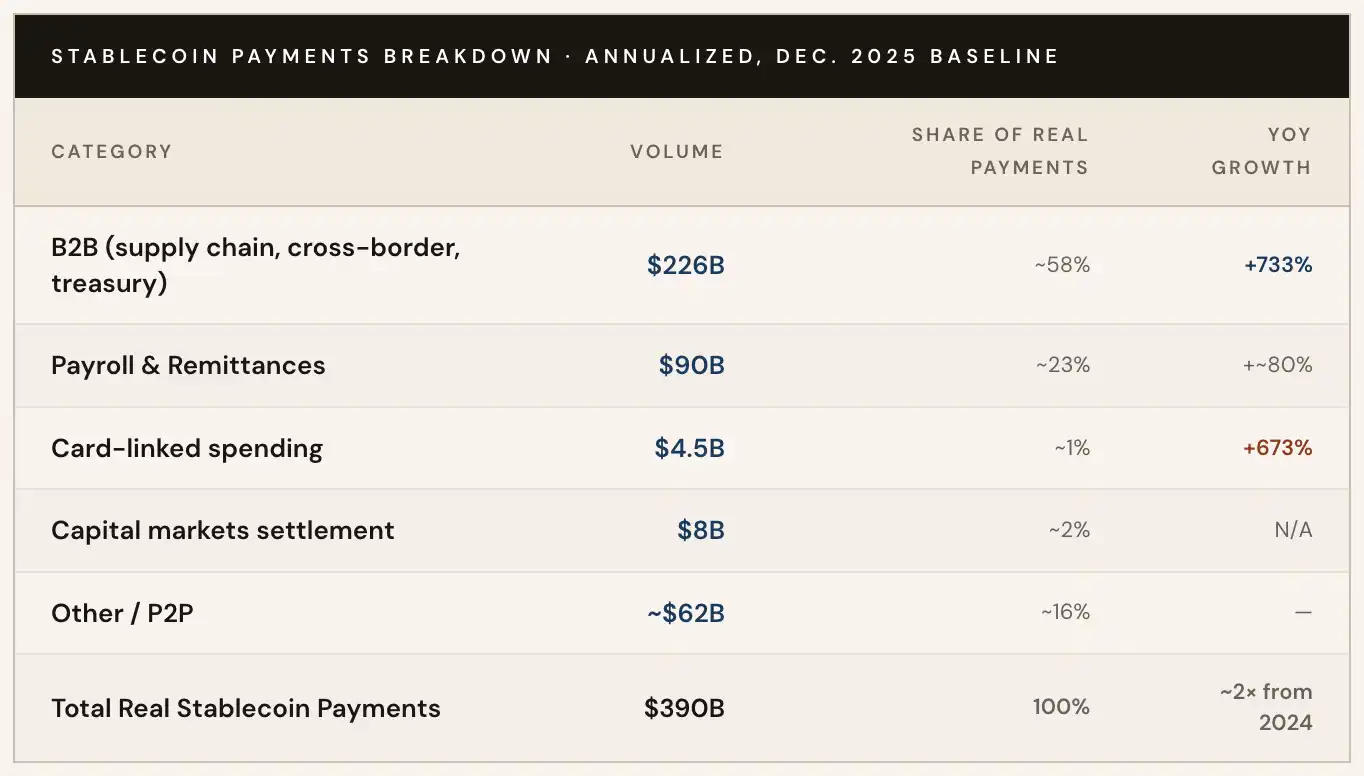
For context: this total of $390 billion represents only 0.02% of McKinsey's estimated global annual payment total of over 2 quadrillion dollars. Specifically, B2B stablecoin flow accounts for about 0.01% of the global $160 trillion B2B payment market.

These numbers are large in the context of stablecoins but remain minuscule in the context of the global financial system.

Monthly run-rate data more intuitively shows where the momentum lies. According to data cited by BVNK from the McKinsey/Artemis report, stablecoin monthly payment volume was only $5 billion in January 2024; by early 2026, this number had exceeded $30 billion—a sixfold increase in less than two years, with the steepest acceleration occurring in the second half of 2025.

Annualized, this run rate now exceeds $390 billion.

"The fact that real stablecoin payments are far lower than conventional estimates does not diminish the long-term potential of stablecoins as a payment rail; it simply establishes a clearer baseline for assessing where the market stands." — McKinsey/Artemis Analytics, February 2026

Why the Gap Exists: Five Structural Forces Excluding Retail

The divergence between the explosive adoption in B2B and the negligible consumer usage is not coincidental but the product of structural asymmetries that systematically favor corporate use cases over retail ones.

Here are the five forces driving the institutional gap:

1) Financial Efficiency Beats Consumer Convenience

Corporate treasurers are driven by specific, quantifiable pain points: SWIFT correspondent banking chains that take one to five business days to settle, currency exchange windows that tie up working capital, and intermediary fees layered on at every transaction point.

Stablecoins solve all three problems simultaneously. For a company paying suppliers in fifteen countries, the economic case is clear; for a consumer buying coffee, it is not. The incentive to switch is orders of magnitude greater on the enterprise side.

2) Programmability Has No Equivalent Value on the Retail Side

The B2B explosion is partly a story of programmable payments. Smart contracts enable conditional logic—invoice triggering, delivery confirmation, escrow release—that can automate entire accounts payable processes at scale.

This is naturally suited to corporate finance operations, as high-value, structured, repetitive payment processes benefit immensely from automation. Retail payments lack similar trigger use cases at any scale.

Consumers buying groceries don't need programmable conditions; they need something that works like swiping a card. The cognitive complexity of blockchain-native payments remains a barrier on the retail side, and programmability does nothing to help that.

3) Regulatory Architecture Favors Institutions

Post the GENIUS Act, institutional operators have adapted to the compliance architecture—AML/CFT, Travel Rule, licensing requirements—and built the legal infrastructure to operate confidently.

Corporate finance teams have dedicated compliance functions that can absorb onboarding friction; individual consumers cannot. The result is that, in most jurisdictions, on-ramps for stablecoins remain operationally complex for retail users, and the merchant acceptance gap persists globally.

Every frictionless B2B payment today is a data point institutions use to justify further investment; the consumer ecosystem, meanwhile, awaits a compliant, user-experience-smooth entry point that has not yet emerged at scale.

4) Closed-Loop Advantage

B2B stablecoin payments succeed precisely because they are closed-loop: business sends to business, both have wallets, both have compliance infrastructure, and neither needs a universal merchant network.

Consumer payments face the classic chicken-and-egg problem: merchants won't invest in stablecoin acceptance infrastructure until consumers demand it; consumers won't enable wallets until they can spend widely.

The institutional world completely bypasses this problem by operating in bilateral or consortium environments, requiring no open merchant network.

5) Institutional Incentives Point Upstream

Corporate treasurers holding stablecoins gain yield, reduce FX exposure, and improve liquidity management—advantages that accrue internally and, if shared downstream, introduce complexity or competitive vulnerability.

Extending stablecoin use to a supplier's supplier, employees, or end consumers requires building a network that benefits those downstream parties, which is not necessarily in the interest of the originating finance team.

In the absence of a clear ROI driving network expansion outward, companies rationally choose to consolidate internal gains.

Market Context

BVNK's own infrastructure data corroborates the dominance of B2B from an operator's perspective. The company processed $30 billion in annualized stablecoin payment volume in 2025, a 2.3x year-on-year increase, with one-third of the volume coming from the US market.

Its client list (Worldpay, Deel, Flywire, Rapyd, Thunes) consists of leaders in cross-border B2B and payroll, not consumer applications.

As BVNK stated in its 2025 year-end review:

"The initial assumption that remittances and consumer transfers would lead stablecoin growth did not materialize as the primary driver; B2B instead assumed that role."

When Will Retail Catch Up—If Ever

The McKinsey/Artemis baseline makes the current situation clear. What it cannot answer is whether the institutional gap will narrow, widen, or permanently solidify.

Here are three possible scenarios for the next 18 months:
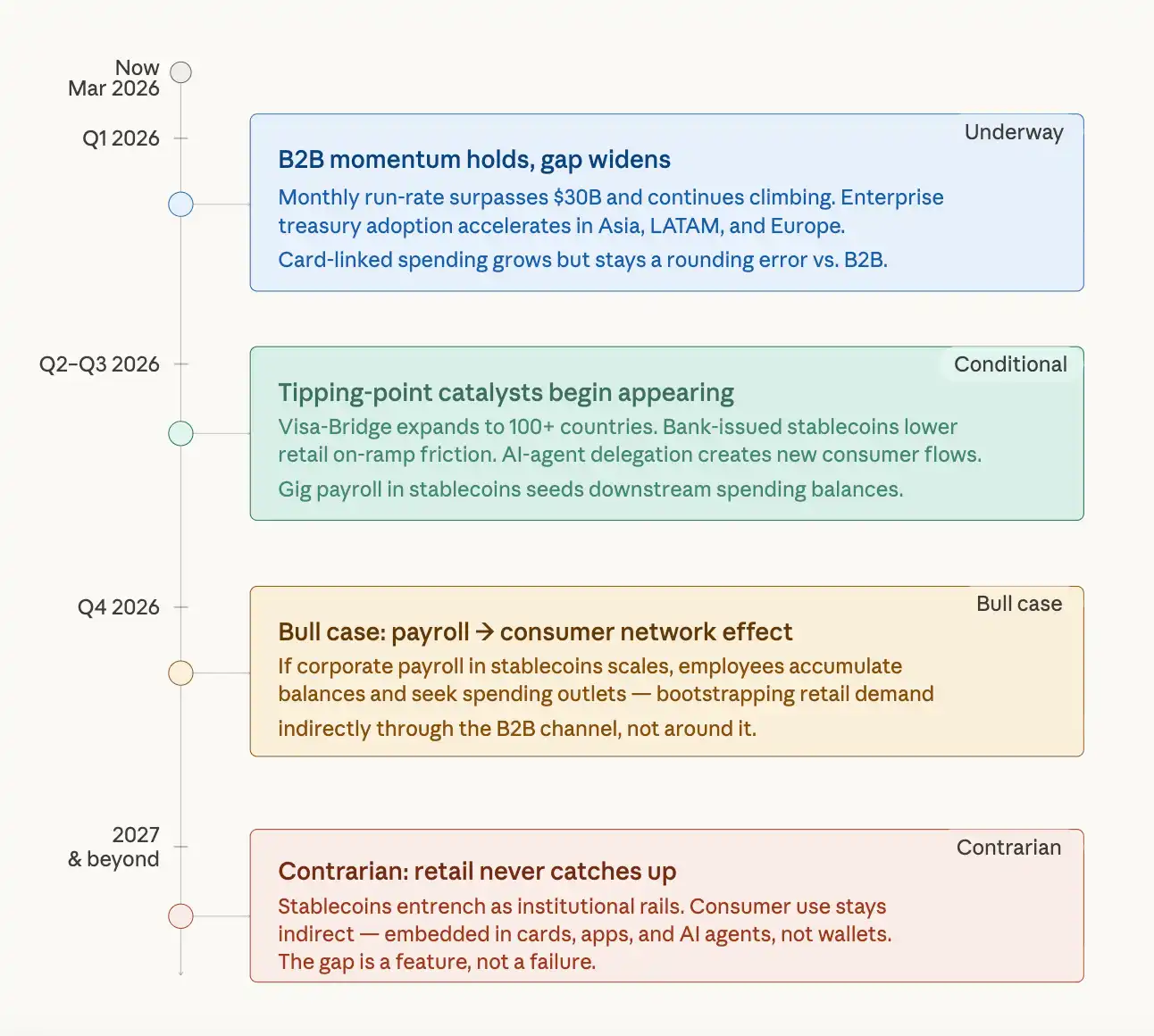
Near Term 2026—The Gap Widens Further

B2B momentum shows no signs of slowing. The monthly run rate of over $30 billion continues its trajectory as more companies use stablecoin rails for cross-border accounts payable and financial operations. Consumer stablecoin card spending grows modestly but remains negligible in absolute terms compared to B2B flow. Even if retail adoption advances slowly in percentage terms, the gap widens in absolute dollar terms.

Mid-Term End-2026 to 2027—Inflection Points Begin to Appear

Several catalysts could begin to bridge the gap: bank-issued multi-currency stablecoins reduce retail on-ramp friction; programmable features extend to consumer applications via AI Agent payment delegation; gig economy wages paid in stablecoins create downstream spending balances for employees.

US Treasury Secretary Scott Bessent predicted that stablecoin supply could reach $3 trillion by 2030, a trajectory implying consumer network effects will eventually emerge.

Counterview—Retail May Never 'Catch Up,' and That Might Be the Point

The most honest reading of the McKinsey data is that stablecoins may be evolving into what the report faintly hints at: a programmable settlement layer on the internet for machines, finance departments, and institutions, with consumer adoption being an indirect, embedded benefit, not the primary use case.

If this framework holds, then the institutional gap is not a failure of adoption but a feature of the technology's natural architecture. Corporate wages paid in stablecoins may eventually create downstream consumer spending, but the path from B2B infrastructure to retail wallets is long, circuitous, and dependent on user experience breakthroughs that have not yet emerged at scale.

An Honest Baseline

The McKinsey/Artemis report did something more valuable than recording stablecoin growth: it established an honest baseline the industry has clearly been missing.

Stripping away trading noise, internal shuffling, and automated smart contract loops reveals a genuinely growing market—real payment volume doubled from 2024 to 2025—but one that is highly concentrated on the institutional side in a structural, non-accidental way.

The 733% growth in B2B is not a deferred consumer story; it is a maturing finance story.

The enterprises building on stablecoin rails today are solving real operational problems—cross-border friction, correspondent banking inefficiencies, working capital delays—problems that have nothing to do with whether consumers hold stablecoin wallets. They will continue building, regardless.


Preguntas relacionadas

QAccording to the McKinsey and Artemis report, what percentage of the $35 trillion in annual stablecoin transaction volume represents real payments?

AOnly about 1% of the $35 trillion in annual stablecoin transaction volume, or approximately $390 billion, represents real payments.

QWhich segment dominates the real stablecoin payment volume, and what was its growth rate?

ABusiness-to-business (B2B) transactions dominate the real stablecoin payment volume, accounting for 58% ($226 billion) and experiencing a growth rate of 733% year-over-year.

QWhat are the five structural reasons identified for the gap between institutional and consumer adoption of stablecoins?

AThe five structural reasons are: 1) Financial efficiency beats consumer convenience, 2) Programmability has no equivalent value in retail, 3) Regulatory architecture favors institutions, 4) Closed-loop advantages, and 5) Institutional incentives point upstream.

QHow does the real stablecoin payment volume compare to the global payment market?

AThe $390 billion in real stablecoin payments represents only 0.02% of the global annual payment volume of over $2 quadrillion, and the B2B stablecoin volume is about 0.01% of the global $160 trillion B2B payment market.

QWhat is one potential future scenario where the gap between institutional and consumer stablecoin use might begin to narrow?

AA potential scenario for narrowing the gap includes catalysts such as bank-issued multi-currency stablecoins reducing retail onboarding friction, programmable features extending to consumer applications via AI Agent payments, and gig economy wages paid in stablecoins creating downstream consumer spending balances.

Lecturas Relacionadas

Anthropic and OpenAI Have Single-Handedly Severed the Logic of Pre-IPO Stock Tokenization

The pre-IPO stock token market is experiencing significant turmoil following strong statements from AI giants Anthropic and OpenAI. Both companies have updated their official policies, declaring that any transfer of their company shares—including sales, transfers, or assignments of share interests—without prior board approval is "invalid" and will not be recognized in their corporate records. This means buyers in such unauthorized transactions would not be recognized as shareholders and would have no shareholder rights. A major point of contention is the use of Special Purpose Vehicles (SPVs), which are legal entities commonly used by pre-IPO token platforms to pool investor funds and indirectly acquire shares from employees or early investors. The companies explicitly state they do not permit SPVs to acquire their shares, and any such transfer violates their restrictions. They warn that third parties selling shares through SPVs, direct sales, forward contracts, or stock tokens are likely engaged in fraud or are offering worthless investments due to these transfer limits. This stance directly threatens the core model of many pre-IPO token platforms, which rely on SPV structures. The announcement revealed additional risks within this model, such as complex "SPV-within-SPV" layering that obscures legal transparency, increases management fees, and creates a chain reaction risk of invalidation. Following the news, tokens like ANTHROPIC and OPENAI on platforms like PreStocks fell sharply (over 20%). The market reaction highlights a divergence: while asset-backed pre-IPO tokens plummeted, purely speculative pre-IPO futures contracts, which are bilateral bets on future IPO prices with no claim to actual shares, remained relatively stable as they are unaffected by the transfer restrictions. The industry is split on the implications. Some believe the fundamental logic of pre-IPO token trading is broken if leading companies reject SPV-held shares, potentially causing a domino effect. Others, like Rivet founder Nick Abouzeid, argue that buyers of such unofficial tokens always knowingly accepted the risk of non-recognition by the company. The statements serve as a stark risk warning and a corrective measure for a market where valuations for some AI-related pre-IPO tokens had soared to irrational levels, far exceeding recent funding round valuations.

marsbitHace 39 min(s)

Anthropic and OpenAI Have Single-Handedly Severed the Logic of Pre-IPO Stock Tokenization

marsbitHace 39 min(s)

Anthropic and OpenAI Personally Sever the Logic of Pre-IPO Crypto-Stocks

The pre-IPO token market has been rocked by strong statements from Anthropic and OpenAI. Both AI giants have updated official warnings, declaring that any sale or transfer of their company shares without explicit board approval is "invalid" and will not be recognized on their corporate records. This directly targets Special Purpose Vehicles (SPVs), the common legal structure used by pre-IPO token platforms. These platforms typically use an SPV to acquire shares from employees or early investors, then issue blockchain-based tokens representing a claim on the SPV's economic benefits. Anthropic and OpenAI's position means that if an SPV's share purchase lacked authorization, the underlying asset could be deemed worthless, nullifying the token's value. Anthropic explicitly warned that any third party selling its shares—via direct sales, forwards, or tokens—is likely fraudulent or offering a valueless investment. The crackdown highlights risks in the popular SPV model, including complex multi-layered "Russian doll" SPV structures that obscure legal ownership, add fees, and concentrate risk. If one layer is invalidated, the entire chain could collapse. Following the announcements, tokens like ANTHROPIC and OPENAI on platforms like PreStocks fell sharply (over 20%). In contrast, purely speculative pre-IPO prediction contracts remained stable, as they involve no actual share ownership. The move is seen as a corrective measure amid a market frenzy where some pre-IPO token valuations (e.g., Anthropic's token hitting a $1.4 trillion implied valuation) far exceeded recent official funding rounds. Opinions are split: some believe this undermines the core logic of pre-IPO token trading if top companies reject SPVs, while others argue buyers always assumed this legal risk when accessing unofficial channels. The statements serve as a stark warning and a potential catalyst for market de-leveraging and clearer boundaries.

Odaily星球日报Hace 43 min(s)

Anthropic and OpenAI Personally Sever the Logic of Pre-IPO Crypto-Stocks

Odaily星球日报Hace 43 min(s)

The Waged Worker Driven to Poverty by AI Subscriptions

"AI Membership: The Hidden Cost Pushing Workers Toward 'Poverty'" The widespread corporate push for AI adoption is creating a hidden financial burden for employees. Companies, from giants like Alibaba to small firms, are mandating AI use, often tying token consumption to KPIs, but frequently refuse to cover the costs. Workers are forced to pay for subscriptions out of pocket to stay competitive and avoid being replaced. Front-end developer Long Shen spends up to 2000 RMB monthly on tools like Cursor and ChatGPT Plus, seeing it as a necessary 3% salary investment to handle 90% of his coding tasks. While it boosted his performance and led to promotions, he now faces idle time at work, pretending to be busy. Designer Peng Peng navigates strict company firewalls by using personal devices and accounts for AI image generation tools like Midjourney, spending hundreds monthly without reimbursement, while her boss demands faster, more numerous revisions. The pressure creates workplace anxiety and suspicion. Programmer Li Huahua, after a friend's experience of raised KPIs following AI success, fears being branded a "traitor" for using it yet worries about falling behind if she doesn't. The dynamic allows management to demand results without understanding the tools or covering expenses, treating employees like AI "agents." While some, like entrepreneur Jin Tu, find high value in paid AI, building entire systems and winning competitions, for most, it's a trap. Free tools like Kimi and Doubao are introducing fees, closing off alternatives. The initial efficiency gains individual advantage, but as AI becomes ubiquitous, the personal edge disappears, workloads increase, and a cycle of dependency begins. Workers like Long Shen realize they cannot maintain AI-generated code without AI, making stopping harder than continuing to pay. The tool promising liberation is instead becoming a compulsory, costly chain in the modern workplace.

marsbitHace 1 hora(s)

The Waged Worker Driven to Poverty by AI Subscriptions

marsbitHace 1 hora(s)

SK Hynix's Trillion-Won Empire: The Successors

"SK Hynix's Trillion-Won Empire and Its Heirs" explores the unconventional succession narrative within SK Group, South Korea's second-largest conglomerate, following SK Hynix's dramatic market rise. Unlike traditional chaebol scripts prioritizing the eldest son, ownership, and political marriages, Chairman Choi Tae-won's three children from his first marriage are charting distinct paths. The eldest daughter, Choi Yun-jeong, is considered the most visible candidate. With a background in biology, consulting, and a PhD, she holds executive roles at SK Bioscience and SK Inc.'s growth strategy unit, focusing on biopharma and new businesses. Her marriage is to an AI infrastructure entrepreneur, not a traditional chaebol heir. The second daughter, Choi Min-jeong, took a unique route by voluntarily serving as a South Korean naval officer, including a tour in the Gulf of Aden. She later worked on policy and strategy for SK Hynix in Washington D.C. before co-founding an AI-driven healthcare startup in San Francisco. She married a former U.S. Marine Corps officer, connecting the family to U.S. defense and policy networks. The son, Choi In-geun, who has Type 1 diabetes, followed a more classic preparatory path with a physics degree and a stint at SK E&S but left to join McKinsey's Seoul office. He remains publicly silent and holds no SK shares, defying the traditional "crown prince" archetype. Their paths unfold against the backdrop of their parents' high-profile, contentious divorce and a record-setting asset division lawsuit. The article argues that as SK Hynix becomes a geopolitical asset in the AI era, the conventional rules of chaebol inheritance are changing. The heirs are being groomed not simply to take over, but to navigate a complex global landscape defined by AI, biotech, geopolitics, and policy, forging legitimacy through their own expertise and networks rather than birth order alone.

marsbitHace 1 hora(s)

SK Hynix's Trillion-Won Empire: The Successors

marsbitHace 1 hora(s)

Trading

Spot
Futuros
活动图片