$MAXI: The Next Crypto to 1000X? How Political Scandal is Driving Eyes to New Defi Projects

bitcoinistPublicado a 2026-02-03Actualizado a 2026-02-03

Resumen

U.S. political scandals, like Senator Chris Murphy’s allegations of "potentially criminal conduct" in crypto deals, are shifting investor attention from institutional projects to decentralized finance (DeFi). This distrust is driving capital toward community-driven, politically independent assets. Maxi Doge ($MAXI), a meme token emphasizing transparency, leverage, and high-risk growth, is positioned to benefit. With over $4.5M raised in its presale and a focus on active community participation, it appeals to traders seeking alternatives to politically influenced cryptocurrencies. However, such investments carry significant risk.

When U.S. Senators start tossing around terms like ‘potentially criminal conduct’ to describe high-profile crypto deals, the market listens.

But perhaps not in the way regulators intend. Senator Chris Murphy’s recent grilling of potential UAE investments, citing ‘brazen, open corruption’, has dominated headlines. Yet, this geopolitical friction highlights a growing fracture. It’s the widening gap between ‘corporate’ crypto and the wild, permissionless world of DeFi.
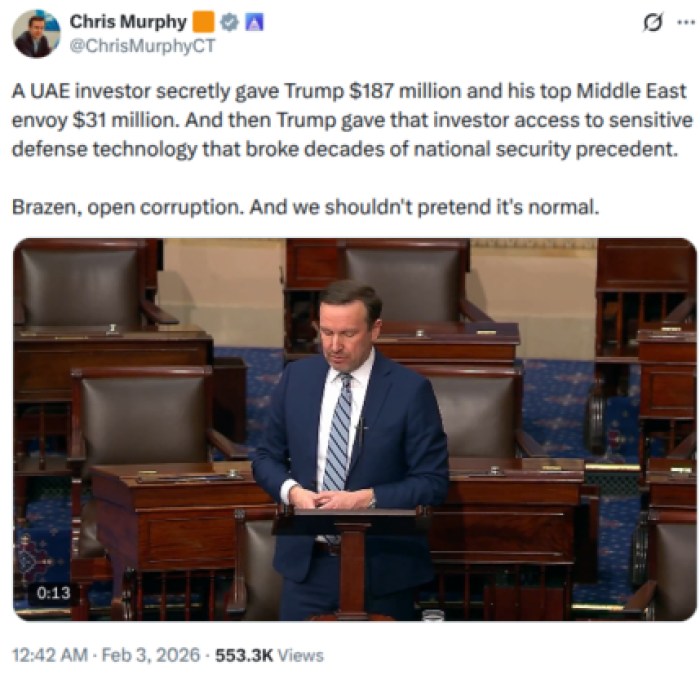
Source: X

The fear? Foreign entities are buying influence through blockchain projects tied to political figures. For the average retail trader, that signals a familiar danger: becoming exit liquidity for backroom deals. Trust is the only real currency here.

When that erodes at the institutional level, bogged down by regulatory scrutiny and conflicts of interest, capital historically flees toward the ‘wild west’ of the market.

We’re already seeing this migration on-chain. While institutional projects stall under the weight of Senate hearings, traders are rotating liquidity into assets that prioritize raw community strength. The narrative is shifting from ‘who do you know in Washington?’ to ‘how strong is your community?’

In this trust vacuum, high-leverage meme tokens are emerging as vehicles for retail conviction. So, who is leading this charge? Maxi Doge ($MAXI) , a project capitalizing on the market’s appetite for assets that operate far outside the sphere of political influence. It could be the next crypto to 1000x.

Escaping The Political Theater Through High-Leverage DeFi

The allure of DeFi during political scandals is simple: transparency. There are no backroom deals in a smart contract; there is only code. This environment has paved the way for Maxi Doge ($MAXI), a project that strips away the pretense of ‘institutional adoption’ to focus on what you actually want: volatility, leverage, and aggressive growth.

Traders familiar with previous cycles know that during periods of regulatory FUD (Fear, Uncertainty, and Doubt), meme coins often outperform utility tokens precisely because they’re uncorrelated with government policy. Maxi Doge leans into this.

Branding itself as a ‘240-lb canine juggernaut’ with a ‘lift, trade, repeat’ mentality, it creates a distinct psychological separation from the suit-and-tie narrative of Washington-linked crypto. The selling point isn’t a treaty; it’s a ‘Leverage King Culture,’ something wildly different from other kawaii dog-themed coins.
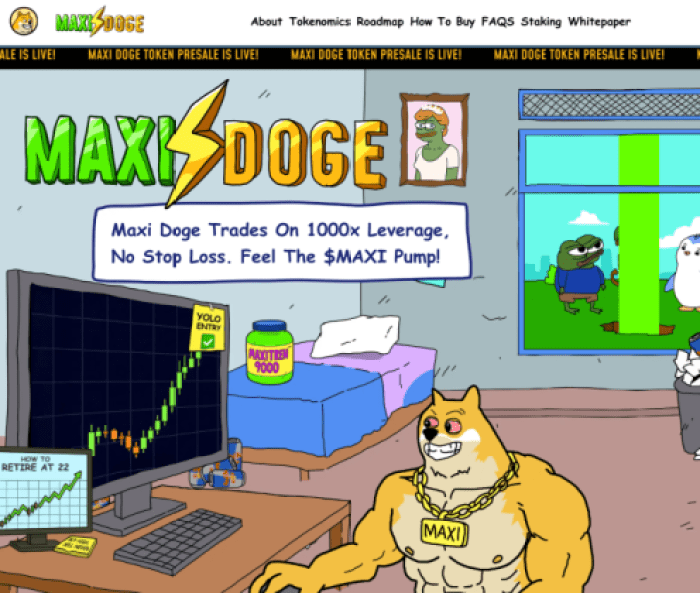
Source: Maxi Doge

Through planned holder-only trading competitions and a gamified ‘Maxi Fund’ treasury, the project plans to incentivize active participation rather than passive speculation. It hopes to solve a critical problem for retail traders lacking whale-tier capital: offering a playground where conviction pays better than connections.

Plus, the plan to integrate futures platform partnerships suggests a roadmap designed to capture the high-risk, high-reward segment alienated by current political discourse.

Learn ‘how to buy maxi doge’ in our guide.

Retail Hype Signals Shift Toward Retail-First Assets

While headlines focus on Senators and foreign treaties, social media and project engagement show where investors are looking. Political scandal appears to be driving investors toward fresh presales offering better risk-to-reward ratios than established, politically sensitive coins.

Maxi Doge has already secured over $4.5M in its ongoing presale, suggesting significant liquidity is rotating into this new sector. Even more telling is the social media following it’s managed to garner. Boasting over 6K followers on X, and over 3.3K subscribers on Telegram, $MAXI clearly has its fans.

Don’t get us wrong, these aren’t numbers to break a bank, but it’s still something to note for a hype project still in presale, that’s mainly thriving on vibes alone.

Beyond the socials, the protocol’s staking mechanics offer shelter for its capital. With dynamic APY fueled by daily automatic smart contract distribution, investors can compound holdings while waiting for the broader market to stabilize.

It fits the project’s ‘Never skip leg-day’ ethos: steady accumulation regardless of external conditions. If you’re exhausted by the volatility of political news cycles, the straightforward mechanics of a meme-driven ecosystem offer a refreshing (if high-risk) alternative.

CHECK OUT THE MAXI DOGE ($MAXI) PRESALE.

The information provided in this article is for educational purposes only and does not constitute financial advice. Cryptocurrency investments, particularly in meme tokens and presales, carry high risks, including the potential for significant loss. Always perform independent due diligence.


Preguntas relacionadas

QWhat is the main reason the article suggests that DeFi projects like Maxi Doge ($MAXI) are gaining attention during political scandals?

AThe article suggests that DeFi projects gain attention during political scandals because they offer transparency through smart contracts, operating outside the sphere of political influence and backroom deals, which attracts capital fleeing institutional crypto due to eroding trust, regulatory scrutiny, and conflicts of interest.

QAccording to the article, what specific feature of Maxi Doge ($MAXI) is designed to incentivize active participation rather than passive speculation?

AMaxi Doge plans to incentivize active participation through holder-only trading competitions and a gamified 'Maxi Fund' treasury, creating a playground where conviction is rewarded more than connections.

QHow does the article describe the performance of meme coins compared to utility tokens during periods of regulatory FUD (Fear, Uncertainty, and Doubt)?

AThe article states that during periods of regulatory FUD, meme coins often outperform utility tokens because they are uncorrelated with government policy, making them a more attractive option for traders seeking assets detached from political influence.

QWhat evidence does the article provide to show that Maxi Doge ($MAXI) is attracting significant interest from retail investors?

AThe article cites that Maxi Doge has secured over $4.5M in its ongoing presale and has garnered a social media following of over 6K followers on X and 3.3K subscribers on Telegram, indicating significant retail investor interest and liquidity rotation.

QWhat is the core ethos or mentality that the Maxi Doge ($MAXI) project brands itself with, according to the article?

AMaxi Doge brands itself with a 'Leverage King Culture' and a 'lift, trade, repeat' mentality, creating a psychological separation from traditional finance and emphasizing steady accumulation and high-risk, high-reward dynamics, encapsulated in its 'Never skip leg-day' ethos.

Lecturas Relacionadas

The Niche Consensus Among Elites: Has College Become an Expensive Waste?

**Summary:** A growing "anti-college" movement is gaining traction among elite circles in Silicon Valley, challenging the traditional value of a four-year university degree. Proponents argue that college has become an expensive, slow, and increasingly irrelevant waste of time, especially in the fast-paced tech world where opportunities pass by quickly. The movement is led by figures like billionaire Peter Thiel, who criticizes universities for high costs, ideological indoctrination, and stifling true innovation. His "Thiel Fellowship" pays young people to drop out and pursue ventures. Companies like Palantir Technologies (co-founded by Thiel) fuel this trend with programs like the "Meritocracy Fellowship," which offers high school graduates paid internships as an alternative to immediate college enrollment, promising a practical "Palantir Degree." Key drivers include: 1. **Economics:** Skyrocketing student debt versus the allure of immediate, high-paying tech jobs or startup funding. 2. **Technology:** AI and online tools lowering barriers to self-education and product development, making formal instruction seem inefficient. 3. **Culture:** A backlash against perceived "woke" ideology and DEI policies in universities, coupled with a belief that these institutions suppress meritocracy and masculine drive. The movement is notably male-dominated. Critics, like economist David Deming, warn against overgeneralizing from dropout success stories (survivorship bias). He emphasizes that genuine autodidacts are rare, corporate training is narrowly focused, and the "college wage premium" remains high for most people. University liberal arts education, he argues, builds adaptable problem-solving skills and broad perspectives. The debate highlights a deeper crisis in education. The core model of the modern university appears increasingly mismatched with the speed of the information age. The movement signals a shift in the locus of learning from institutional "education" to personal, active "learning" powered by the internet and AI. Ultimately, this may not mean the end of university, but rather a painful evolution. The future likely holds more hybrid, personalized, and lifelong learning pathways. The central question becomes: in a world changing faster than any curriculum, how do we best learn?

marsbitHace 20 min(s)

The Niche Consensus Among Elites: Has College Become an Expensive Waste?

marsbitHace 20 min(s)

From Subsidies to Token-Based Pricing to Price Cuts: Is OpenAI Sparking a Price War? Is the Inflection Point for Token Economics Nearing?

The commercialization of generative AI is facing a critical inflection point as a potential price war looms. According to The Wall Street Journal, OpenAI is considering a significant cut to its token fees to compete with rival Anthropic, signaling a shift from a growth-at-all-costs model focused on token consumption. This move comes as both companies, reportedly losing billions on compute, prepare for IPOs, and as enterprise customers face "bill shock" from switching to usage-based token billing. Reports indicate poor ROI, with one analysis finding only 18 cents of every dollar spent on AI tokens generates user-facing value. The industry's initial phases—from flat-rate subscriptions to aggressive subsidies—have given way to a reckoning with real costs. Analysts debate the future: some predict a bifurcation between premium, high-cost models for complex tasks and cheaper alternatives for routine work, while others believe overall spending will still rise as agentic AI increases tokens per task. Notably, Chinese model DeepSeek's low-cost API is gaining traction with U.S. enterprises, adding competitive pressure. The core challenge is redefining value beyond token volume ("tokenmaxxing") toward measurable productivity ("valuemaxxing"), as the entire AI value chain, from cloud providers to chipmakers, feels the ripple effects of unsustainable pricing.

marsbitHace 24 min(s)

From Subsidies to Token-Based Pricing to Price Cuts: Is OpenAI Sparking a Price War? Is the Inflection Point for Token Economics Nearing?

marsbitHace 24 min(s)

Trading

Spot
Futuros
活动图片




