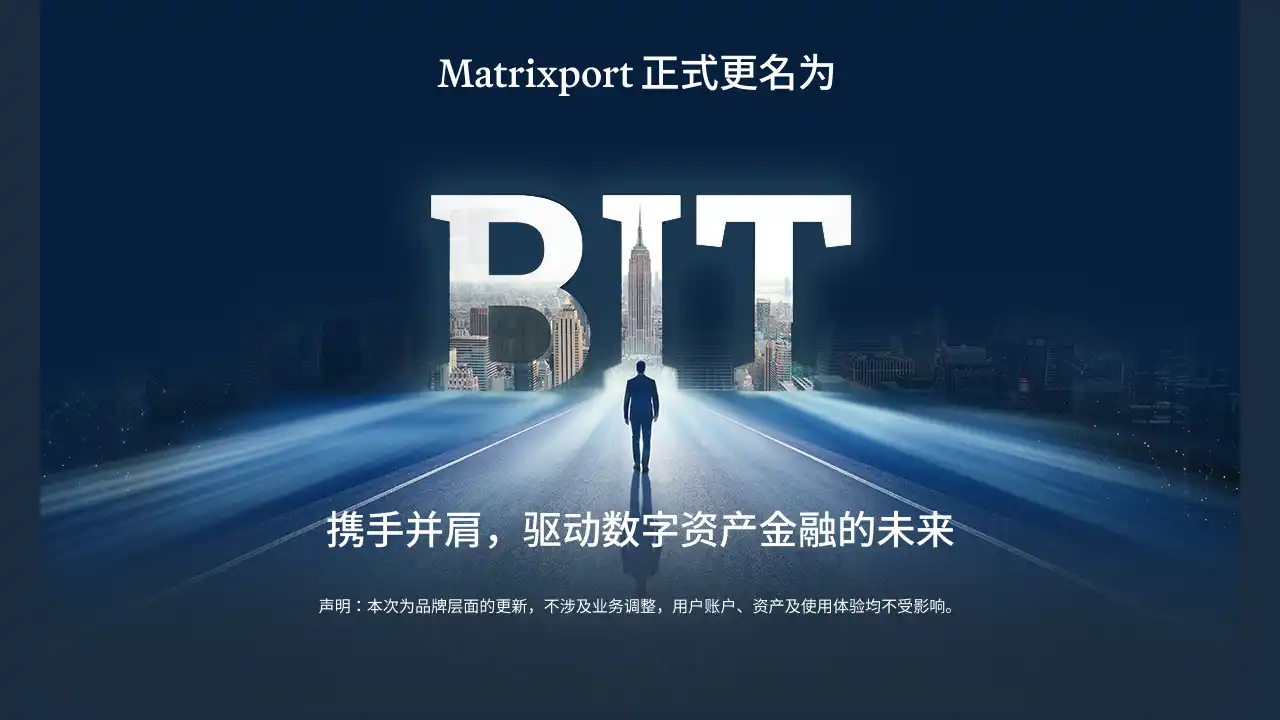
Matrixport Officially Rebrands as BIT, Clarifying New Strategic Positioning

marsbitPublicado a 2026-03-20Actualizado a 2026-03-20

Resumen

Digital financial services group Matrixport has officially rebranded to BIT, marking a new phase in its strategic positioning. The company will now operate globally under the unified BIT brand. Alongside the rebranding, BIT released its "2026 Trust Whitepaper," which systematically details the group's established governance and risk control frameworks to provide a verifiable foundation of trust for clients and partners. As the digital asset industry undergoes increasing institutionalization and regulatory maturation, market demands for robust governance and compliance capabilities are growing. The new BIT brand better reflects the company's current business focus and strategic direction for future development. CEO John Ge stated that the industry is entering a stage where governance and compliance are increasingly critical. The name BIT represents the evolution of the company's business and its long-term commitment to building trusted digital asset financial infrastructure. The brand's tagline, "Bridge into Tomorrow," signifies its vision to connect traditional finance with digital asset markets and build lasting trust with clients. The rebrand does not affect existing customer accounts, products, or services, and all legal entities and contractual arrangements remain unchanged. As part of its next strategic phase, BIT is also exploring opportunities in U.S. capital markets, including a potential public listing. Founded in 2019 and headquartered in Singapore, BIT operates...

Digital financial services group Matrixport today announced its official rebranding as BIT and will operate globally under the unified BIT brand. Along with the brand upgrade, BIT simultaneously released the "2026 Trust Whitepaper," systematically disclosing for the first time the governance and risk control framework the group has established and continues to operate, providing customers and partners with a verifiable foundation of trust.

Currently, as the digital asset industry's institutionalization process accelerates and the regulatory system becomes increasingly完善, market demands for platform governance capabilities and compliant operations are continuously rising. The new BIT brand more clearly reflects the company's current business positioning and represents the strategic direction for the next phase of development.

BIT CEO John Ge stated: "The digital asset industry is entering a new phase where governance capabilities and compliant operations are becoming increasingly important. BIT embodies the成果 of the company's continuous business evolution and our long-term commitment to building a trusted digital asset financial infrastructure."

He added: "'Bridge into Tomorrow' is not only our brand proposition but also represents our vision of connecting traditional finance with the digital asset market and establishing long-term trust with our customers."

The company stated that this rebranding does not affect existing customer accounts, products, or services, with all relevant legal entities and contractual arrangements remaining unchanged.

As part of the next phase of its strategy, BIT is also actively exploring opportunities related to the U.S. capital markets, including a potential public listing.

About BIT

BIT (formerly Matrixport), founded in 2019, is a global digital asset financial services group built on integrity. The group is headquartered in Singapore and has offices in seven countries and regions worldwide. Through a robust governance system, technological capabilities, and compliant operations, it connects traditional finance with the digital asset market.

BIT provides global institutional and professional investors with services covering trading, custody, asset management, liquidity, and financing solutions, and supports the on-chain introduction and application of real-world assets (RWA). Its entities hold corresponding licenses and are regulated in Singapore, Hong Kong, Switzerland, the UK, the US, and Bhutan, including a Major Payment Institution (MPI) license in Singapore and a collective asset management license issued by Switzerland's FINMA.

Currently, the group manages over $6 billion in assets, with a monthly trading volume exceeding $7 billion. It has累计 paid over $2 billion in interest to customers, boasts a valuation exceeding $1 billion, and has been入选 the "2024 Hurun Global Unicorn List" and the "2025 Singapore FinTech Unicorn List."


Preguntas relacionadas

QWhat is the new name of the digital financial services group formerly known as Matrixport?

AThe new name is BIT.

QWhat did the company release alongside its rebranding to BIT?

AThe company released its '2026 Trust Whitepaper', which systematically discloses the governance and risk control framework it has established and continues to operate.

QWhat is the significance of the new brand name 'BIT' according to the CEO?

AThe CEO stated that 'BIT' represents the company's evolved business focus and its long-term commitment to building trusted digital asset financial infrastructure. It also stands for the brand proposition 'Bridge into Tomorrow', symbolizing the vision to connect traditional finance with the digital asset market and build long-term trust with clients.

QDoes the rebranding to BIT affect existing customer accounts, products, or services?

ANo, the company stated that the rebranding does not affect existing customer accounts, products, or services, and all relevant legal entities and contractual arrangements remain unchanged.

QWhat is one of the strategic opportunities BIT is exploring as part of its next phase?

ABIT is exploring opportunities in the U.S. capital markets, including a potential public listing.

Lecturas Relacionadas

Qualcomm: AI Hype Subsides, When Will Smartphones Emerge from the Gloom?

Qualcomm reported its Q3 FY2026 results (ending June 2026), with revenue of $9.95B, down 4% YoY but above expectations. Gross margin declined to 53.1%, pressured by rising costs across manufacturing and memory. Key business segments showed mixed performance: Handset revenue fell 19.6% YoY to $5.09B, dragged by an 11% decline in non-Apple Android shipments and weaker high-end mix. Conversely, Automotive revenue surged 61% to $1.59B, and IoT grew 9% to $1.83B. Core operating profit dropped 41% YoY due to margin compression and higher expenses. Management's Q4 FY2026 guidance projects revenue of $9.7B-$10.5B, in line with consensus, but Non-GAAP EPS guidance of $2.05-$2.25 fell short of expectations. Amidst persistent weakness in its core handset market, Qualcomm is pursuing growth in AI, focusing on Edge AI (smartphones, PCs, automotive) and Data Center AI. Its data center strategy includes four pillars: AI accelerators (e.g., AI200), commercial CPUs (Dragonfly C1000), custom silicon, and connectivity solutions. While these initiatives initially boosted its stock, concerns over AI capital expenditure sustainability have since erased those gains. The company targets $5B in data center revenue for FY2027 and $15B for FY2029. The report concludes that with the traditional handset business still under pressure, the data center opportunity is currently viewed as a longer-term option, and a more conservative valuation based on core operations may be warranted until AI contributions materialize.

marsbitHace 2 min(s)

Qualcomm: AI Hype Subsides, When Will Smartphones Emerge from the Gloom?

marsbitHace 2 min(s)

From TPU to Self-Evolving Agents: How Jeff Dean Predicts the Next Step in AI

At the 2026 YC Startup School, Jeff Dean outlined his vision for AI's next phase, shifting focus from simply scaling models to building intelligent, autonomous systems. He believes AI's progress is no longer just about creating smarter models, but about integrating them into systems capable of long-term, iterative work, automated experimentation, and continuous learning. This evolution moves the competition from "who has the bigger model" to "who can best organize intelligence." Dean suggests AI capabilities are now comparable to a junior engineer, enabling the automation of complex workflows. However, the true challenge and opportunity lie in managing these AI "workers" at scale. He emphasizes the importance of **context engineering**—structuring tools, memory, and feedback loops—over raw model power. For startups, this means building deep expertise in niche domains where general models currently fail (near 0-1% success rates), leveraging proprietary data, specialized tools, and domain-specific evaluators. A recurring theme is re-examining fundamental constraints. Dean's past work, like moving Google's search index to memory or creating the TPU, stemmed from questioning outdated assumptions about hardware and cost. He sees similar inflection points today, particularly in **specialized inference hardware** to drastically reduce latency and energy consumption for real-time Agent operation. Notably, he points out that in modern AI systems, the dominant cost is often not computation but **data movement**. Reliable, long-running Agents require robust system design, borrowing concepts from distributed computing like checkpointing, state management, and parallel exploration to handle failures and maintain progress over days or weeks. As AI automates execution, the scarcest human skills will shift to **defining clear specifications**, **judging what problems are worth solving** (taste), and designing effective feedback loops. Ultimately, Dean's framework prioritizes understanding the problem deeply, identifying the true bottlenecks, and systematically building closed-loop systems where AI can not only perform tasks but also improve AI itself.

marsbitHace 3 min(s)

From TPU to Self-Evolving Agents: How Jeff Dean Predicts the Next Step in AI

marsbitHace 3 min(s)

Trading

Spot
活动图片




