Matrixdock Releases Latest Semi-Annual Physical Gold Audit Report, Strengthening Transparency Practices for Physical Gold

marsbitPublicado a 2026-01-15Actualizado a 2026-01-15

Resumen

Matrixdock, the RWA platform under Matrixport, has released its H2 2025 semi-annual physical gold audit report for its XAUm token. The audit, conducted by an independent third party, verified 482 LBMA-approved 1kg gold bars held across Brink’s Hong Kong, Brink’s Singapore, and Malca-Amit Singapore vaults. The total reserve amounts to approximately 482 kg (15,595.336 oz), valued at around $71.75 million based on the audit date gold price. No discrepancies were found between the physical gold and recorded assets. Compared to the H1 2025 audit, an additional 61 gold bars were added to the reserve. Matrixdock employs a dual-verification mechanism, combining physical audits with on-chain validation tools, allowing XAUm holders to verify the gold backing their tokens via a Web3 wallet. Each 1kg gold bar corresponds to approximately 32.148 XAUm tokens. The platform emphasizes transparency and institutional-grade operations to build trust in digital gold assets.

Matrixdock, the RWA platform under Matrixport, recently released its semi-annual physical gold audit report for the second half (H2) of 2025. The report discloses details about the physical gold reserves corresponding to the XAUm token, reflecting Matrixdock's ongoing commitment to physical asset verification and information transparency.

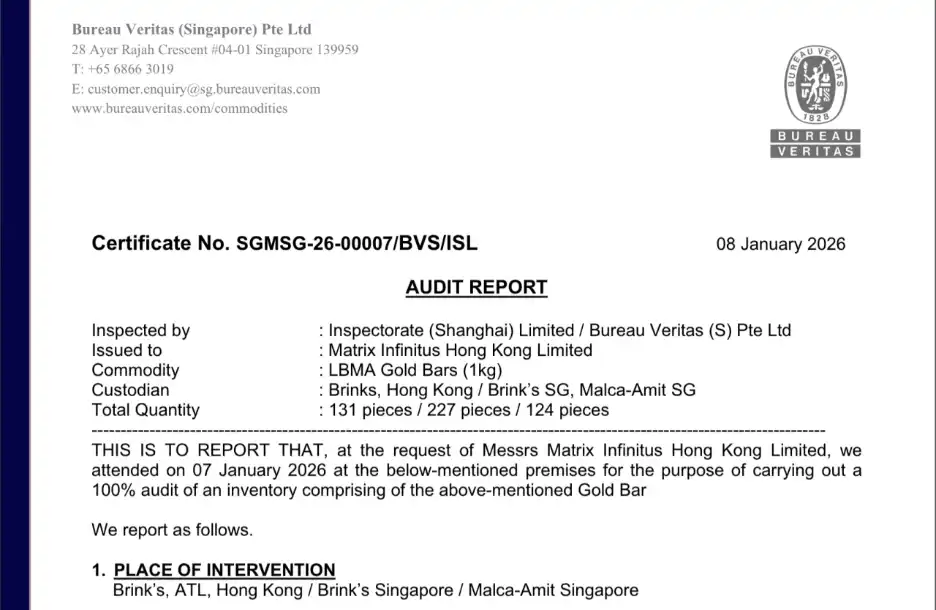
The audit was conducted by an independent third-party professional agency according to institutional-grade standards, providing a comprehensive inspection of the physical gold reserves corresponding to the XAUm token. The audit strictly followed leading industry standards for gold ETF audits, covering all elements including weight, purity, serial numbers, and vault custody information, achieving item-by-item verification of each physical gold bar.

Matrixdock's XAUm gold token employs a "dual-layer verification" mechanism: on one hand, it relies on an independent physical audit process; on the other hand, it combines on-chain real-time verification tools, enabling investors to transparently and continuously observe the mapping relationship between token supply and the corresponding gold reserves.

Audit Coverage and Key Data

● Audit execution date: January 7, 2026

● Physical gold reserves: 482 LBMA-approved 1-kilogram gold bars

● Total weight: 482 kilograms (approximately 15,595.336 ounces)

● Custody vaults: Brink’s Hong Kong, Brink’s Singapore, Malca-Amit Singapore

● Market value of the relevant physical gold, estimated at the audit time point: approximately $71.75 million

● The audit results showed no discrepancies between the physical gold and the related records.

Furthermore, compared to the audit for the first half of 2025, the number of physical gold bars covered in this audit increased by 61.
Enhancing the Verifiability of Tokenized Gold Through On-Chain Tools

Additionally, Matrixdock's gold allocation query tool allows XAUm holders to view the specific gold bar information corresponding to their tokens via a Web3 wallet. For example, one standard 1-kilogram gold bar corresponds to approximately 32.148 XAUm tokens, providing a more intuitive asset mapping method for tokenized gold.

As tokenized assets transition from innovation to infrastructure building, investor trust will increasingly rely on verifiable facts rather than verbal promises. Matrixdock stated that it will continue to advance reserve transparency and institutionalized operational standards, committed to providing global investors with more trustworthy and secure digital asset solutions for gold.

Audit report link: https://matrixdock.gitbook.io/matrixdock-docs/english/gold-token-xaum/physical-gold-vault-audit


Preguntas relacionadas

QWhat is the main purpose of Matrixdock's recently released semi-annual physical gold audit report?

AThe main purpose is to disclose the status of the physical gold reserves backing the XAUm tokens, demonstrating Matrixdock's ongoing commitment to physical asset verification and information transparency.

QHow many physical gold bars were verified in the audit, and what was their total weight?

AThe audit verified 482 LBMA-approved 1-kilogram gold bars, with a total weight of 482 kilograms (approximately 15,595.336 troy ounces).

QWhich independent third-party standards were followed for the physical gold audit?

AThe audit was conducted by an independent third-party professional agency according to institutional-grade standards, strictly referencing the leading gold ETF audit standards in the industry.

QWhat is the 'dual-layer verification' mechanism used for the XAUm gold token?

AThe 'dual-layer verification' mechanism combines an independent physical audit process with an on-chain real-time verification tool, allowing investors to transparently and continuously see the mapping relationship between the token supply and the corresponding gold reserves.

QHow can XAUm token holders verify which specific gold bars their tokens are backed by?

AXAUm holders can use Matrixdock's gold allocation query tool via a Web3 wallet to view the specific information of the gold bars corresponding to their tokens.

Lecturas Relacionadas

The "Impossible Triad" Is Fundamentally a Pseudo-Problem

The article argues that blockchain's fundamental limitation is not the scalability trilemma (decentralization, scalability, security), which has been largely solved, but the lack of **privacy** and, until recently, clear **legitimacy**. Blockchain is described as a slow, expensive, globally shared computer whose core value is censorship resistance and verifiability. While ideal for native digital assets like money (e.g., stablecoins), its default transparency acts as a **tax**, exposing all transactions and enabling MEV extraction, which deters serious institutional capital. Simultaneously, its permissionless nature created regulatory ambiguity. The piece contends that **privacy** is the missing critical feature. It rejects the false choice between total transparency and complete anonymity. Modern cryptography (like zero-knowledge proofs) enables **compliant privacy**: users can prove facts (solvency, KYC status, compliance) without revealing the underlying sensitive data (specific holdings, identities). This preserves auditability for regulators and eliminates the leak of financial information. With recent regulatory progress (e.g., the GENIUS Act) addressing legitimacy, adding default, provably compliant privacy becomes a pure upgrade. It transforms blockchain from a costly, public ledger into a confidential settlement layer, finally bridging the gap to mainstream institutional and individual adoption of on-chain finance.

链捕手Hace 11 hora(s)

The "Impossible Triad" Is Fundamentally a Pseudo-Problem

链捕手Hace 11 hora(s)

Optical Chips: Collective Capacity Expansion

The global optical chip industry is experiencing a massive wave of expansion driven by surging AI data center demand. Major players across the US, Japan, Europe, and China are aggressively investing to ramp up production capacity. In the US, Coherent is expanding its 6-inch Indium Phosphide (InP) semiconductor fab in Texas, supported by CHIPS Act funding and a $2 billion strategic investment from NVIDIA. Lumentum is building a new factory for InP optical devices, and Nokia is scaling its advanced photonic chip packaging and testing capabilities. NVIDIA's investments aim to secure future supply of critical lasers and optical interconnect products for AI infrastructure. Japan's JX Advanced Metals, a leading InP substrate supplier, plans a multi-billion yen investment to increase its capacity 7-10 times, strengthening its grip on the crucial upstream materials market. In Europe, IQE and Tower Semiconductor settled a patent dispute and signed a multi-year InP epitaxial wafer supply agreement, highlighting that next-generation silicon photonics platforms will integrate high-performance InP components. STMicroelectronics and Sivers Semiconductors are also expanding silicon photonics production and partnerships. China is rapidly building out its domestic supply chain. Dongshan Precision's subsidiary, Source Photonics, announced a $12 billion project to expand optical chip and module production. Companies like Sanan Optoelectronics and Yunnan Germanium are scaling up InP chip manufacturing and substrate production, moving towards vertical integration from materials to modules. While debate continues around the exact future architecture—whether CPO (Co-Packaged Optics), NPO, or pluggables will dominate—analysts like Morgan Stanley argue the underlying driver is unchangeable: the explosive growth in bandwidth demand. This will inevitably increase the volume of optical engines, lasers, and related content per GPU, regardless of the final technical path. The competition for "more light" in the AI era has intensified into a global, full-chain capacity race.

marsbitHace 14 hora(s)

Optical Chips: Collective Capacity Expansion

marsbitHace 14 hora(s)

Trading

Spot
Futuros
活动图片