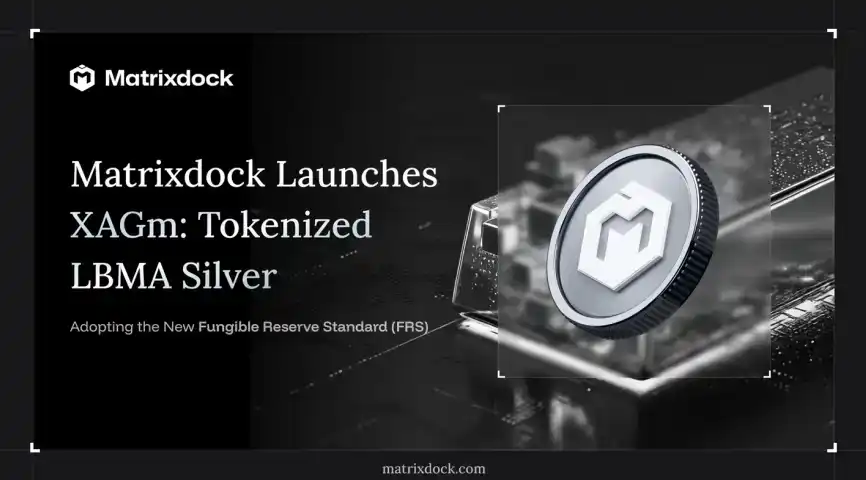
Matrixdock Launches Silver Token XAGm, Building On-Chain Silver Reserve Asset Based on FRS Standard

marsbitPublicado a 2026-03-17Actualizado a 2026-03-17

Resumen

Matrixdock, a leading RWA platform, has launched XAGm, an institutional-grade silver token backed by fully allocated physical silver. The token is supported by LBMA Good Delivery standard silver bars, enabling this widely traded precious metal to enter the on-chain financial ecosystem. XAGm expands Matrixdock’s on-chain precious metals system, supporting use cases such as trading, collateralization, and DeFi applications. Unlike gold, which primarily serves as a store of value, silver possesses both investment and industrial demand, introducing stronger cyclical dynamics and diversified utility in on-chain markets. XAGm is one of the few institutional-grade tokenized silver products, with verifiable asset backing held in professional vaults. The token is issued under Matrixdock’s FRS (Fungible Reserve Standard) framework, which ensures transparent and sustainable alignment between on-chain tokens and underlying physical assets. Initially deployed on Ethereum, XAGm is set to expand to other blockchain ecosystems to improve accessibility and liquidity. This launch further develops Matrixdock’s Reserve Layer, combining gold and silver to create a more resilient and diversified on-chain asset base for the decentralized financial system.

Matrixdock, a leading global RWA platform, today announced the launch of the silver token XAGm for institutional use. This product is backed by fully allocated physical silver as the underlying asset and incorporates silver bar assets that comply with the LBMA Good Delivery standard, enabling silver—a widely traded precious metal commodity in traditional markets—to enter the on-chain financial system.
The launch of XAGm further enriches Matrixdock's on-chain precious metal asset system, allowing silver, a precious metal asset that has long played a significant role in traditional markets, to enter a programmable on-chain financial environment. It supports various financial application scenarios such as collateralization, trading, capital allocation, and DeFi.

As real-world assets continue to enter the blockchain financial system, market focus is gradually shifting from "whether assets can be on-chain" to "which assets can operate stably on-chain in the long term." Against this backdrop, precious metal assets with mature market structures, stable value foundations, and global liquidity are becoming important asset types in the on-chain financial system, featuring institutional-grade structural design.

Combining Investment and Industrial Attributes, Silver Expands On-Chain Trading and Collateral Scenarios

Unlike gold, which primarily serves as a store of value, silver is influenced by both investment demand and industrial consumption, resulting in more pronounced cyclical characteristics. This dual nature as both a financial asset and an industrial commodity enables silver to support more diverse trading, collateral, and asset allocation scenarios in the on-chain market.

If gold provides a stable value anchor for reserve assets in the on-chain financial system, then silver introduces greater market activity and cyclical characteristics to this system. The two form a complementary relationship, providing a more complete structural foundation for the on-chain precious metal asset system.

As one of the few tokenized silver products in the current market with an institutional-grade structural design, XAGm is backed by physical silver in the form of LBMA Good Delivery standard silver bars, stored in professional institutional vault facilities. Through clear asset allocation arrangements and information disclosure mechanisms, the correspondence between XAGm tokens and the underlying silver assets can be independently verified within the established framework, providing institutional participants with an auditable and verifiable channel for on-chain silver asset allocation.

FRS Issuance Framework: Supporting the Long-Term Operation of Real Assets On-Chain

In terms of asset structure design, XAGm adopts Matrixdock's FRS (Fungible Reserve Standard) issuance framework. FRS is an issuance mechanism designed by Matrixdock for RWA on-chain, establishing a transparent and verifiable correspondence between the on-chain token supply structure and the underlying asset holding structure through programmable means, enabling tokens to continuously reflect the economic attributes of the held real assets. While maintaining the integrity of the underlying assets' economic attributes, FRS also incorporates long-term operational costs such as custody and auditing into the mechanism design, thereby providing a more sustainable structural model for long-term RWA assets.

XAGm will first be deployed on the Ethereum network, with plans to gradually expand to more blockchain ecosystems in the future to further enhance the accessibility and liquidity of assets in different on-chain financial environments.

The launch of XAGm also marks the continuous expansion of Matrixdock's Reserve Layer system. With the successive introduction of gold and silver as two types of precious metal assets, Matrixdock is building an on-chain reserve structure composed of assets driven by different economic cycles, providing a more stable and diversified asset infrastructure for the on-chain financial system.

Eva Meng, Head of Matrixdock, stated: "There are still relatively few tokenized silver products in the current market that truly meet institutional-grade standards. With XAGm, we are bringing fully allocated silver assets, custodied by professional institutional vaults, on-chain, operating within a clear and verifiable framework. Gold primarily serves as a store of wealth, while silver plays a complementary role driven by both industrial demand and monetary attributes. Together, they will provide a more complete and resilient asset foundation for on-chain precious metal infrastructure."

In the future, Matrixdock will continue to expand into more high-quality real-world assets, including precious metals and other commodity assets with mature market structures, to promote the construction of a more transparent and resilient on-chain reserve asset system, providing long-term sustainable infrastructure support for the development of the on-chain financial ecosystem.

Preguntas relacionadas

QWhat is the name of the new silver token launched by Matrixdock and what standard is it built on?

AThe new silver token is called XAGm, and it is built on the FRS (Fungible Reserve Standard).

QWhat is the primary purpose of the FRS (Fungible Reserve Standard) framework used for XAGm?

AThe FRS framework is designed to establish a transparent and verifiable correspondence between the on-chain token supply structure and the underlying asset holding structure, ensuring the token continuously reflects the economic attributes of the real asset while incorporating long-term operational costs like custody and auditing.

QHow does the role of silver (XAGm) differ from that of gold in the on-chain financial system according to the article?

AGold primarily serves as a store of value, while silver, influenced by both investment demand and industrial consumption, introduces stronger market activity and cyclical characteristics, creating a complementary relationship within the on-chain precious metals system.

QWhat specific standard do the physical silver bars backing XAGm comply with, and how is the asset's authenticity verified?

AThe physical silver bars backing XAGm comply with the LBMA Good Delivery standard. The correspondence between the tokens and the underlying silver is independently verifiable within a defined framework through clear asset allocation arrangements and information disclosure mechanisms.

QOn which blockchain network will XAGm be initially deployed, and what are the plans for its future expansion?

AXAGm will first be deployed on the Ethereum network, with future plans to expand to more blockchain ecosystems to enhance its accessibility and liquidity across different on-chain financial environments.

Lecturas Relacionadas

Cyclical Stock or Growth Stock? Coinbase's Q2 Earnings Report Reveals 'Valuation Disagreement'

Coinbase's Q2 2026 financial results revealed a mixed performance, reigniting debate over whether the company should be valued as a cyclical stock tied to crypto markets or a growth stock with future potential. Total revenue missed expectations at $1.22 billion, down 19% year-over-year. Transaction revenue fell to $599 million, with retail crypto spot trading revenue dropping 30% to $452 million, back to 2023 levels. The company reported a net loss of $359 million, marking its third consecutive quarterly loss. Despite CEO Brian Armstrong's positive commentary on metrics like a 10.3% overall crypto trading market share and 106% growth in prediction markets, the market reacted negatively, with shares dropping over 5% after-hours. A key issue is the decline in core retail trading. While Coinbase touted record market share, this figure includes derivatives and new products. Its traditional crypto spot trading share is likely shrinking. New ventures like prediction markets, while growing, contributed less than $30 million, insufficient to offset the core revenue decline. The valuation debate hinges on perspective. As a cyclical stock, Coinbase remains deeply tied to the crypto bear market, with user attrition and competitive pressures justifying a lower valuation. The company's strategy appears focused on surviving until the next bull cycle. Viewed as a growth stock, however, Coinbase shows promising diversification. Subscription and service revenue reached $555 million, nearly matching transaction revenue. Stablecoin revenue, its second-largest source at $292 million, remains strong through its partnership with Circle. Critically, Coinbase is positioning itself as a leader in the emerging on-chain "agent economy." Over 90% of agent-based stablecoin transactions occur on its Base network, which it believes could handle trillions in future agent transactions. The recent acquisition of Deribit also aims to boost its international derivatives offering. In summary, Coinbase's present struggles are clear, but its future hinges on whether its investments in revenue diversification, stablecoins, and the agent economy can ultimately transform its business model and justify a growth premium.

Odaily星球日报Hace 5 min(s)

Cyclical Stock or Growth Stock? Coinbase's Q2 Earnings Report Reveals 'Valuation Disagreement'

Odaily星球日报Hace 5 min(s)

Global Market Share Survey: Japanese Firms Lead in Semiconductor Materials

Global Market Share Survey: Japanese Firms Lead in Semiconductor Materials According to the 2025 "Major Goods and Services Market Share Survey" by Nikkei, Japanese companies maintain strong positions in semiconductor-related materials. In silicon wafers, Shin-Etsu Chemical ranks first with a 26.3% share, followed by SUMCO at 17.8%. Together, they hold 44.1% of the market, widening their lead over competitors from Taiwan, Germany, and South Korea. In photoresists, Tokyo Ohka Kogyo, JSR, and Shin-Etsu Chemical occupy the top three spots, with a combined share of 60.5%. Despite their strength in materials, Japanese firms have a weaker presence in core semiconductor segments like DRAM and NAND flash memory, where South Korean and U.S. companies dominate. For instance, SK Hynix and Samsung lead in DRAM, while China’s CXMT doubled its share to 6% in 2025. The semiconductor market is projected to grow rapidly, with WSTS forecasting a 90% increase to $1.5112 trillion by 2026. Major players like Samsung, SK Hynix, and Micron are making massive investments to expand capacity. To maintain their edge in materials, Japanese companies must similarly commit to large-scale, risk-taking investments. In contrast, Japan’s automotive sector shows stagnation. Toyota remains the global leader but with only a slight share increase to 12.3%, while Japanese brands are absent from the top five in the EV market. In shipbuilding, Imabari Shipbuilding rose to third place globally with a 7.2% share, benefiting from large container ship deliveries. However, Chinese and South Korean firms dominate the sector, holding the top two positions. Japan aims to revitalize its shipbuilding industry through government and corporate efforts, targeting a near doubling of output by 2035. Addressing labor shortages and adopting advanced technologies like physical AI will be critical for competitiveness.

marsbitHace 30 min(s)

Global Market Share Survey: Japanese Firms Lead in Semiconductor Materials

marsbitHace 30 min(s)

Trading

Spot
活动图片