Market Divergence: SOL Becomes Institutional Darling, Terra Ecosystem Completely Collapses, ZEC Shorts Forced to 'Hold the Bag' by Whales?

金色财经Publicado a 2025-12-12Actualizado a 2025-12-12

Resumen

The cryptocurrency market is currently experiencing significant divergence, with some assets surging while others face severe downturns. Bitcoin (BTC) is testing a critical resistance zone between $92,000 and $94,000. A successful breakout could propel it toward $100,000, while failure may lead to a pullback below $90,000. Similarly, Ethereum (ETH) is approaching its key level at $3,400. Holding above this could push it to $3,700-$3,800, otherwise a retest of $3,000 support is likely. Solana (SOL) has emerged as a major institutional favorite. Despite market volatility, SOL ETFs continue seeing consistent inflows. Support from major platforms like Coinbase, which integrated Solana DEX functionality, and growing adoption by traditional finance giants like JPMorgan and Nasdaq, highlight strong fundamental strength. Accumulating SOL gradually is recommended. In contrast, the Terra ecosystem (LUNA, LUNC, USTC) has effectively collapsed. Founder Do Kwon received a 15-year prison sentence, and the project's $40 billion collapse triggered a broader market crisis. These assets are considered uninvestable. Zcash (ZEC) presents a cautionary tale for short sellers. Many are trapped in losing positions as large holders (whales) maintain price range, collecting funding rates systematically. This strategy allows whales to profit from perpetual funding while gradually squeezing shorts. The lesson: take profits quickly when shorting ZEC and avoid greed. Overall strategy: Wait for BTC/E...

The crypto space is truly a case of "some rejoice while others mourn"! Some coins are being frantically bought by institutions, some have been handed a death sentence, and others are leaving short sellers crying in the bathroom — this article breaks down the trading logic of the hot coins clearly. Save it now!

BTC/ETH: Stuck at Key Levels, Only a Breakout Brings Opportunity!

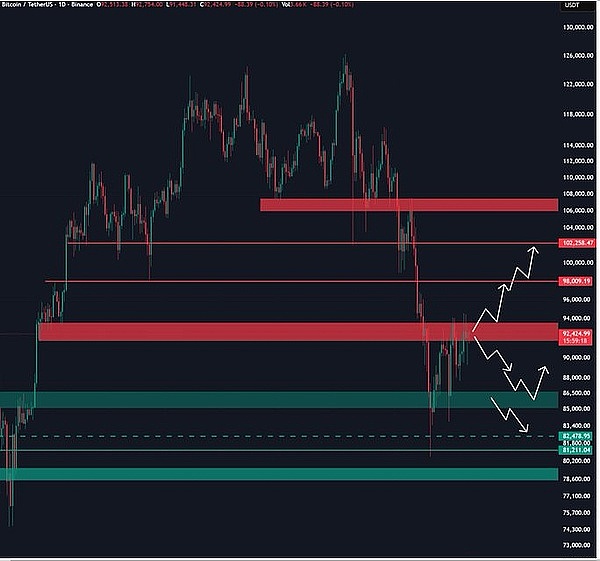
BTC: The $92k-$94k Line is a Matter of Life and Death

Big Brother Bitcoin is back in the $92,000-$94,000 resistance zone! Now it's up to the bulls: if they can break through this range, the next target is directly aiming for $100,000; if they can't break through, it will likely fall back below $90,000. This back-and-forth is so tedious~
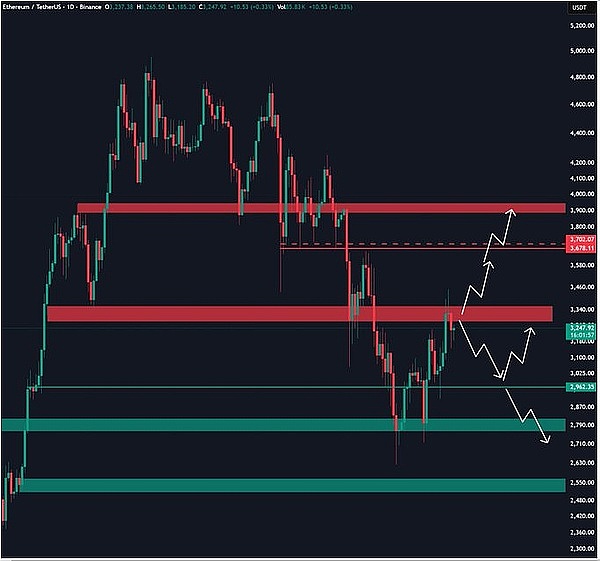
ETH: $3400 Determines the Direction

Ethereum is charging at the resistance level again! The key is to see if the daily chart can hold firmly above $3400: if it holds, it will run towards $3700-$3800; if it fails to hold, it will have to go back and test the $3000 support. Don't blindly chase the high, wait for a clear direction before acting!
SOL: The 'Potential Stock' Frenziedly Bought by Institutions, Buying a Little Daily is Worth It!

If we're talking about the altcoin most favored by institutions right now, SOL definitely takes first place! Its fund flows are too strong:

  • It's been almost two months since the ETF approval, and no matter how much the market falls, funds have been quietly adding to their positions, completely unfazed;

  • Coinbase directly added DEX trading functionality for the Solana ecosystem in its official App, essentially opening a "green channel" for SOL;

  • From JPMorgan to Nasdaq, traditional finance bigwigs are building on the Solana chain, making the ecosystem increasingly stable!

Remember: follow the market funds, don't be swayed by various bull/bear news! SOL is currently a key target for institutional布局 (layout). Buy a little bit daily and accumulate slowly, making money is just a matter of time~
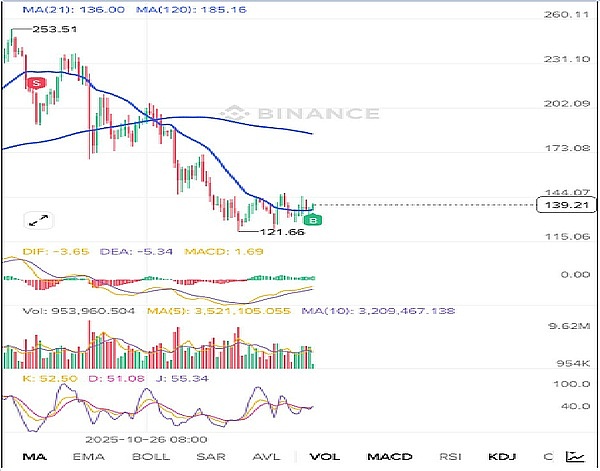
Terra Ecosystem (LUNA/LUNC/USTC): Game Over! Founder Sentenced, Paying for the $40 Billion Loss

The Terra ecosystem is completely finished! Founder Do Kwon has been sentenced to 15 years in prison. The "crash disaster" he created back then directly evaporated $40 billion and triggered a chain reaction: FTX collapsed next, trust in algorithmic stablecoins completely crumbled, and the crypto market went into winter~

LUNA, LUNC, and USTC are now completely battered by the fall. This isn't a simple pullback; it's the complete landing of negative news. There's little chance of a comeback later. Don't even think about buying the dip, don't touch them!

ZEC: Stubborn Shorts Get Trapped, Whales Profit by 'Sideways Movement'!

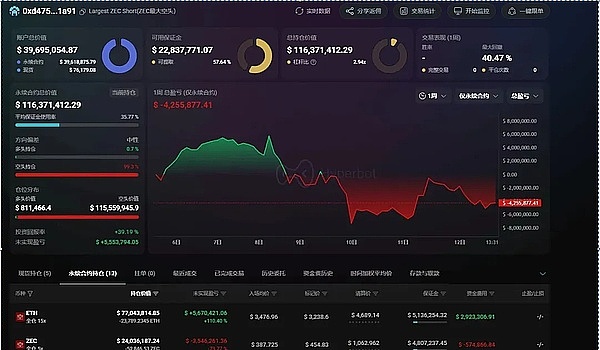
ZEC short sellers have had it rough lately! Many opened short positions hoping to make a profit, but ended up getting trapped deeper, and some fearless ones kept charging in, being extremely stubborn~

Especially the "top short seller" with the largest position, who was already profitable but didn't close the position, is now back in the red! Although they reduced their position a bit when the price dropped to the 300s, most of the position is still there. Fortunately, the whale has sufficient margin, with a liquidation point at $1057U, so they are safe for now, but the后续 (follow-up) is even more uncomfortable:

The whales have no intention of making big pumps or dumps; they just maintain the current price sideways, making money daily by collecting funding fees! Even though it's collected only every 8 hours, the large position size means they earn a significant amount~ They can even use the collected funding fees to slowly pump the price, wearing down these short sellers!

So ZEC isn't impossible to short, the key is to know when to stop, take profits and run quickly when you have them, don't linger. Money in hand is real money!
Summary: Wait for a breakout before acting on BTC/ETH, SOL can be accumulated daily with small positions, blacklist the Terra ecosystem entirely, don't be greedy when shorting ZEC.


Criptos en tendencia

Preguntas relacionadas

QWhat is the key resistance range for Bitcoin (BTC) according to the article?

AThe key resistance range for Bitcoin (BTC) is $92,000 to $94,000. A successful break above this range could target $100,000, while a failure could see the price drop back below $90,000.

QWhy is Solana (SOL) considered a favorite among institutions?

ASolana (SOL) is favored by institutions because its ETFs have seen consistent capital inflows for nearly two months, Coinbase has integrated Solana ecosystem DEX trading, and major traditional finance players like JPMorgan and Nasdaq are building on its blockchain, indicating strong and stable ecosystem growth.

QWhat was the outcome for Terra's founder, Do Kwon, and its ecosystem tokens?

ATerra's founder, Do Kwon, was sentenced to 15 years in prison. The Terra ecosystem tokens (LUNA, LUNC, USTC) have crashed significantly following the $40 billion collapse, and the article advises against any investment in them as they are considered to have no recovery potential.

QWhat is the current trading strategy suggested for ZEC based on the article?

AThe article suggests that shorting ZEC can be done but advises taking profits quickly and not being greedy. It highlights that large holders (whales) are maintaining a sideways price action to collect funding fees from over-leveraged short sellers, making it risky to hold short positions for too long.

QWhat is the critical price level that Ethereum (ETH) needs to hold on a daily close for a bullish move?

AEthereum (ETH) needs to achieve a daily close above $3,400 to potentially move towards the $3,700-$3,800 range. If it fails to hold this level, it may fall back to test support at $3,000.

Lecturas Relacionadas

Gate Research Institute: The 'Wall Street-ization' Wave of Crypto Financial Products – Competition or Integration?

The article titled "Gate Research Institute: Are Crypto Financial Products Sparking a 'Wall Street' Wave—Competition or Convergence?" explores the evolving relationship between the crypto ecosystem and traditional finance (TradFi). The piece begins by reflecting on Bitcoin's original 2009 vision of decentralization, disintermediation, and moving away from banks. It then contrasts this with the 2024 landscape, where key crypto assets like Bitcoin are increasingly held through Wall Street products like ETFs issued by giants like BlackRock. The article questions whether this signifies that TradFi is systematically taking over the rights to issue, price, custody, and distribute crypto financial assets. The core argument is that this is not a zero-sum takeover but rather a bidirectional convergence where each side addresses the other's weaknesses. Crypto offers 24/7 global markets, programmable settlement, and open access but lacks compliant channels, institutional-grade custody, deep fiat liquidity, and mainstream distribution. TradFi possesses these but is constrained by legacy systems, limited operating hours, and slow settlement. Two primary convergence paths are highlighted: * **Path A (CEX to TradFi):** Exemplified by Gate, which has progressed from offering tokenized stocks and CFDs to providing direct, real stock trading (US, Hong Kong, South Korea) within its platform, using USDT. * **Path B (TradFi to Crypto):** Exemplified by Robinhood, which has integrated crypto trading, acquired exchanges like Bitstamp, and is moving traditional assets like stocks onto the blockchain via tokenization and its own Layer 2. Both paths are ultimately competing to become the next-generation, unified financial account—a "super account" where users can seamlessly trade cryptocurrencies, stocks, ETFs, RWA (Real World Assets), and tokenized treasury products in one interface. The growth of RWA and tokenized treasuries (e.g., BlackRock's BUIDL) is presented as the asset-layer fusion, providing stable, yield-bearing assets on-chain and acting as a bridge between the two worlds. In conclusion, the "Wall Street-ization" of crypto is framed as a mutual transformation. Decentralized ideals persist in the protocol layer, while at the application layer, a more efficient, global, and accessible unified capital market is emerging from this convergence. The future competition lies not between crypto exchanges and stockbrokers, but between platforms vying to offer the most comprehensive asset coverage, liquidity, and user experience within a single account.

marsbitHace 2 min(s)

Gate Research Institute: The 'Wall Street-ization' Wave of Crypto Financial Products – Competition or Integration?

marsbitHace 2 min(s)

Claude's Major New Feature: Screen Recording + Voice, Distilling Your Skills into AI Tasks in One Click

Claude has introduced a major new feature called "Record a Skill," available for Pro, Max, and Team users. This function, found in the Claude desktop app's CoWork menu, allows users to create reusable AI skills simply by recording their screen and providing voice narration while performing a task. Claude then automatically analyzes the recording and generates a functional Skill. A hands-on test confirmed the feature works seamlessly. Users start recording via the Skills manager, perform their workflow while verbally explaining the steps and logic, and avoid including sensitive information. After recording, Claude processes the content and creates the Skill, which can be saved and later invoked with a slash command (/). This eliminates the need for manual adjustments or writing complex instruction files. The innovation goes beyond mere efficiency. Previously, creating a Skill required writing a detailed SKILL.md file in Markdown—a significant barrier for non-technical users. "Record a Skill" bypasses this by directly capturing both actions and the implicit reasoning shared in the narration. This lowers the barrier to knowledge transfer and automation, addressing a core challenge in corporate knowledge management: the difficulty of getting experts to write and maintain documentation. However, the feature also highlights a shift in the nature of work. A case study from March 2026 showed a freelancer whose five-year client relationship was effectively replaced by a hand-coded Claude Skill automating their content workflow. With the even lower barrier of screen recording, the ability to distill personal expertise into automatable skills accelerates this trend. The "moat" for work is moving from simply knowing how to do a task to mastering tasks that are difficult or impossible to automate.

marsbitHace 6 min(s)

Claude's Major New Feature: Screen Recording + Voice, Distilling Your Skills into AI Tasks in One Click

marsbitHace 6 min(s)

Feeding AI "Noise" Can Also Boost Scores, This Work Enables Positive Transfer with Noise

Feeding "Noise" to AI Can Improve Performance: A Method Enables Positive Transfer from Noise This work, Semi-Supervised Noise Adaptation (SSNA), introduces a Noise Adaptation Framework (NAF) that challenges traditional transfer learning. Instead of requiring a labeled source domain of real data (e.g., images, text), NAF uses randomly generated Gaussian noise as the source. For a target task with C classes, it constructs C noise clusters by sampling from Gaussian distributions. Although this synthetic noise contains no semantic meaning, NAF trains it to form a discriminative class structure in a shared representation space—clustering same-class noise and separating different classes. The key is aligning this learned structure from the noise domain to the real, sparsely labeled target domain. A small number of target labels are still essential to establish the correspondence between noise clusters and actual classes. The training objective combines: 1) supervised loss on the few labeled target samples, 2) classification loss for the noise to build its structure, and 3) a distribution alignment loss (using Negative Domain Similarity) to minimize the gap between the noise and target domains in the shared space. Experiments show significant gains in few-label settings. With just 4 labels per class, NAF with a ResNet-18 backbone improves accuracy over a standard supervised baseline (ERM) by +12.35% on CIFAR-10, +7.61% on CIFAR-100, +4.38% on DTD-47, and +2.74% on Caltech-101. It also benefits fine-grained datasets and scales to ImageNet-1K (with 100 labels/class) and text classification (AG News). NAF can be integrated into existing semi-supervised methods like FixMatch for further gains. Ablation studies confirm the transferred benefit comes from the discriminative structure of the noise, not randomness itself. Collapsing all noise into a single point causes negative transfer, while increasing separation between noise cluster centers improves performance. The amount of noise per class is less critical once a basic structure forms. In conclusion, this work demonstrates that for positive transfer, the semantic content of source data may not be necessary. What can be effectively transferred is the *organizational structure* of categories within a representation space. This offers a promising alternative for scenarios where real source data is unavailable due to privacy, copyright, or procurement constraints.

marsbitHace 8 min(s)

Feeding AI "Noise" Can Also Boost Scores, This Work Enables Positive Transfer with Noise

marsbitHace 8 min(s)

Trading

Spot

Artículos destacados

Cómo comprar ZEC

¡Bienvenido a HTX.com! Hemos hecho que comprar Zcash (ZEC) sea simple y conveniente. Sigue nuestra guía paso a paso para iniciar tu viaje de criptos.Paso 1: crea tu cuenta HTXUtiliza tu correo electrónico o número de teléfono para registrarte y obtener una cuenta gratuita en HTX. Experimenta un proceso de registro sin complicaciones y desbloquea todas las funciones.Obtener mi cuentaPaso 2: ve a Comprar cripto y elige tu método de pagoTarjeta de crédito/débito: usa tu Visa o Mastercard para comprar Zcash (ZEC) al instante.Saldo: utiliza fondos del saldo de tu cuenta HTX para tradear sin problemas.Terceros: hemos agregado métodos de pago populares como Google Pay y Apple Pay para mejorar la comodidad.P2P: tradear directamente con otros usuarios en HTX.Over-the-Counter (OTC): ofrecemos servicios personalizados y tipos de cambio competitivos para los traders.Paso 3: guarda tu Zcash (ZEC)Después de comprar tu Zcash (ZEC), guárdalo en tu cuenta HTX. Alternativamente, puedes enviarlo a otro lugar mediante transferencia blockchain o utilizarlo para tradear otras criptomonedas.Paso 4: tradear Zcash (ZEC)Tradear fácilmente con Zcash (ZEC) en HTX's mercado spot. Simplemente accede a tu cuenta, selecciona tu par de trading, ejecuta tus trades y monitorea en tiempo real. Ofrecemos una experiencia fácil de usar tanto para principiantes como para traders experimentados.

391 Vistas totalesPublicado en 2024.12.12Actualizado en 2026.06.02

Cómo comprar ZEC

Discusiones

Bienvenido a la comunidad de HTX. Aquí puedes mantenerte informado sobre los últimos desarrollos de la plataforma y acceder a análisis profesionales del mercado. A continuación se presentan las opiniones de los usuarios sobre el precio de ZEC (ZEC).

活动图片