Mar-a-Lago Secret Meeting: What Are They Plotting?

比推Publicado a 2026-02-19Actualizado a 2026-02-19

Resumen

A private forum was held at Mar-a-Lago, hosted by the Trump family's DeFi project, World Liberty Financial (WLFI). Attendees included top Wall Street executives (Goldman Sachs CEO, Nasdaq Chair), crypto leaders (Coinbase founder), regulators (CFTC Chair), and celebrities. Discussions focused on WLFI’s initiatives: expanding its USD1 stablecoin into institutional use via a partnership with Apex Group, tokenizing real estate assets (Trump Maldives resort), and developing a foreign exchange platform. Critics raised concerns over ethical conflicts and potential foreign influence, citing a $500M investment linked to Abu Dhabi. WLFI token has fallen 69% from its peak, with 80% of tokens still locked. The event highlights the merging of political influence, finance, and crypto under the Trump brand.

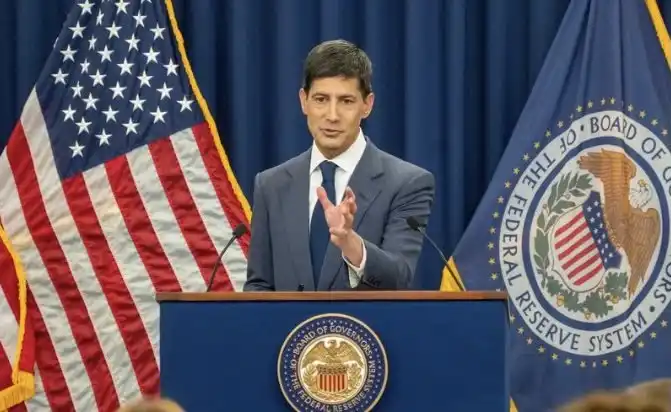
February 18, Palm Beach, Florida, Mar-a-Lago.

This place, referred to by Trump as the "Winter White House," welcomed top Wall Street and crypto elites—Goldman Sachs CEO, Nasdaq Chairman, Coinbase founder, FIFA President, and a rapper named Nicki Minaj.

According to public records, this was the "World Liberty Forum" (World Liberty Forum) hosted by the Trump family's DeFi project, World Liberty Financial (WLFI). Approximately 400 top figures from global finance, technology, regulation, and entertainment gathered here for a full day of closed-door discussions.

Meanwhile, it was during the Chinese Lunar New Year holiday. While investors in the Chinese-speaking market were still anxious about the notion that "the crypto circle is dead," Americans across the ocean were already sitting together, discussing how to firmly grasp the next round of financial transformation in their own hands.

What Are They "Plotting"?

World Liberty Financial is a DeFi protocol deeply involved with the Trump family, officially launched in September 2024. The core figures of the project are Trump's two sons—Donald Trump Jr. and Eric Trump—while the 18-year-old Barron Trump was appointed as the "Chief DeFi Vision Planner."

The goal of this project is straightforward: to establish a decentralized lending platform and issue the USD1 stablecoin pegged to the U.S. dollar, challenging the traditional banking system. As of now, the circulation of USD1 has exceeded $5 billion, making it the fifth-largest stablecoin globally.

However, the Trump brothers revealed a more genuine reason in an interview with CNBC: they entered the crypto space not because they were at the forefront of technology but because they were "forced to."

"In 2020 and 2021, we were the most 'banned' people in the world," Eric Trump recalled, explaining that due to political reasons, the family's bank accounts were forcibly closed, making it impossible to pay suppliers and employees. "So we said, there must be a better way."

Donald Trump Jr. was even more blunt: the traditional banking system is a "Ponzi scheme." "The banks created this monster; we entered this field out of necessity."

As Eric put it, being able to advance their agenda now is "almost a form of revenge."

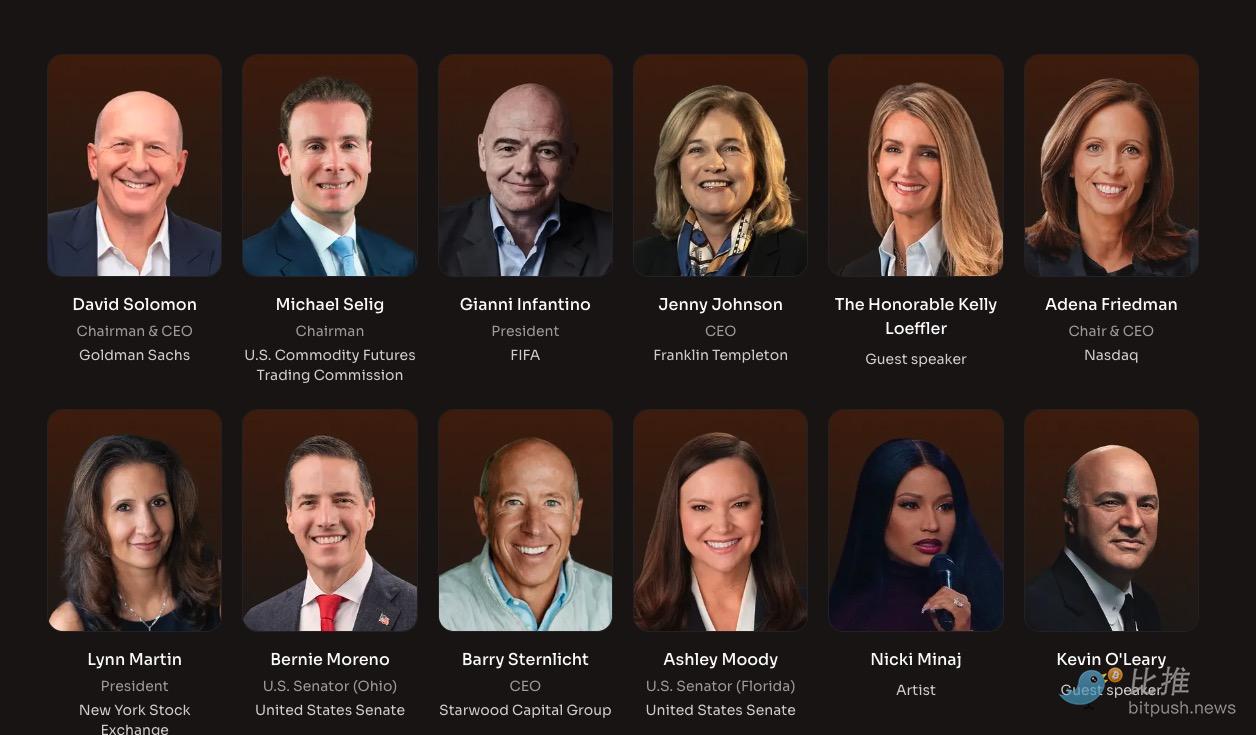
Although the forum was invitation-only and limited to about 400 attendees, the guest list was nothing short of a "power roster."

Wall Street Executives:

- Goldman Sachs CEO David Solomon

- Nasdaq Chairman Adena Friedman

- NYSE President Lynn Martin

- Franklin Templeton CEO Jenny Johnson

- Third Point founder Daniel Loeb, etc.

Crypto Giants:

- Coinbase founder Brian Armstrong

- BitGo CEO Mike Belshe

- Securitize founder Carlos Domingo

Government and Regulatory Figures:

- U.S. Commodity Futures Trading Commission (CFTC) Chairman Michael Selig

- Under Secretary of State for Economic Affairs Jacob Helberg

- Florida Senator Ashley Moody, Ohio Senator Bernie Moreno

Sports, Entertainment, and Investment Figures:

- FIFA President Gianni Infantino

- Prominent investor Kevin O'Leary

- Rapper Nicki Minaj

This cross-industry lineup indicates one thing: WLFI is no longer just a simple family startup project but has become a "super interface" connecting the White House, Wall Street, and the crypto industry.
What Was Discussed?

1. The "Institutionalization" of USD1

During the forum, global financial services provider Apex Group, which manages over $3.5 trillion in assets, announced a pilot partnership with WLFI to use the USD1 stablecoin for fund subscriptions, redemptions, and dividends.

This means USD1 is transitioning from a "retail toy" to an "institutional tool." Apex's clients include hedge funds, pension funds, banks, and family offices. If the pilot is successful, USD1 will be directly integrated into the capillaries of traditional finance.

2. Real Estate RWA Officially Launched

WLFI announced a collaboration with Securitize to tokenize the loan proceeds of the "Trump International Hotel and Resort Maldives."

This ultra-luxury resort, developed by Saudi developer Dar Global, is expected to be completed by 2030. Investors can earn fixed returns and a share of the loan proceeds through digital tokens. This is a classic RWA (Real World Asset tokenization) approach—packaging real-world cash flows on-chain and offering them to global investors.

3. Bitcoin Mining Business Growth

Eric Trump disclosed on X that the Nasdaq-listed "American Bitcoin" (ABTC) now holds over 6,000 BTC, calling it the "fastest-growing among globally listed mining companies."

4. "World Swap" on the Horizon

Reports suggest that WLFI is preparing a foreign exchange/remittance platform called "World Swap," targeting the $7 trillion cross-border payment market. If true, this would be a significant application scenario for USD1.

Controversies

Amid the clinking of glasses at Mar-a-Lago, external scrutiny has never ceased.

Six legal and government ethics experts expressed concerns in interviews with Reuters. Critics argue that the presence of regulators (CFTC Chairman) and policymakers (senators) at the same event as the Trump family's business project raises serious conflict-of-interest issues.

Chris Swartz, a former lawyer at the U.S. Office of Government Ethics during the Trump administration, stated, "Any reasonable person would have serious questions about the propriety of this event." He believes the Trump family is leveraging the president's public office to benefit their private crypto business, which is concerning.

A larger controversy stems from external investment. According to The Wall Street Journal, just days before Trump's inauguration, an investment vehicle linked to the Abu Dhabi royal family acquired a 49% stake in WLFI for $500 million.

This immediately drew a response from Democrats. Senators Elizabeth Warren and Andy Kim sent a letter to the Treasury Secretary, urging the Committee on Foreign Investment in the United States (CFIUS) to investigate whether the transaction poses national security risks. They pointed out that this investment could grant foreign governments access to U.S. citizens' financial and personal data.

Additionally, despite its strong backing, WLFI's token performance has been lackluster. Only 20% of WLFI tokens are currently unlocked, with the remaining 80% still locked. This means early investors, despite paying real money, can only access one-fifth of their assets.

To make matters worse, the token price has fallen approximately 69% from its peak. For the locked 80%, investors cannot cut losses or hedge risks through other means.

The project team previously promised that the unlocking timeline for the remaining tokens would be determined by holder voting, but this vote has yet to materialize. In a recent governance vote, the vast majority of ordinary holders were unable to participate due to locked tokens, and the outcome was dominated by a few team wallets.

In response to the controversies, a White House spokesperson stated that the president's assets are held in a trust managed by his children and that "there is no conflict of interest." The White House legal counsel emphasized that "the president does not participate in business transactions involving constitutional responsibilities."

In summary, the secret talks at Mar-a-Lago are more than just a launch event. They represent an extension of "Trumpism" into the financial world—a new ecosystem woven from political prestige, family interests, and cutting-edge technology. Whether WLFI will become a leader in decentralized finance or devolve into a massive political controversy depends on USD1's adoption in mainstream markets and the final legal and policy verdict on its "special status."


Twitter:https://twitter.com/BitpushNewsCN

Bitpush TG Discussion Group:https://t.me/BitPushCommunity

Bitpush TG Subscription: https://t.me/bitpush

Original link:https://www.bitpush.news/articles/7612986

Preguntas relacionadas

QWhat was the main purpose of the closed-door meeting held at Mar-a-Lago on February 18th?

AThe meeting was the 'World Liberty Forum' hosted by the Trump family's DeFi project, World Liberty Financial (WLFI). Its purpose was to bring together top figures from finance, technology, regulation, and entertainment to discuss the next wave of financial transformation, specifically the institutionalization of their stablecoin USD1 and the expansion of their crypto-related businesses.

QWhich major financial institution announced a pilot program to use the WLFI's USD1 stablecoin, and for what purpose?

AApex Group, a global financial services provider managing over $3.5 trillion in assets, announced a pilot program to use the USD1 stablecoin for fund subscriptions, redemptions, and dividends for its clients, which include hedge funds, pensions, banks, and family offices.

QWhat are the two main criticisms or controversies surrounding the WLFI project and the Mar-a-Lago event mentioned in the article?

AThe two main criticisms are: 1) A potential conflict of interest as regulators (like the CFTC chairman) and policymakers (senators) attended a event for the Trump family's commercial project. 2) A national security concern raised by Democratic senators regarding a $500 million investment from a vehicle linked to the Abu Dhabi royal family for a 49% stake in WLFI.

QAccording to Eric Trump, what was the primary reason the Trump family entered the cryptocurrency space?

AEric Trump stated that the family entered the cryptocurrency space out of necessity, not because they were at the technological forefront. He explained that their bank accounts were forcibly closed for political reasons in 2020-2021, leaving them unable to pay suppliers and employees, which led them to seek a 'better way' outside the traditional banking system.

QWhat real-world asset (RWA) did WLFI announce it was tokenizing in partnership with Securitize?

AWLFI announced a partnership with Securitize to tokenize the loan proceeds for the 'Trump International Hotel and Resort Maldives,' an ultra-luxury resort being developed by Saudi developer Dar Global. Investors can earn fixed returns and a share of the loan profits through digital tokens.

Lecturas Relacionadas

Ethereum Q1 2026 Report: Fees Decline, Users and Transaction Volume Hit New Highs

Ethereum Q1 2026 Report: Fees Down, Users & Transactions Hit New Highs Token Terminal's Q1 2026 report on Ethereum presents a pivotal development: the network achieved record highs in monthly active users (13.2M, +85.9% YoY), total transactions (200.4M, +81.5% YoY), and throughput (25.78 TPS), while transaction fees on the mainnet plummeted by 47.9% quarter-over-quarter. This shift is attributed to the network's strategic move into a "low fees for scale" phase, exemplified by the Fusaka upgrade which increased data capacity and lowered block space costs, releasing pent-up demand (a manifestation of Jevons's Paradox). The report highlights a core narrative shift for Ethereum: from a DeFi-centric blockchain to a global financial settlement layer. It maintains a dominant position in tokenized assets, holding majority market shares among top chains in stablecoins (61.8%), tokenized funds (73.0%), and tokenized commodities (84.0%). Growth in tokenized funds (+73.1% YoY) and commodities (+325.9% YoY) was particularly strong, driven by institutions like BlackRock and JPMorgan entering the space. Contrasting these usage gains, several USD-denominated value metrics declined in Q1: fully diluted market cap fell 30.3% QoQ, total value locked (TVL) dropped 11.0%, and ecosystem transaction volume decreased 24.0%. The report interprets this as Ethereum prioritizing long-term network expansion and cementing its role as the default settlement layer for finance over short-term fee capture. The commentary from Etherealize argues that, much like the early internet, Ethereum's open, permissionless model is poised to win over closed alternatives as institutional tokenization accelerates.

marsbitHace 1 hora(s)

Ethereum Q1 2026 Report: Fees Decline, Users and Transaction Volume Hit New Highs

marsbitHace 1 hora(s)

He Just Raised 2.7 Billion, and Li Fei-Fei Also Invested

Pete Florence, a former senior research scientist at Google DeepMind and a key contributor to the Vision-Language-Action (VLA) model architecture, is deliberately distancing his startup, Generalist AI, from the trendy "world model" label. He argues that the industry should prioritize concrete goals over buzzwords. His goal is to create robots that can perform a vast range of unseen tasks with high speed and success rates, without needing task-specific training data. Recently, his company raised $400 million (¥2.7 billion) at a $2 billion valuation. Notable investors include NVIDIA's NVentures, Bezos Expeditions, NFDG, as well as Xiaomi co-founder Lin Bin, Zoom founder Eric Yuan, and renowned AI scientist Fei-Fei Li. Florence's approach stems from his academic background at MIT under Professor Russ Tedrake, focusing on understanding the physical world. After joining DeepMind, he developed models like Transporter Network and co-created the VLA framework. He left in 2025 to found Generalist AI. The company has launched two models: GEN-0, which demonstrated that scaling laws apply to physical motion, and GEN-1. GEN-1 was trained on over 500,000 hours of physical interaction data collected via a specialized wearable device. It achieves a 99% success rate on precise mechanical tasks like folding boxes and maintains performance three times faster than its predecessor. Florence believes GEN-1 is reaching a commercial utility threshold similar to the GPT-3 inflection point. The substantial funding round, following GEN-1's release, signifies strong investor confidence in Generalist AI's practical, goal-driven path to creating versatile, useful robots, regardless of the "world model" terminology.

marsbitHace 1 hora(s)

He Just Raised 2.7 Billion, and Li Fei-Fei Also Invested

marsbitHace 1 hora(s)

Two Legends Lost in Three Days: Is Google's AI Talent Dam Cracking?

In three days, Google lost two AI legends. On June 18, Noam Shazeer, co-author of the seminal "Attention is All You Need" paper and Gemini co-lead, left for OpenAI. Just 48 hours later, John Jumper, 2024 Nobel laureate and AlphaFold lead, departed DeepMind for Anthropic. This follows Andrej Karpathy joining Anthropic in May. These moves highlight a structural trend: top AI talent is concentrating at mission-driven, pre-IPO firms like OpenAI and Anthropic, while Google becomes a primary source. The exodus stems from a core mission mismatch. Google's ad-centric model often subordinates AI research to product and revenue goals, creating friction for pioneers like Shazeer, who returned in 2024 only to leave again. In contrast, OpenAI and Anthropic offer singular focus on pushing AI boundaries, whether towards AGI or safety-aligned models, which deeply appeals to top researchers like Jumper. Financial incentives amplify the pull. With both OpenAI and Anthropic nearing IPO, employees stand to gain immensely from equity, an upside Google's mature stock cannot match. Furthermore, the 2023 merger of Google Brain and DeepMind, intended to consolidate strength, has instead created cultural tension and slowed the path from research to product, as evidenced by Gemini's pace. This talent redistribution is reshaping the AI landscape. While Google retains vast data and compute resources, its true crisis is the quiet, continuous loss of the people who define the field's future. The real moat in AI is not infrastructure, but the concentration of brilliant minds—a battle Google is currently losing.

marsbitHace 3 hora(s)

Two Legends Lost in Three Days: Is Google's AI Talent Dam Cracking?

marsbitHace 3 hora(s)

Behind the AI Report Card, Lies a Chinese 'Exam Setter'

Beyond the familiar performance charts like MMLU-Pro and MMMU, which major AI models strive to ace, stands a key "examiner": Chinese-Canadian researcher Wenhu Chen. An assistant professor at the University of Waterloo and founder of TIGERLab, Chen addresses the crucial need for more rigorous AI evaluation. As models like GPT-4 began scoring near-perfect results on older benchmarks like MMLU, it became difficult to distinguish their true capabilities. In response, Chen introduced MMLU-Pro in 2024, featuring harder, more reasoning-focused questions with more answer choices, successfully reintroducing meaningful performance gaps. His work extends to multi-modal evaluation with MMMU and its enhanced version, MMMU-Pro. These benchmarks test a model's ability to understand and reason with complex information from images, charts, and text across diverse academic subjects, exposing the significant challenges even top models face in genuine comprehension. Chen's background in complex QA, table reasoning, and his experience at Google DeepMind on projects like Gemini inform his approach. He understands that effective benchmarks must anticipate how models might "cheat" by memorizing data or avoiding visual analysis. His lab also actively researches video understanding and generation models (e.g., UniVideo, Vamba), ensuring his evaluation work is grounded in practical model-building challenges. Now at Meta's Super Intelligence Lab, Chen continues his focus on multi-modal data and evaluation, representing the deep yet often unseen contributions of Chinese talent in shaping the fundamental tools of the AI industry.

marsbitHace 3 hora(s)

Behind the AI Report Card, Lies a Chinese 'Exam Setter'

marsbitHace 3 hora(s)

Trading

Spot
Futuros
活动图片