Mar-a-Lago Secret Meeting: What Are They Plotting?

比推Publicado a 2026-02-19Actualizado a 2026-02-19

Resumen

A private forum was held at Mar-a-Lago, hosted by the Trump family's DeFi project, World Liberty Financial (WLFI). Attendees included top Wall Street executives (Goldman Sachs CEO, Nasdaq Chair), crypto leaders (Coinbase founder), regulators (CFTC Chair), and celebrities. Discussions focused on WLFI’s initiatives: expanding its USD1 stablecoin into institutional use via a partnership with Apex Group, tokenizing real estate assets (Trump Maldives resort), and developing a foreign exchange platform. Critics raised concerns over ethical conflicts and potential foreign influence, citing a $500M investment linked to Abu Dhabi. WLFI token has fallen 69% from its peak, with 80% of tokens still locked. The event highlights the merging of political influence, finance, and crypto under the Trump brand.

February 18, Palm Beach, Florida, Mar-a-Lago.

This place, referred to by Trump as the "Winter White House," welcomed top Wall Street and crypto elites—Goldman Sachs CEO, Nasdaq Chairman, Coinbase founder, FIFA President, and a rapper named Nicki Minaj.

According to public records, this was the "World Liberty Forum" (World Liberty Forum) hosted by the Trump family's DeFi project, World Liberty Financial (WLFI). Approximately 400 top figures from global finance, technology, regulation, and entertainment gathered here for a full day of closed-door discussions.

Meanwhile, it was during the Chinese Lunar New Year holiday. While investors in the Chinese-speaking market were still anxious about the notion that "the crypto circle is dead," Americans across the ocean were already sitting together, discussing how to firmly grasp the next round of financial transformation in their own hands.

What Are They "Plotting"?

World Liberty Financial is a DeFi protocol deeply involved with the Trump family, officially launched in September 2024. The core figures of the project are Trump's two sons—Donald Trump Jr. and Eric Trump—while the 18-year-old Barron Trump was appointed as the "Chief DeFi Vision Planner."

The goal of this project is straightforward: to establish a decentralized lending platform and issue the USD1 stablecoin pegged to the U.S. dollar, challenging the traditional banking system. As of now, the circulation of USD1 has exceeded $5 billion, making it the fifth-largest stablecoin globally.

However, the Trump brothers revealed a more genuine reason in an interview with CNBC: they entered the crypto space not because they were at the forefront of technology but because they were "forced to."

"In 2020 and 2021, we were the most 'banned' people in the world," Eric Trump recalled, explaining that due to political reasons, the family's bank accounts were forcibly closed, making it impossible to pay suppliers and employees. "So we said, there must be a better way."

Donald Trump Jr. was even more blunt: the traditional banking system is a "Ponzi scheme." "The banks created this monster; we entered this field out of necessity."

As Eric put it, being able to advance their agenda now is "almost a form of revenge."

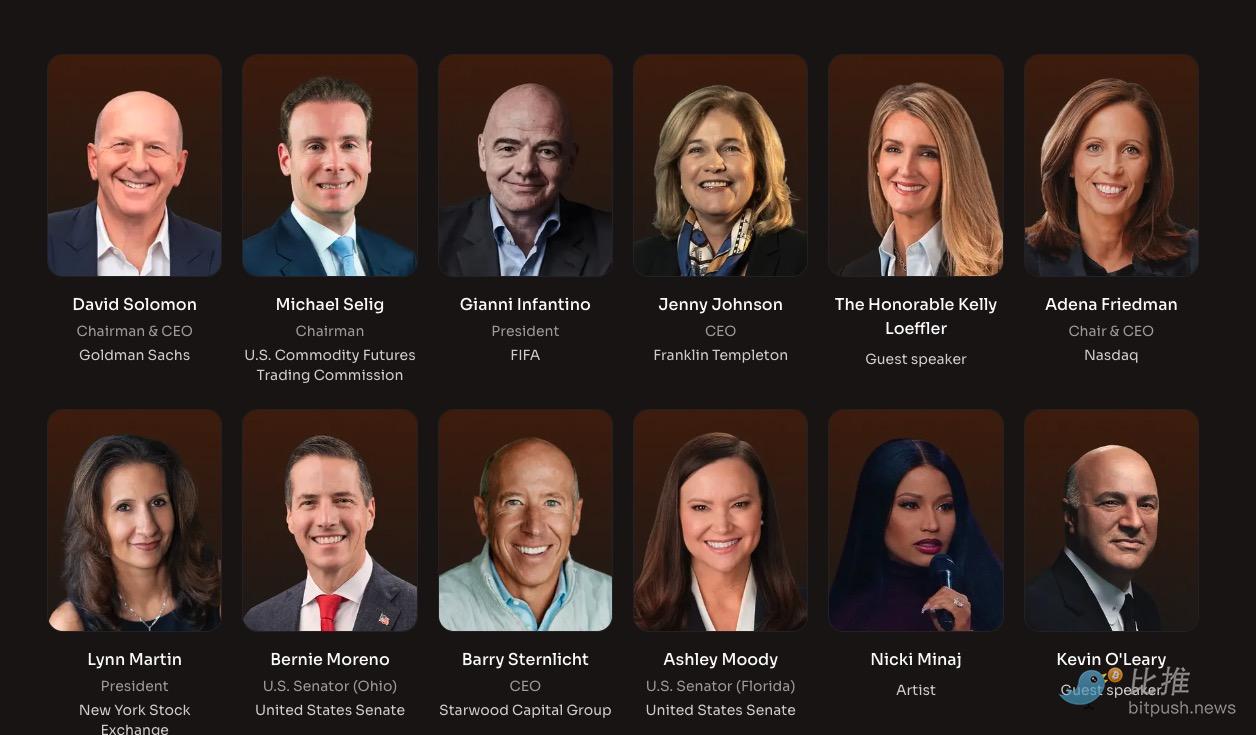
Although the forum was invitation-only and limited to about 400 attendees, the guest list was nothing short of a "power roster."

Wall Street Executives:

- Goldman Sachs CEO David Solomon

- Nasdaq Chairman Adena Friedman

- NYSE President Lynn Martin

- Franklin Templeton CEO Jenny Johnson

- Third Point founder Daniel Loeb, etc.

Crypto Giants:

- Coinbase founder Brian Armstrong

- BitGo CEO Mike Belshe

- Securitize founder Carlos Domingo

Government and Regulatory Figures:

- U.S. Commodity Futures Trading Commission (CFTC) Chairman Michael Selig

- Under Secretary of State for Economic Affairs Jacob Helberg

- Florida Senator Ashley Moody, Ohio Senator Bernie Moreno

Sports, Entertainment, and Investment Figures:

- FIFA President Gianni Infantino

- Prominent investor Kevin O'Leary

- Rapper Nicki Minaj

This cross-industry lineup indicates one thing: WLFI is no longer just a simple family startup project but has become a "super interface" connecting the White House, Wall Street, and the crypto industry.
What Was Discussed?

1. The "Institutionalization" of USD1

During the forum, global financial services provider Apex Group, which manages over $3.5 trillion in assets, announced a pilot partnership with WLFI to use the USD1 stablecoin for fund subscriptions, redemptions, and dividends.

This means USD1 is transitioning from a "retail toy" to an "institutional tool." Apex's clients include hedge funds, pension funds, banks, and family offices. If the pilot is successful, USD1 will be directly integrated into the capillaries of traditional finance.

2. Real Estate RWA Officially Launched

WLFI announced a collaboration with Securitize to tokenize the loan proceeds of the "Trump International Hotel and Resort Maldives."

This ultra-luxury resort, developed by Saudi developer Dar Global, is expected to be completed by 2030. Investors can earn fixed returns and a share of the loan proceeds through digital tokens. This is a classic RWA (Real World Asset tokenization) approach—packaging real-world cash flows on-chain and offering them to global investors.

3. Bitcoin Mining Business Growth

Eric Trump disclosed on X that the Nasdaq-listed "American Bitcoin" (ABTC) now holds over 6,000 BTC, calling it the "fastest-growing among globally listed mining companies."

4. "World Swap" on the Horizon

Reports suggest that WLFI is preparing a foreign exchange/remittance platform called "World Swap," targeting the $7 trillion cross-border payment market. If true, this would be a significant application scenario for USD1.

Controversies

Amid the clinking of glasses at Mar-a-Lago, external scrutiny has never ceased.

Six legal and government ethics experts expressed concerns in interviews with Reuters. Critics argue that the presence of regulators (CFTC Chairman) and policymakers (senators) at the same event as the Trump family's business project raises serious conflict-of-interest issues.

Chris Swartz, a former lawyer at the U.S. Office of Government Ethics during the Trump administration, stated, "Any reasonable person would have serious questions about the propriety of this event." He believes the Trump family is leveraging the president's public office to benefit their private crypto business, which is concerning.

A larger controversy stems from external investment. According to The Wall Street Journal, just days before Trump's inauguration, an investment vehicle linked to the Abu Dhabi royal family acquired a 49% stake in WLFI for $500 million.

This immediately drew a response from Democrats. Senators Elizabeth Warren and Andy Kim sent a letter to the Treasury Secretary, urging the Committee on Foreign Investment in the United States (CFIUS) to investigate whether the transaction poses national security risks. They pointed out that this investment could grant foreign governments access to U.S. citizens' financial and personal data.

Additionally, despite its strong backing, WLFI's token performance has been lackluster. Only 20% of WLFI tokens are currently unlocked, with the remaining 80% still locked. This means early investors, despite paying real money, can only access one-fifth of their assets.

To make matters worse, the token price has fallen approximately 69% from its peak. For the locked 80%, investors cannot cut losses or hedge risks through other means.

The project team previously promised that the unlocking timeline for the remaining tokens would be determined by holder voting, but this vote has yet to materialize. In a recent governance vote, the vast majority of ordinary holders were unable to participate due to locked tokens, and the outcome was dominated by a few team wallets.

In response to the controversies, a White House spokesperson stated that the president's assets are held in a trust managed by his children and that "there is no conflict of interest." The White House legal counsel emphasized that "the president does not participate in business transactions involving constitutional responsibilities."

In summary, the secret talks at Mar-a-Lago are more than just a launch event. They represent an extension of "Trumpism" into the financial world—a new ecosystem woven from political prestige, family interests, and cutting-edge technology. Whether WLFI will become a leader in decentralized finance or devolve into a massive political controversy depends on USD1's adoption in mainstream markets and the final legal and policy verdict on its "special status."


Twitter:https://twitter.com/BitpushNewsCN

Bitpush TG Discussion Group:https://t.me/BitPushCommunity

Bitpush TG Subscription: https://t.me/bitpush

Original link:https://www.bitpush.news/articles/7612986

Preguntas relacionadas

QWhat was the main purpose of the closed-door meeting held at Mar-a-Lago on February 18th?

AThe meeting was the 'World Liberty Forum' hosted by the Trump family's DeFi project, World Liberty Financial (WLFI). Its purpose was to bring together top figures from finance, technology, regulation, and entertainment to discuss the next wave of financial transformation, specifically the institutionalization of their stablecoin USD1 and the expansion of their crypto-related businesses.

QWhich major financial institution announced a pilot program to use the WLFI's USD1 stablecoin, and for what purpose?

AApex Group, a global financial services provider managing over $3.5 trillion in assets, announced a pilot program to use the USD1 stablecoin for fund subscriptions, redemptions, and dividends for its clients, which include hedge funds, pensions, banks, and family offices.

QWhat are the two main criticisms or controversies surrounding the WLFI project and the Mar-a-Lago event mentioned in the article?

AThe two main criticisms are: 1) A potential conflict of interest as regulators (like the CFTC chairman) and policymakers (senators) attended a event for the Trump family's commercial project. 2) A national security concern raised by Democratic senators regarding a $500 million investment from a vehicle linked to the Abu Dhabi royal family for a 49% stake in WLFI.

QAccording to Eric Trump, what was the primary reason the Trump family entered the cryptocurrency space?

AEric Trump stated that the family entered the cryptocurrency space out of necessity, not because they were at the technological forefront. He explained that their bank accounts were forcibly closed for political reasons in 2020-2021, leaving them unable to pay suppliers and employees, which led them to seek a 'better way' outside the traditional banking system.

QWhat real-world asset (RWA) did WLFI announce it was tokenizing in partnership with Securitize?

AWLFI announced a partnership with Securitize to tokenize the loan proceeds for the 'Trump International Hotel and Resort Maldives,' an ultra-luxury resort being developed by Saudi developer Dar Global. Investors can earn fixed returns and a share of the loan profits through digital tokens.

Lecturas Relacionadas

It Took Me a Year to See the Bitter Truth About Agent Payments

After a year building infrastructure for the Agent economy, engaging with major players like Stripe, Visa, and Coinbase, the author shares a sobering analysis of the current state of Agent payments. The core finding is a stark lack of genuine, immediate demand across most envisioned use cases. The article breaks down four key market segments: 1. **Agent-to-Merchant (Consumer Shopping):** For most product categories (e.g., clothing, electronics), conversational AI shopping is a step backwards from visual e-commerce interfaces. While agents excel at understanding needs, they can't replace side-by-side product comparison. Real merchant interest is defensive "Agent Engine Optimization," not driven by current customer demand. Potential exists for high-frequency, low-decision purchases (like food delivery) or navigating complex store UIs, but these require massive B2C distribution channels dominated by giants like Amazon. 2. **Agent-to-API (Developer Services):** Developers already have subscriptions and billing relationships for APIs (compute, data). Prepaid balances solve micro-payment issues for low transaction volumes. A deeper structural problem is that major SaaS vendors' business models rely on enterprise contracts, resisting granular pay-per-call pricing. While protocols like MPP and x402 serve the long tail of niche services, this market is small and developers are historically low-willingness-to-pay. 3. **Agent-to-Agent:** This remains largely theoretical with minimal transaction volume. While it represents a long-term bet on a fundamentally new transaction infrastructure (sub-second, micro-penny to million-dollar, multi-party settlements), it does not constitute a present market. 4. **Agent-to-Finance:** This is the only category with existing, paying demand. Integrating AI into financial workflows (trading, portfolio management) is a natural evolution and enables new capabilities like autonomous rebalancing. However, competition favors established, regulated institutions. The "real problem" is not moving money between agents, but the broader challenge of **coordination**—orchestrating work between agents and humans, verifying outcomes, and settling results. Payment is just one component of settlement, which is itself part of coordination. Companies that solve the coordination layer will subsume payment, not the other way around. While well-funded incumbents build defensively for a long-term future, startups must find where the market is today—which, for the author's team, lies outside these four categories in an area of real, growing, and underserved activity.

marsbitHace 11 min(s)

It Took Me a Year to See the Bitter Truth About Agent Payments

marsbitHace 11 min(s)

It Took Me a Year to See the Hard Truth About Agent Payments

**Title: It Took Me a Year to See the Hard Truth About Agent Payments** Over the past year, I've worked on infrastructure for the Agent economy, engaging with major players like Stripe, Visa, Coinbase, and numerous startups. The findings reveal a stark reality: genuine, widespread demand for Agent-based payments does not yet exist. **Key Observations:** * **Agent-to-Merchant (Shopping):** The user experience for AI shopping often falls short, especially for visual product discovery. While AI excels at understanding needs, conversational interfaces can't yet replace browsing and comparing multiple products visually. Current merchant interest is largely defensive ("Agent Engine Optimization") for a future that hasn't arrived. High-frequency, low-friction purchases (like food delivery) are potential fits, but lack open APIs and face high AI inference costs. Simpler, more affordable, or cross-language interactions for complex UIs are a niche opportunity but require massive consumer distribution to scale. * **Agent-to-API (Developer Tools):** Developer payment needs for APIs (computing, data, models) are already met through subscriptions and prepaid credits. The core challenge is not payment friction but supplier economics: most large SaaS providers prefer enterprise contracts over micropayments for API calls. Protocols like MPP and x402 suit the long-tail of smaller services but cater to a developer market historically reluctant to pay for these tools. Major infrastructure needs at the top of the stack are already being addressed. * **Agent-to-Agent (Machine Commerce):** This is a long-term vision with almost no current transaction volume. While a future with high-speed, high-frequency, multi-party machine-to-machine transactions would require novel infrastructure, it remains theoretical. The market is not here yet. * **Agent-to-Finance:** This is the only category with clear, present demand. Financial professionals and DeFi users already pay for tools, and AI augmentation is a natural evolution. Autonomous AI agents can enable entirely new financial strategies. However, competition is fierce from established, regulated incumbents who can more easily layer AI onto their existing products. **The Core Insight:** Companies, especially giants with long time horizons, are building defensively for a potential future of mass machine commerce. For them, early investment is a low-cost hedge. For startups, the current market reality is different. The primary challenge isn't just moving money between agents (payments). The larger, unsolved problem is **orchestration** – coordinating work between agents and humans, verifying outcomes, and then settling. Payment is just a part of settlement, which is just a part of orchestration. Companies that solve the orchestration problem will subsume payments, not the other way around. After a year of building, we see the real, growing, and underserved market opportunity lies in this broader domain of orchestration.

链捕手Hace 34 min(s)

It Took Me a Year to See the Hard Truth About Agent Payments

链捕手Hace 34 min(s)

Claude Opus 4.8 Finds a $4.5 Billion Bug: The AI Era is Mass-Producing Hackers

A researcher discovered a critical "infinite mint" vulnerability in the Zcash cryptocurrency's Orchard protocol using Claude Opus 4.8, leading to a swift fix but also a 50% market drop, erasing billions in value. This incident highlights a new era where powerful, accessible AI models are dramatically lowering the barrier to finding software vulnerabilities. Previously, the security community feared specialized models like Claude Mythos Preview, capable of finding decades-old zero-day exploits. The Zcash case, however, involved a publicly available, general-purpose model. This shift makes advanced security auditing—and attack capabilities—accessible to far more people, not just experts. The mass democratization of vulnerability discovery brings a dual challenge: a flood of low-quality, AI-generated false reports that overwhelm maintainers, and the real, rapid uncovering of deep, dangerous bugs. Open-source projects, often understaffed and unfunded, are particularly vulnerable to this "attention DDoS." The article cites examples like curl shutting down its bug bounty program due to the unsustainable workload. Our perceived digital safety has often been luck, relying on the high cost and effort required to find deeply hidden flaws in complex systems, as seen with historical vulnerabilities like Heartbleed or Baron Samedit. AI changes this cost structure, effectively "mass-producing flashlights" to illuminate every corner of our codebase. While large companies operate extensive security chains involving external white-hat hackers and massive defensive operations, the global cybersecurity workforce faces a severe shortage, especially of experienced personnel capable of analyzing complex threats and coordinating fixes. The core dilemma emerges: AI makes *finding* bugs cheap and scalable, but *fixing* them remains a slow, expensive, and human-intensive process. The article concludes that AI won't destroy the internet but acts as a bright light, revealing that our digital existence is not inherently secure but is precariously maintained by ongoing human effort. The true cost in the AI era may not be discovery, but whether there will be enough people left willing and able to do the hard work of repair.

marsbitHace 1 hora(s)

Claude Opus 4.8 Finds a $4.5 Billion Bug: The AI Era is Mass-Producing Hackers

marsbitHace 1 hora(s)

Codex Goal Mode Usage Guide: How to Make AI Continuously Pursue a Specific Objective

"Codex Goal Mode: How to Make AI Work Continuously Toward a Specific Goal" OpenAI's Codex "goal mode" (/goal) transforms the AI from a reactive code assistant into a proactive execution agent capable of working autonomously for hours or even days to achieve a defined objective. To maximize its effectiveness, follow these key principles: 1. **Define Clear, Verifiable Exit Criteria:** The goal prompt should be a concise, measurable success condition, not a lengthy specification. Use quantifiable metrics like "reduce build time by 30%" or "achieve 100% test parity." 2. **Provide Initial Guidance and Tools:** Direct Codex toward likely problem areas and specify available tools (e.g., browsers, testing environments) to prevent it from exploring unproductive paths. 3. **Enable Progress Measurement:** Equip Codex with ways to track advancement, such as creating comparison tools for visual tasks or evaluation sets, ensuring it can gauge its own progress. 4. **Use a Realistic Execution Environment:** For tasks like performance optimization, provide access to environments that closely mimic production (e.g., similar configs, databases) to yield valid results. 5. **Be Cautious with Visual Goals:** Avoid vague "pixel-perfect" instructions. Instead, supplement visual references with functional checklists or design system specifications to prevent Codex from obsessing over minor details. 6. **Implement Progress Tracking:** For long-running tasks, have Codex commit code to draft PRs, update progress documents, or send Slack updates to maintain visibility into its work. 7. **Review and Consolidate Results:** Once the goal is met, instruct Codex to review its work, clean up ineffective experimental code, and reflect on what strategies succeeded or failed. Ultimately, using goal mode shifts the developer's role from writing prompts to managing a persistent engineering agent—defining objectives, establishing metrics, configuring environments, and conducting final reviews.

marsbitHace 2 hora(s)

Codex Goal Mode Usage Guide: How to Make AI Continuously Pursue a Specific Objective

marsbitHace 2 hora(s)

Trading

Spot
Futuros
活动图片

